By Alexander Merz · Updated on · Details checked on 7 October 2026
Anyone can see with the naked eye that the Moon has a violent past behind it. Asteroids and meteorites blasted chunks of moon rock of many different sizes out of our nearest neighbor. For up to several million years, this debris drifted along a more or less predictable orbit through space before crashing down onto other planets of the solar system. A few fragments of that nearby parent body also found their way straight to Earth, where they were only recognized as lunar meteorites much later.⚡ The quick answer: Moon rock reaches Earth in three ways: samples returned by the American Apollo missions, samples brought back by the Soviet Luna missions, and lunar meteorites — pieces knocked off the Moon’s surface by impacts that later fell naturally to our planet. These natural arrivals, such as Dho 280, Calcalong Creek, and DAG 400, now number in the hundreds and are found mostly in hot deserts and the blue-ice fields of Antarctica.
Where does moon rock come from?
There are currently three sources of moon rock on Earth:- rock collected by the American Apollo missions;
- samples returned by the Soviet Luna missions;
- lunar rocks blasted off the Moon’s surface by impacts, which then fell to Earth as meteorites.
The lunar meteorite Dho 280
Weighing about half a pound (251.2 g), the lunar meteorite Dho 280 belongs to a group that now includes more than 90 meteorites of similar composition. Like Dho 081 and Dho 910, it comes from the southwest of the Sultanate of Oman, on the eastern edge of the Arabian Peninsula. Identifying its parent body was straightforward in the spring of 2001: by then the origin of several such samples, from specific regions of the solar system, was already known. Before plunging into Earth’s atmosphere, Dho 280 had likely traveled its near-Earth orbit for a few million years. Its composition shows that the parent body was the lunar highlands. There, millions of years ago, another “wanderer” from the solar system struck it and catapulted the debris onto an unpredictable orbit close to Earth. It is also possible that the fragments found later were once a single, larger meteorite before the crash.The lunar meteorite Calcalong Creek
That this tiny 19 g pebble of moon rock was identified as a meteorite at all is thanks to the care of a “meteorite hunter.” He had owned the treasure for commercial purposes since 1960. Only in 1991, through comparison with samples returned by the lunar missions, was Calcalong Creek classified as a lunar meteorite. Analysis pointed to the lunar highlands as its parent body. A much larger chunk was likely knocked off there, perhaps collided with more debris within the solar system, and finally “landed” on Earth. Despite intensive searching, Calcalong Creek remains to this day the only lunar meteorite recovered in Australia. Before it, debris from the parent body Moon had been found only in the blue-ice fields of Antarctica. Yet it is unlikely that these coveted lunar trophies fell from their restless orbit only over Antarctica. Future research will probably reveal further unattributed rocks from the solar system that turn out to be lunar meteorites.The largest lunar find: DAG 400
The discovery site of DAG 400 is close to perfect for preserving meteorites. First, there is the bright surface of the Dar al-Gani plateau in central Libya, where a rock as black as the lunar meteorite DAG 400 stands out at once. Second, the climatic and geological conditions there slow rock erosion enormously. As a result, this fragment of the parent body Moon — which fell to Earth from its orbit at some point — has survived in almost unweathered condition since its arrival from the solar system. At 1.425 kg, DAG 400 is hardly an enormous weight for a meteorite. Even so, it remains the largest lunar fragment ever found, and one of the few discoveries that did not come from the blue-ice fields of Antarctica.| Lunar meteorite | Mass | Location found | Parent terrain |
|---|---|---|---|
| Dho 280 | 251.2 g | Oman (Arabian Peninsula) | Lunar highlands |
| Calcalong Creek | 19 g | Australia | Lunar highlands |
| DAG 400 | 1.425 kg | Libya (Dar al-Gani plateau) | Lunar surface |
Are there Earth meteorites on the Moon?
On Earth, finding a lunar meteorite before weathering destroys it is a stroke of luck. Only dry desert regions or the icy expanses of the Arctic and Antarctic preserve a meteorite from decay for long. In the late 1970s, the debris from the parent body Moon gave rise to the idea that Mars meteorites might also have reached us from the solar system. Once that was confirmed, the conclusion was clear: Earth meteorites, too, could once have rained down onto neighboring worlds. Every lunar meteorite is a witness to an age when rock collisions across the solar system struck the Earth as well, sometimes with tremendous force. Scientists now hope that a future lunar mission will uncover traces of the parent body Earth on the Moon’s surface. The possible distances between Moon and Earth are so small that at least occasional impacts on the Moon are considered certain. Finding such a meteorite in the airless environment of the Moon would tell us a great deal about the early Earth and its fate.Observing the Moon yourself
You won’t find moon rock in your back yard, but you can admire its cratered surface — the very stage of these impacts — with a modest instrument. Even a small refractor is enough to reveal the seas, the great craters, and the mountain ranges along the terminator.Great for the Moon: Omegon Telescope AC 70/700 AZ-2
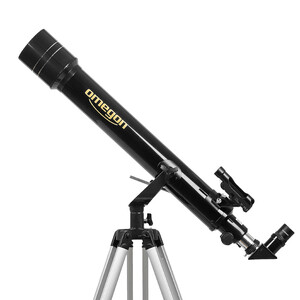
The no-pitfall starter refractor: Moon, Saturn's rings and Jupiter's moons from the very first night. No collimation.
Price: € 129
Best for advanced observers: Skywatcher Dobson Telescope N 200/1200 Skyliner Classic
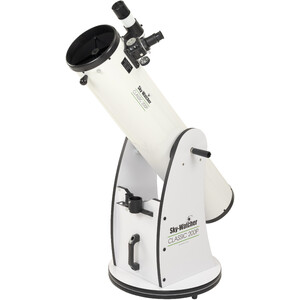
200 mm of aperture — the most sky for your money. Set it on the ground, point by hand: nebulae, clusters and galaxies for years to come.
Price: € 479
* Affiliate link: if you buy through this link we may earn a small commission from Astroshop or High Point Scientific, at no extra cost to you.