By Alexander Merz · Updated on · Details checked on 12 October 2026
The Canes Venatici constellation (Latin for “the hunting dogs”) is one of the smaller constellations of the spring sky: two stars right below the handle of the Big Dipper, Cor Caroli and Chara – but one of the richest galaxy regions for the telescope.
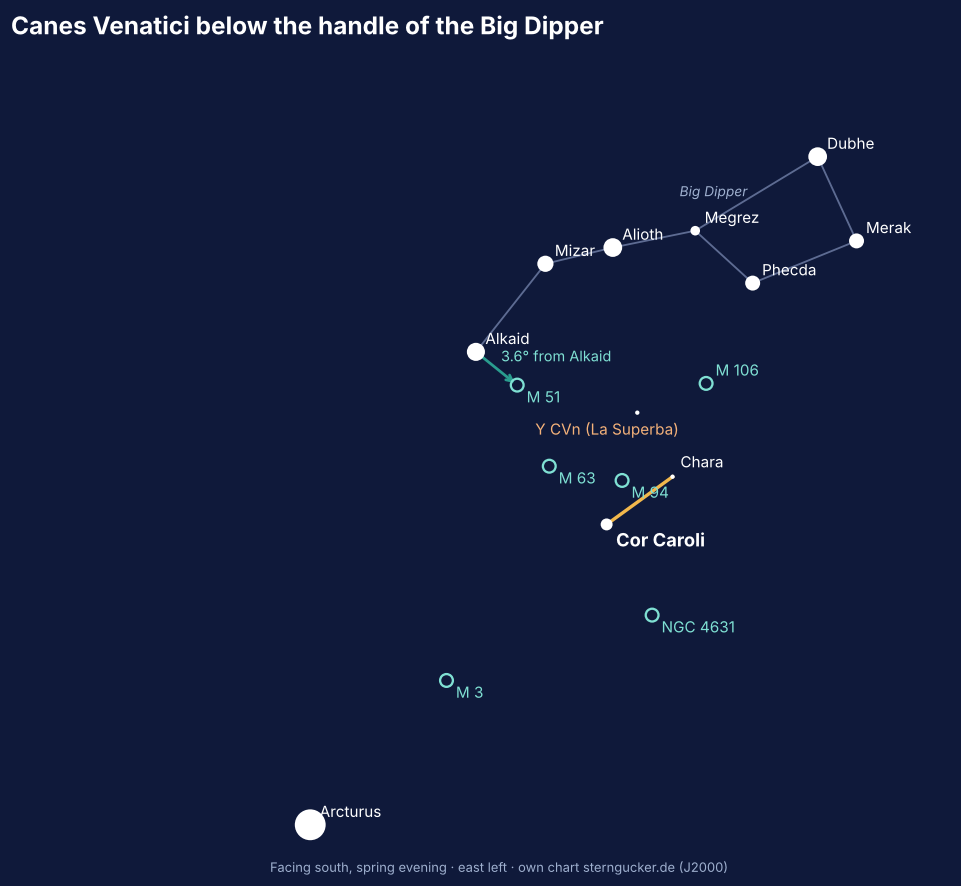
The Canes Venatici constellation at a glance
Canes Venatici is a young constellation: Johannes Hevelius only introduced it in 1690. Before that, its stars belonged to Ursa Major, the Great Bear.
| Feature | Value |
|---|---|
| Latin name | Canes Venatici (genitive Canum Venaticorum, abbreviation CVn) |
| Area | 465 square degrees – rank 38 of 88 |
| Brightest star | Cor Caroli (α² CVn), 2.9 mag |
| Second star | Chara (β CVn), 4.3 mag |
| Best viewing time | April to June |
| Neighbors | Ursa Major, Boötes, Coma Berenices |
How to find Canes Venatici: below the handle
Start from the Big Dipper. Below the handle, about 14° from Alkaid and 17° from Mizar, stands a lone third-magnitude star – that is Cor Caroli.
Chara sits 5° further to the upper right, but is already noticeably fainter. There is no more figure than that: in the sky, Canes Venatici is a short line of two stars.
| Pointer | Distance |
|---|---|
| Alkaid → Cor Caroli | 14.4° |
| Mizar → Cor Caroli | 17.3° |
| Cor Caroli → Chara | 5.3° |
| Alkaid → M 51 | 3.6° |
| Cor Caroli → M 94 | 3.0° |
| Cor Caroli → M 63 | 5.3° |
| Arcturus → M 3 | 12.0° |
Our own calculation, sterngucker.de (astropy, J2000).
When can you see Canes Venatici?
In May at 10 pm, Cor Caroli stands almost at the zenith, about 78° high at 50° north. In April and June it is still over 60°.
Across the US, south of 51.7° latitude, Cor Caroli does set; only north of about 51.7° latitude (e.g. northern Germany, London) does it become circumpolar. Even so, the constellation is only really usable in spring and early summer; in fall it sits just above the northern horizon in the evening.
| Month | Cor Caroli at 10 pm | at its highest (CET) |
|---|---|---|
| February | 32° | 3:38 am |
| March | 49° | 1:48 am |
| April | 68° | 11:42 pm |
| May | 78° | 9:44 pm |
| June | 63° | 7:42 pm |
| July | 44° | 5:44 pm |
| August | 26° | during the day |
| October to December | 0–3° | during the day |
Our own calculation for 50° north, 10° east, on the 15th of each month; during daylight saving time, one hour later.
The stars of Canes Venatici
Cor Caroli: the heart of Charles
Cor Caroli means “heart of Charles” and commemorates the English King Charles I or his son Charles II. The star is about 110 light-years away.
In a telescope it becomes the most beautiful easy double star of spring: a 5.6 mag companion sits 19.4 arcseconds away. Even 50 mm of aperture at 40× magnification splits the two cleanly.
The primary star is also the prototype of its own class of variable stars: strong magnetic fields spread chemical elements in patches across the surface, and the brightness varies minimally with its 5.5-day rotation.
Chara: a twin of the Sun
At 27 light-years, Chara is the nearest star in the constellation and very similar to the Sun, spectral type G0. That’s why it appears on the lists in the search for Earth-like planets.
La Superba: one of the reddest stars
The astronomer Angelo Secchi named Y Canum Venaticorum “La Superba”. This carbon star varies between 5 and 6 mag and glows a deep orange-red in binoculars – one of the most colorful stars in the northern sky.
Deep sky in Canes Venatici: galaxies and a globular cluster
Canes Venatici lies far from the Milky Way. That’s why your view goes unobstructed into the space between the galaxies – five Messier objects lie within its borders.
| Object | Type | Magnitude | Distance | Equipment |
|---|---|---|---|---|
| M 3 | Globular cluster | 6.2 mag | about 33,000 ly | Binoculars, telescope |
| M 51 Whirlpool | Spiral galaxy with companion | 8.4 mag | about 30 million ly | Telescope from 130 mm |
| M 94 | Spiral galaxy | 8.2 mag | about 16–20 million ly | Telescope |
| M 63 Sunflower | Spiral galaxy | 8.6 mag | about 30 million ly | Telescope |
| M 106 | Spiral galaxy | 8.4 mag | about 24–30 million ly | Telescope |
| NGC 4631 Whale Galaxy | Spiral galaxy, edge-on | 9.2 mag | about 25 million ly | Telescope from 150 mm |
Galaxy distances vary depending on the measurement method; common ranges are given.
M 51: the Whirlpool Galaxy
M 51 sits only 3.6° from Alkaid, the last star of the handle. Here in 1845, Lord Rosse was the first to see the spiral structure of a galaxy – which turned the label “nebula” into a special case.
In a 130 mm telescope you see two fuzzy patches side by side: the main galaxy and its smaller companion NGC 5195. The spiral arms need a dark sky and rather 200 mm of aperture.
M 3: hundreds of thousands of stars in one ball
The globular cluster M 3 lies at the southern edge of Canes Venatici, 12° from Arcturus. In binoculars it is a round, bright fuzzy patch; from 150 mm of aperture, individual stars resolve at its edge.
Which equipment for Canes Venatici?
Canes Venatici is a galaxy constellation, and galaxies need aperture. Binoculars show M 3 here and, with effort, M 51 as a smudge – nothing more.
With 130 mm of aperture, M 51, M 94 and M 63 become reliably visible, and Cor Caroli splits with ease. For getting started, that is the honest minimum; more on this in Telescopes for beginners.
The honest way into galaxies: Skywatcher Dobson Telescope N 130/650 Heritage FlexTube
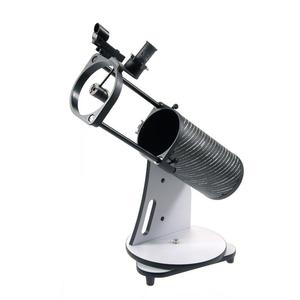
A compact tabletop Dobson with a true parabolic mirror. Folds down, fits in a bag: the Moon, planets and the bright deep-sky classics.
Price: € 265
If you want more: 200 mm for the spiral arms
A 200 mm Dobsonian collects more than twice as much light. Under a dark sky it shows the spiral arms of M 51 and the bridge to its companion – the very target for which many people buy a bigger telescope in the first place.
For advanced observers: spiral arms in M 51: Skywatcher Dobson Telescope N 200/1200 Skyliner Classic
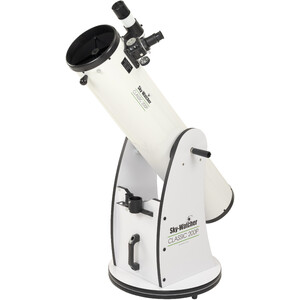
200 mm of aperture — the most sky for your money. Set it on the ground, point by hand: nebulae, clusters and galaxies for years to come.
Price: € 479
History and mythology of Canes Venatici
Hevelius depicted Canes Venatici as two dogs on the leash of Boötes, the herdsman, chasing the Great Bear around the pole. He named the two dogs Asterion and Chara.
The name Cor Caroli is older than the constellation. It goes back to the court physician Charles Scarborough, who linked the star with the return of Charles II in 1660; Edmond Halley later adopted it in his star charts.
Frequently asked questions about the Canes Venatici constellation
Where in the sky is the Canes Venatici constellation?
Right below the handle of the Big Dipper, between Ursa Major, Boötes and Coma Berenices. Its brightest star, Cor Caroli, sits about 14° from Alkaid.
When is the best time to see Canes Venatici?
From April to June. In May at 10 pm, Cor Caroli stands almost at the zenith.
What is the brightest star in Canes Venatici?
Cor Caroli (α² Canum Venaticorum), at 2.9 mag. In a telescope it is an easy-to-split double star.
What does Cor Caroli mean?
“Heart of Charles” – in honor of the English King Charles I or his son Charles II.
What does the Latin name Canes Venatici mean?
Canes Venatici means “hunting dogs”; the genitive is Canum Venaticorum, abbreviated CVn.
Can you see M 51 with binoculars?
Under a very dark sky, as a faint smudge near Alkaid. Seeing the galaxy as a pair, let alone the spiral arms, takes a telescope.
Read more on Sterngucker
- Big Dipper – the signpost to Canes Venatici
- Arcturus – the bright neighbor in Boötes
- Coma Berenices – the southern neighbor constellation full of galaxies
- Deep-sky objects – rewarding targets for binoculars and telescopes
- Telescopes for beginners – which aperture is enough for galaxies
- All constellations – the entry point to our catalog