By Alexander Merz · Updated on · Details checked on 14 September 2026
The Big Dipper is the best known star pattern of the northern sky, and for most people it is the very first thing they ever recognised above their heads. Seven bright stars – four of them forming a slightly skewed rectangle, three trailing off in a gentle curve – make a shape so memorable that you can pick it out again after years of never looking up.
⚡ The short version
The Big Dipper is not a constellation of its own. It is an asterism – the bright core figure of seven stars inside the far larger constellation Ursa Major, the Great Bear. In Britain and Ireland the same seven stars are known as the Plough.
From the latitude of Britain, Germany or the northern United States the figure is circumpolar: it never sets, so it is up on every clear night of the year. Only its height and orientation change. At 51° N it stands almost overhead in May and barely 18° above the northern horizon in November.
Its most useful trick is navigation. The far edge of the bowl, Merak → Dubhe, extended about five times, runs straight into Polaris – and Polaris always marks true north.
There is no zodiac sign called the Big Dipper: Ursa Major lies far from the plane of the ecliptic, so it can never be a sign of the zodiac.
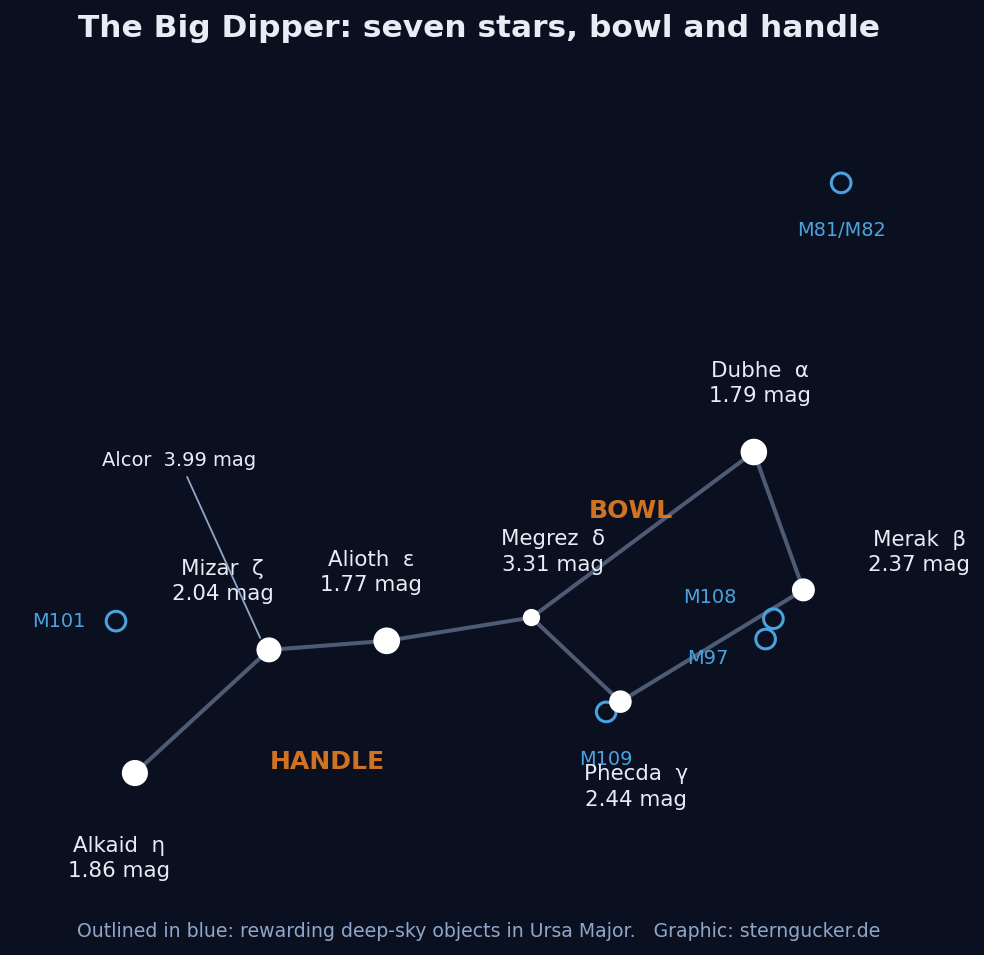
This article covers everything people actually ask about the figure: the seven stars with names, magnitudes and distances, a precise recipe for finding Polaris, a month-by-month visibility table, the difference between the Big Dipper and the Little Dipper, the objects worth hunting inside Ursa Major – and the surprisingly large number of myths that have gathered around these seven stars.
The key facts at a glance
- Seven stars: Dubhe, Merak, Phecda and Megrez form the bowl, Alioth, Mizar and Alkaid the handle.
- An asterism, not a constellation: the Dipper is the bright part of Ursa Major, which at 1,280 square degrees is the third largest of the 88 constellations.
- Visible all year: north of about 41° latitude not one of the seven stars ever sets.
- Size of the figure: roughly 25.7° from Dubhe to Alkaid – about two and a half outstretched hand widths.
- Signpost number one: Merak → Dubhe, extended five times, leads to Polaris and therefore to true north.
- Most famous detail: Mizar and Alcor at the bend of the handle – the classic eyesight test, and in reality a sextuple star system.
- Not forever: five of the seven stars belong to the same moving group; Dubhe and Alkaid travel the opposite way. In 100,000 years the figure will have fallen apart.
Big Dipper or Ursa Major: why both names are right
“Big Dipper” and “Ursa Major” are used interchangeably in everyday speech, but they do not mean the same thing. Ursa Major is one of the 88 official constellations recognised by the International Astronomical Union: a clearly bounded region of sky covering 1,280 square degrees – after Hydra and Virgo the third largest of them all. Besides the seven bright stars it contains dozens of fainter ones that outline the bear’s head, muzzle and three pairs of paws.
The Big Dipper, by contrast, is an asterism: a striking star pattern with no official boundary, which exists simply because the human eye keeps seeing it. It uses only the seven brightest stars of the bear. Think of it as a famous neighbourhood inside a large city – the neighbourhood has a name everyone knows, but no town hall of its own.
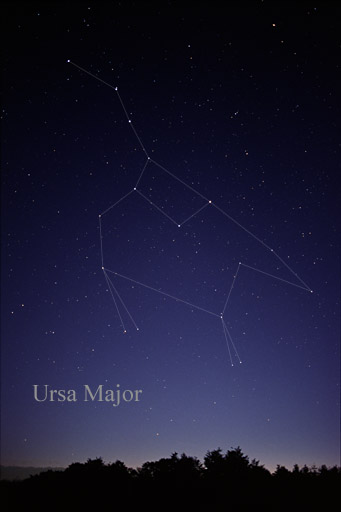
Why a bear, of all things? The remarkable part is that entirely unconnected cultures in Europe, Siberia and North America saw the same bear in this pattern. For cultural historians that is one of the strongest hints that the interpretation is very old indeed and may have travelled across the Bering land bridge with the first people to reach the Americas – a myth possibly more than 10,000 years old. The long “tail”, which real bears do not have, is the giveaway: in many North American versions the three handle stars are therefore not a tail at all, but hunters following the bear.
Zodiac sign Big Dipper: why it does not exist
One of the most common searches on the subject is “Big Dipper zodiac sign”, and the honest answer is that no such sign exists. The signs of the zodiac are the twelve divisions of that narrow band of sky through which the Sun appears to travel over the course of a year. Only constellations sitting on that path can supply a zodiac sign: Aries, Taurus, Gemini and the nine others.
Ursa Major, however, lies far to the north, some 50 to 60 degrees away from the ecliptic. The Sun never comes anywhere near it. Famous as it is, it simply cannot be a zodiac sign. What the Big Dipper does share with the zodiac is a role in orientation – but that role is geographic, not astrological.
💡 In one line
Constellation = an official region of sky (Ursa Major). Asterism = a striking figure within it (the Big Dipper). Zodiac sign = a section of the ecliptic – and Ursa Major is not one of them.
The seven Big Dipper stars: names and brightness
All seven Dipper stars are brighter than magnitude 3.4, which means they remain visible even from a well-lit city centre – that, more than anything, is why the figure is so famous. The Arabic names we still use almost all refer either to parts of the bear or to the older Arabic funeral procession that people saw in the very same stars.
| Star | Bayer | Magnitude | Distance | Position | Meaning of the name |
|---|---|---|---|---|---|
| Dubhe | α UMa | 1.79 mag | approx. 123 ly | bowl, front top | “the bear” (Arabic dubb) |
| Merak | β UMa | 2.37 mag | approx. 80 ly | bowl, front bottom | “the loin” |
| Phecda | γ UMa | 2.44 mag | approx. 83 ly | bowl, rear bottom | “the thigh” |
| Megrez | δ UMa | 3.31 mag | approx. 81 ly | bowl, rear top | “the root of the tail” |
| Alioth | ε UMa | 1.77 mag | approx. 83 ly | handle, inner | “the fat tail” – brightest star of the figure |
| Mizar | ζ UMa | 2.04 mag | approx. 83 ly | handle, middle | “the apron” – with its companion Alcor |
| Alkaid | η UMa | 1.86 mag | approx. 104 ly | tip of the handle | “the leader”, also called Benetnash |
Two things stand out in this table. First, Dubhe is not the brightest star, even though it carries the letter α: Alioth beats it by a hair at 1.77 mag. When Johann Bayer handed out his Greek letters in 1603 he did not order them strictly by brightness but often by position within the figure – here numbered from front to back.
Second, five of the seven stars sit at practically the same distance, 80 to 83 light years. That is no coincidence; it is the heart of one of the most interesting discoveries about this figure, and we come back to it further down in the section on the changing shape.
Star in Ursa Major: crossword answers by length
“Star in Ursa Major” and “Big Dipper star” are staple crossword clues, and because the names are unfamiliar it helps to sort them by letter count. Here is the full list of the answers that actually turn up in puzzles:
| Letters | Answer | Which star? |
|---|---|---|
| 4 | PHAD | short form of Phecda (γ UMa) |
| 5 | DUBHE | α UMa, front upper bowl star |
| 5 | MERAK | β UMa, front lower bowl star |
| 5 | MIZAR | ζ UMa, middle star of the handle |
| 5 | ALCOR | the companion next to Mizar, 80 UMa |
| 6 | PHECDA | γ UMa, rear lower bowl star |
| 6 | MEGREZ | δ UMa, faintest of the seven |
| 6 | ALIOTH | ε UMa, brightest star of the figure |
| 6 | ALKAID | η UMa, tip of the handle |
| 9 | BENETNASH | second name for Alkaid |
If the clue asks for five letters starting with M, only MERAK and MIZAR fit. A clue asking for six letters and “brightest” wants ALIOTH, not Dubhe – a trap that catches out a lot of solvers.
The Mizar and Alcor eye test: a sextuple system
At the bend of the handle sits the most famous star pair of the northern sky. Right beside bright Mizar (2.04 mag), a mere 12 arcminutes away, stands the noticeably fainter Alcor (3.99 mag). Splitting the two with the naked eye means you have good eyes; medieval Arab astronomers used the pair as a test of visual acuity, and in German the little star is still called “the little rider” because it seems to sit on the horse pulling the wagon. In practice almost anyone with normal vision passes the test, provided the sky is not too badly washed out.
Mizar has made astronomical history twice over. In 1617 it became the first double star ever resolved with a telescope, and in 1889 the first spectroscopic binary – a pair no telescope can separate, whose double nature gives itself away in the spectrum.
🔎 Correcting a stubborn myth
For decades books and websites said that Mizar and Alcor were merely an optical double: two stars that happen to lie in the same direction, in reality about three light years apart and unrelated. That is out of date.
Measurements published in 2009 and 2011 showed that the two really are gravitationally bound. Their true separation is about 0.28 light years, roughly 17,800 astronomical units – wide, but not infinite.
That makes Mizar–Alcor a sextuple system: Mizar consists of two binaries (Mizar A and Mizar B, each a pair in its own right) and Alcor of one more pair. After Castor in Gemini it is the second nearest known six-star system. So Alcor is not a triple star, and the pair is not a “star cluster” either – both claims are unfortunately easy to find online.
How the Big Dipper looks: bowl, handle and size
The figure has two clearly separate parts. The bowl is a slightly distorted quadrilateral made of Dubhe, Merak, Phecda and Megrez – the ladle in the American reading, the wagon body in the German one, the blade of the plough in the British one. The handle attaches to the bowl and swings outwards in a soft arc: Megrez, Alioth, Mizar, Alkaid.
Two angular measurements make the figure much easier to find. From Dubhe to Alkaid it spans about 25.7 degrees. For comparison, an outstretched hand with spread fingers covers roughly 20 degrees at arm’s length and a clenched fist about 10 degrees. So the Dipper is about two and a half fist widths long – considerably bigger than most people remember it. The far edge of the bowl from Merak to Dubhe, on the other hand, measures only 5.4 degrees, a good half fist. That short distance is the single most useful yardstick in the northern sky.
One detail surprises many people: the handle is curved, not straight. That curve is exactly what distinguishes the Big Dipper from the Little Dipper, whose handle bends the other way – towards the bowl instead of away from it. If you are looking at a dipper shape and are not sure which one you have, the quickest check is brightness: in the Big Dipper all seven stars are obvious, in the Little Dipper essentially only two are.
Finding the Big Dipper and the North Star: step by step
The Big Dipper is the navigation instrument of the northern sky. The instructions are so simple that they have been passed on unchanged for centuries:
- Face north and look for the most conspicuous pattern in the upper half of the sky – seven bright stars, four of them in a rectangle.
- Find the far edge of the bowl: the two stars opposite the point where the handle joins. Those are Merak (bottom) and Dubhe (top).
- Draw an imaginary line from Merak through Dubhe and extend it about five times their separation – roughly 27 degrees, a good two and a half fist widths.
- There you will find a single star of middling brightness with no bright neighbours: Polaris, which sits almost exactly on the north celestial pole.
- Drop a vertical line from Polaris to the horizon – that direction is true north. Its altitude above the horizon also equals your geographic latitude.
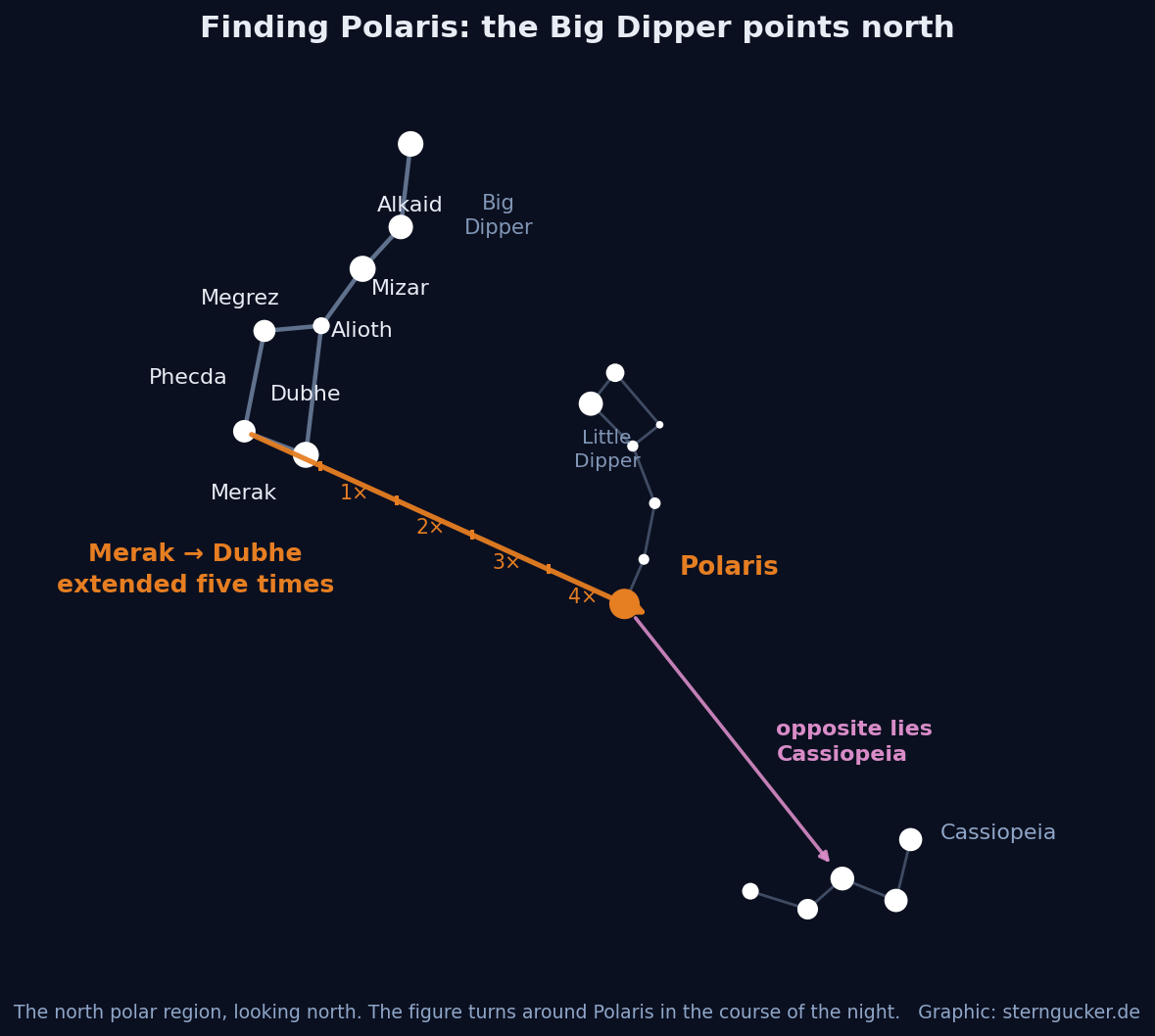
Two common mistakes cost beginners the most time. First, Polaris is not especially bright. At 1.98 mag it is only the 48th brightest star in the sky and clearly fainter than Alioth or Dubhe. Anyone hunting for a dazzling beacon is looking for the wrong object. Second, the Dipper appears at every conceivable angle depending on the season and the hour – sometimes upside down, sometimes standing on end. The Merak-to-Dubhe extension still works, because it rotates along with the figure.
Once you have Polaris, look at the far side of the pole. About the same distance beyond it, directly opposite the Big Dipper, stands the unmistakable W of Cassiopeia. Both figures circle the pole through the night, and when one is low the other is high. So on the autumn evenings when trees or buildings hide the Dipper, Cassiopeia takes over as the signpost.
🧭 North without a compass
Polaris sits about 0.7 degrees from the exact north celestial pole – roughly one and a half full-moon diameters. For any practical purpose that is irrelevant: follow the line below Polaris and you are walking north, more accurately than a compass with its local magnetic declination can manage.
Big Dipper tonight: visibility month by month
From the latitude of Britain, Ireland, Germany or Canada the Big Dipper is circumpolar: none of its seven stars ever sets. So the question “when can you see the Big Dipper?” has a rather flat answer – always. The far more useful question is where to look, because the figure swings once right around Polaris in the course of a year and its altitude changes a great deal.
The table gives the altitude and compass direction of the centre of the figure at 10 p.m. local time for 51° N – the latitude of London, Calgary or Kyiv. Further north the values rise, further south they fall by roughly one degree per degree of latitude, so from New York (41° N) subtract about ten degrees.
| Month | Altitude at 10 p.m. | Direction | Appearance |
|---|---|---|---|
| January | 34° | northeast | climbing, handle pointing down |
| February | 48° | northeast | well placed in the evening sky |
| March | 62° | northeast | high, handle down to the left |
| April | 71° | northeast | almost overhead |
| May | 85° | north | highest point – practically at the zenith |
| June | 72° | northwest | beginning to sink |
| July | 56° | northwest | handle pointing west |
| August | 41° | northwest | easy to see in the early evening |
| September | 28° | northwest | noticeably lower already |
| October | 20° | north | low; trees and buildings get in the way |
| November | 18° | north | lowest point above the northern horizon |
| December | 23° | northeast | climbing again |
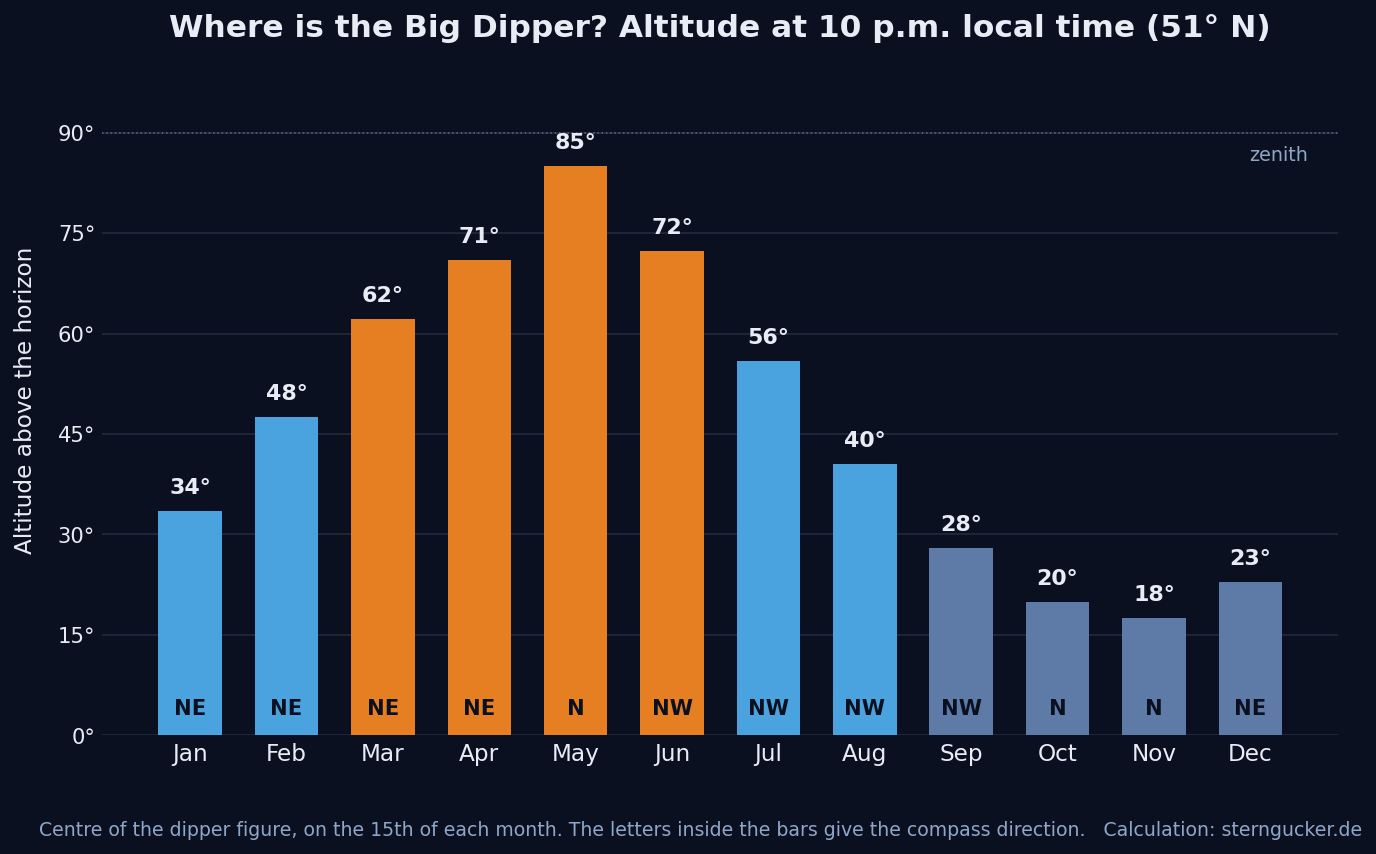
In practice this means the best season for the Big Dipper is spring, from March to June. It then stands high in the evening, well clear of the haze and the lights near the horizon – and at the same time it is the springboard to the finest targets of the spring sky. In October and November, by contrast, it scrapes along the northern horizon and is simply invisible from a city or from a south-facing balcony. If you want it then, you need a clear view north or the patience to wait past midnight until it climbs again.
📍 How far south does it stay circumpolar?
A star is circumpolar only north of a particular latitude. For Alkaid, the southernmost of the seven, the limit is 40.7° N – roughly the latitude of Madrid, Naples or New York. For Dubhe, the northernmost, 28.2° N is enough. So from Britain, Ireland, Canada and the northern United States all seven stars stay above the horizon at all times, while from Los Angeles, Florida or Cairo the tip of the handle dips below it for part of the night.
Big Dipper vs Little Dipper: the differences
Hardly any question comes up more often than how the two dippers relate to each other. They are two separate figures in two separate constellations – the Big Dipper in Ursa Major, the Little Dipper in Ursa Minor. Both are made of seven stars and share the same basic bowl-and-handle shape, but they have little else in common:
| Feature | Big Dipper | Little Dipper |
|---|---|---|
| Constellation | Ursa Major | Ursa Minor |
| Size of the figure | 25.7° | 16.6° |
| Brightest star | Alioth, 1.77 mag | Polaris, 1.98 mag |
| Stars brighter than 3.5 mag | all seven | only two (Polaris, Kochab) |
| Visibility from a city | complete | usually just two stars |
| Curve of the handle | away from the bowl | towards the bowl |
| Contains Polaris? | no | yes, at the tip of the handle |
| Role in orientation | signpost to Polaris | contains Polaris |
The decisive practical difference is brightness. The Big Dipper is fully visible even from a brightly lit city centre. The Little Dipper all but disappears: five of its seven stars lie between magnitude 3.0 and 5.0 and are swallowed by even moderate light pollution. That is why the route always runs in the same direction – you find the little one by way of the big one, never the other way round.
Mix-ups almost always come from someone taking the Little Dipper for the Big one or vice versa. Two reliable tests: the Big Dipper is about one and a half times as long, and its handle curves the other way. If in doubt, simply count the stars you can actually see – seven bright ones means you are looking at the Big Dipper.
The Big Dipper as a signpost: three classic star hops
The route to Polaris is only the best known of several. The Big Dipper is the springboard to the whole spring sky, and two more mnemonics belong to the standard repertoire of every stargazer.
Arc to Arcturus, spike to Spica
Follow the curve of the handle onwards past Alkaid, keeping the same arc, and after about 30 degrees you arrive at a strikingly orange star: Arcturus in Boötes, at −0.05 mag the brightest star in the entire northern sky. Carry on along the same arc for roughly the same distance again and you reach the bluish-white Spica in Virgo. The English mnemonic is “arc to Arcturus, then speed on to Spica” – one line that hands you two first-magnitude stars.
The bowl diagonal to Regulus
The second route runs the other way. Draw a line from Megrez through Phecda – diagonally across the bowl – and extend it a good four times, and you land on Regulus, the lead star of Leo. A third, less often quoted hop: the line from Megrez through Merak points south towards Gemini with Castor and Pollux.
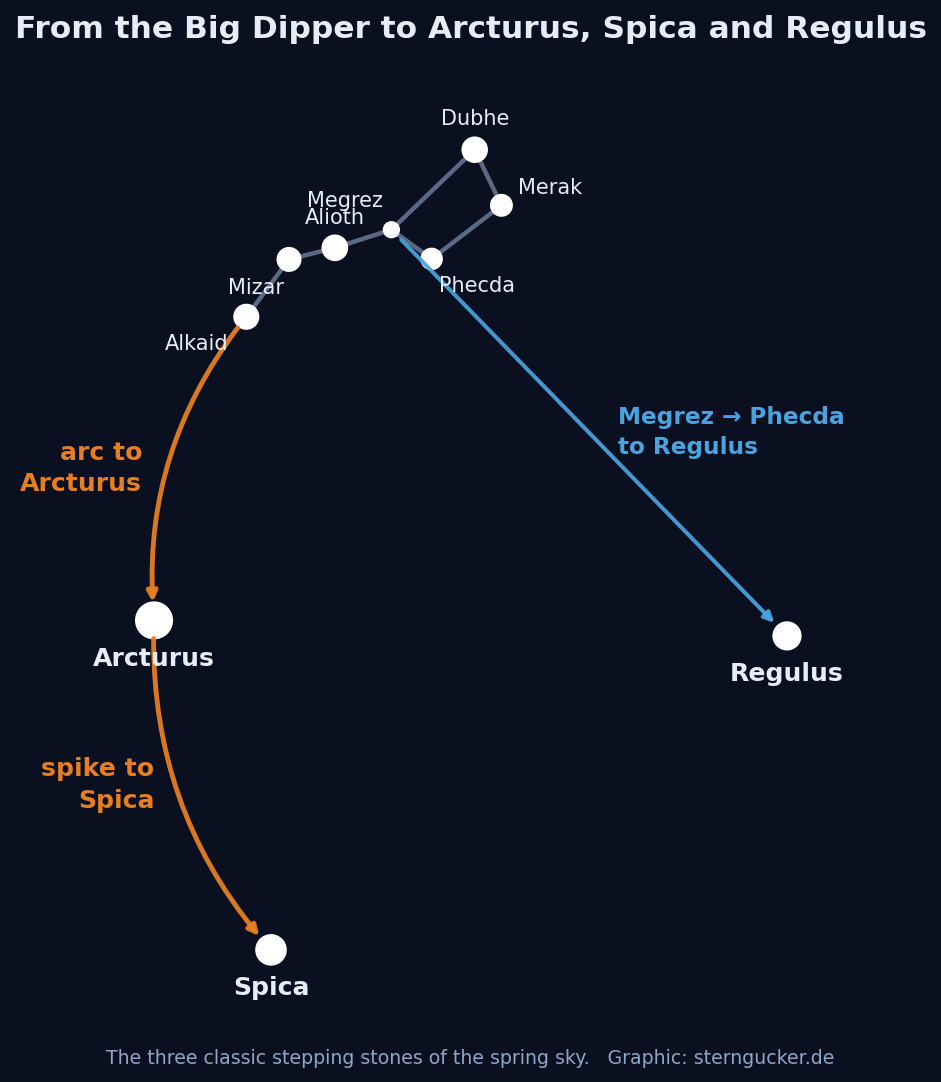
These routes are more than folklore: they are the fastest way to orient yourself without an app. Find the Big Dipper and within two minutes you have identified Polaris, the brightest star of the northern sky and two more zodiac constellations. A planisphere helps you set the current orientation of the figure before you even go outside.
The Big Dipper is where almost everyone starts. And after that?
Six short questions, an honest answer by e-mail – including when binoculars are the better start.
Objects in Ursa Major: galaxies, nebulae, doubles
Ursa Major lies a long way off the plane of the Milky Way. Looking in this direction means looking out of the disc of our own galaxy – no obscuring dust, but a clear view into intergalactic space. That is precisely why the Great Bear is one of the most galaxy-rich areas of the northern sky and, in exchange, contains almost no open star clusters.
| Object | Type | Magnitude | Distance | What you see |
|---|---|---|---|---|
| M81 (Bode’s Galaxy) | spiral galaxy | 6.9 mag | 12 million ly | a misty patch in binoculars, a bright core from 10 cm up |
| M82 (Cigar Galaxy) | starburst galaxy | 8.4 mag | 12 million ly | a narrow streak right next to M81 – both fit one field of view |
| M101 (Pinwheel) | face-on spiral | 7.9 mag | 21 million ly | large area, low surface brightness – needs a dark sky |
| M108 | edge-on spiral | 10.0 mag | 46 million ly | a slim spindle close to Merak, from 10 cm up |
| M109 | barred spiral | 9.8 mag | 84 million ly | close to Phecda, whose glare noticeably interferes |
| M97 (Owl Nebula) | planetary nebula | 9.9 mag | approx. 2,000 ly | a round disc; the “eyes” only from 20 cm and with a nebula filter |
| M40 (Winnecke 4) | optical double star | 9.6 mag | – | Messier’s famous mistake: he went looking for a nebula and found two stars |
| Mizar & Alcor | sextuple system | 2.0 / 4.0 mag | 83 ly | split with the naked eye; Mizar A/B in the smallest telescope |
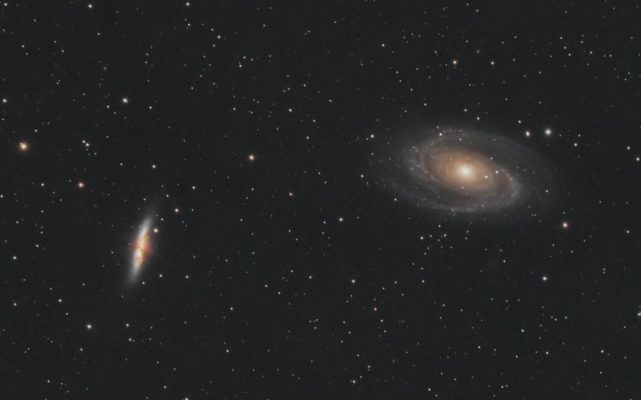
The most rewarding pair is without doubt M81 and M82: two completely different galaxies just 38 arcminutes apart, a good full-moon diameter. M81 is a textbook spiral, while M82 is a starburst galaxy in which a close encounter with M81 some 100 million years ago set off an enormous wave of star formation. Find them by taking the diagonal Phecda → Dubhe and extending it about the same distance again beyond Dubhe.
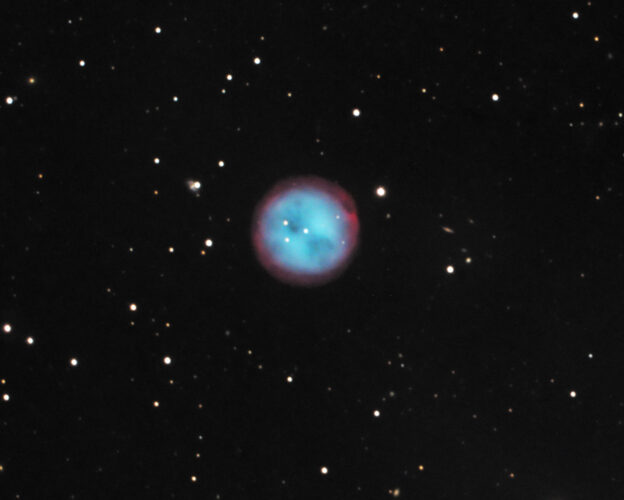
The planetary nebula M97 sits only 2.5 degrees southeast of Merak and owes its name to two darker patches that suggest an owl’s eyes. It is a demanding target all the same: 9.9 mag spread over more than three arcminutes makes for low surface brightness. M108 lies in the same field of view – two Messier objects side by side, a popular first step into deep-sky observing. The third prominent galaxy, M101, sits above the handle and is deceptive: its total magnitude sounds promising, but it is spread across an area larger than the full moon.
Which instrument for Ursa Major?
For the Dipper figure itself you need nothing at all – it is a naked-eye object, and the Mizar/Alcor eye test works without any equipment either. As soon as the objects inside Ursa Major come into play, though, the calculation changes. Binoculars show M81 and M82 as two faint smudges in the same field, which is charming, but they stay smudges. Everything that makes this article interesting needs magnification and aperture: splitting Mizar A and B, the spindle of M108, the structure in M97, the bright core of M81.
So here is the honest recommendation: if you can only buy one instrument and you really want to explore the sky, buy the telescope; binoculars are the supplement, not the substitute. That goes double for Ursa Major, because what waits here is almost exclusively galaxies and one planetary nebula – exactly the classes of object where every centimetre of aperture counts.
A compact start for double stars and the brighter galaxies
Our pick for beginners: Skywatcher Dobson Telescope N 130/650 Heritage FlexTube
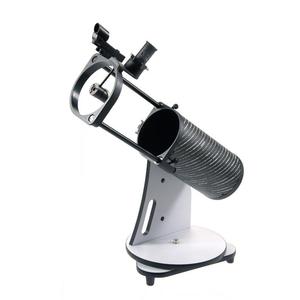
A compact tabletop Dobson with a true parabolic mirror. Folds down, fits in a bag: the Moon, planets and the bright deep-sky classics.
Price: € 265
Thirteen centimetres of aperture split Mizar A and B effortlessly, show M81 with a distinct core, M82 as a structured streak and M97 as a round disc. If you already know that galaxies are going to be your subject, start bigger straight away – the step up to 20 centimetres collects two and a half times as much light and is the only change that really helps with low-surface-brightness targets like M101:
The better choice if galaxies are the goal
The stronger deep-sky option: Skywatcher Dobson Telescope N 200/1200 Skyliner Classic
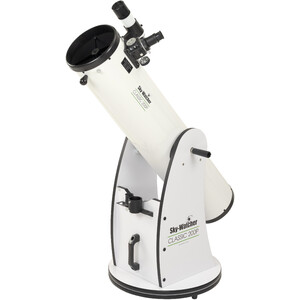
200 mm of aperture — the most sky for your money. Set it on the ground, point by hand: nebulae, clusters and galaxies for years to come.
Price: € 479
For the background to that choice, see our guides telescope for galaxies, best beginner telescopes and the basic question of telescope vs binoculars. If you would rather start with no equipment at all, stargazing for beginners covers the essentials – and a pair of astronomy binoculars always keeps its place as a second instrument for wide star fields and the Milky Way.
* Affiliate link: if you buy through this link we may earn a small commission from Astroshop or High Point Scientific, at no extra cost to you.
The Big Dipper is changing shape
Constellations feel eternal, but they are not. Every star moves through the galaxy at its own speed, and over tens of thousands of years that adds up to visible shifts. In the Big Dipper the effect is unusually well studied – and unusually striking.

The reason lies in the family relationships between the stars. Five of the seven – Merak, Phecda, Megrez, Alioth and Mizar – belong to the Ursa Major moving group, the nearest known stellar stream to us. They formed together out of the same cloud of gas about 500 million years ago and have been flying through the galaxy as a loose association ever since. That is also why they all sit at 80 to 83 light years.
Dubhe and Alkaid are not part of it. They are further away – 123 and 104 light years respectively – and they are moving in practically the opposite direction. Those two happen to sit at the ends of the figure, which has a rather elegant consequence: the five middle stars keep their arrangement while the two outer ones wander outwards. The Dipper does not become chaotic, it is simply stretched apart.
In about 50,000 years the familiar shape will be distorted beyond easy recognition. After roughly 100,000 years a completely new figure emerges which, with a little imagination, can be read as a dipper again – only mirrored: Alkaid and Phecda then form the corners of a new bowl while Megrez, Merak and Dubhe make up the handle. And 100,000 years ago it was the other way round: the bowl was tighter and the handle shorter.
☀️ Is the Sun part of the group?
Our Sun happens to lie inside the volume of the Ursa Major moving group, but it is not a member: at about 4.6 billion years it is roughly nine times older than the stream and moves differently. We are simply passing through the group by coincidence.
Big Dipper meaning: myths from four continents
Few star patterns have been read in so many different ways. That comes down to three properties: it is large, it is bright, and it sits in an empty part of the sky where no competing pattern distracts from it. Practically every culture of the northern hemisphere has given it a story.
Callisto and Arcas: the Greek bear legend
The best known account comes from Greece. The nymph Callisto, a companion of Artemis, had taken a vow of chastity – and was made pregnant by Zeus all the same. As punishment she was turned into a bear. Ovid’s Metamorphoses has Hera perform the transformation out of jealousy; in other versions it is Artemis punishing the broken vow. Years later Callisto’s son Arcas met the bear while hunting and was about to kill her, not recognising his own mother. Zeus prevented the matricide by placing them both in the sky: she as the Great Bear, he as the Little Bear – or, depending on the version, as Boötes the bear keeper.
A second, less familiar Greek story takes the wagon reading literally. The herdsman Icarius had given Dionysus hospitality and received the gift of wine in return. When he shared it with other herdsmen, they mistook their intoxication for poisoning and killed him. In consolation Dionysus set his wagon among the stars.
Older still is the Egyptian reading: the same stars were the “foreleg of Seth” – khepesh or meskhetiu, the foreleg of a bull, an image that can be traced on temple ceilings back to the age of the pyramids. And in the star lore of Ptolemy the dragon coiled around the golden apples of the Hesperides, with the three handle stars Alioth, Mizar and Alkaid standing for the apples themselves and the Little Bear for the guardians.
Dipper, coffin and plough: the names worldwide
Leave Europe and the wagon turns into something else entirely – and the names say a great deal about the everyday life of each culture:
| Culture | Name | The image behind it |
|---|---|---|
| United States | Big Dipper | the large ladle |
| Britain and Ireland | the Plough | bowl as blade, handle as the beam |
| Germany | Großer Wagen | the great wagon, with a shaft to pull it |
| France | Casserole / Grande Ourse | the saucepan with its long handle |
| China | běidǒu qīxīng (北斗七星) | the seven stars of the Northern Dipper |
| Arabic tradition | na‘sh with three banāt | a bier with three mourning daughters |
| Kyrgyzstan | seven wolves | a pack hunting the horse of the sky |
| North America | a she-bear with cubs or hunters | the bowl is the bear, the handle follows her |
| Scandinavia | Karlavagnen | the wagon of Charlemagne, or of Thor |
The Arabic name incidentally explains the star names themselves: Alkaid is short for al-qā’id banāt na‘sh, “the leader of the daughters of the bier” – hence the alternative name Benetnash. It was the funeral procession, not the bear, that gave these stars their names. The Chinese reading as a ladle, meanwhile, is practically identical to the American one, even though the two arose completely independently.
Bible, art and philosophy: the Dipper in Europe
The figure appears early and often in European intellectual history. Homer mentions it in the Odyssey as “the Bear, which men also call the Wain” – so both readings were already in parallel use some 2,700 years ago. Aristotle discusses the constellation and the celestial pole in Book XII of his Metaphysics, where the eternal circling of the circumpolar stars leads him to the idea of an unmoved mover.
The Old Testament knows the figure too. The Book of Job (9:9) says that God “made the Bear, Orion and the Pleiades, and the chambers of the south”. In Shakespeare, and later in Lord Tennyson, the Bear stands above all for orientation and constancy – the figure travellers steer by.
A curiosity on the side: when Julius Schiller published his Coelum Stellatum Christianum in 1627, he set out to replace every “pagan” constellation with a biblical one. Ursa Major became the “Boat of Saint Peter”. It never caught on – the atlas is a collector’s item today, and a fine illustration of how tenacious established sky pictures really are.
The spiritual meaning: what can honestly be said
Search for the “spiritual meaning” of the Big Dipper and you will mostly find interpretations that cannot be checked. Astronomically there is none – seven stars 80 to 120 light years away have no influence on anything on Earth. What can be documented very well, however, is the cultural meaning, and it is remarkably consistent: in almost every tradition the figure stands for orientation, constancy and finding the way home. The reason is entirely down to earth – it never sets and it reliably points north. As a tattoo motif or a symbol, that reading is by far the most defensible one.
Big Dipper questions: quick answers
Is the Big Dipper a constellation?
No. The Big Dipper is an asterism – a striking star pattern with no official status. The constellation its seven stars belong to is Ursa Major, the Great Bear, which at 1,280 square degrees is roughly four times the area of the Dipper figure.
How many stars does the Big Dipper have?
The figure is made of seven stars: Dubhe, Merak, Phecda and Megrez form the bowl, Alioth, Mizar and Alkaid the handle. Count the companion Alcor next to Mizar and you have eight naked-eye stars. The whole constellation of Ursa Major contains around 20 stars brighter than magnitude 5.
Where is the Big Dipper tonight?
Always in the north – but at very different heights depending on the season. In spring you will find it almost overhead in the evening, in autumn low above the northern horizon. At 10 p.m. local time it peaks in May at about 85° and bottoms out in November at barely 18°. The monthly table above gives the altitude and direction for every month of the year.
Can you see the Big Dipper all year round?
Yes. From Britain, Ireland, Canada, the northern United States and central Europe it is circumpolar: none of its stars ever sets, so it is up on every clear night. North of about 41° latitude that holds for all seven stars. Further south – in the southern United States or North Africa – the tip of the handle dips below the horizon for part of the night.
Why is the Big Dipper called the Plough?
Because British and Irish farmers read the same seven stars as a plough rather than a ladle: the bowl is the blade turning the soil and the handle is the beam the horses pull. The Plough is still the everyday name in the UK and Ireland, while Big Dipper is the standard in North America. Both refer to exactly the same stars in Ursa Major.
How do I find the North Star with the Big Dipper?
Use the far edge of the bowl: extend the line from Merak through Dubhe by five times their separation, about 27 degrees or a good two and a half fist widths at arm’s length. There stands Polaris, a lone star of middling brightness. Drop a vertical from it to the horizon and you are facing true north.
Why are there almost only galaxies in Ursa Major?
Because the constellation lies far from the plane of the Milky Way. Looking that way means looking out of the disc of our own galaxy, with none of the dust that blocks the view towards the galactic centre. That is why Ursa Major is full of galaxies such as M81, M82 and M101 but contains virtually no open star clusters.
Read on at Sterngucker
- Polaris, the North Star – a portrait of the most useful star in the northern sky
- Cassiopeia – the Dipper’s counterpart on the far side of the pole
- Arcturus – where the arc of the handle takes you
- Deep-sky observing – how to get started on galaxies and nebulae
- Star chart – set the current orientation of the figure before you go out
- Light pollution – why the Little Dipper disappears in town
- All constellations – the entry point to our catalogue