By Alexander Merz · Published on · Details checked on 11 October 2026
Canis Major (the Great Dog) is a constellation of the winter sky and home to Sirius, the brightest star in the entire night sky. It lies southeast of Orion, covers 380 square degrees and, seen from the northern US, stays fairly low above the horizon.
More in our overview: Constellations.
At a glance
| Latin name | Canis Major |
| Area | 380 square degrees (rank 43 of 88) |
| Brightest star | Sirius, magnitude −1.46 |
| Best time to observe | February evenings |
| Culmination altitude of Sirius | 26° in Seattle, 33° in New York, 48° in Miami |
| Neighbors | Monoceros, Lepus, Columba, Puppis; to the northwest Canis Major borders the Orion region |
| Best-known deep-sky object | M 41, open star cluster, magnitude 4.5 |
How to find the Canis Major constellation
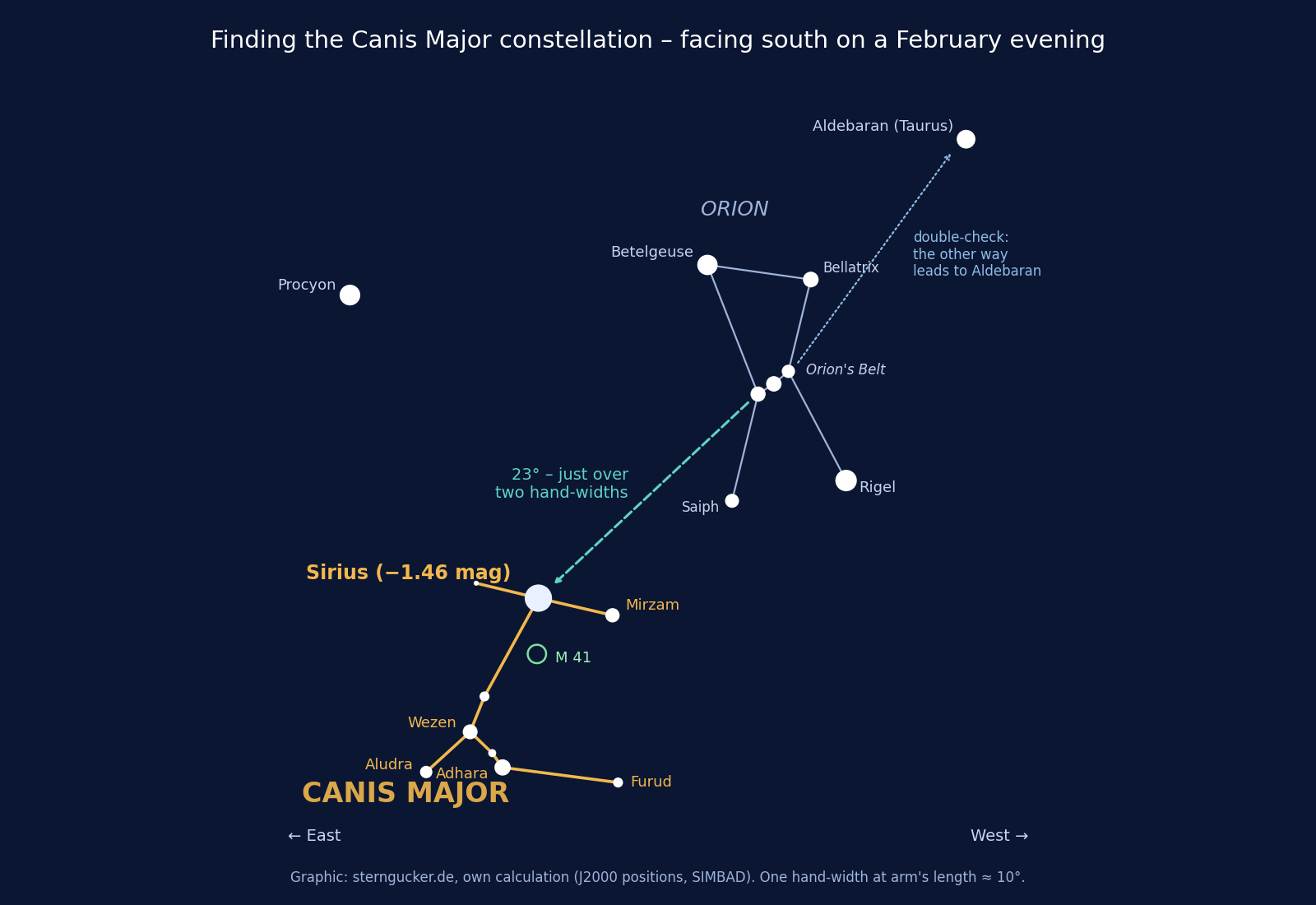
There is hardly an easier star-hop in the whole sky. Extend Orion’s three belt stars down to the left, and after 23 degrees you reach Sirius – that is just over two outstretched hand-widths.
You can hardly mistake it. Sirius is by far the brightest object in this part of the sky and, because it sits fairly low, often twinkles in striking colors – red, blue and white in turn.
Making out the figure itself, on the other hand, takes a dark sky. The body with Adhara, Wezen and Aludra sits even lower than Sirius and disappears in the haze over the city.
The stars of Canis Major
| Star | Magnitude | Distance | Type |
|---|---|---|---|
| Sirius (α CMa) | −1.46 | 8.6 light-years | white main-sequence star A1 V |
| Adhara (ε CMa) | 1.50 | about 430 light-years | blue giant B2 II |
| Wezen (δ CMa) | 1.83 | about 1,600 light-years | yellow supergiant F8 Ia |
| Mirzam (β CMa) | 1.98 | about 490 light-years | variable B1 II/III |
| Aludra (η CMa) | 2.45 | about 2,000 light-years | blue supergiant B5 Ia |
| Furud (ζ CMa) | 3.02 | about 340 light-years | B2.5 V |
This table tells the constellation’s real story. Sirius is the brightest star in the sky only because it is one of the nearest – in true luminosity, every other star on this list outshines it many times over.
Aludra, for example, shines tens of thousands of times brighter than Sirius. It is only about 230 times farther away – and that is why it ends up in fifth place instead of first.
Sirius: the brightest star and its invisible companion
Sirius is a double star. Every 50-odd years Sirius B, a white dwarf of about magnitude 8.4, circles it – a burned-out stellar remnant with the mass of the Sun, squeezed down to the size of Earth.
Seeing it is one of the toughest challenges for amateurs. The problem is not its brightness but the contrast: Sirius A outshines it ten-thousandfold at a separation of just a few arcseconds.
The good news: the two are currently close to their maximum separation. If you want to try, you need at least 150 mm (6 in) of aperture, a very steady night and patience – and you should catch Sirius at culmination if possible.
More about the star itself – distance, proper motion and the puzzle of its color in ancient sources – is on our page about Sirius.
Why it stands so low over the northern US
Sirius has a declination of about −17 degrees, so it lies well south of the celestial equator. In New York it reaches 33 degrees at best, in Seattle just 26 – and the rest of the Dog sits even lower.
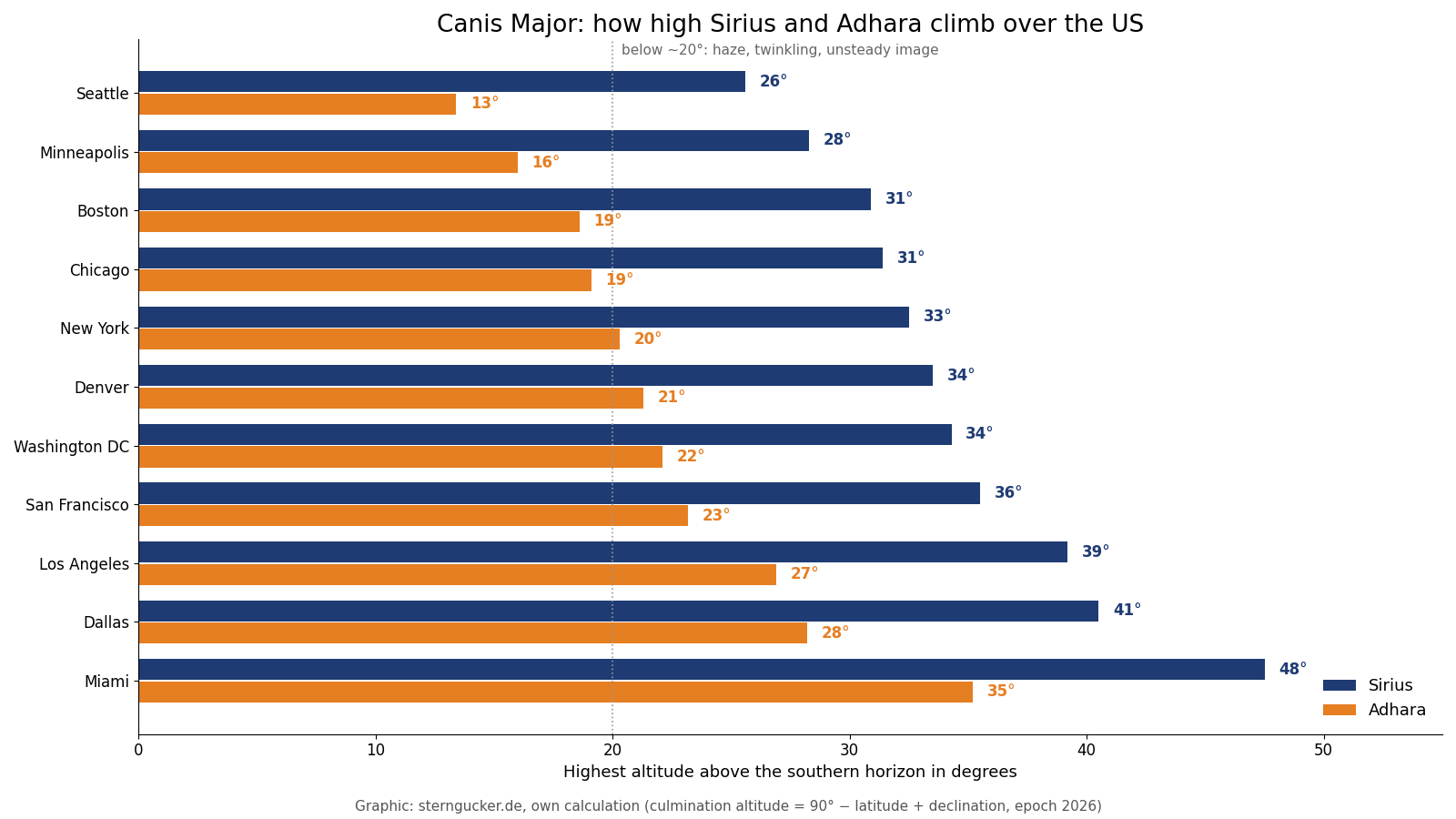
That has consequences worth knowing. Below about 20 degrees of altitude the air swallows so much light that colors get distorted and telescope images turn unsteady – that is exactly the famous twinkling of Sirius. In Seattle, Adhara never gets above 13 degrees.
When you can see Canis Major
The constellation is a pure winter object. From December to March Sirius stands above the southern horizon in the evening, best in February – it then culminates around 9 p.m.
| Month | Altitude at 10 p.m. | Culmination |
|---|---|---|
| December | 19° | 1:07 a.m. |
| January | 31° | 11:00 p.m. |
| February | 31° | 8:58 p.m. |
| March | 27° | 8:08 p.m. EDT |
| April | 11° | 6:06 p.m. EDT |
| May to November | at or below the horizon | during the day or after midnight |
In high summer Sirius is up with the Sun in the daytime sky. That is exactly where the term “dog days” comes from: in antiquity, Sirius reappeared in the morning twilight in late July for the first time – at the same time as the worst heat.
The star has nothing to do with the heat, of course. The timing was pure coincidence – and because of the precession of Earth’s axis, the date has shifted since antiquity anyway.
M 41: the star cluster below Sirius
Four degrees south of Sirius lies M 41, an open star cluster with about 100 members at a distance of roughly 2,300 light-years. At magnitude 4.5 it can be glimpsed as a smudge with the naked eye under a dark sky.
Its natural instrument is a pair of binoculars. The cluster is a good full Moon across – in a telescope at high magnification you only see parts of it.
The same constellation, by the way, holds VY Canis Majoris, one of the largest known stars of all. You can’t see it with the naked eye – it lies about 3,900 light-years away behind dense clouds of dust. The record holder among giant stars, however, is Stephenson 2-18 – more giants in our overview of stars.
Binoculars or telescope
For this constellation the answer is unusually clear. M 41 and the wide star fields of the winter Milky Way call for a wide field of view, not high magnification – binoculars genuinely win here.
The right choice for M 41: Celestron Cometron 7x50 Binoculars
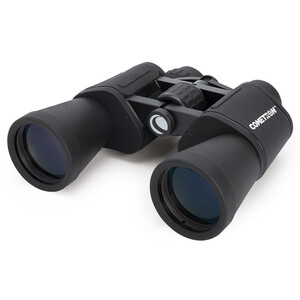
The astronomy classic among affordable binoculars: 7×50 with a large exit pupil for bright handheld views of the Moon and Milky Way – the ideal first step before a telescope.
Price: € 65
When a telescope is still worth it
As soon as you want to split Sirius B, there is no way around aperture. Below 150 mm (6 in) you needn’t even try, and even then the steadiness of the air decides.
The Skyliner 200/1200 DobsonianSkyliner 200/1200 Dobsonian brings 200 mm (8 in) of aperture. Here that means Sirius B comes within reach at all in steady air, and M 41 resolves down to its fainter members. The extra cost is worth it if double stars and deep-sky objects keep drawing you in – for the view of the constellation itself you don’t need it.
For advanced observers: Skywatcher Dobson Telescope N 200/1200 Skyliner Classic
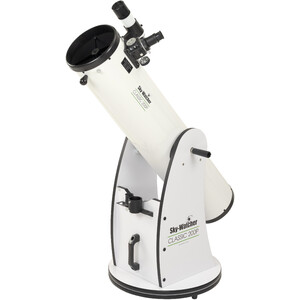
200 mm of aperture — the most sky for your money. Set it on the ground, point by hand: nebulae, clusters and galaxies for years to come.
Price: € 479
* Affiliate link: if you buy through this link we may earn a small commission from Astroshop or High Point Scientific, at no extra cost to you.
Frequently asked questions about the Canis Major constellation
How do I find the Canis Major constellation?
Extend Orion’s three belt stars down to the left. After about 23 degrees – just over two hand-widths at arm’s length – you reach Sirius, the brightest star in the sky. The rest of the figure lies below it and to the southeast.
What is the brightest star in Canis Major?
Sirius, at magnitude −1.46. It is also the brightest star in the entire night sky – not because it is especially luminous, but because at 8.6 light-years it is one of our nearest neighbors.
Why does Sirius twinkle so strongly and in so many colors?
Because from the northern US it stands quite low. Its light therefore crosses a particularly large amount of atmosphere, which breaks it up like a restless prism. The effect is down to the air, not the star.
When is the best time to see Canis Major?
On clear February evenings. Sirius then stands at its highest around 9 p.m. From May to November the constellation is practically unobservable from the US in the evening, because it is only above the horizon during the day or late at night.
What do the dog days have to do with the constellation?
The name comes from Sirius, the Dog Star. In antiquity it reappeared in the morning twilight in late July for the first time – right at the hottest time of the year. There is no connection with the weather, only a coincidence in timing.
Can you see Sirius B with an amateur telescope?
With at least 150 mm (6 in) of aperture and very steady air, yes, but it isn’t easy. The white dwarf sits right next to a star ten thousand times brighter. It works best when Sirius has reached its highest point.
Further reading
- Sirius – a portrait of the brightest star
- Orion constellation – the signpost to Canis Major
- All constellations – our catalog at a glance
- Deep-sky objects – what sets star clusters, nebulae and galaxies apart
- Identify constellations – the method that really works