By Alexander Merz · Updated on · Details checked on 7 October 2026
⚡ The short version
Orion is the most striking constellation of the winter sky and, for most people, the gateway to stargazing. Its hallmark is the three stars in a row – the belt Mintaka, Alnilam and Alnitak, perfectly lined up over just 2.74°.
The brightest star is Rigel (0.1 mag, bluish-white, lower right), the best-known the red supergiant Betelgeuse (upper left). In the middle of the Sword glows the Orion Nebula M 42 – the only star-forming region you can see with the naked eye in Central Europe.
Visible in Central Europe from October to April in the evening sky, Orion is at its highest in January around 10 p.m. From May to August it stands in the sky during the day and remains invisible.
More in our overview: Constellations.
There is no other pattern in the night sky that imprints itself so quickly: three roughly equally bright stars, exactly in a row, plus four corner points spanning a large rectangle. Anyone who has once seen Orion finds it again instantly every winter – and then uses it as a signpost to everything else.
Orion in 30 seconds: the key facts
| Feature | Detail |
|---|---|
| Latin name | Orion, genitive Orionis, abbreviation Ori |
| English name | Orion, the celestial hunter |
| Area | 594 square degrees (rank 26 of 88) |
| Brightest star | Rigel (β Ori), 0.1 mag |
| Stars brighter than 3 mag | 8 |
| Visible in Central Europe | October to April in the evening sky |
| Highest point | mid-January around 10 p.m., about 39° above the horizon (50° North) |
| Neighbouring constellations | Taurus, Gemini, Monoceros, Canis Major, Lepus, Eridanus |
| Best-known object | Orion Nebula M 42 (3.7 mag, visible to the naked eye) |
| Meteor shower | Orionids, peak around 21 October |
Orion lies exactly on the celestial equator – the middle belt star Alnilam sits just over a degree south of it. This has a lovely consequence: Orion is visible from every inhabited place on Earth.
Only its orientation turns. Anyone who sees it from Cape Town or Sydney sees it upside down – there Betelgeuse is at the lower right and Rigel at the upper left, and the Orion Nebula hangs not below the belt but above it.
How to find Orion: the three stars in a row
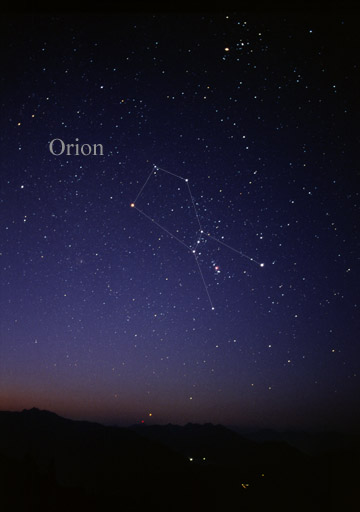
The search always begins at the belt. Three roughly equally bright stars in an exact row occur only once in the entire sky – confusion is practically impossible. On a clear winter evening, look south, roughly halfway between the horizon and the zenith.
- Look south (in December already from about 9 p.m., in January at its highest around 10 p.m.).
- Look for three equally bright stars in a slanting row. The whole row is only 2.74° long – about as wide as two fingers held side by side at arm’s length.
- Above and below the row stand four bright stars forming a large rectangle: Betelgeuse (reddish, upper left), Bellatrix (upper right), Rigel (bluish, lower right) and Saiph (lower left).
- Below the belt hangs a smaller, vertical chain of stars: the Sword. The middle “star” in it is in truth the Orion Nebula.
The diagonal of the rectangle from Betelgeuse to Rigel measures 18.6°. For comparison: an outstretched hand with fingers spread covers about 20° in the sky. So Orion fits almost exactly between the thumb and little finger – it is considerably larger than most people remember it.
How large is Orion in the sky really?
Almost all distances within Orion can be estimated with the outstretched hand. The following values are calculated from the star positions for 2026:
| Segment | Angular distance | Hand measure at arm’s length |
|---|---|---|
| Mintaka – Alnilam (belt, half) | 1.39° | index finger, width |
| Alnilam – Alnitak (belt, half) | 1.36° | index finger, width |
| Mintaka – Alnitak (whole belt) | 2.74° | two fingers |
| Alnilam – Orion Nebula M 42 | 4.20° | three fingers |
| Betelgeuse – Bellatrix (shoulders) | 7.53° | fist (about 10°) |
| Rigel – Saiph (feet) | 8.33° | fist |
| Bellatrix – Rigel (right side) | 14.79° | one and a half fists |
| Betelgeuse – Saiph (diagonal) | 17.18° | spread hand (about 20°) |
| Betelgeuse – Rigel (diagonal) | 18.61° | spread hand |
| Alnitak – Horsehead Nebula B 33 | 0.52° | one full-moon diameter |
The last value is the most remarkable: the famous Horsehead Nebula sits just a single full-moon diameter below Alnitak, the left belt star. In every Orion photo you are looking straight at it without realising.
Orion’s Belt: three stars, many names
Orion’s Belt is the row of three stars – Alnitak, Alnilam and Mintaka – in the middle of the constellation Orion. The chain is 2.7° long, its stars shine at magnitude 1.7 to 2.2 and all lie roughly 1,250 light-years away.
The three belt stars Mintaka, Alnilam and Alnitak
From left to right – that is, from east to west – the stars are called Alnitak, Alnilam and Mintaka. All three are hot, blue-white giants and supergiants, each tens of thousands of times more luminous than the Sun.
| Star | Position | Magnitude | Distance | Special feature |
|---|---|---|---|---|
| ζ Alnitak | left (east) | 1.77 | about 1,260 ly | triple system, hottest of the three |
| ε Alnilam | centre | 1.69 | about 1,250 ly | single star, blue supergiant |
| δ Mintaka | right (west) | 2.23 to 2.35 | about 1,250 ly | multiple system, slightly variable |
Older tables often give 818, 916 and 1,342 light-years – these are Hipparcos measurements from the 1990s, which carry large errors for such distant, bright stars. More recent measurements put all three at about 380 to 390 parsecs, i.e. roughly 1,250 light-years.
So the row is more than a trick of perspective: the three stars really belong together, as part of the young stellar group Orion OB1b. With the naked eye you see three stars; in binoculars they become dozens – the belt sits inside the loose star cluster Collinder 70, which spans about 3°.
Mintaka is a multiple system: two of its stars eclipse each other every 5.7 days, and the brightness drops barely noticeably from 2.23 to 2.35 mag. Mintaka also lies almost exactly on the celestial equator.
The hot primary of Alnitak makes the neighbouring Flame Nebula NGC 2024 glow. Only 0.52° south of Alnitak lies the Horsehead Nebula – more on that in the deep-sky section below.
The belt as a signpost to Sirius and Aldebaran
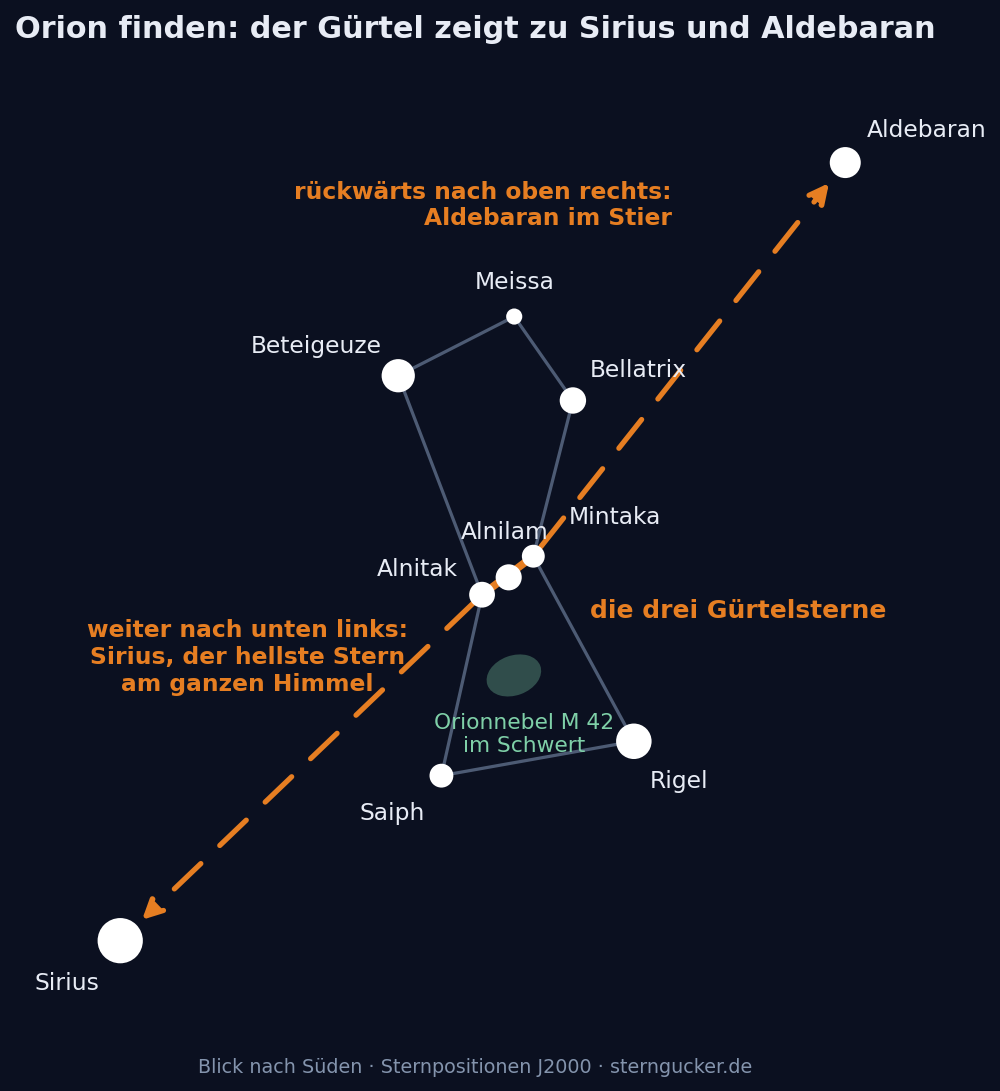
The belt’s real value lies in the fact that it points in both directions. It is the starting figure of the winter sky, just as the Big Dipper is of the northern sky:
- Extended down to the left (about eight times the belt length, 21.7° from Alnitak), the line meets Sirius – the brightest star in the entire night sky. It lies only 2.6° beside the extension and near the horizon often twinkles fiercely in all colours; that is atmospheric turbulence, not a property of the star.
- Extended up to the right, the line passes Aldebaran, the orange-red eye of Taurus, after 23°. It lies about 5° above the line. Another 13.7° beyond Aldebaran you reach the Pleiades.
- From Rigel on past Betelgeuse you reach Gemini with Castor and Pollux.
Anyone who has walked these three lines once has unlocked half the winter sky. Together with Procyon in Canis Minor and Capella in Auriga, Sirius, Rigel, Aldebaran, Pollux and Betelgeuse form the Winter Hexagon – the largest striking figure of the season.
Three Kings, Jacob’s Staff, Three Marys: the names of the belt
The belt has more names than any other row of stars. Across much of Europe the three stars are popularly called the Three Kings (the Magi); in medieval Europe Jacob’s Staff and Jacob’s Ladder were common too.
In Spain, Portugal and Latin America they are Las Tres Marías, the Three Marys. The link to the Magi came later: the row served as a calendar marker long before any Christian interpretation, because its appearance in the evening announces winter.
| Star | Arabic origin | Meaning |
|---|---|---|
| Alnitak | an-niṭāq | “the girdle” |
| Alnilam | an-niẓām | “the string of pearls” |
| Mintaka | al-minṭaqa | “the belt” |
Curiously, two of the three names mean the same thing. Originally the whole row was called the “string of pearls”; only later were the names shared out among the individual stars.
When can you see Orion’s Belt?
The belt lies on the celestial equator. That is why, anywhere in the world, it rises almost exactly in the east and sets in the west, staying just under 12 hours above the horizon.
At 50° north it reaches about 39° altitude at most, due south. The table shows for mid-month when the middle star Alnilam rises, culminates and sets – and when it stands at least 10° high in full darkness.
| Month | Rises | Highest | Sets | Dark and ≥ 10° high |
|---|---|---|---|---|
| January | 16:19 | 22:16 | 04:13 | 18:05–03:05 |
| February | 14:17 | 20:14 | 02:11 | 18:50–01:00 |
| March | 12:27 | 18:24 | 00:21 | 19:35–23:10 |
| April | 11:21 | 17:22 | 23:19 | 21:35–22:10 |
| May | 09:23 | 15:24 | 21:21 | daytime, not visible |
| June | 07:21 | 13:22 | 19:19 | daytime, not visible |
| July | 05:23 | 11:20 | 17:21 | daytime, not visible |
| August | 03:21 | 09:18 | 15:19 | 04:30–04:45 |
| September | 01:19 | 07:16 | 13:17 | 02:30–05:45 |
| October | 23:22 | 05:18 | 11:15 | 00:30–06:30 |
| November | 20:20 | 02:17 | 08:13 | 21:30–06:15 |
| December | 18:22 | 00:19 | 06:16 | 19:30–05:05 |
Calculated with Skyfield for 50° N / 10° E on the 15th of each month, times in CET or CEST (Central European Time). “Dark” means the Sun is more than 12° below the horizon. Times shift by 4 minutes per degree of longitude, and in the UK or US add your own time zone offset.
In short: the belt stands well above the horizon before midnight from late October to mid-April, longest in December and January. From mid-August it appears in the morning sky – for many the first herald of winter.
Below the belt: the sword and the Orion Nebula
About 4° below the middle belt star hangs a short, vertical chain of stars – Orion’s Sword. The middle “star” in it is in truth the Orion Nebula M 42, a star-forming region about 1,350 light-years away.
Under a dark country sky you can see it with the naked eye as a hazy patch. In binoculars the belt and sword just fit into one view: from Mintaka to the lower end of the sword is 5.7°, and typical 10×50 binoculars show 5 to 6.5°.
For detail in the nebula – the Trapezium, the bright wings – you need a telescope. Which instrument really shows the Orion Nebula is covered further down in the deep-sky and telescope sections.
The pyramids of Giza and the Orion correlation
One of the most popular theses about Orion concerns the pyramids of Giza: their arrangement is said to match the pattern of the three belt stars, including the slight offset of the smallest pyramid. This so-called Orion correlation theory was made known in 1994 by Robert Bauval.
What is true: three structures, two large and one smaller one offset to the side – that really is reminiscent of the belt. And the ancient Egyptians did associate the stars of Orion with their god Osiris.
What is not: the three pyramids were built under three pharaohs over several decades, not to one common plan. The sizes do not match the brightnesses, and the fit only works if you turn the sky chart upside down, with south at the top.
Bauval’s claim that the pattern best matches the sky around 10,500 BC contradicts the archaeological dating of the pyramids to around 2,500 BC. Our verdict: a pretty resemblance, but no blueprint.
When Orion can be seen: worked out month by month
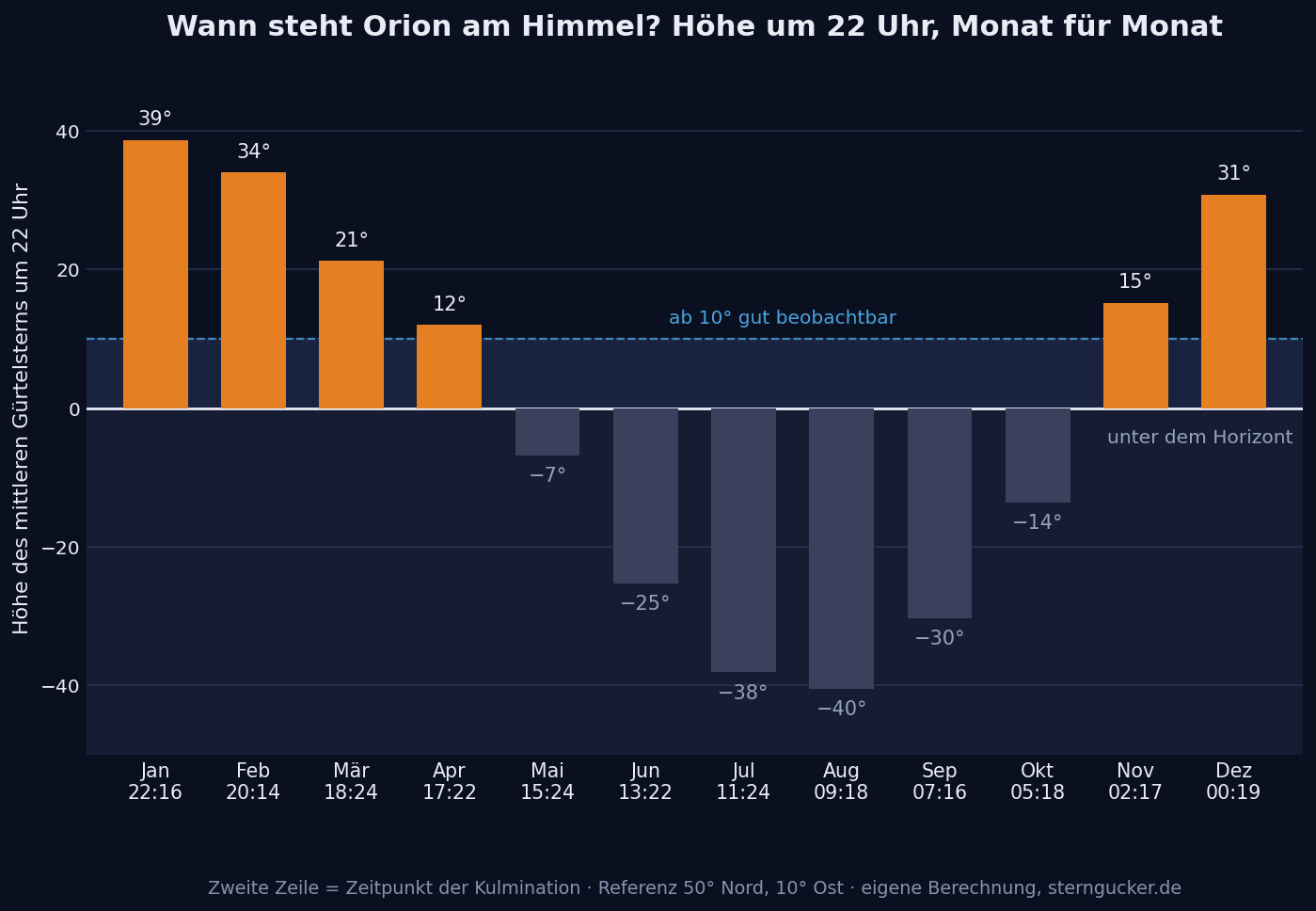
Orion is a pure winter constellation – but not because it is absent from the sky in summer. It is very much there then, only together with the Sun, that is, in the daytime sky. In August it culminates around 9 a.m.
Visibility over the course of the year
| Month | Altitude at 10 p.m. | Direction | Culmination | Rating |
|---|---|---|---|---|
| January | 38.7° | South | 10:16 p.m. | ★★★ optimal |
| February | 34.0° | Southwest | 8:14 p.m. | ★★★ very good |
| March | 21.2° | Southwest | 6:24 p.m. | ★★ good, early in the evening |
| April | 12.0° | West | 5:22 p.m. | ★ low, only until about 10 p.m. |
| May | −6.8° | West | 3:24 p.m. | – already set |
| June | −25.3° | Northwest | 1:22 p.m. | – invisible |
| July | −38.1° | Northwest | 11:24 a.m. | – invisible |
| August | −40.5° | North | 9:18 a.m. | – only in the morning sky from mid-August |
| September | −30.3° | Northeast | 7:16 a.m. | – only in the morning sky |
| October | −13.6° | East | 5:18 a.m. | ★ mid-October only around midnight, late October from about 9:30 p.m. in the east |
| November | 15.2° | East | 2:17 a.m. | ★★ good, from late evening |
| December | 30.8° | Southeast | 0:19 a.m. | ★★★ very good |
🗓 The two visibility windows (50° North)
Morning sky: from 13 August Orion rises in the east before dawn – the classic “first Orion of the year” that early risers report in late August. This window lasts until 3 March.
Evening sky: from 9 October to 22 April. Anyone who observes only in the evening therefore has Orion available for a good half-year.
How high does Orion stand where you live?
The maximum altitude above the horizon depends solely on the geographic latitude. The farther south, the higher – and the steadier the air, which makes a visible difference precisely for the Orion Nebula. All values apply to the moment of culmination:
| City | Latitude | Betelgeuse | Alnilam (belt) | Orion Nebula M 42 | Rigel |
|---|---|---|---|---|---|
| Hamburg | 53.6° N | 43.9° | 35.3° | 31.1° | 28.3° |
| Berlin | 52.5° N | 44.9° | 36.3° | 32.1° | 29.3° |
| Dresden | 51.1° N | 46.4° | 37.8° | 33.6° | 30.8° |
| Cologne | 50.9° N | 46.5° | 37.9° | 33.7° | 30.9° |
| Frankfurt | 50.1° N | 47.3° | 38.7° | 34.5° | 31.7° |
| Stuttgart | 48.8° N | 48.6° | 40.0° | 35.8° | 33.1° |
| Vienna | 48.2° N | 49.2° | 40.6° | 36.4° | 33.6° |
| Munich | 48.1° N | 49.3° | 40.7° | 36.5° | 33.7° |
| Zurich | 47.4° N | 50.0° | 41.4° | 37.2° | 34.4° |
| Graz | 47.1° N | 50.3° | 41.7° | 37.6° | 34.8° |
| Bern | 47.0° N | 50.5° | 41.9° | 37.7° | 34.9° |
The difference between Hamburg and Bern for the Orion Nebula is 6.6°. That sounds small, but it is precisely the range in which atmospheric turbulence increases sharply: an object at 31° altitude is viewed through noticeably more atmosphere than one at 38°. Anyone living in northern Germany should therefore observe the Orion Nebula as close to culmination as possible.
How long does Orion stay above the horizon?
Because Orion lies on the celestial equator, its stars are almost exactly twelve hours above and twelve hours below the horizon. The deviations show how differently the head and the feet behave (calculated for 50° North):
| Star | Declination | Time above the horizon |
|---|---|---|
| Betelgeuse (shoulder) | +7.4° | 13 h 11 min |
| Alnilam (belt centre) | −1.2° | 11 h 49 min |
| Rigel (foot) | −8.2° | 10 h 41 min |
| Saiph (foot) | −9.7° | 10 h 26 min |
In practice this means: Betelgeuse rises about 75 minutes earlier than Rigel and sets correspondingly later. Anyone who bids farewell to the last Orion of the year in April sees in the end only the shoulders above the western horizon – the feet are long gone.
The stars of Orion: magnitudes, colours and distances
Orion contains eight stars brighter than 3 mag – more than any other constellation in the entire sky. That is exactly what makes it so striking. And it is a textbook of star colours: the palette ranges from the deep-red supergiant to the bluish-white giant with 25,000 degrees of surface temperature.
| Stern | Magnitude (mag) | Distance (ly) | Spectral class | Notable feature |
|---|---|---|---|---|
| α Betelgeuse | 0.0 to 1.6 (variable) | about 550 | M1–2 Ia-Iab | red supergiant |
| β Rigel | 0.03 to 0.3 | 773 | B8 Iab | blue-white supergiant |
| γ Bellatrix | 1.64 | 243 | B2 III | blue giant |
| ε Alnilam | 1.69 | ≈ 1,250 | B0 Iab | blue supergiant |
| ζ Alnitak | 1.77 | ≈ 1,260 | O9.7 Ibe | triple system |
| κ Saiph | 2.07 | 722 | B0.5 Ia | blue supergiant |
| δ Mintaka | 2.23 to 2.35 | ≈ 1,250 | O9.5 II + B1 V | eclipsing variable |
| ι Hatysa (Nair al Saif) | 2.75 | 1,326 | O9 III | brightest star in the Sword |
| π³ Tabit | 3.19 | 26 | F6 V | Sun-like, neighbourhood |
| η Eta Orionis | 3.35 | 901 | B1 V + B2 | close double system |
| λ Meissa | 3.39 | 1,056 | O8 III + B0.5 V | the “head” |
One detail in this table is almost always overlooked: π³ Orionis (Tabit) in the hunter’s outstretched hand is only 26 light-years away – a Sun-like star in our immediate cosmic neighbourhood. All the other stars of the figure are 200 to 1,400 light-years away. The constellation is simply a chance figure of perspective; physically its stars have nothing to do with Tabit.
Betelgeuse – the red supergiant before the supernova
Betelgeuse (α Orionis) is the most famous star of the constellation, although it is not the brightest. It is a red supergiant with about 15 times the Sun’s mass and roughly 630 times the Sun’s diameter. If you placed it where the Sun is, its surface would lie beyond the orbit of Mars.
Its brightness varies irregularly between 0.0 and 1.6 mag – you can see this with the naked eye by comparing it over months with Rigel and Bellatrix. In late 2019 it experienced a century minimum and grew fainter than 1.7 mag, which triggered supernova speculation worldwide. According to current understanding, the cause was an ejected dust cloud that moved in front of the star – not an imminent collapse.
That Betelgeuse will end as a supernova is nonetheless certain. The expected timeframe is up to 100,000 years – tomorrow in astronomical terms, practically never in human terms.
When it happens, the star will be as bright as the half-moon for weeks and visible in the daytime sky. At 550 light-years’ distance there is no danger to Earth.
An honest note on the distance: the figures range between about 450 and 650 light-years. The reason is the star’s huge, pulsating and fuzzily bounded surface, which makes a clean parallax measurement difficult.
If you need a rounded number, take about 550 light-years. More about Betelgeuse and its supernova →
Rigel – the brightest star in Orion
Rigel (β Orionis) is, at 0.1 mag, the brightest star of the constellation – contrary to the Bayer designation, which assigns α to Betelgeuse. Betelgeuse was probably at a brightness maximum at the time the names were given. In the entire sky Rigel ranks seventh.
The name comes from Arabic and simply means “the left foot” – from the point of view of the hunter facing us, it stands at the lower right for us. Rigel is a blue-white supergiant at 773 light-years‘ distance, with 17 times the Sun’s mass, 60 times the diameter and roughly 40,000 times the luminosity of the Sun. That makes it one of the absolutely most luminous stars in our wider surroundings.
Rigel too is slightly variable: its brightness pulsates over about 25 days between 0.03 and 0.3 mag. A companion star of the 6th magnitude stands 9 arcseconds away – a rewarding but demanding target, because the main star fairly outshines it.
From about 100 mm of aperture and in steady air the separation succeeds. Everything about Rigel →
Bellatrix, Saiph and Meissa
Bellatrix (γ Ori, 1.64 mag) is the right shoulder and, at 243 light-years, the closest to us of the bright Orion stars. Its Latin name means “the female warrior”. It shines about 4,000 times as bright as the Sun.
Saiph (κ Ori, 2.07 mag) is the right foot and physically almost a twin of Rigel: a blue supergiant at 722 light-years. That it nevertheless appears distinctly fainter to us is because a large part of its radiation lies in the ultraviolet, where our eye is blind.
Meissa (λ Ori, 3.39 mag) marks the head. To the naked eye it is an inconspicuous point above the shoulders; in binoculars it turns out that it lies at the centre of a loose star cluster (Collinder 69). For binoculars this is a pretty and rarely noticed target.
How far is Orion from Earth?
This question is often asked and, strictly speaking, has no single answer: a constellation has no distance. It is a perspective figure of stars that happen to stand in the same line of sight, but that are in truth at different distances.
The spread within Orion is extreme. The nearest bright star of the figure, Tabit, is 26 light-years away.
The most distant – the three belt stars and Hatysa in the sword – lie about 1,250 to 1,330 light-years away, about 50 times farther. The belt itself, by contrast, is a real group: according to more recent measurements its three stars are practically equidistant.
If you still want to give a number, the most sensible reference is the Orion molecular cloud complex – the gas cloud from which the young belt stars and the Orion Nebula actually formed together. It lies at about 1,350 light-years‘ distance. That is the number meant when someone speaks of the “distance of Orion”.
🔭 A glance into the past
The light of the Orion Nebula falling into your eye tonight set out around the year 676 – long before Charlemagne. The light of Bellatrix, by contrast, only started out around 1783, the year of the first manned balloon flight. Anyone contemplating Orion sees not a single moment, but about a thousand years of history at the same time.
The deep-sky objects in Orion: from the Orion Nebula to the Horsehead
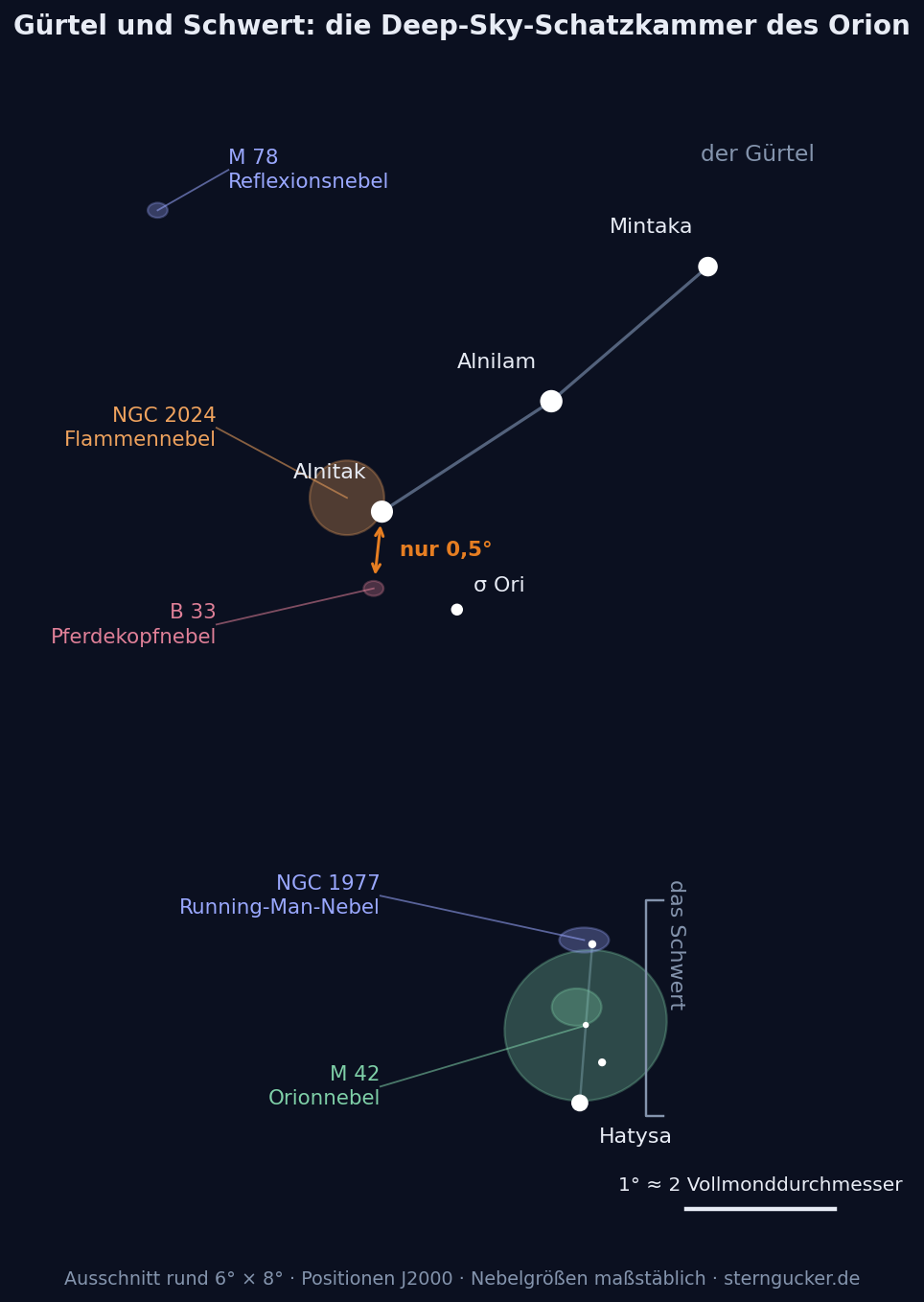
Orion is not only the most striking star figure, it is also the nearest large star-forming region of all. Behind the figure lies the Orion molecular cloud complex, a gas cloud hundreds of light-years across, in which new suns are being born right now. This is why so many nebulae crowd together here in the smallest space, as nowhere else in the sky.
| Object | Name | mag | Size | Distance (ly) | From which instrument |
|---|---|---|---|---|---|
| M 42 | Orion Nebula | 3.7 | 65′ × 60′ | 1,350 | naked eye |
| M 43 | De Mairan’s Nebula | 9.0 | 20′ × 15′ | 1,350 | from 50 mm |
| NGC 1977 | Running Man Nebula | 7.0 | 20′ × 10′ | 1,350 | from 80 mm |
| NGC 2024 | Flame Nebula | – | 30′ × 30′ | 1,500 | from 100 mm, very dark sky |
| B 33 | Horsehead Nebula | – | 8′ × 6′ | 1,500 | from 250 mm + H-β filter |
| M 78 | Reflection nebula | 8.3 | 8′ × 6′ | 1,600 | from 80 mm |
| NGC 2169 | “37 Cluster” | 5.9 | 6′ | 3,400 | binoculars |
| Barnard’s Loop | Sh 2-276 | – | arc of about 12° | 1,400 | photography only |
M 42 – the Orion Nebula with the naked eye
The Orion Nebula is the only object of its kind that you can see without aids in Central Europe. In the Sword below the belt the middle “star” does not look quite point-like, but blurred – that is the nebula. Even simple binoculars turn the smudge into a distinct, wing-shaped glow.
| Feature | Detail |
|---|---|
| Catalogue designation | M 42 / NGC 1976 |
| Apparent magnitude | 3.7 mag |
| Apparent size | 65′ × 60′ – a good two full-moon diameters |
| Distance | 1,350 ± 23 light-years |
| True diameter | about 24 light-years |
| Mass | 700 to 2,100 solar masses |
| Age | about 3 million years |
| Discovery | Nicolas-Claude Fabri de Peiresc, 1610 |
| Cause of the glow | ionisation by the hot star θ¹ Orionis C |
Important for managing expectations: in the eyepiece the nebula is not coloured. The human eye sees no colours at low light levels, which is why M 42 appears grey to grey-greenish, sometimes with a hint of turquoise.
The spectacular red tones in photos only arise through minutes-long exposure. Anyone who knows this is not disappointed at the first glance, but impressed – for the structure is overwhelming visually too.

The Trapezium at the heart of the nebula
In the brightest part of M 42 stands the Trapezium (θ¹ Orionis), a group of very young, extremely hot stars. It is their ultraviolet light that excites the surrounding gas to glow in the first place – without the Trapezium the Orion Nebula would be invisible.
For the observer the Trapezium is a perfect test of optics and steadiness of the air. At 50× magnification four stars appear in a lopsided quadrilateral.
At 150× magnification, with good optics and steady air, two more join them, traditionally called E and F. Anyone who sees six Trapezium stars has caught a truly good night.
NGC 2024 and B 33: the Flame and Horsehead Nebulae
Right beside the left belt star Alnitak lie the two most famous “difficult” objects in the sky. The Flame Nebula NGC 2024 was discovered on 1 January 1786 by William Herschel, measures 30′ × 30′ and is about 1,500 light-years away with a true diameter of 13 light-years.
It is excited by Alnitak itself – and that is precisely the problem: the bright star outshines it. The trick is to nudge Alnitak just out of the field of view.
The Horsehead Nebula B 33 is not a glowing but a dark nebula: a dust cloud that stands out as a silhouette against the red-glowing emission nebula IC 434. It was discovered by Williamina Fleming in 1887 on a photographic plate from Harvard Observatory – visually no one had noticed it before.
🐴 An honest word on the Horsehead Nebula
B 33 is the most photographed and most rarely seen object in the sky. Visually it realistically requires: at least 250 mm of aperture, an H-β filter, a truly dark sky without light pollution and at least 30 minutes of dark adaptation. Even then you do not see a horse’s head, but a faint indentation in a pale band.
Photographically, by contrast, it is astonishingly easy: just a few minutes of exposure with a camera on a tracker show it clearly. Anyone who wants to see it should photograph rather than look through.
M 78 and Barnard’s Loop
M 78 (NGC 2068) lies a good 2° northeast of Alnitak and is, at 8.3 mag, the brightest reflection nebula in the sky – it does not glow by itself, but scatters the light of nearby stars, which is why it appears bluish in photos. Pierre Méchain discovered it in March 1780. In an 80 mm telescope it appears as a small, comet-like nebular patch with two embedded stars.
Barnard’s Loop is the largest and at the same time most invisible object of the region: a vast arc of ionised hydrogen that stretches over about 12° around the entire Orion figure – 24 full-moon diameters. Visually it is practically unreachable, but on a wide-angle shot with an H-α filter it is unmissable. It is presumably the remnant of a supernova that exploded about two million years ago.
A pretty additional target away from the well-known objects is NGC 2169 in the north of the constellation, a small open star cluster of 5.9 mag at about 3,400 light-years, discovered by G. Hodierna around 1654. It bears the nickname “37 Cluster”, because its brightest stars actually trace out the digit sequence 37 in binoculars. More deep-sky objects for beginners →
Which telescope for Orion: an honest assessment
Most recommendations for this constellation reflexively reach for binoculars. For Orion that is only half the truth.
For the figure and for the wide nebula fields it is correct – but the real highlights, that is the Trapezium, the Flame Nebula and the structures in the Orion Nebula, need aperture. So here is the order according to what is actually visible:
| Instrument | What you see in Orion | Price range |
|---|---|---|
| Naked eye | figure, belt, Sword; M 42 as a smudge | free |
| Binoculars 10×50 | M 42 wing-shaped, M 78, NGC 2169, Meissa cluster | from about $100€100 |
| Telescope 100–130 mm | Trapezium with four stars, M 42 with structure, NGC 1977 | from about $250€250 |
| Telescope 200 mm | Trapezium with six stars, Flame Nebula, plenty of nebula detail | from about $500€500 |
| Telescope 250 mm + H-β | Horsehead Nebula visually (under a very dark sky) | from about $900€900 |
The affordable start
Anyone who wants to see as much of Orion as possible on a limited budget does considerably better with a compact reflecting telescope than with an equally priced refractor – aperture per dollareuro is the decisive criterion here. The Skywatcher Heritage 130 is the classic answer to this calculation: 130 mm of aperture, set up without tools, small enough for the balcony.
Our recommendation for beginners: Skywatcher Dobson Telescope N 130/650 Heritage FlexTube
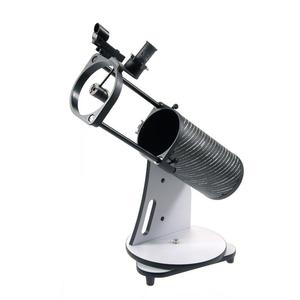
A compact tabletop Dobson with a true parabolic mirror. Folds down, fits in a bag: the Moon, planets and the bright deep-sky classics.
Price: € 265
With this instrument the Trapezium shows up cleanly as a group of four, the Orion Nebula gains structure and extensions, and NGC 1977 becomes recognisable as a little nebula in its own right. For the Flame Nebula it just about suffices at a very good site, for the Horsehead not.
When the Orion Nebula is the real goal
As soon as the goal is no longer “find the constellation” but “see something in the Orion Nebula”, the recommendation changes. Nebulae are extended objects, and extended objects gain almost exclusively from light-gathering power. A 200 mm Dobsonian gathers about 2.4 times as much light as a 130 mm – this jump is immediately visible at the eyepiece and greater than any difference between two instruments of the same aperture class.
The considerably better choice for nebulae: Skywatcher Dobson Telescope N 200/1200 Skyliner Classic
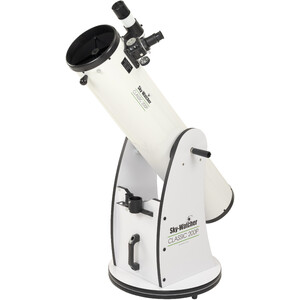
200 mm of aperture — the most sky for your money. Set it on the ground, point by hand: nebulae, clusters and galaxies for years to come.
Price: € 479
A Dobsonian is nothing other than a large mirror on a simple wooden rocker – you save on the expensive mount and put all the money into the optics. The drawback is the size: the instrument is about 1.20 m long and has to be carried.
Anyone with a balcony on the third floor is better served by the Heritage. Anyone with the garden right outside should reach for the Dobsonian. Telescope or binoculars – the direct comparison →
* The links marked with an asterisk are affiliate links. If you buy through them, we receive a small commission. The price does not change for you.
Orion in mythology: the hunter, the scorpion and the Pleiades
In Greek mythology Orion was a giant hunter, usually described as a son of the sea god Poseidon. As a constellation he therefore stands for the celestial hunter – and because he is visible from everywhere on Earth, almost every culture has read its own story into this pattern.
The hunter and his end
Orion boasted that he could slay any animal on Earth. The earth goddess Gaia thereupon sent a scorpion that killed him with a single sting. Both were placed in the sky – but, as a precaution, on opposite sides.
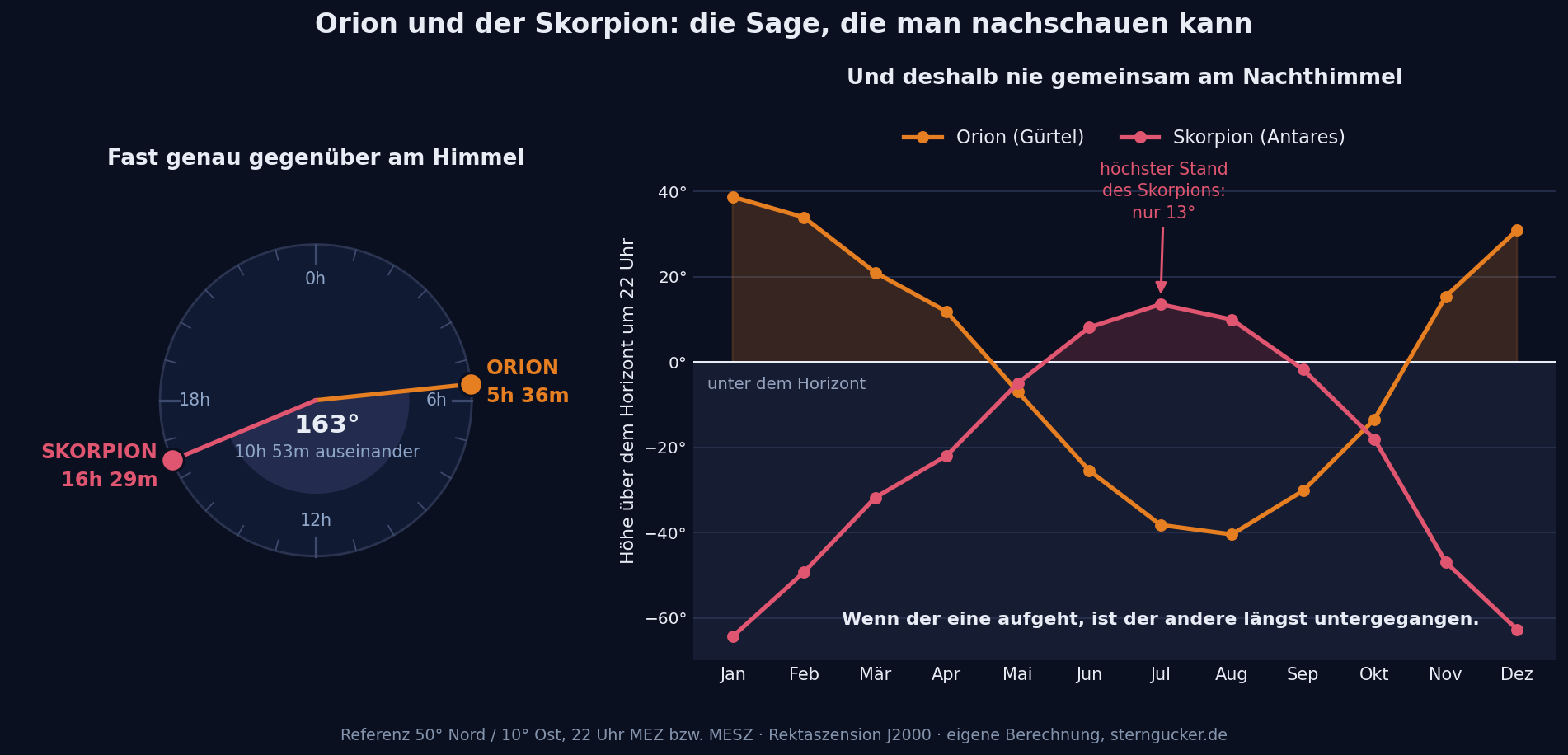
And that is precisely the beautiful part of the story: it is astronomically true. Orion and the Scorpion stand diametrically opposite each other in the sky and are therefore never visible at the same time.
When the Scorpion rises in the southeast in summer, Orion has long since set in the west. When Orion returns in autumn, the Scorpion vanishes. To this day the hunter flees before his murderer.
A second tale pursues Orion in another direction: he is said to have chased after the seven daughters of Atlas, who were set in the sky as the Pleiades. That too can be traced in the sky – Orion follows the Pleiades night after night without ever catching them.
Where does the name Orion come from?
In English, as in German, Orion is simply Orion: the name is a Greek proper name with no secure translation. Descriptively, the figure is called the Hunter.
Antiquity itself was already in disagreement. The Greeks themselves told a coarse folk etymology: the childless farmer Hyrieus of Boeotia entertained Zeus, Poseidon and Hermes so hospitably that they granted him a wish. He wished for a son – the three gods thereupon let their water flow onto the hide of the sacrificed bull, had it buried, and nine months later the boy rose out of the earth.
From the Greek ouron (“urine”) the name Urion was derived, from which Orion later arose. Ovid tells this version in the Fasti. Linguistically it is invented after the fact – a typical ancient explanation for a name that no one understood anymore.
More probably the name is older than the Greek legend. The Babylonians already knew the figure as MUL.SIPA.ZI.AN.NA, “the faithful shepherd of heaven”.
A derivation from the Akkadian Uru-anna, “light of heaven”, is often cited – it is not attested, but it fits the finding that the constellation was already, in Mesopotamia over 3,000 years ago, a name of weight. In Homer and Hesiod, that is around 700 BC, Orion is already a fixed figure: a hunter who still hunts even in the realm of the dead.
Orion, Artemis and the blinding
Anyone searching for Orion in Greek mythology almost always comes across Artemis, the goddess of the hunt – and rightly so: in most traditions she is the central figure of his life and his death. The two hunted together, which for the virgin goddess was a remarkable exception. Her brother Apollo watched this with growing suspicion.
Before that lies the darkest episode of the legend: on the island of Chios, Orion assaulted Merope, the daughter of King Oenopion. The king had him blinded in his sleep.
Blind, Orion groped his way to Lemnos, where the smith god Hephaestus set his helper Cedalion on his shoulders, who guided him eastward – to where the Sun rises. The first ray of Helios restored his sight. It is one of the oldest images of healing through light of all.
How Orion died: four versions
There is not one single story of how Orion came into the sky. The ancient authors hand down at least four versions, which agree on one point: Artemis is always involved.
| Version | Who kills him | The reason | Handed down by |
|---|---|---|---|
| Gaia’s scorpion | a scorpion | Orion boasted that he could slay any animal on Earth. The earth goddess Gaia sent him the smallest one, the one that could kill him. | Pseudo-Apollodorus, Hyginus |
| Artemis’s scorpion | a scorpion | This time it is Artemis herself (in other versions Hera) who sends the scorpion – because Orion had harassed her or one of her companions. | Hyginus, Astronomica |
| Artemis’s arrow | Artemis | Eos, the goddess of the dawn, had taken Orion as her lover. Out of jealousy of this happiness, Artemis shot him on Delos. | Homer, Odyssey V |
| Apollo’s ruse | Artemis, without knowing it | Apollo feared that his sister might fall in love. He challenged her to hit a distant dark point in the sea. She hit it – it was Orion’s head, protruding from the waves as he swam. | Hyginus, Ovid |
Only in the two scorpion versions does the animal also come into the sky – and it is precisely these versions that have prevailed, because they can be checked in the sky: Orion and the Scorpion stand opposite each other and never meet. A legend that can be checked survives longer than one that must merely be believed.
What does Orion mean as a constellation?
In brief, if you need the meaning of the constellation Orion in a single paragraph: Orion is the celestial hunter – the answer to the riddle “Who is called the celestial hunter?” is simply ORION. It is regarded as the most striking constellation of the winter sky, as a signpost to Sirius and Aldebaran, and as home to the Orion Nebula, the nearest large star-forming region to Earth.
Culturally it stands for strength, new beginnings and transience: a hunter who returns every winter and disappears again every spring. Despite its prominence it is not a zodiac sign – it lies too far from the ecliptic for that.
Orion in the Bible and among other peoples
The Book of Job names the constellation under the Hebrew name Kesil and places it beside the Pleiades. For the Egyptians the figure embodied the god Osiris, ruler over death and rebirth – fitting the constellation’s annual disappearance and reappearance.
In Scandinavia the belt was regarded as Frigg’s Distaff, the goddess’s spinning tool. Among the Lakota of North America it formed the hand of a chief.
In Latin America the three stars are still called Las Tres Marías to this day. And European farmers simply used them as a calendar: when the belt stands in the east in the evening, winter begins.
What does Orion mean spiritually?
In esoteric interpretations Orion mostly stands for strength, determination and protection – derived from the hunter figure. As a tattoo motif, the three belt stars are almost always meant, often with the meaning “orientation” or as a reminder of three people who belong together.
These are cultural attributions, not astronomical statements: astronomically, Orion is a chance figure of stars at very different distances. Anyone getting the belt stars tattooed should only pay attention to the correct order – the middle star does not lie exactly on the connecting line, but is minimally offset. That is precisely what makes the figure genuine.
Observing Orion with children: the simplest start
Orion is the ideal first constellation for children – for a very practical reason: in winter it is already in the sky before 8 p.m. You do not have to keep anyone awake until midnight, and the figure is so unambiguous that children point it out themselves the second time.
- Start with the three stars. “Can you find three stars that stand exactly in a row?” This works almost always on the first try and gives an immediate sense of achievement.
- Complete the figure. Only afterwards show the four corner points – shoulders and feet. Many children see an hourglass or a butterfly of their own accord; that is perfectly fine.
- Compare the colours. Betelgeuse at the upper left against Rigel at the lower right. The colour difference is the best proof that stars are not all the same – red means cool, blue means hot.
- Look for the Sword. Below the belt hang three fainter stars. The middle one is blurred – “that is not a star, it is a cloud in which new suns are being born right now”.
- Point the binoculars at it. Best when propped up or lying down. The moment when the blurred smudge becomes a glowing formation is the real aha moment.
👨👩👧 Three tips that make the difference
- Dress warmly – two layers more than you think. Cold feet end any observing night faster than clouds.
- Red light instead of a torch – red light does not destroy dark adaptation. A bicycle tail light or red film over the phone’s light will do.
- Keep it short – 20 minutes with an aha moment are better than an hour of freezing. The rest comes by itself. Telescopes for children compared →
Orion in the crossword: the most common answers
Orion and its stars turn up regularly in crosswords. Here are the most common clues with the number of letters:
| Clue | Letters | Answer |
|---|---|---|
| Diffuse region in the constellation Orion | 10 | ORIONNEBEL |
| Brightest star in Orion | 5 | RIGEL |
| Star in Orion | 5 | RIGEL, SAIPH, TABIT |
| Star in Orion | 6 | MEISSA, HATYSA |
| Star in Orion | 7 | ALNILAM, ALNITAK, MINTAKA (7) |
| Star in Orion | 9 | BELLATRIX |
| Red giant star in Orion | 10 | BETEIGEUZE |
| Constellation with 5 letters | 5 | ORION |
| Who is called the celestial hunter? | 5 | ORION |
| Belt of Orion, popular name | 11 | DREIKOENIGE |
| Constellation of the winter sky | 5 | ORION |
| Meteor shower from Orion | 9 | ORIONIDEN |
The most frequent stumbling block: “Star in Orion with 5 letters” has two valid answers – RIGEL and SAIPH. If “brightest” or “blue supergiant” is also mentioned, RIGEL is meant. For “red supergiant” or ten letters it is BETEIGEUZE.
Shooting stars from Orion: the Orionids in October
Every year around 21 October, shooting stars appear to come from the region of Orion – more precisely from the area northeast of Betelgeuse. The shower is therefore called the Orionids, but has nothing to do with the constellation itself: the radiant only happens by chance to lie in this line of sight.
The origin is prominent: the Orionids are dust particles of Halley’s Comet. Twice a year the Earth crosses its orbit – in May as the Eta Aquariids, in October as the Orionids. At about 66 km/s they are among the fastest meteors of all and often leave visible glowing trails.
Under a dark sky you can expect about 20 meteors per hour. The best time is after midnight, when Orion stands high enough in the east.
Important: do not look directly at the radiant, but about 40° to the side – that is where the trails are longer. Everything about the Orionids →
Orion is the best winter target for a first telescope: the Orion Nebula, the Trapezium and colourful double stars.
Six short questions, an honest answer by email – even when binoculars are the better choice.
Frequently asked questions about the constellation Orion
When can you see the constellation Orion?
In the evening sky Orion is visible from 9 October to 22 April, at its highest in mid-January around 10 p.m. at about 39° above the horizon. Anyone who gets up early sees it as early as mid-August before dawn in the east. From May to early August it stands in the sky during the day and remains invisible.
What are the three stars in a row?
That is the Belt of Orion with the stars Mintaka, Alnilam and Alnitak. They are lined up almost perfectly over just 2.74° and are about equally bright at 2.2 to 1.7 mag. In popular usage they are called “the Three Kings” or “Jacob’s Staff”. According to more recent measurements all three lie about 1,250 light-years away and belong to the same young stellar group.
Which is the brightest star in Orion?
Rigel at 0.1 mag – not Betelgeuse, although the latter bears the designation α. Rigel stands at the lower right in the figure and is the seventh-brightest star in the entire night sky. At its maximum, Betelgeuse can briefly become similarly bright, but usually falls back noticeably.
How many stars does the constellation Orion have?
The classic figure consists of seven main stars: four corner points (Betelgeuse, Bellatrix, Rigel, Saiph) and three belt stars. If you add the head and the Sword, you arrive at about twelve stars visible to the naked eye. In total the constellation contains eight stars brighter than 3 mag – more than any other.
How many stars are in Orion’s Belt?
With the naked eye three: Alnitak, Alnilam and Mintaka. In binoculars dozens of fainter stars of the cluster Collinder 70, which surrounds the belt stars, join them. Mintaka and Alnitak are themselves multiple systems of several suns orbiting closely.
Can you see the Orion Nebula with the naked eye?
Yes. The middle “star” in the Sword below the belt appears, under a reasonably dark sky, not point-like but blurred – that is M 42 at 3.7 mag. In the city it takes a little patience and dark adaptation. Binoculars turn it at once into a distinct, wing-shaped glow.
Why does the Orion Nebula not look colourful in the telescope?
Because the human eye is insensitive to colour at low brightness. Colour vision is handled by the cones, which only work above a certain amount of light. That is why M 42 appears grey to grey-greenish visually. The red tones in photos arise through minutes-long exposure, which the eye cannot achieve.
Is Orion a zodiac sign?
No. Zodiac signs are exclusively the twelve constellations along the ecliptic, that is, the Sun’s apparent path. Orion lies just south of it and is never crossed by the Sun. It is a constellation, but not a sign of the zodiac.
Will Betelgeuse soon explode as a supernova?
It is certain that it will end as a supernova – but the timeframe is up to 100,000 years. The brightness minimum in late 2019 was not a harbinger, but a dust cloud in front of the star. At about 550 light-years’ distance the explosion would be harmless to Earth, but visible for weeks, as bright as day.
Where is the Horsehead Nebula?
Just 0.52° south of Alnitak, the left belt star – a single full-moon diameter. Despite this prominent position, B 33 is extremely difficult visually: it takes about 250 mm of aperture, an H-β filter and a very dark sky. Photographically, by contrast, it succeeds even with modest equipment.
Why is Orion upside down in Australia?
Because the constellation lies almost exactly on the celestial equator and, from the southern hemisphere, you look up at it in a sense “from the other side”. There Betelgeuse is at the bottom and Rigel at the top, and the Orion Nebula hangs above the belt instead of below it. In Australia the figure is therefore often interpreted as a pot or saucepan.
Read on at Sterngucker
- Betelgeuse – the red supergiant and its supernova
- Rigel – the portrait of the brightest Orion star
- Sirius – where the belt points down to the left
- Taurus – where it points up to the right
- Nebulae at a glance – emission, reflection and dark nebulae explained
- Orionids – the meteor shower of Halley’s Comet
- Working with the star chart – for everything that comes next
- All constellations at a glance – the entry point to our catalogue