By Alexander Merz · Published on · Details checked on 3 November 2026
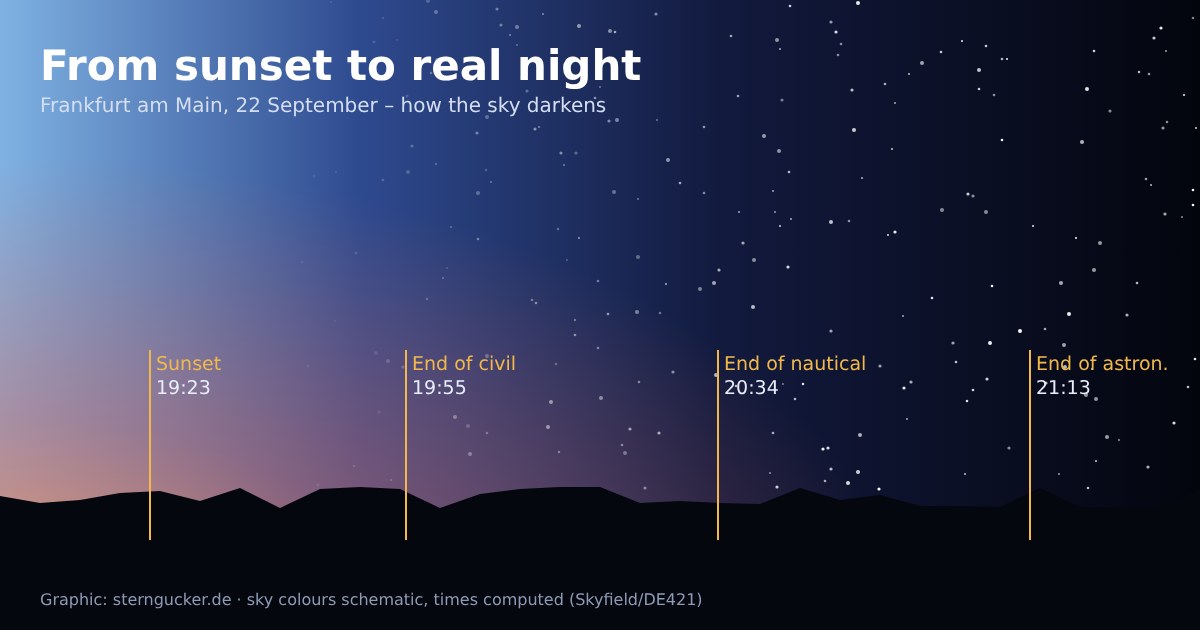
Twilight is the time between day and night, when the Sun is already below the horizon but its light still brightens the atmosphere. Three phases are distinguished by how far the Sun has sunk: civil twilight (down to 6° below the horizon), nautical twilight (to 12°) and astronomical twilight (to 18°).
More to explore: our free astronomy tools.
Twilight times today for your location
Pick a date and a place, and the calculator shows you all three twilight phases, sunset and sunrise. It also gives you the dark window: the hours when neither the Sun nor the Moon brightens the sky. That is the time for galaxies, nebulae and the Milky Way.
The location button asks your browser for your position. Everything is computed on your own device; nothing is sent to us or stored.
The three twilight phases at a glance
All that matters is how far the Sun is below the horizon – not the clock. In the evening the phases run in the order civil, nautical, astronomical; in the morning the order is reversed.
| Phase | Sun below the horizon | How the sky looks | What you can observe |
|---|---|---|---|
| Civil twilight | 0° to 6° | bright enough to read, horizon clear | Moon, Venus, Jupiter, and towards the end the brightest stars |
| Nautical twilight | 6° to 12° | almost night to the eye, horizon still visible | constellations, planets, double stars |
| Astronomical twilight | 12° to 18° | looks dark, only a pale glimmer near the horizon | almost everything except faint galaxies and nebulae |
| Astronomical night | more than 18° | no sunlight left in the sky | deep sky, Milky Way, astrophotography |
Civil twilight
Civil twilight runs from sunset until the Sun is 6° below the horizon. Outdoors you can still read and work without a lamp. That is where the name comes from: civil life gets by without artificial light during this time.
The first points of light now appear in the sky. Venus and Jupiter first, and towards the end the brightest stars such as Vega, Arcturus or Sirius. For photographers this is the blue hour – more on that further down.
Nautical twilight
During nautical twilight the Sun sinks from 6° to 12° below the horizon. Sailors could see the stars and the line of the sea horizon at the same time during this window. That is exactly what they needed to fix their position with a sextant.
To the eye it is almost night; for stargazing it is not yet. The constellations are fully visible, but the sky above the horizon still glows blue. For the Moon, planets and double stars in a telescope that is perfectly sufficient.
Astronomical twilight
Astronomical twilight lasts until the Sun is 18° below the horizon. In a town you will barely notice it with the naked eye. At a dark site you can still make out one last pale glimmer towards the Sun.
For astrophotography and faint galaxies this phase is decisive. The camera records the residual brightness as a colour gradient across the frame. Only after it does astronomical night begin.
How long does twilight last?
From sunset to astronomical night takes a little under two hours in Central Europe. Twilight is shortest around the equinoxes in March and September. Around the summer solstice it never ends at all – more on the seasons on our page about the astronomical seasons.
| Date | civil | nautical | astronomical | until night |
|---|---|---|---|---|
| 20 March | 32 min | 38 min | 39 min | 1 h 50 min |
| 21 June | 44 min | 66 min | until morning | no night |
| 22 September | 32 min | 38 min | 39 min | 1 h 49 min |
| 21 December | 38 min | 41 min | 39 min | 1 h 59 min |
The further north you are, the longer twilight lasts. Up there the Sun sinks below the horizon at a shallower angle. In March it takes just under two hours until night in Hamburg (1 h 59 min), and 1 h 45 min in Munich.
In December twilight lasts slightly longer than in March, even though the nights are far longer. That too comes down to the shallower path the Sun takes below the horizon.
Twilight times through the year
The times hold almost to the minute every year. The table gives them for Frankfurt am Main; for any other place and date, use the calculator above.
| Date | Sunset | End of nautical | End of astronomical | Start of astronomical (morning) |
|---|---|---|---|---|
| 1 January | 16:33 | 17:53 | 18:32 | 06:25 |
| 1 February | 17:18 | 18:32 | 19:10 | 06:06 |
| 1 March | 18:06 | 19:16 | 19:54 | 05:19 |
| 1 April | 19:56 | 21:09 | 21:51 | 05:06 |
| 1 May | 20:43 | 22:07 | 23:04 | 03:39 |
| 1 June | 21:25 | 23:10 | no night | – |
| 1 July | 21:38 | 23:27 | no night | – |
| 1 August | 21:08 | 22:38 | 23:44 | 03:19 |
| 1 September | 20:10 | 21:24 | 22:09 | 04:41 |
| 1 October | 19:04 | 20:14 | 20:52 | 05:37 |
| 1 November | 17:02 | 18:14 | 18:52 | 05:26 |
| 1 December | 16:26 | 17:44 | 18:23 | 06:05 |
No astronomical night in summer
In summer the Sun no longer sinks 18° below the horizon at night across large parts of Central Europe. Evening astronomical twilight then runs straight into morning twilight. The boundary lies at about 48.6° north: only south of it does it still get properly dark, briefly, even at the summer solstice.
| Place | Latitude | without astronomical night | Nights |
|---|---|---|---|
| Flensburg | 54.8° N | 8 May to 3 August | 88 |
| Hamburg | 53.6° N | 12 May to 29 July | 79 |
| Berlin | 52.5° N | 17 May to 25 July | 70 |
| Cologne | 50.9° N | 25 May to 17 July | 54 |
| Frankfurt am Main | 50.1° N | 30 May to 11 July | 43 |
| Stuttgart | 48.8° N | 12 to 28 June | 17 |
| Munich | 48.1° N | always a short night (21 June: 70 min) | 0 |
| Vienna | 48.2° N | always a short night | 0 |
| Zurich | 47.4° N | always a short night | 0 |
For deep sky that means a summer break. On observing forums astrophotographers report that from early June into August they shoot no nebulae or galaxies, because fine structure is lost in the brightened sky. Planets, the Moon, double stars and bright globular clusters work just as well as ever.
From August the nights come back quickly. By mid-August astronomical night in Frankfurt already lasts around five hours again. Anyone who wants deep sky in high summer needs a site further south and the days around new moon.
What you can observe in which phase
Not every target needs full night. Use this rule of thumb to plan your evening:
- Civil twilight: the Moon, Venus and Jupiter. Planets are more pleasant against a still-bright sky because they dazzle less. What is up right now is listed under planets visible tonight.
- Nautical twilight: learning constellations, double stars, Saturn, bright star clusters. The interactive star chart helps with that.
- Astronomical night without the Moon: galaxies, nebulae, the Milky Way and astrophotography.
The Moon counts for as much here as the Sun. A bright Moon brightens the sky more than astronomical twilight does. That is why the calculator shows the dark window separately, and in the moon calendar you can see the moonless weeks at a glance.
Dark adaptation: putting twilight to good use
Your eyes need 20 to 30 minutes to adapt to darkness. Start at the end of nautical twilight and you will be ready exactly when astronomical night begins. In Central Europe about 40 minutes separate the two.
One glance at a white phone screen undoes that adaptation in seconds. For the star chart and for changing eyepieces, take a lamp with red light instead.
Keeps your eyes dark-adapted: Omegon LED Headlamp (red/white)

Headlamp with red and white light. The red beam preserves your dark adaptation while reading charts at the telescope – which is the whole point of it.
Price: € 14.90
Blue hour and golden hour
The blue hour roughly coincides with civil twilight. Depending on the definition, the Sun is then 4° to 8° below the horizon. Sky and city lights are about equally bright, which is ideal for landscape shots with the Moon or Venus.
The golden hour, by contrast, falls before sunset and after sunrise. The Sun is then still just above the horizon, so it does not count as twilight.
Frequently asked questions about twilight
What is the difference between civil, nautical and astronomical twilight?
The only difference is the position of the Sun: 0° to 6° below the horizon is civil twilight, 6° to 12° nautical and 12° to 18° astronomical. With each phase the sky grows darker and more stars become visible. Only below 18° does astronomical night begin.
Is it already dark during nautical twilight?
Almost, to the eye: street lamps are on and the constellations are fully visible. But the horizon can still be made out as a line and the sky there is faintly blue. For galaxies and astrophotos it is still too bright.
Why is it called civil twilight?
During this phase it is still bright enough outdoors for everyday activities without artificial light – that is, for civil life. Nautical twilight is named after seafaring, and astronomical twilight after the requirements of stargazing.
When is twilight today?
That depends on your place and the date. The calculator above gives you all the times for your location. As a rule of thumb: civil twilight ends a good half hour after sunset, astronomical twilight a little under two hours after it.
What is the difference between twilight and sunset?
Sunset is a moment in time: the instant the upper edge of the Sun disappears behind the horizon. Twilight is the span after it, during which the sky is still brightened by sunlight.
When is it dark enough to observe stars?
Constellations and planets are already there from the end of nautical twilight. For galaxies and nebulae you need astronomical night and no Moon in the sky. Both line up best around new moon; what is up right now is listed under planets visible tonight.
Want to get started yourself? Our guide to the best beginner telescopes shows which instruments suit the Moon, the planets and deep sky.
Links marked with an asterisk (*) are affiliate links. If you buy through them we receive a small commission. The price stays the same for you.