By Alexander Merz · Published on · Details checked on 14 October 2026
Tycho Brahe (1546–1601) was a Danish astronomer and the most accurate observer of the era before the telescope. The measurements he collected over decades became the foundation of Kepler’s laws, and with his proof that comets are farther away than the Moon he overturned the almost two-thousand-year-old assumption that they were weather phenomena in the Earth’s atmosphere.
More on this topic: the planets of our solar system.
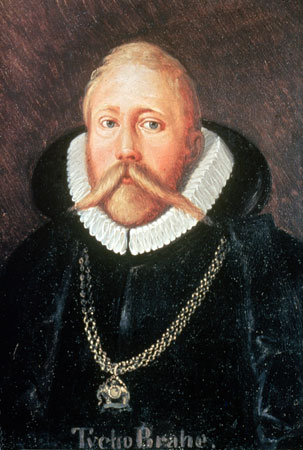
For almost 2,000 years comets were considered a weather phenomenon of the Earth’s atmosphere. The Danish astronomer Tycho Brahe changed that view in the middle of the 16th century and produced evidence that comets belong among the celestial phenomena.
His work was outstanding because he carried out his astronomical observations very carefully and precisely without telescopes. Tycho Brahe laid the groundwork for a new picture of the universe and decisively influenced the scientific development of the generations that followed.
With his approach of measuring and checking ever more precisely, he established the method and the working style of modern research.
Tycho Brahe and the magic of the darkened Sun
The most important astronomer of his age was born on 14 December 1546 and grew up among the nobility. Tycho Brahe was enthusiastic about astronomy from an early age.
In his youth he witnessed something special: a total solar eclipse took place on 21 August 1560. That was the beginning of his remarkable path through life. The 14-year-old Tycho was impressed by the rare event, and even more by the fact that astronomers had predicted it.
He read many books on astronomy with great enthusiasm, among them the Almagest by Ptolemy. At that time this book was the accepted handbook and contained all the answers astronomy had to offer. Brahe built his first celestial globe, which showed the positions of the stars.
Tycho Brahe: hot-headed researcher and his findings
In 1562 he moved to Leipzig and studied at the university there. During that time he observed how Jupiter and Saturn line up one behind the other as seen from Earth. That configuration made it look as if the two bodies were merging into a single bright planet.
Tycho Brahe discovered that the tables available until then, which gave the positions of the planets and stars, were inaccurate. The records of Nicolaus Copernicus also missed the events by several days. Tycho decided to devote his life to observing the sky. His goal was to obtain accurate data.
The pursuit of astronomical progress
Many years later he was in the service of King Frederick II of Denmark. Tycho founded a gigantic programme: with numerous assistants he developed instruments and watched the night sky for more than two decades. His findings and measurements of the planetary system, along with the precise positions of hundreds of stars, surpassed every other set of values in accuracy until the first telescopes came into use in the 17th century.
His travels and the golden nose
Tycho Brahe travelled a great deal and enjoyed it. He studied in Leipzig, Rostock, Wittenberg, Augsburg and Basel. In every new place he gathered information and bought astronomical and mathematical instruments.
On his travels Tycho earned a reputation as someone who left his bills unpaid and as a choleric hothead. In a duel he lost a large part of his nose. The researcher found a quick solution: from then on he wore a replacement made of bronze, which he fixed to his face with wax. In 1571 he built a small observatory in Denmark.
The exploding star
Back home Tycho Brahe had another decisive experience: on 11 November 1572 he saw a new star in the constellation of Cassiopeia. The star shone more brightly than Venus and it appeared in a position where no star had ever been seen before. Today we know that the astronomer had seen a supernova, the explosion of a star. The star shone far more brightly than before for several weeks. A new star had appeared in a sky that until then was thought to be unchanging.
Parallax and a new perspective
The astronomical world view of the day was finally shaken when Tycho Brahe kept observing the comet and entered into a lively exchange with other researchers.
Over a longer period of observation the comet gradually moved through different constellations. For a few days, however, it seemed to be firmly anchored in one constellation. If one follows the Aristotelian world view, in which comets are weather phenomena close to the Earth, then a comet seen from different vantage points on Earth would appear in front of different constellations.
But if the body is seen in front of the same constellation from different viewing angles, it must be much farther from the Earth than the Moon or the clouds. This phenomenon is called parallax (from the Greek word for “alteration”). A parallax is easiest to follow if you hold an object in front of your face.
Now you can look at the object with your right eye and then with your left. If it is very close to your face, you see it against a changing background. As the object moves away from your face, the background barely changes at all.
Tycho Brahe applied this principle to the comet and analysed his data together with the findings of scientists at other observatories.
Tycho Brahe: respected astronomer and his famous observatory
In 1573 Tycho Brahe published his scientific discoveries in a report entitled “De nova stella”. With his finding that comets belong to the sphere of the planets and the heavens, his reputation changed from that of a Danish amateur to that of a respected professional among astronomers.
Tycho Brahe was not only a scientist but also a craftsman and an artist. On Hven he built an observatory and called it Uraniborg (= castle of the heavens). He had the observatory fitted out by Dutch and Italian craftsmen and artists.
His records were produced in a printing shop of his own, and in Augsburg specialists built extraordinary astronomical instruments. A great many assistants worked for Tycho, and visitors from all over Europe made the Uraniborg observatory the centre of astronomical research.
His final years in Prague
When Frederick II died in 1588, Tycho Brahe’s influence waned rapidly. He received less pay because his demands kept growing while, by contrast, he let his duties as a vassal slide. In 1599 Tycho moved to Prague.
There Emperor Rudolf II granted him a pension and an estate on which a new planetarium was to be built. Before it was finished, Tycho Brahe died in 1601. He left his scientific research and his astronomical instruments to his assistant Johannes Kepler. With his three laws of planetary motion, Kepler created the foundation for Isaac Newton’s theory of gravitation.
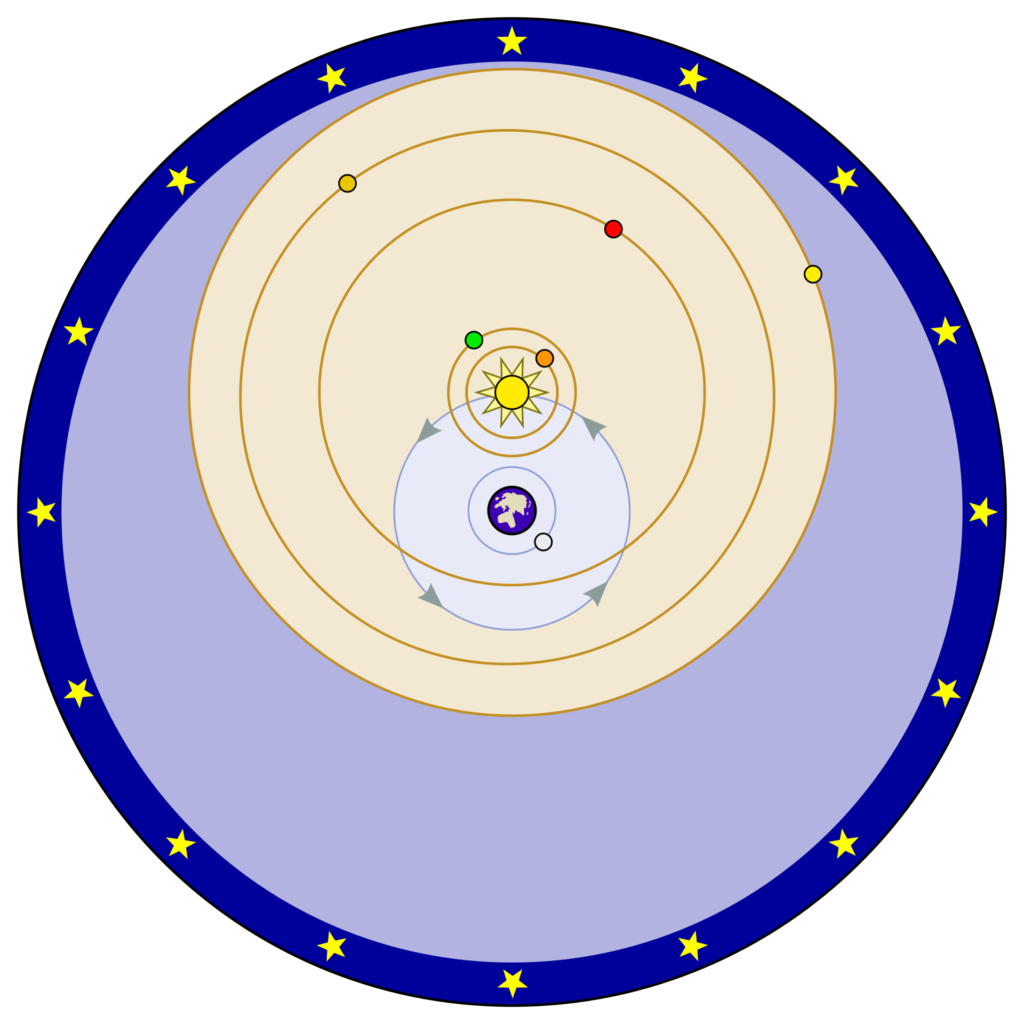
Brahe’s discoveries about the planetary system
Tycho Brahe shook the traditional view that the picture of the heavens was unchanging. He did not, however, make the decisive step from the Earth-centred world view of Ptolemy, which placed the Earth at the centre of the planetary system, to the Sun-centred world view of Nicolaus Copernicus.
On the basis of Tycho Brahe’s detailed measurements of the planetary orbits and his observations of the planet Mars, Johannes Kepler went on to develop his work on the paths of the planets.
Sources
- Eduard Ender (1822-1883), Tycho Brahe, marked as public domain, details on Wikimedia Commons
- Fastfission, Tychonian system, marked as public domain, details on Wikimedia Commons