By Alexander Merz · Published on · Details checked on 14 October 2026
The geocentric model is the idea that the Earth rests motionless at the centre of the cosmos while the Sun, the Moon, the planets and the stars circle around it. It arose in ancient Greece, was worked out by Ptolemy around AD 150 and remained the accepted view in Europe until the 17th century.
More on this topic: the planets of our solar system.
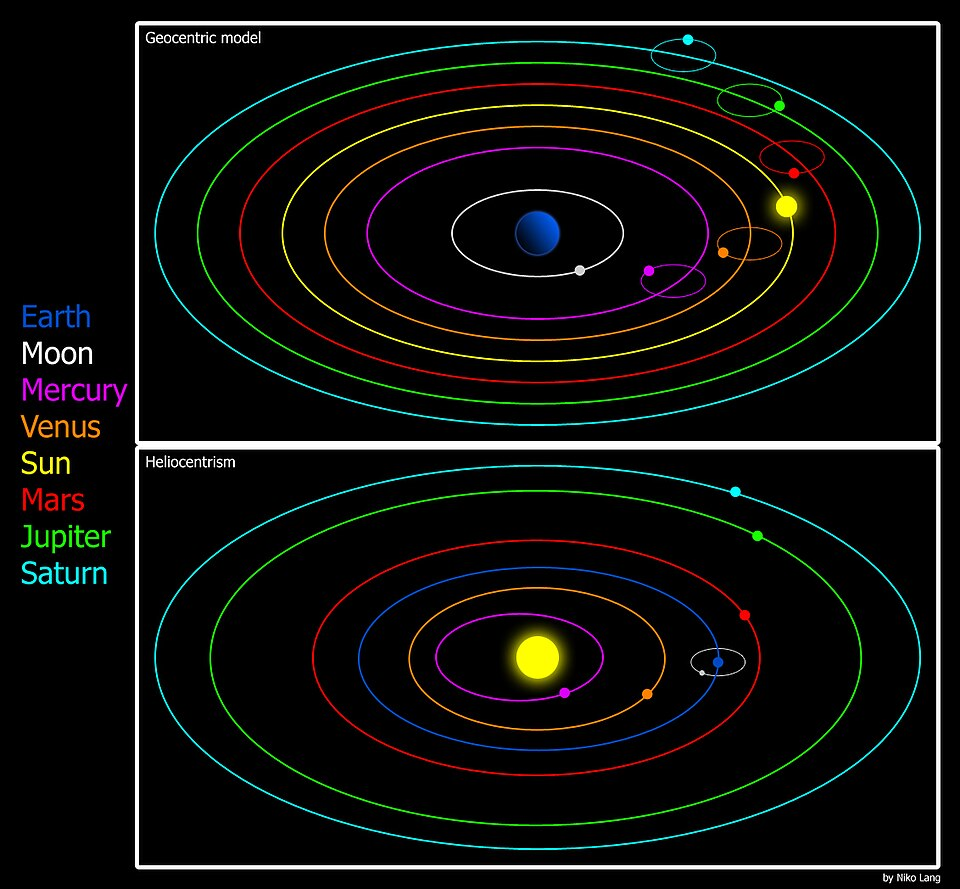
Geocentric and heliocentric compared
Geocentric comes from the Greek gē for Earth, heliocentric from hēlios for Sun. The difference lies not only in what sits at the centre, but also in how many auxiliary constructions each model needs. Both are milestones in the long history of models of the universe.
| Geocentric model | Heliocentric model | |
|---|---|---|
| At the centre | the Earth, motionless | the Sun |
| The Earth | rests, does not rotate | rotates once a day and orbits the Sun once a year |
| Best-known proponents | Aristotle, Ptolemy | Aristarchus, Copernicus, Kepler, Galileo |
| Period | about the 4th century BC to the 17th century | idea from the 3rd century BC, established in the 17th century |
| Retrograde loops of the planets | only explicable with auxiliary circles (epicycles) | follow by themselves, because the Earth overtakes other planets |
| Today | refuted | holds for our solar system |
Why people saw the Earth at the centre
The geocentric model rested on observations that anyone could make for themselves. The Sun, the Moon and the stars cross the sky every day, while the ground under your feet appears to stand still. On top of that came two arguments that sounded convincing at the time.
The Earth appears to stand still
If the Earth were turning, people reasoned, a stone thrown straight up would have to land some distance away. That does not happen – so, they concluded, the Earth stands still. Only the physics of the modern era explained that the stone, the air and the thrower simply share the rotation.
No wobble of the stars to be seen
The strongest argument was an astronomical one: if the Earth orbits the Sun, nearby stars would have to shift slightly back and forth over the course of a year. Nobody saw this so-called parallax. In fact it is so tiny that Friedrich Wilhelm Bessel was not able to measure it until 1838.
Heavy things fall towards the centre
According to the physics of Aristotle, everything heavy strives towards the centre of the world. Because stones fall to the Earth, the Earth had to be that centre. Newton’s law of gravitation did not replace this reasoning until the 17th century.
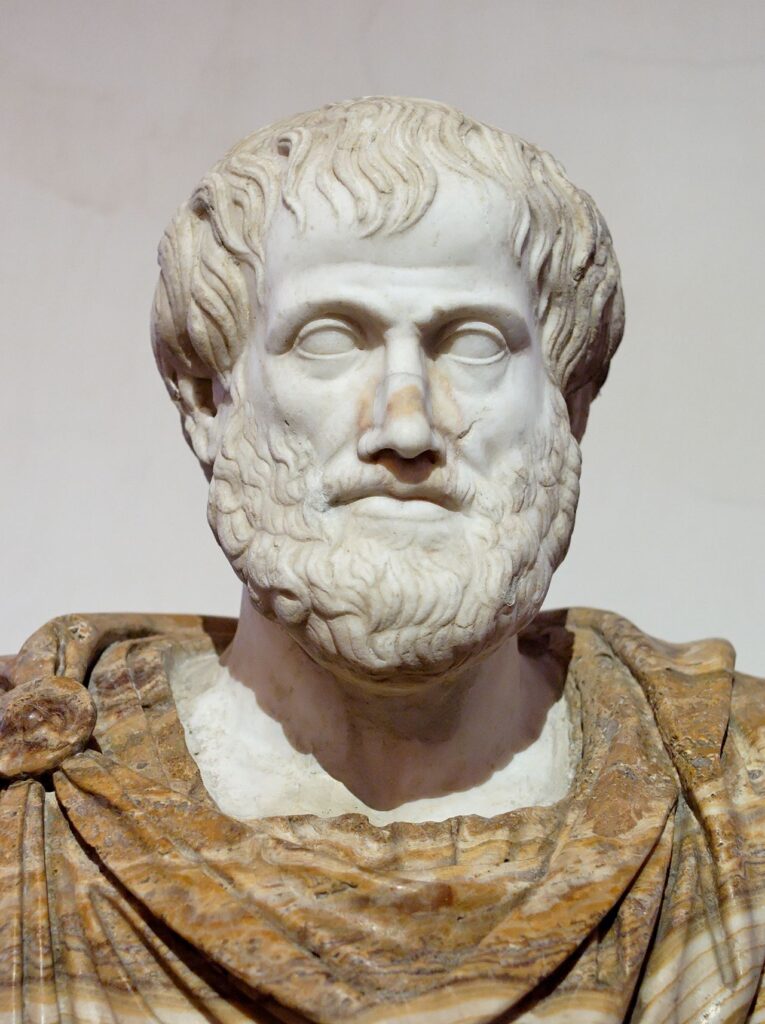
The geocentric model according to Aristotle
Plato laid the groundwork around 380 BC with his demand that the motions of the heavens be reduced to uniform circular movements. His pupil Eudoxus of Cnidus turned that into the first mathematical model: every celestial body sits on nested spherical shells around the Earth, 27 of them in all.
Aristotle turned those calculating aids into real, transparent spheres and expanded the system to 55 shells. For him, everything below the Moon was perishable, everything above it eternal and perfect. That division shaped thinking in Europe for almost 2,000 years.
The Ptolemaic model
Claudius Ptolemy wrote the Almagest in Alexandria around AD 150, the standard work of astronomy well into the early modern period. In it he describes the geocentric model so precisely that planetary positions could be calculated years in advance.
To do so he needed auxiliary constructions: every planet runs on a small circle, the epicycle, whose centre travels on a large circle around the Earth. Added to that were slightly offset circle centres and an equant point that reproduced the uneven speed of the planets.
How the geocentric model was put together
From the inside outwards the model looked like this: the resting Earth at the centre, around it the spheres of the seven “wandering stars”, and the fixed stars right at the outside. The Sun and the Moon counted as planets back then as well – the Greek word means “wanderer”.
- Earth – motionless at the centre
- Moon, then Mercury and Venus
- Sun in fourth place
- Mars, Jupiter, Saturn
- Sphere of the fixed stars – turns around the Earth once a day
The fixed stars keep their distances from one another and cross the sky together. That is why people pictured them fastened to a single outer shell.
Problems with the geocentric model
Ancient astronomers were good observers and knew the weak points. Every new discrepancy was patched with yet another auxiliary circle – the model became more accurate, but ever more complicated.
Retrograde loops
Roughly every 26 months Mars slows down for about two months, runs backwards and then forwards again. In the geocentric model that only worked with epicycles. In the heliocentric picture it is simple: the Earth overtakes the slower Mars on the inside track.
Changing brightness
In some years Mars is brighter than almost every star, in others it is inconspicuous. That shows how strongly its distance from the Earth varies – hard to reconcile with circles centred on the Earth.
Mercury and Venus stay near the Sun
Mercury and Venus are only ever seen at dawn or dusk, never around midnight. Ptolemy therefore had to tie their epicycles artificially to the direction of the Sun. In the heliocentric model this follows by itself, because both planets orbit inside the Earth’s path.
The phases of Venus
A way out was offered for a short while by the Tychonic system of Tycho Brahe: the planets orbit the Sun, but the Sun orbits the resting Earth. The Earth at the centre was finally finished once Kepler’s elliptical orbits and Newton’s gravitation explained planetary motion without any auxiliary circles.
Where the puzzling planetary loops really come from is shown by our calculation for retrograde Mercury, with a graphic drawn to scale.
Frequently asked questions about the geocentric model
What is the geocentric model, simply explained?
The idea that the Earth stands still and everything else – the Sun, the Moon, the planets and the stars – circles around it. For almost 2,000 years it was the accepted model.
Who developed the geocentric model?
The idea comes from ancient Greece. Eudoxus of Cnidus built the first mathematical model, Aristotle supplied the physics for it, and Claudius Ptolemy turned it into a calculating tool in the Almagest around AD 150.
What is the difference between geocentric and heliocentric?
Geocentric means the Earth is at the centre. Heliocentric means the Sun is at the centre, and the Earth is one of several planets orbiting it.
When was the geocentric model replaced?
Copernicus published his heliocentric model in 1543. It only became established in the 17th century, with Galileo’s observations, Kepler’s laws and Newton’s theory of gravitation.
What problems did the geocentric model have?
It could only explain the retrograde loops of the planets, the varying brightness of Mars and the closeness of Mercury and Venus to the Sun with ever more auxiliary circles. The phases of Venus could not be explained at all any more.
Sources
- Niko Lang, Geoz wb en, CC BY-SA 2.5
- After Lysippos creator QS:P170,Q4233718,P1877,Q192222, Aristotle Altemps Inv8575, marked as public domain, details on Wikimedia Commons