By Alexander Merz · Published on · Details checked on 3 October 2026
Mercury retrograde is an apparent motion of the planet Mercury: for about three weeks it drifts from east to west against the stars instead of from west to east as usual. This happens three to four times a year, every time Mercury overtakes Earth on the inside lane.
⭐ In short: The next phase runs from 24 October to 13 November 2026, and in 2027 the next one follows in February. Mercury does not actually move backwards, nor does it slow down – it is a perspective effect, and there is no evidence of any effect on people. You will see little of it: in these weeks Mercury is close to the Sun, and from the UK and Ireland it only appears low in the south-east in the morning sky from 11 November 2026.
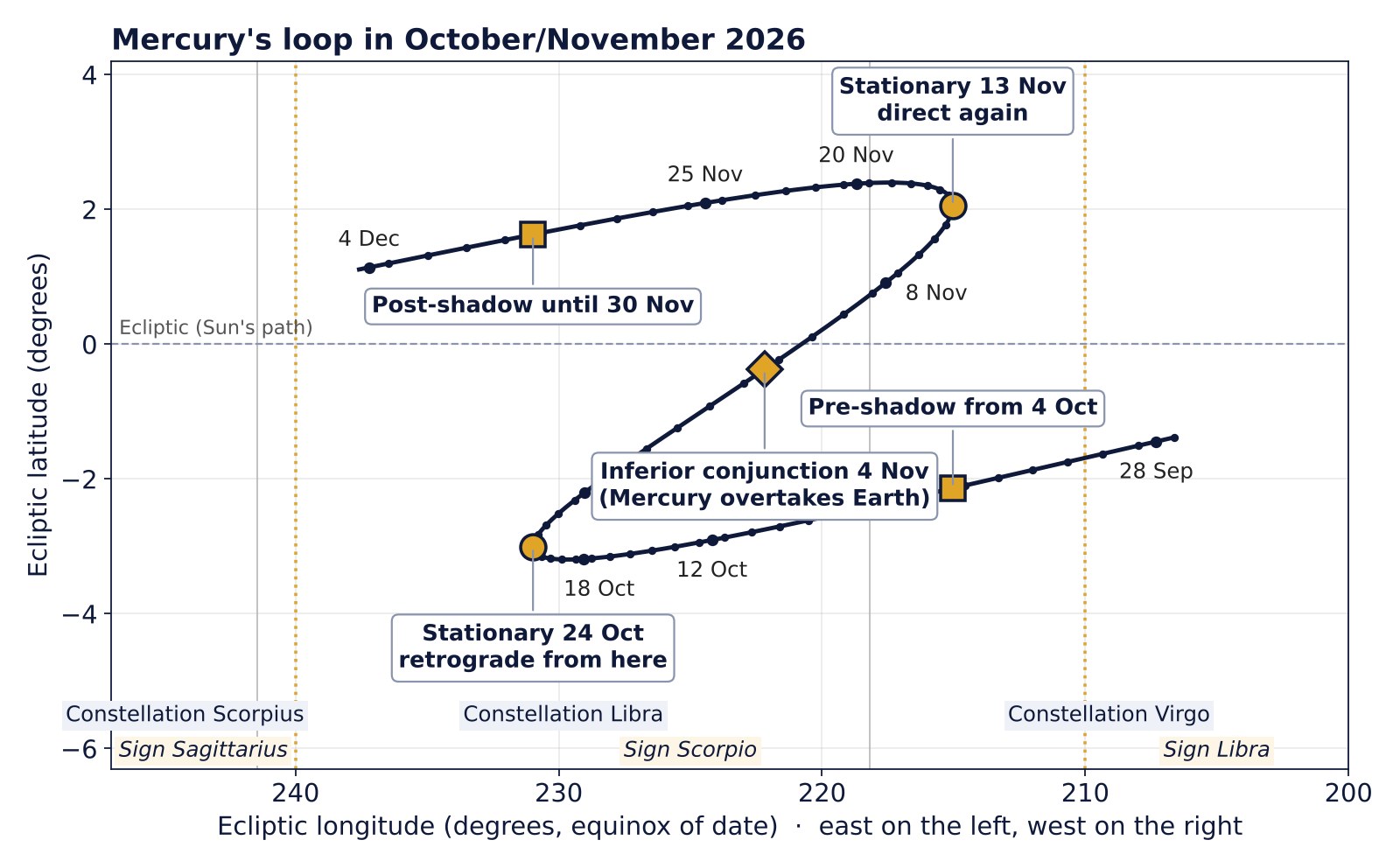
Mercury retrograde 2026: all three phases with times
We calculated the stationary points ourselves with NASA’s DE421 ephemeris. A stationary point is the moment when Mercury’s longitude along the ecliptic – the Sun’s apparent path across the sky – neither increases nor decreases. In 2026 there are three phases, and the first two are already behind us.
| Phase | Retrograde from | Direct again | Duration | Inferior conjunction | Sign |
|---|---|---|---|---|---|
| February/March | 26 Feb 2026, 06:48 | 20 Mar 2026, 19:33 | 22.5 days | 7 Mar 2026 | Pisces |
| June/July | 29 Jun 2026, 18:36 | 23 Jul 2026, 23:58 | 24.2 days | 13 Jul 2026 | Cancer |
| October/November | 24 Oct 2026, 08:13 | 13 Nov 2026, 15:54 | 20.4 days | 4 Nov 2026 | Scorpio |
The minute is mathematically exact, but you cannot notice it in the sky. Around a stationary point Mercury barely moves: a day before or after, it covers only a little more than 0.1 degrees, a quarter of the full Moon’s diameter. If other calendars differ by a few hours or even give 24 instead of 23 July, that is usually down to the time zone or rounding.
The “sign” in the table is the zodiac sign Mercury is in, i.e. a 30-degree section of the ecliptic. It almost never matches the constellation in the sky – we show why further down in a separate table.
Mercury retrograde 2027 dates and a look ahead to 2028
In 2027 and 2028, too, Mercury goes retrograde three times each year. The phases move forward by a good two and a half weeks every year, because Mercury overtakes Earth every 116 days and three such cycles do not quite fill a year.
| Phase | Retrograde from | Direct again | Duration | Inferior conjunction | Sign |
|---|---|---|---|---|---|
| February/March 2027 | 9 Feb 2027, 17:36 | 3 Mar 2027, 12:32 | 21.8 days | 18 Feb 2027 | Pisces → Aquarius |
| June/July 2027 | 10 Jun 2027, 19:15 | 4 Jul 2027, 20:39 | 24.1 days | 23 Jun 2027 | Cancer → Gemini |
| October 2027 | 7 Oct 2027, 15:37 | 28 Oct 2027, 15:11 | 21.0 days | 19 Oct 2027 | Scorpio → Libra |
| January/February 2028 | 24 Jan 2028, 11:02 | 14 Feb 2028, 12:38 | 21.1 days | 2 Feb 2028 | Aquarius |
| May/June 2028 | 21 May 2028, 09:43 | 14 Jun 2028, 07:06 | 23.9 days | 2 Jun 2028 | Gemini |
| September/October 2028 | 19 Sep 2028, 17:34 | 11 Oct 2028, 11:28 | 21.7 days | 2 Oct 2028 | Libra |
In three phases of 2027 Mercury changes sign while retrograde, so it moves back across a 30-degree boundary. Astronomically this is nothing special, because the boundaries of the zodiac signs are not marked in the sky.
Pre-shadow and post-shadow: checked astronomically
The shadow phases come from astrology, but they can be defined precisely. The pre-shadow begins when Mercury first reaches the longitude at which it will later turn direct again. The post-shadow ends when it passes the longitude of the first stationary point once more.
During these weeks Mercury crosses the same stretch of sky three times: forwards, backwards and forwards again. In the graphic above, these are the two squares at the beginning and end of the loop.
| Phase | Pre-shadow from | Retrograde | Post-shadow until | Length of the loop |
|---|---|---|---|---|
| February/March 2026 | 11 Feb 2026 | 26 Feb – 20 Mar 2026 | 9 Apr 2026 | 14.1° |
| June/July 2026 | 13 Jun 2026 | 29 Jun – 23 Jul 2026 | 7 Aug 2026 | 9.9° |
| October/November 2026 | 4 Oct 2026 | 24 Oct – 13 Nov 2026 | 30 Nov 2026 | 15.9° |
| February/March 2027 | 25 Jan 2027 | 9 Feb – 3 Mar 2027 | 23 Mar 2027 | 15.1° |
| June/July 2027 | 26 May 2027 | 10 Jun – 4 Jul 2027 | 19 Jul 2027 | 8.9° |
| October 2027 | 17 Sep 2027 | 7 Oct – 28 Oct 2027 | 13 Nov 2027 | 15.6° |
For autumn 2026 you will also read 8 October as the start of the pre-shadow. Recalculated, however, Mercury already reaches the longitude of the second stationary point (215.0°) on 4 October; by 8 October it is almost 5 degrees further on.
Why Mercury goes retrograde: the overtaking manoeuvre
Mercury orbits the Sun in 88 days at an average of 47.4 kilometres per second, while Earth needs a year and manages 29.8 km/s. Every 116 days Mercury catches up with Earth and passes it on the inside. This moment is called inferior conjunction: Mercury then stands exactly between Earth and the Sun.
Imagine two runners in a stadium, a fast one on the inside lane and you on an outer lane. As long as he is on the opposite side, you see him making progress in your running direction against the grandstand. While he overtakes you on the inside, he seems to fall back against the grandstand – even though he is running forwards the whole time.
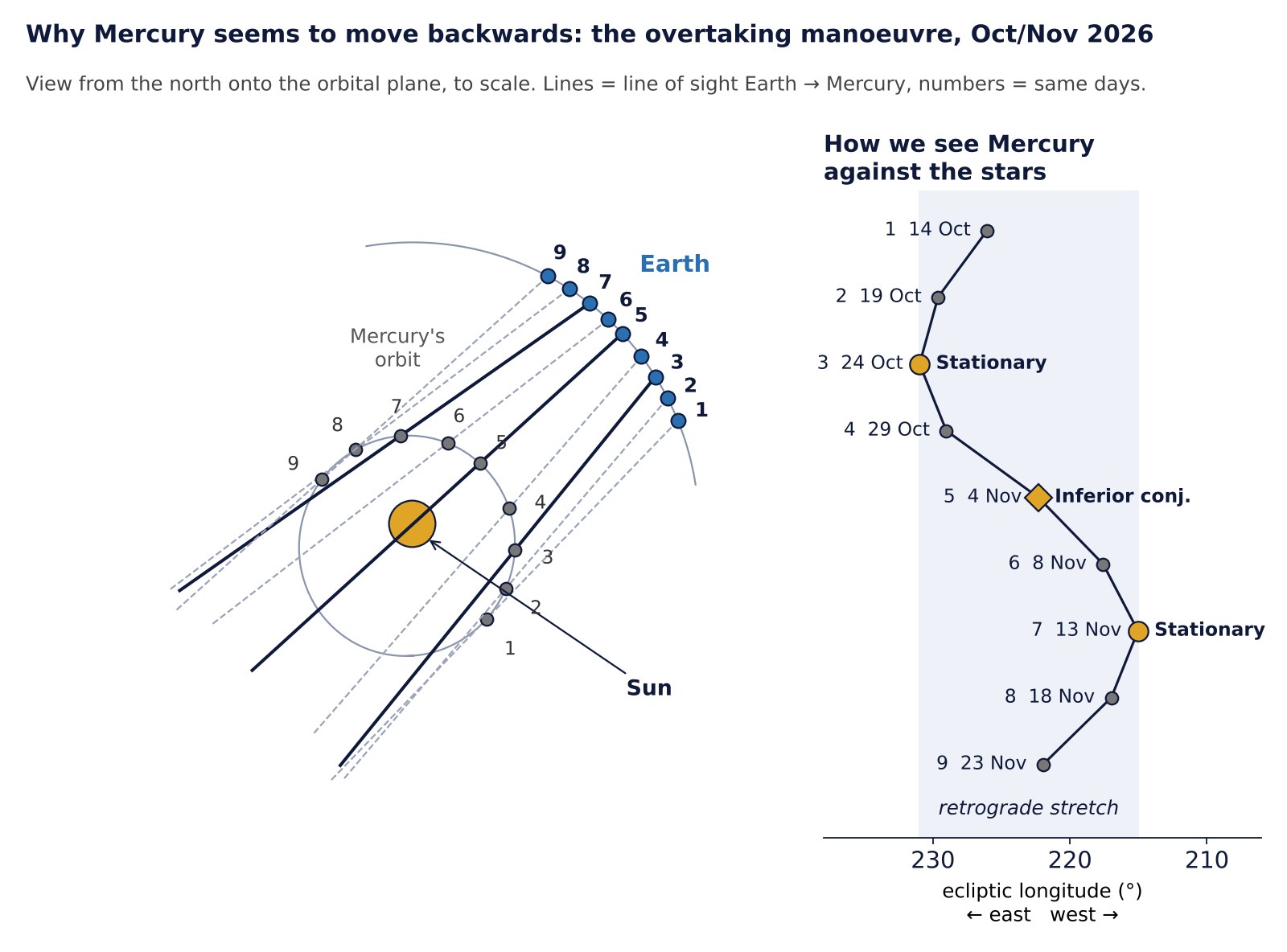
Positions 1 to 9 are each about five days apart. From 3 to 7 the Earth–Mercury line of sight swings back, which is why Mercury drifts west in the sky during this time. Before and after, it is “direct” again, as astronomers call the normal eastward motion.
Inferior conjunction: the moment of overtaking
Inferior conjunction always falls roughly in the middle of the retrograde phase. Mercury is then closest to Earth, in 2026 and 2027 between 83 and 101 million kilometres away. On 4 November 2026 it passes only 0.4 degrees from the Sun – a near miss, because the next transit of Mercury across the solar disc will not happen until 13 November 2032.
Not slower: the most common misconception
Mercury does not brake and does not turn around; it always orbits the Sun in the same direction. Only the direction in which we see it against the stars is retrograde. On its way back it even covers up to 1.3 degrees per day in the sky.
Its elliptical orbit explains why the summer phases last longer. In June and July Mercury overtakes Earth near the point of its orbit farthest from the Sun, where it travels at only 38.9 km/s, and in autumn near the closest point at up to 59.0 km/s. That is why overtaking takes around 24 days in summer but only 20 to 21 in autumn.
Loops and epicycles: how retrograde motion changed our view of the cosmos
In the geocentric model, with Earth at the centre, the planetary loops were a puzzle. Ptolemy explained them with epicycles, small circles on which the planets were supposed to travel in addition.
Only the heliocentric model of Copernicus turned the loops into what they really are: an overtaking effect between planets that all orbit the Sun. Johannes Kepler supplied the matching mathematics with his elliptical orbits.
Retrograde in Scorpio or Libra: sign versus constellation
Astrological calendars name the zodiac sign in which Mercury goes retrograde. Zodiac signs are twelve equal 30-degree sections of the ecliptic, counted from the vernal equinox point, whereas constellations are irregular areas of sky with the boundaries set by the International Astronomical Union (IAU) in 1930. We determined both for every phase.
| Phase | Zodiac sign | Constellation in the sky (IAU) |
|---|---|---|
| February/March 2026 | Pisces | Pisces → Aquarius |
| June/July 2026 | Cancer | Gemini |
| October/November 2026 | Scorpio | Libra → Virgo |
| February/March 2027 | Pisces → Aquarius | Aquarius → Capricornus |
| June/July 2027 | Cancer → Gemini | Gemini → Orion → Taurus |
| October 2027 | Scorpio → Libra | Virgo |
| January/February 2028 | Aquarius | Aquarius → Capricornus |
| May/June 2028 | Gemini | Taurus |
| September/October 2028 | Libra | Virgo |
The constellation usually lags a whole sign “behind”. The reason is precession: Earth’s axis wobbles like a spinning top, so the vernal equinox point shifts by about 1 degree every 72 years and has moved by almost 30 degrees since antiquity. So in autumn 2026 Mercury is “retrograde in Scorpio” but actually stands in Libra and Virgo.
In June 2027 Mercury even slips briefly into Orion, because it runs 4 degrees south of the ecliptic and Orion reaches right up to the planets’ path there. The complete comparison of all signs can be found in our article zodiac signs vs constellations.
Seeing Mercury retrograde: mostly impossible, sometimes briefly
Mercury is retrograde when it stands between Earth and the Sun – exactly when it is drowned out by the Sun’s glare. At the beginning and end of a phase it is 15 to 22 degrees from the Sun, in the middle only a few degrees. For every day we calculated how high it stands above the horizon at the end or beginning of civil twilight (London, 51.5° N).
| Phase | Visible (at least 5° high) | When and where | Max. altitude |
|---|---|---|---|
| February/March 2026 | 26 – 28 Feb | evening, west | 8° |
| June/July 2026 | no | – | below 1° |
| October/November 2026 | 11 – 13 Nov | morning, south-east | 8° |
| February/March 2027 | 9 – 12 Feb | evening, west | 8° |
| June/July 2027 | no | – | below 2° |
| October 2027 | 26 – 28 Oct | morning, south-east | 8° |
The honest conclusion: you will see nothing of the actual backward motion. Only on the first or last two or three days of some phases does Mercury stand low in the twilight, and even then you need a clear horizon.
The good news lies in the post-shadow. The best Mercury apparition of 2026 begins exactly at the end of the autumn phase: until early December it stands up to 10 degrees high in the south-east at around 6:45 am. All dates and tips for finding it are on our page about the planet Mercury.
Warning: Mercury is never far from the Sun. Only point binoculars or a telescope at it while the Sun has not yet risen or has already set. A look at the Sun through optics damages your eyes permanently in a fraction of a second – observing the Sun always requires a certified front-mounted solar filter (here is how to do it safely).
How often Mercury goes retrograde: three to four times a year
From one inferior conjunction to the next takes 115.88 days on average, the synodic period. That fits a good three overtaking manoeuvres into one year, and overall Mercury is retrograde about 19 per cent of the time – roughly 70 days a year.
| Year | Phases | Start of the phases |
|---|---|---|
| 2026 | 3 | 26 Feb, 29 Jun, 24 Oct |
| 2027 | 3 | 9 Feb, 10 Jun, 7 Oct |
| 2028 | 3 | 24 Jan, 21 May, 19 Sep |
| 2029 | 4 | 7 Jan, 2 May, 2 Sep, 22 Dec |
A fourth phase only fits in when the first one begins very early in January. Between 1950 and 2052 this was the case in 16 out of 103 years, most recently in 2016 and 2022, and next in 2029.
Does Mercury retrograde have an effect? An honest look
For many people Mercury retrograde is a fixed date in the calendar; in astrology it symbolically stands for reflection, misunderstandings and delays. That is an interpretation, not a measurement – and here we can only describe what can be measured in the sky.
| What? | Does it change when Mercury is retrograde … |
|---|---|
| Orbit and direction of travel | no, Mercury keeps orbiting the Sun forwards |
| Speed | no, only the usual variation due to its elliptical orbit |
| Distance from Earth | yes, it is at its smallest (83 to 101 million km) |
| Gravitational pull on us | vanishingly small, around 10,000 times weaker than the Moon’s |
| Direction against the stars | yes, that is the actual retrograde motion |
Physically, then, nothing changes that could reach Earth. There is no reliable evidence of any effect on technology, contracts or relationships. If things still go wrong in these weeks, it is because something always goes wrong – it is just more noticeable when you are looking out for it.
Tip: If the phase prompts you to read important emails twice or make a backup, that is a good habit. Even nicer is seeing Mercury for yourself – in the morning sky from mid-November 2026, right in the “post-shadow”.
Retrograde planets in 2026 and 2027: Venus, Mars, Jupiter, Saturn
All planets move backwards from time to time, just for different reasons. Like Mercury, Venus turns retrograde when it overtakes Earth on the inside; with Mars, Jupiter and Saturn, Earth overtakes them. This happens around opposition, when the planet stands opposite the Sun and is visible all night.
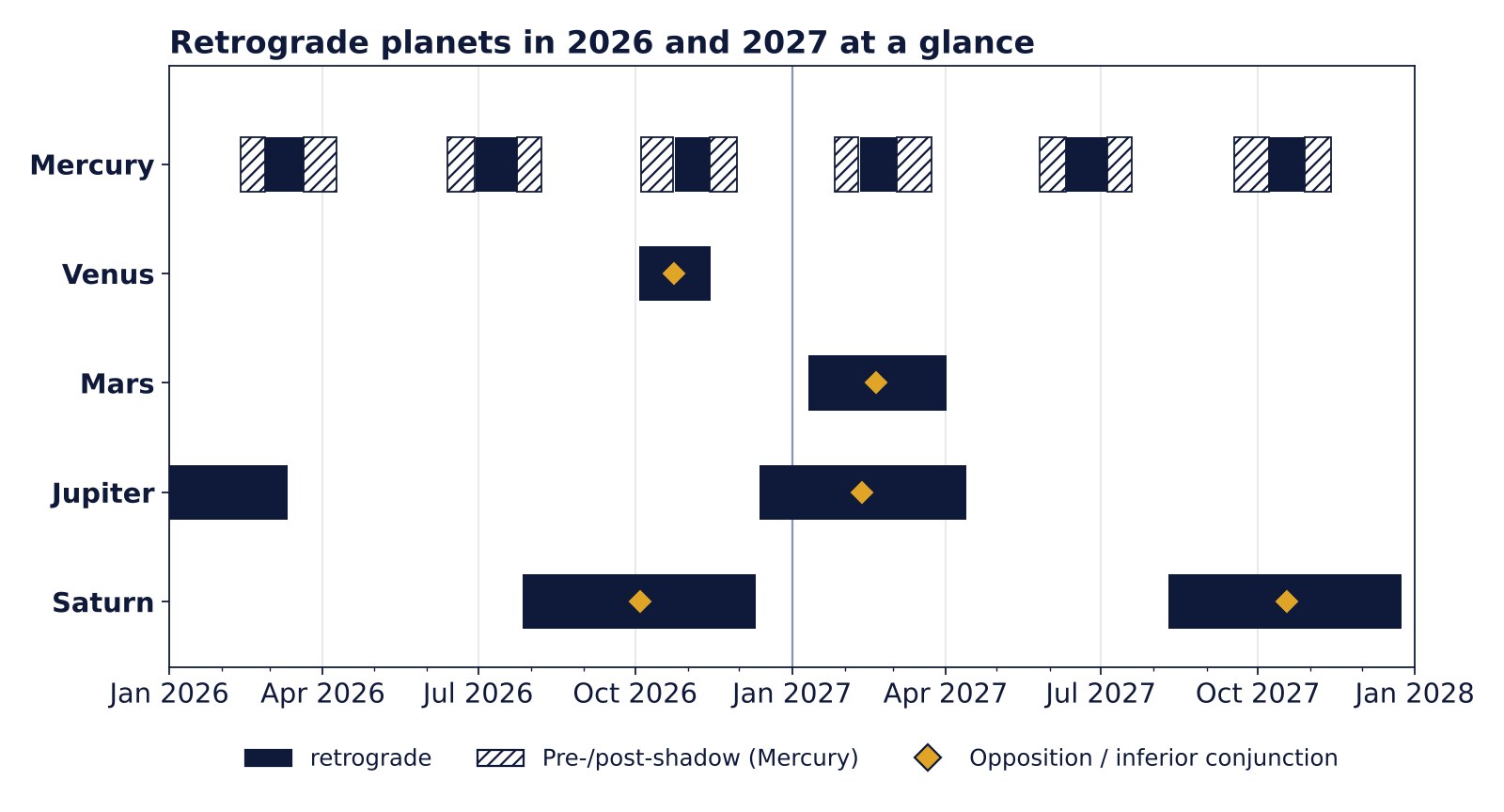
| Planet | Retrograde from | Direct again | Duration | Middle of the phase | Constellation |
|---|---|---|---|---|---|
| Venus | 3 Oct 2026 | 14 Nov 2026 | 42 days | inferior conjunction 24 Oct 2026 | Virgo |
| Mars | 10 Jan 2027 | 1 Apr 2027 | 81 days | opposition 19 Feb 2027 | Leo |
| Jupiter | 11 Nov 2025 | 11 Mar 2026 | 119 days | opposition 10 Jan 2026 | Gemini |
| Jupiter | 13 Dec 2026 | 13 Apr 2027 | 121 days | opposition 11 Feb 2027 | Leo → Cancer |
| Saturn | 26 Jul 2026 | 10 Dec 2026 | 137 days | opposition 4 Oct 2026 | Pisces → Cetus |
| Saturn | 9 Aug 2027 | 24 Dec 2027 | 136 days | opposition 18 Oct 2027 | Pisces |
Autumn 2026 has a special feature: from 24 October to 13 November Mercury and Venus are retrograde at the same time, both in the Virgo–Libra area. Venus comes within 40.8 million kilometres of Earth on 24 October, and Mercury makes its closest approach eleven days later.
The farther out a planet orbits, the longer but smaller its loop. Jupiter and Saturn are retrograde for four to four and a half months every year, but cover only about 10 and 7 degrees respectively. Which planets you can find in the evening right now is shown on our page Which planets are visible tonight?
The 2027 Mars loop: follow it with the naked eye
Unlike Mercury’s, you can observe Mars’s retrograde motion wonderfully for yourself. From January to April 2027 it traces a loop almost 20 degrees long in Leo, about 4 degrees north of the bright star Regulus. At opposition on 19 February 2027 it shines all night at magnitude −1.3.
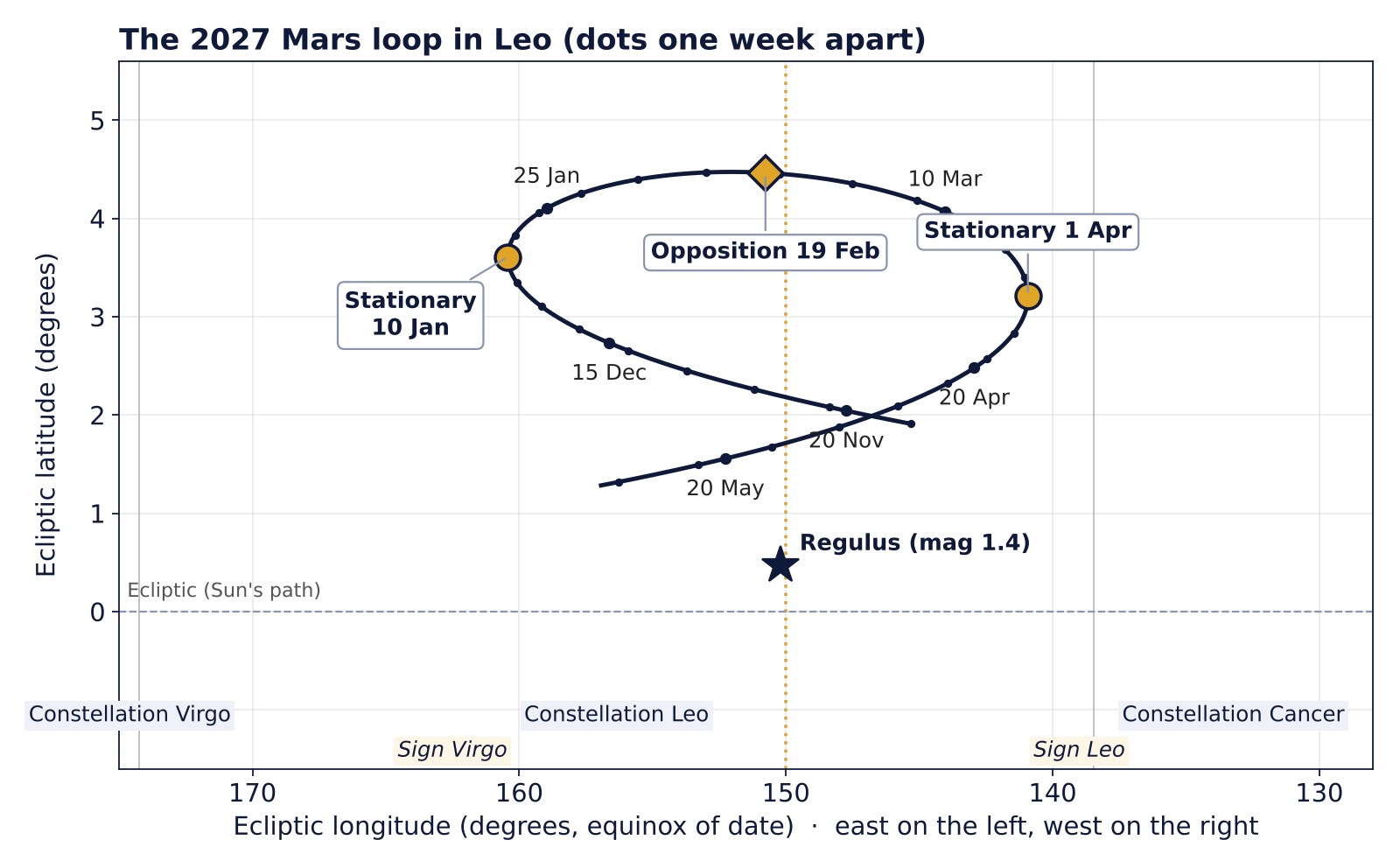
The easiest way is to note once a week where Mars stands relative to Regulus, or to photograph the spot with your smartphone. After a few weeks you will see the loop with your own eyes – exactly the puzzle that astronomers wrestled with for two thousand years.
In a telescope Mars stays small in 2027 because it reaches opposition far from the Sun: its disc measures at most 13.8 arcseconds. Even so, a solid beginner’s instrument from about 130 mm aperture – the diameter of the main mirror – shows the polar cap and dark regions. How to get the most out of it is explained in our guide observing Mars with a telescope.
Beginner tip for the 2027 Mars opposition: Skywatcher Dobson Telescope N 130/650 Heritage FlexTube
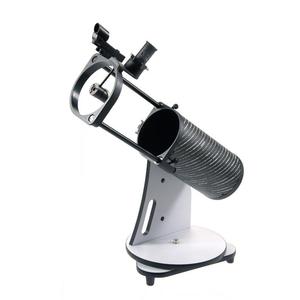
A compact tabletop Dobson with a true parabolic mirror. Folds down, fits in a bag: the Moon, planets and the bright deep-sky classics.
Price: € 265
If you want more: the 200 mm Dobsonian
With its 200 mm mirror, the Skyliner 200/1200 gathers about 2.4 times as much light as the 130 and resolves finer detail. On Mars, Jupiter and Saturn it shows noticeably more structure on steady nights, plus many galaxies and nebulae. The extra cost is worth it if you have a fixed observing spot and do not have to carry the instrument far – it weighs around 20 kg and needs space.
For advanced observers: Skywatcher Dobson Telescope N 200/1200 Skyliner Classic
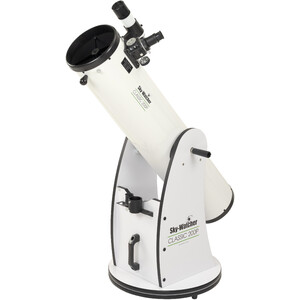
200 mm of aperture — the most sky for your money. Set it on the ground, point by hand: nebulae, clusters and galaxies for years to come.
Price: € 479
Frequently asked questions about Mercury retrograde
When is Mercury retrograde in 2026?
In 2026 Mercury is retrograde three times: from 26 February to 20 March, from 29 June to 23 July (UK time) and from 24 October to 13 November 2026. The autumn phase begins at 08:13 BST and ends at 15:54 GMT.
When is Mercury retrograde in 2027?
2027 also has three phases: 9 February to 3 March, 10 June to 4 July and 7 to 28 October 2027. In 2028 they are followed by 24 January to 14 February, 21 May to 14 June and 19 September to 11 October.
What does Mercury retrograde mean?
Astronomically it means that Mercury moves against the background stars from east to west for about three weeks instead of from west to east as usual. The cause is that Mercury overtakes Earth on the inside lane. In astrology the phase is interpreted symbolically; no measurable effect is known.
Does Mercury really move backwards?
No. Mercury always orbits the Sun in the same direction and does not slow down either. The backward motion is a perspective effect, because we see it from Earth, which is also moving.
How long is Mercury retrograde?
A phase lasts 20 to 24 days, so about three weeks. In summer it is around 24 days, in autumn only 20 to 21, because Mercury is then near the point of its orbit closest to the Sun and moves particularly fast.
What are the pre-shadow and post-shadow?
These are the roughly two to three weeks before and after the retrograde phase in which Mercury crosses the same stretch of sky that it covers again backwards. In autumn 2026 the pre-shadow runs from 4 to 24 October and the post-shadow from 13 to 30 November.
How often is Mercury retrograde in a year?
Usually three times, in some years four times, most recently in 2022 and again in 2029. On average Mercury is retrograde about 19 per cent of the time, roughly 70 days a year.
Can you see Mercury retrograde?
Hardly. During this time Mercury is close to the Sun; only on two or three days at the beginning or end of some phases can you find it up to 8 degrees high in the twilight. From the UK and Ireland this works in 2026 from 11 to 13 November in the morning in the south-east, and afterwards it gets even better in the post-shadow.
Is Venus also retrograde in 2026?
Yes, from 3 October to 14 November 2026, with inferior conjunction on 24 October. From 24 October to 13 November Mercury and Venus are therefore retrograde at the same time.
Links marked with an asterisk (*) are affiliate links. If you buy through them we earn a small commission – the price stays the same for you.