By Alexander Merz · Updated on
The Nebra sky disc is a bronze disc about 32 cm across with gold inlays, buried around 1600 BC on the Mittelberg hill in Saxony-Anhalt, Germany: the oldest known concrete depiction of the sky, with the Moon, stars and the path of the Sun. It is one of the early steps in the story we tell in models of the universe from the Bronze Age to today.
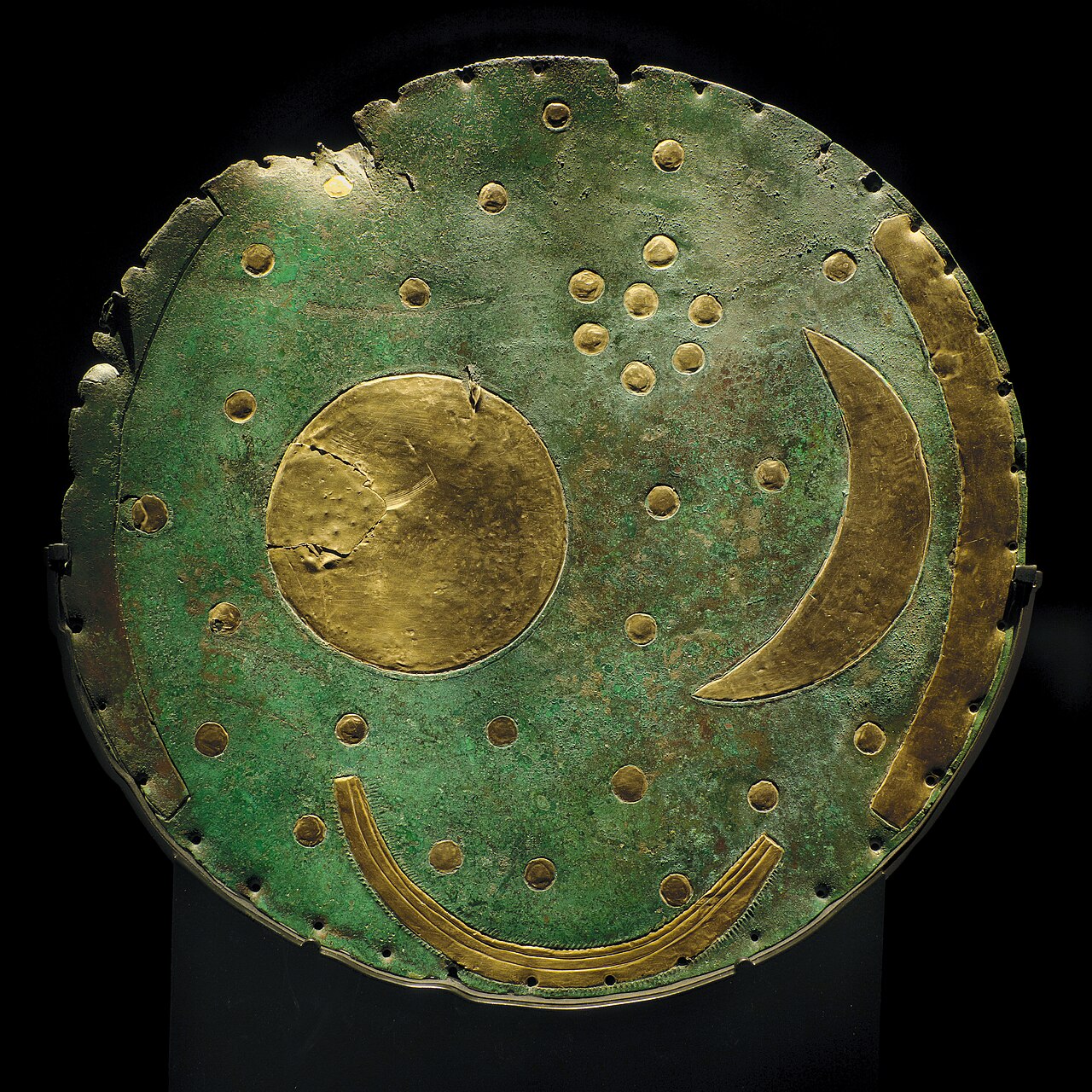
The Nebra sky disc explained: what it shows
The disc shows a night sky made of gold sheet on bronze. Today 30 golden dots can be seen, plus a round gold disc, a crescent, an arc on the right edge and a curved ship at the bottom. Originally there were 32 stars; two later disappeared under the rim arc.
The disc was not originally green. The colour comes from malachite, a corrosion layer that only formed over centuries in the ground. Experiments by the restorer Christian-Heinrich Wunderlich suggest that the bronze once had a dark, black-violet surface – the gold then shone like stars in the night sky.
The State Museum in Halle stresses that the stars are deliberately spread out so that no constellations form. Only one group stands out: seven closely spaced dots between the round celestial body and the crescent. The table sums up how experts read the individual elements and how certain that is.
| Element | What it probably shows | How certain |
|---|---|---|
| 7 closely spaced dots | the Pleiades, the “Seven Sisters” in Taurus | widely accepted, some astronomers have doubts |
| large round gold disc | full moon or Sun | open, both views are held |
| Crescent | waxing Moon | certain as the Moon, the age of the crescent is interpretation |
| 23 remaining dots | starry sky in general | deliberately spread without constellations |
| rim arc on the right (left one missing) | movement of sunrise and sunset points over the year | angle fits well, details disputed |
| feathered arc at the bottom | barque, a “solar ship” | interpretation with parallels in Egypt and Scandinavia |
| 39 holes around the rim | fixing, for example as a standard | unexplained |
Sources: State Museum of Prehistory Halle (The universe of the sky disc, The phases of the sky disc), Wikipedia (Nebra sky disc).
Why seven dots stand for the Pleiades
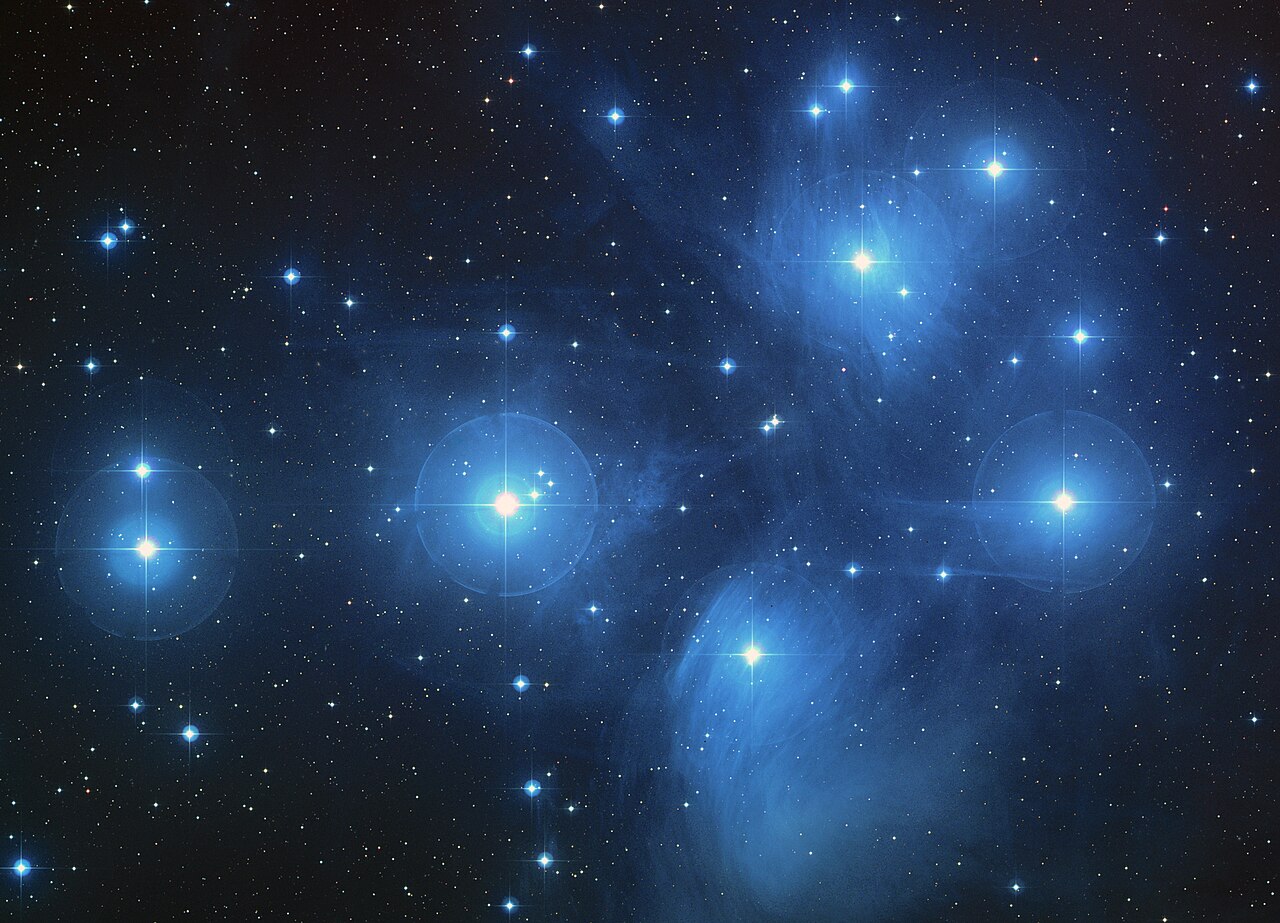
The Pleiades are the most striking star group in the sky: with the naked eye you can make out six to nine stars close together, depending on conditions. Hardly any other star group looks so compact, almost like a small bunch of grapes. That is why the group of seven on the disc is considered the clearest sign of a real section of sky.
Even this is not entirely undisputed, though. Some astronomers consider the identification unprovable, because the other 23 dots follow no real star pattern. The researchers Emília Pásztor and Curt Roslund, for example, saw the disc in 2007 as a symbolic image of the cosmos rather than a star map.
Full moon or Sun?
The large gold disc was first interpreted as the Sun; today it is often read as the full moon. Next to a crescent moon and stars, a second moon in the night sky makes more sense. The State Museum leaves both open and speaks of “full moon or Sun”.
Barque and rim holes: the later additions
The disc was remodelled several times – unusual for an archaeological find. First the rim arcs were added, then the barque at the bottom, and finally the rim was pierced with 39 holes of about 3 mm. The gold sheets of each phase contain a different amount of silver, so they come from different gold.
The barque recalls the solar ships known from Egypt. The fine notches along its edges are read as oars, similar to Bronze Age ship images from Scandinavia. It might show the Sun’s nightly journey back to the east – a religious, not a calendrical addition.
Nebra disc fact file: size, material, origin
| Feature | Value |
|---|---|
| Diameter | approx. 32 cm (12.6 in) |
| Thickness | 4.5 mm in the centre, 1.7 mm at the rim |
| Weight | approx. 2.05 kg (4.5 lb) |
| Material | bronze with only 2.6 % tin, inlays of gold sheet (inlaid, “damascened”) |
| Origin of the copper | Mitterberg near Mühlbach am Hochkönig (Austria) |
| Origin of the tin and gold | Cornwall (England) |
| Manufacture | heated to approx. 700 °C and forged about ten times |
| Find site | Mittelberg (252 m) near Nebra, Burgenlandkreis district, Saxony-Anhalt |
| Buried | around 1600 BC, together with swords, axes, a chisel and arm spirals |
| Culture | Únětice culture, Early Bronze Age |
| Today | State Museum of Prehistory, Halle (Saale) |
| Distinction | UNESCO “Memory of the World” register since June 2013 |
Sources: Wikipedia (Nebra sky disc), State Museum of Prehistory Halle, Mitteldeutsche Zeitung (manufacturing analysis).
The raw materials came from far away – a sign of a wealthy, well-connected patron. Copper from the Eastern Alps, tin and gold from Cornwall: the State Museum describes central Germany at that time as a hub in the European trade in metal, amber and salt. A possible “lord of the sky disc” is thought to be a prince buried around 1800 BC in the Bornhöck burial mound near Halle – a suspicion, not proof.
Leap rule of the sky disc: lunar year meets solar year
A calendar based on the Moon has a problem: twelve lunar months last only about 354 days, but the solar year a good 365. Without correction, the months slip eleven days against the seasons every year. So every few years a 13th month has to be inserted, a leap month.
According to the interpretation of the Hamburg astronomer Rahlf Hansen, the disc shows when this month is due. If a thicker crescent moon about 4.5 days old stands near the Pleiades in spring, a month has to be added – exactly this combination is shown in the first phase of the disc. If only a thin crescent stands there, the year stays normal.
Almost the same rule appears about 1,000 years later in the Babylonian cuneiform compendium MUL.APIN. In 2020 the State Museum concluded from this that people in the heart of Europe were already reckoning with leap months more than 3,600 years ago. How the Moon looks on your observing evening is covered in our guide to the Moon.
Harald Meller and the astronomer Wolfhard Schlosser had previously read the Moon and Pleiades differently: as markers for two dates in the farming year. Around 1600 BC, according to Schlosser, the Pleiades set in the west in the evening twilight around 10 March and in the morning twilight around 17 October. If the Moon stood near them in March, it was a young crescent; in October it was full – hence the crescent and the round moon on the disc.
Horizon arcs and solstices: the 82-degree arc
The two side gold arcs were added later and each span about 82 degrees. Wolfhard Schlosser recognised in them the angle by which sunset moves along the horizon over the course of a year: between the winter and summer solstice the sunset point shifts by roughly this amount at the latitude of Nebra. The same applies to sunrises in the east.
We did the maths: for a flat horizon around 1600 BC the result is a good 81 degrees; today it is about 79 degrees. The difference arises because the Earth’s axis was tilted slightly more at the time (about 23.9 instead of 23.4 degrees). The match with the disc’s 82 degrees is therefore good, but not a precision measurement.
The Brocken theory checked: what remains
According to Meller and Schlosser, the arc, correctly aligned on the Mittelberg, pointed exactly at the Brocken, where the Sun was said to set at the summer solstice. The highest peak of the Harz mountains lies about 85 km away. The State Museum still presents this interpretation on its website, along with a sunset over the Kyffhäuser hills on 1 May.
Checks speak against the Brocken. In 2021 the astronomy journalist Dirk Lorenzen compared the setting with terrain data on Deutschlandfunk radio: seen from the Mittelberg, the Sun sets about 2 degrees to the left of the Brocken, and nearer hills largely hide the mountain. Our own calculation also gives an offset of just under 2 degrees – more than three solar diameters.
Find the Pleiades yourself: the disc’s stars today
The easiest way to find the Pleiades is via Orion’s Belt. Extend the line of the three belt stars up and to the right: after a good 20 degrees you reach reddish Aldebaran in the constellation Taurus. Just under 14 degrees further in roughly the same direction sits a small, strikingly dense cluster of stars – the Seven Sisters.
The bright Pleiades stars spread over a good one degree, about two full-moon widths. The cluster is about 440 light-years away and, at roughly 125 million years, very young for stars. More details are on our page about the Taurus constellation and the Pleiades.
The Pleiades are an autumn and winter object; in spring they stand in the west in the evening. Right there, low over the western horizon in evening twilight, is where the scene of the leap rule plays out. The table shows when to find them where.
| Period | When | Where in the sky |
|---|---|---|
| July–August | in the morning before dawn | east, rising higher every morning |
| September–October | from late evening | low in the east, high in the south at night |
| November–December | all evening | east to southeast, high |
| January–February | from the end of twilight | high in the south to southwest |
| March–April | early evening | west, sinking – the time of the leap rule |
| May–June | – | not visible, too close to the Sun |
Our own calculation (Skyfield, JPL ephemeris DE421) for central Germany (51° N); it applies to all mid-northern latitudes, including the northern US and the UK.
The best instrument for the Pleiades: binoculars
For the Pleiades, binoculars are better than a telescope. The cluster is so large that it fits into the binocular view together with its surroundings. Six to nine stars become dozens.
A 10×50 is the classic: ten times magnification and 50 mm aperture – that is the diameter of the front lenses, which determines how much light comes in. An 8×42 works too, but shows slightly fewer faint stars. Lean against a wall or screw the binoculars onto a tripod, and the view becomes much steadier.
Budget pick: Celestron UpClose G2 10x50 Porro Binoculars
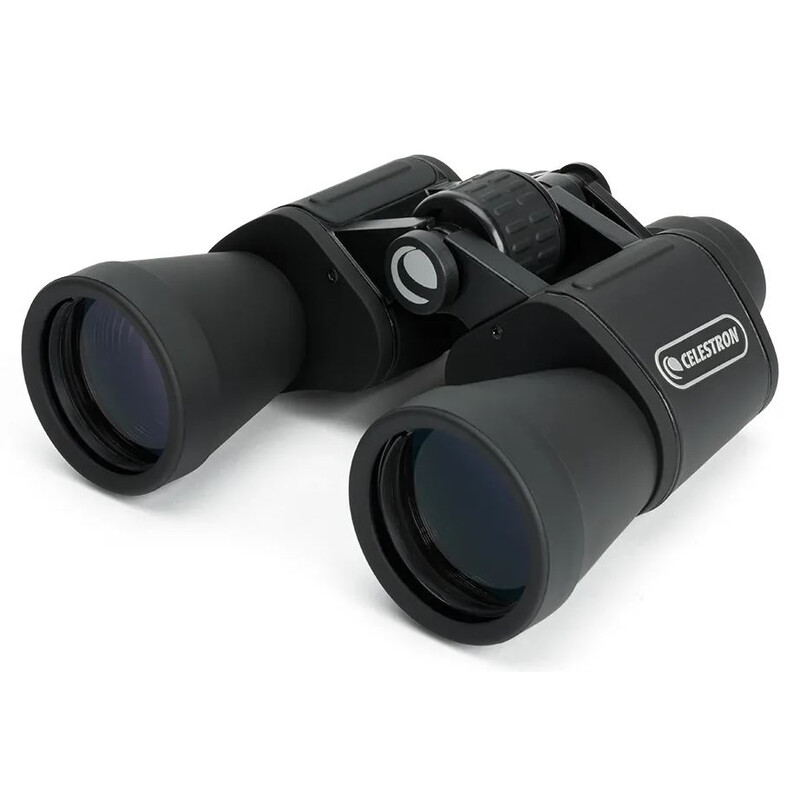
A simple 10x50 porro binocular: shows the Pleiades as a sparkling group of dozens of stars, plus the Moon and the Milky Way. Eyeglass wearers struggle with the short eye relief.
Price: € 62
A telescope shows its strengths elsewhere: on the Moon. A small tabletop Dobsonian such as the Sky-Watcher Heritage 130 Tabletop DobsonianSkywatcher Dobson Telescope N 130/650 Heritage FlexTube shows the sky disc’s crescent with craters along the line between light and shadow. The Pleiades, on the other hand, only fit completely into the view at the lowest magnification.
The Moon near the Pleiades: dates 2026 and 2027
You can see the sky disc’s scenes yourself in the coming months, because the Moon currently passes close to the Pleiades every month. For the leap rule, 13 March 2027 is the evening: a crescent a good five days old then stands about 2.5 degrees from the Seven Sisters in the west. Schlosser’s October date matches the almost full moon at the end of October 2026.
| Date | Moon | Distance to the Pleiades | Where in the sky |
|---|---|---|---|
| 27/28 October 2026 | almost full (96 %) | 2.5° at 10 pm, under 1° around 3 am | east in the evening, southwest in the morning |
| 24 November 2026 | Full moon | a good 3° at moonrise around 5:30 pm | low in the east-northeast |
| 21/22 December 2026 | almost full (92 %) | 2.4° at 8 pm, 0.6° around 1 am | southeast in the evening, west at night |
| 14 February 2027 | half moon | 1° around 7 pm | high in the south |
| 13 March 2027 | crescent, 5.4 days old (30 %) | 2.5° at 8 pm, 1.5° at 10 pm | west – the scene of the leap rule |
| 9 April 2027 | thin crescent, 2.8 days (9 %) | 6° at 9 pm | low in the west |
Our own calculation (Skyfield, JPL ephemeris DE421) for central Europe (51° N), distance to the brightest Pleiades star Alcyone; times CET, in April CEST. The Moon is near the Pleiades on the same nights from North America too, but because of its closeness to Earth the distance there can differ by up to about one degree, and times refer to your local evening.
Found in 1999, seized in Basel: a real crime story
The sky disc was found on 4 July 1999 by two looters searching the Mittelberg with a metal detector without a permit. The hoard also included two swords, two axes, a chisel and fragments of arm spirals. At first the finders thought the disc was the centre of a shield.
Because archaeological finds in Saxony-Anhalt automatically belong to the state, the treasure could not be sold on the legal market. It passed through several middlemen and was finally offered for DM 700,000. On 23 February 2002 the state archaeologist Harald Meller posed as a buyer in a hotel in Basel, and the Swiss police seized the disc.
| Date | Event |
|---|---|
| 4 July 1999 | found by two metal detectorists on the Mittelberg |
| July 1999 | whole hoard sold to a dealer for DM 31,000 |
| 1999–2001 | several changes of ownership, offers of up to DM 1 million |
| 23 February 2002 | seized in Basel during a sting sale |
| 25 September 2002 | first presentation to the press |
| 2003–2007 | convictions of the finders and the fence, final in 2007 |
| 20 June 2007 | opening of the Arche Nebra visitor centre |
| May 2008 | disc in the permanent exhibition in Halle |
| June 2013 | added to the UNESCO Memory of the World register |
| 2020 | dispute about the dating (see below) |
Sources: Wikipedia (Nebra sky disc), State Museum of Prehistory Halle, Mitteldeutsche Zeitung.
The recovery left its mark. A tool blow damaged the rim, a star came loose, a piece of gold was torn from the full moon, and a fence scrubbed the surface with a toothbrush and steel wool. In Halle the star was put back and the missing piece of the moon replaced with new gold.
Age of the sky disc: Bronze Age or Iron Age?
The disc cannot be dated directly, because bronze contains no carbon for radiocarbon dating. The age therefore comes mainly from the objects found with it: the axes and chisel are typical forms of around 1600 BC, and birch bark on a sword hilt was dated to 1600 to 1560 BC. The disc itself is older than its burial – how much older is open.
All the metal can tell us is that it is old. Freshly smelted copper is weakly radioactive for about 100 years; the disc shows nothing of this. Add to that the composition and the slowly grown corrosion layer.
| Position | Who | Main argument |
|---|---|---|
| Early Bronze Age, buried around 1600 BC | State Office of Saxony-Anhalt (Meller), Pernicka et al. | objects found with it, radiocarbon of the birch bark, soil residues match the find site |
| Iron Age, about 800–50 BC | Rupert Gebhard and Rüdiger Krause (2020) | find circumstances uncertain, the other objects may not belong with it, image motifs more Iron Age |
| Reply (November 2020) | 13 researchers led by Ernst Pernicka, Archaeologia Austriaca 104 | critics used incomplete data; metal origin, traces of gold in the soil and the ship motif point to the Bronze Age |
Based on the published arguments, we consider the Bronze Age clearly better founded. Some uncertainty remains, because the find situation has only been reconstructed from the looters’ statements and later excavations. Meller estimates that the disc was used for 100 to 200 years before it was buried – an estimate, not a measurement.
See the original sky disc: Halle and Arche Nebra
The original sky disc is in the State Museum of Prehistory in Halle (Saale), Germany, in the permanent exhibition since May 2008. It is rarely lent out – most recently in 2022 to the British Museum in London and the Drents Museum in Assen in the Netherlands. Even for the major Bronze Age exhibition in Alicante in 2024 only a copy travelled. Everywhere else you see replicas.
The Arche Nebra is the visitor centre near the find site, opened in 2007, with an exhibition and a planetarium. About one kilometre away, a 30 m observation tower stands at the find site on the Mittelberg. Both places belong to the “Sky Paths” (Himmelswege) tourist route, which also includes the Goseck circle about 20 km away.

Frequently asked questions about the Nebra sky disc
When was the Nebra sky disc found?
On 4 July 1999, during an illegal metal-detector search on the Mittelberg near Nebra. It only became publicly known after it was seized in Basel on 23 February 2002. In September 2002 the state of Saxony-Anhalt presented it to the press.
Who found the Nebra sky disc?
Two metal detectorists, Henry Westphal and Mario Renner, who dug without a permit. They sold the whole hoard on the very next day for DM 31,000. The disc was studied scientifically above all by the state archaeologist Harald Meller, the astronomer Wolfhard Schlosser and the archaeometallurgist Ernst Pernicka.
Where is the original Nebra sky disc?
In the State Museum of Prehistory in Halle (Saale), Germany. The Arche Nebra at the find site shows a replica. The disc has left Halle only for a few special exhibitions, most recently in 2022 in London and Assen.
Is there a curse on the Nebra sky disc?
No. The “curse” is a storytelling motif: the find was surrounded by handling of stolen goods, criminal trials and disputes, and the media turned that into a legend. The German ARD thriller “Das dunkle Vermächtnis” (March 2026) explicitly plays with the idea – none of it is proven.
Is the Nebra sky disc genuine?
Yes, the material is demonstrably old: the bronze shows none of the radioactivity of freshly smelted metal, and the corrosion grew over a very long time. Soil samples from the Mittelberg match the soil residues on the disc and the sword. What is disputed is the exact age and the interpretation, not the authenticity.
What is the Nebra sky disc worth?
It cannot be sold, because it belongs to the state of Saxony-Anhalt. In 2006 it was insured for 100 million euros. On the black market it was offered in 2001/2002 for DM 700,000.
Links marked with an asterisk (*) are affiliate links. If you buy through them, we receive a small commission – the price stays the same for you.