By Alexander Merz · Published on · Details checked on 30 September 2026
A solstice is the moment when the Sun reaches its lowest or highest midday position of the year. The next winter solstice is on December 21, 2026, at 3:50 p.m. EST (20:50 UTC), and the next summer solstice on June 21, 2027, at 10:10 a.m. EDT.
Winter solstice 2026: December 21, 3:50 p.m. EST
On December 21, 2026, at 3:50 p.m. EST (12:50 p.m. PST), the Sun stands directly over the Tropic of Capricorn. For the Northern Hemisphere, that makes it the day with the lowest Sun and the longest night of the year. Astronomically, winter begins at that moment.
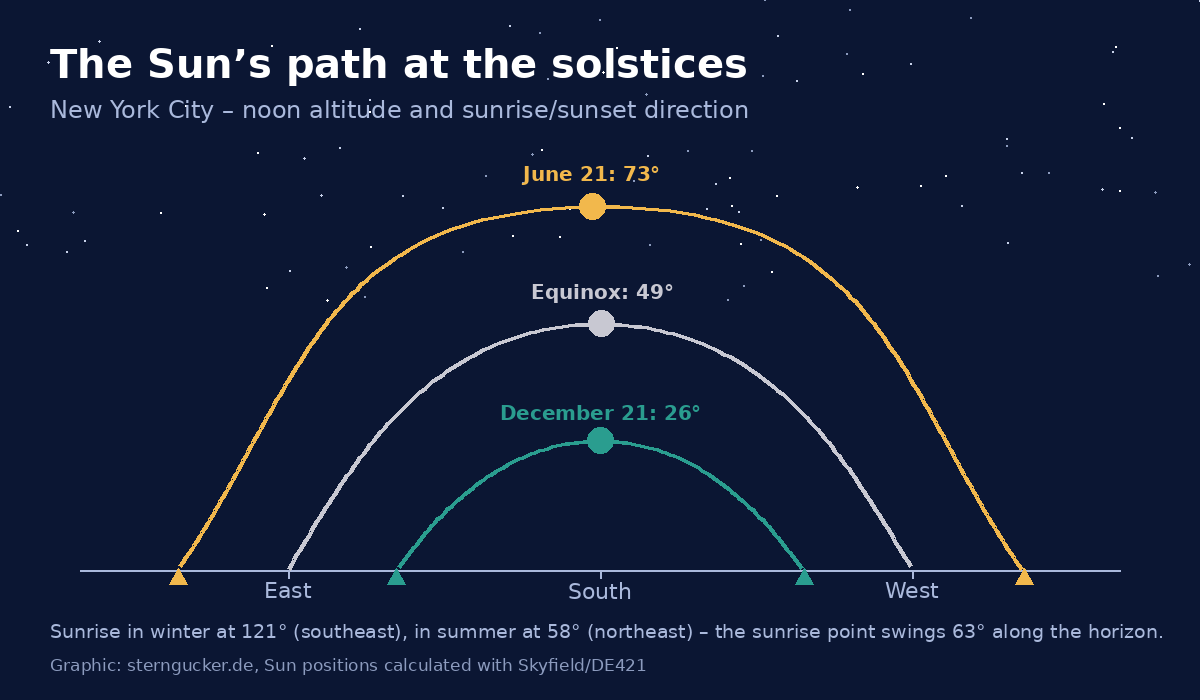
In New York City the Sun rises at 7:16 a.m. that day and sets at 4:31 p.m. At noon it climbs just 26° above the horizon – so low that your shadow is about twice as long as you are tall.
Summer solstice 2027: June 21, 10:10 a.m. EDT
The next summer solstice falls on June 21, 2027, at 10:10 a.m. EDT (7:10 a.m. PDT). Then the Sun stands directly over the Tropic of Cancer, and we get the longest day of the year. This year it was June 21, 2026, at 4:24 a.m. EDT.
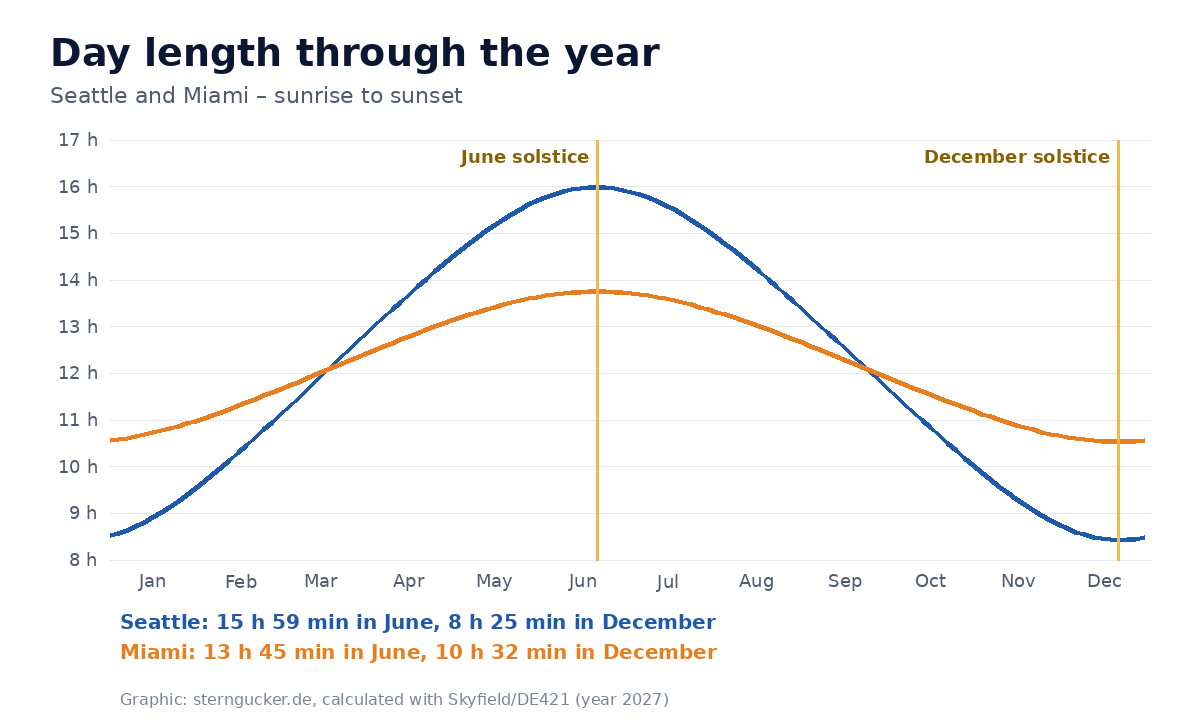
In Seattle the Sun then stays above the horizon for 15 hours and 59 minutes, in Miami for 13 hours and 45 minutes. In the far north, it no longer gets fully dark at night during these weeks: Seattle gets less than two hours of true astronomical darkness, and in Anchorage the Sun never sinks more than 5° below the horizon, so the sky stays in twilight all night.
Solstice dates through 2030
The solstice doesn’t fall on the same day every year. Because a year is almost six hours longer than 365 days, the date slips back by about six hours each year – until the leap day pulls it forward again.
| Year | June solstice (summer) | December solstice (winter) |
|---|---|---|
| 2026 | June 21, 4:24 a.m. EDT 08:24 UTC · CT 3:24 a.m. · MT 2:24 a.m. · PT 1:24 a.m. | December 21, 3:50 p.m. EST 20:50 UTC · CT 2:50 p.m. · MT 1:50 p.m. · PT 12:50 p.m. |
| 2027 | June 21, 10:10 a.m. EDT 14:10 UTC · CT 9:10 a.m. · MT 8:10 a.m. · PT 7:10 a.m. | December 21, 9:42 p.m. EST December 22, 02:42 UTC · CT 8:42 p.m. · MT 7:42 p.m. · PT 6:42 p.m. |
| 2028 | June 20, 4:02 p.m. EDT 20:02 UTC · CT 3:02 p.m. · MT 2:02 p.m. · PT 1:02 p.m. | December 21, 3:19 a.m. EST 08:19 UTC · CT 2:19 a.m. · MT 1:19 a.m. · PT 12:19 a.m. |
| 2029 | June 20, 9:48 p.m. EDT June 21, 01:48 UTC · CT 8:48 p.m. · MT 7:48 p.m. · PT 6:48 p.m. | December 21, 9:14 a.m. EST 14:14 UTC · CT 8:14 a.m. · MT 7:14 a.m. · PT 6:14 a.m. |
| 2030 | June 21, 3:31 a.m. EDT 07:31 UTC · CT 2:31 a.m. · MT 1:31 a.m. · PT 12:31 a.m. | December 21, 3:09 p.m. EST 20:09 UTC · CT 2:09 p.m. · MT 1:09 p.m. · PT 12:09 p.m. |
In 2027 the winter solstice falls on December 21 across the US, even though it’s already December 22 in UTC, and in 2028 and 2029 the summer solstice falls on June 20. So if you’ve memorized the 21st as a fixed date, you won’t always be right. You’ll find the dates for the start of spring and fall on our page about the astronomical seasons.
Day length on the solstice in your city
How short the shortest day is depends mostly on how far north you live. Between Seattle and Miami, the winter solstice brings a difference of about two hours of daylight, and in summer it’s the other way around.
| City | Shortest day (Dec. 21) | Longest day (June 21) | Noon Sun |
|---|---|---|---|
| Seattle | 8 h 25 min 7:54 a.m. to 4:20 p.m. | 15 h 59 min 5:11 a.m. to 9:10 p.m. | 19° / 66° Dec. / June |
| Minneapolis | 8 h 46 min 7:48 a.m. to 4:34 p.m. | 15 h 37 min 5:26 a.m. to 9:03 p.m. | 22° / 69° Dec. / June |
| Boston | 9 h 05 min 7:10 a.m. to 4:14 p.m. | 15 h 17 min 5:07 a.m. to 8:24 p.m. | 24° / 71° Dec. / June |
| Chicago | 9 h 08 min 7:14 a.m. to 4:22 p.m. | 15 h 14 min 5:15 a.m. to 8:29 p.m. | 25° / 72° Dec. / June |
| New York | 9 h 15 min 7:16 a.m. to 4:31 p.m. | 15 h 06 min 5:25 a.m. to 8:30 p.m. | 26° / 73° Dec. / June |
| Denver | 9 h 21 min 7:17 a.m. to 4:38 p.m. | 14 h 59 min 5:32 a.m. to 8:31 p.m. | 27° / 74° Dec. / June |
| Washington, DC | 9 h 26 min 7:23 a.m. to 4:49 p.m. | 14 h 54 min 5:42 a.m. to 8:36 p.m. | 28° / 75° Dec. / June |
| San Francisco | 9 h 33 min 7:21 a.m. to 4:54 p.m. | 14 h 47 min 5:48 a.m. to 8:34 p.m. | 29° / 76° Dec. / June |
| Los Angeles | 9 h 53 min 6:54 a.m. to 4:47 p.m. | 14 h 26 min 5:42 a.m. to 8:07 p.m. | 33° / 79° Dec. / June |
| Dallas | 9 h 59 min 7:25 a.m. to 5:25 p.m. | 14 h 19 min 6:19 a.m. to 8:38 p.m. | 34° / 81° Dec. / June |
| Miami | 10 h 32 min 7:03 a.m. to 5:34 p.m. | 13 h 45 min 6:30 a.m. to 8:15 p.m. | 41° / 88° Dec. / June |
| Anchorage | 5 h 27 min 10:14 a.m. to 3:41 p.m. | 19 h 22 min 4:20 a.m. to 11:42 p.m. | 5° / 52° Dec. / June |
| Honolulu | 10 h 50 min 7:04 a.m. to 5:54 p.m. | 13 h 26 min 5:50 a.m. to 7:16 p.m. | 45° / 88° Dec. / June |
Why the earliest sunset isn’t on the shortest day
You may have noticed that by mid-December, evenings already stay light a little longer. You’re not imagining it: in New York the earliest sunset is on December 7 and 8 (4:28 p.m.), while the latest sunrise doesn’t come until January 4 (7:20 a.m.). The shortest day falls in between.
The reason is Earth’s elliptical orbit. In early January Earth is closest to the Sun and moves faster along its orbit, so solar noon shifts later by about 30 seconds every day during these weeks. As a result, the evenings gain light earlier and the mornings later.
How fast do the days get longer again?
| Date | Day length in New York | Gain since Dec. 21 |
|---|---|---|
| December 21 | 9 h 15 min | – |
| January 1 | 9 h 19 min | +4 min |
| January 10 | 9 h 28 min | +13 min |
| January 21 | 9 h 45 min | +30 min |
| February 1 | 10 h 07 min | +52 min |
In the first few days after the solstice, you gain only seconds, because the Sun barely changes its height at its turning point. By mid-January it’s already about 1½ minutes a day, and in March almost 3.
Why are there solstices?
Earth’s axis isn’t perpendicular to its orbit but tilted by 23.4°. Because this tilt always points in the same direction as Earth travels around the Sun, sometimes the Northern Hemisphere faces the Sun and sometimes the Southern Hemisphere does.
On the summer solstice, the Northern Hemisphere is tilted most strongly toward the Sun: the Sun is high, its light hits steeply and it stays in the sky for a long time. On the winter solstice, it’s exactly the opposite.
This has nothing to do with the distance to the Sun. In January Earth is actually about 3 million miles (5 million km) closer to the Sun than in July – and it’s still winter here.
Is there a fall solstice?
No. There are exactly two solstices, in June and in December. March and September bring the equinoxes: the Sun then stands over the equator, and day and night are roughly equal in length.
The September equinox 2026 was on September 22 at 8:05 p.m. EDT, and the next spring equinox is on March 20, 2027, at 4:24 p.m. EDT. So anyone searching for a “fall solstice” or “autumn solstice” actually means the first day of fall.
| Solstice | Equinox | |
|---|---|---|
| When | around June 21 and December 21 | around March 20 and September 22 |
| Sun directly over | the Tropic of Cancer or Tropic of Capricorn | the equator |
| Day length for us | longest or shortest day | day and night about equal |
| Sunrise | far to the northeast or southeast | due east |
Watching the solstice: how to see it yourself
The solstice itself is a calculated moment, but you can still see it. The easiest way is on the horizon: over the year, the sunrise point in New York swings back and forth by 63° – from 121° (southeast) in December to 58° (northeast) in June.
Pick a tree, a chimney or a hilltop behind which the Sun sets in the evening, and check once a week. For weeks the point moves along steadily, but around the solstice it seems to stand still – that’s exactly where the Latin name “solstitium,” the Sun standing still, comes from.
People were watching exactly this back in the Stone Age. At Stonehenge, the Sun rises over the so-called Heel Stone on the summer solstice, and at Newgrange in Ireland, morning light reaches all the way into the burial chamber only around the winter solstice.
Frequently asked questions about the solstice
When is the winter solstice 2026?
On Monday, December 21, 2026, at 3:50 p.m. EST (12:50 p.m. PST, 20:50 UTC). That makes December 21 the shortest day of the year, too. In 2027 the winter solstice falls on December 21 at 9:42 p.m. EST.
When is the summer solstice 2027?
On Monday, June 21, 2027, at 10:10 a.m. EDT (7:10 a.m. PDT). The summer solstice 2026 was on June 21 at 4:24 a.m. EDT.
How long is the shortest day in the US?
In the lower 48 states, between 8 hours 25 minutes in Seattle and 10 hours 32 minutes in Miami. New York gets 9 hours 15 minutes, Chicago 9 hours 8 minutes, and Anchorage only 5 hours 27 minutes.
How long is the longest day in the US?
In Seattle 15 hours 59 minutes, in Miami 13 hours 45 minutes. So the difference between north and south in the lower 48 is more than two hours, and Anchorage gets 19 hours 22 minutes.
When do the days start getting longer?
Right after the winter solstice, but only by seconds at first. In New York the evenings stay light longer from December 8 on, while mornings only get lighter earlier after January 4. By February 1, the day is almost an hour longer than on the solstice.
Is the solstice always on the 21st?
No. In US time zones, the winter solstice usually falls on December 21 (occasionally the 20th or 22nd), and the summer solstice on June 20 or 21. The date slips by about six hours each year and jumps back with the leap year.
What’s the difference between the solstice and midsummer?
The solstice is an astronomical moment, midsummer is a celebration: in Sweden it’s held on the weekend between June 19 and 25, and in many countries St. John’s Day falls on June 24. Astronomically it hardly makes a difference: in New York, June 24 is only about 20 seconds shorter than the solstice day.
Further reading
- Astronomical seasons – all dates for the start of spring, summer, fall and winter
- Planets visible tonight – what you can see in the sky tonight
- Observing the Sun – safely, with the right filter