By Alexander Merz · Updated on · Details checked on 21 September 2026
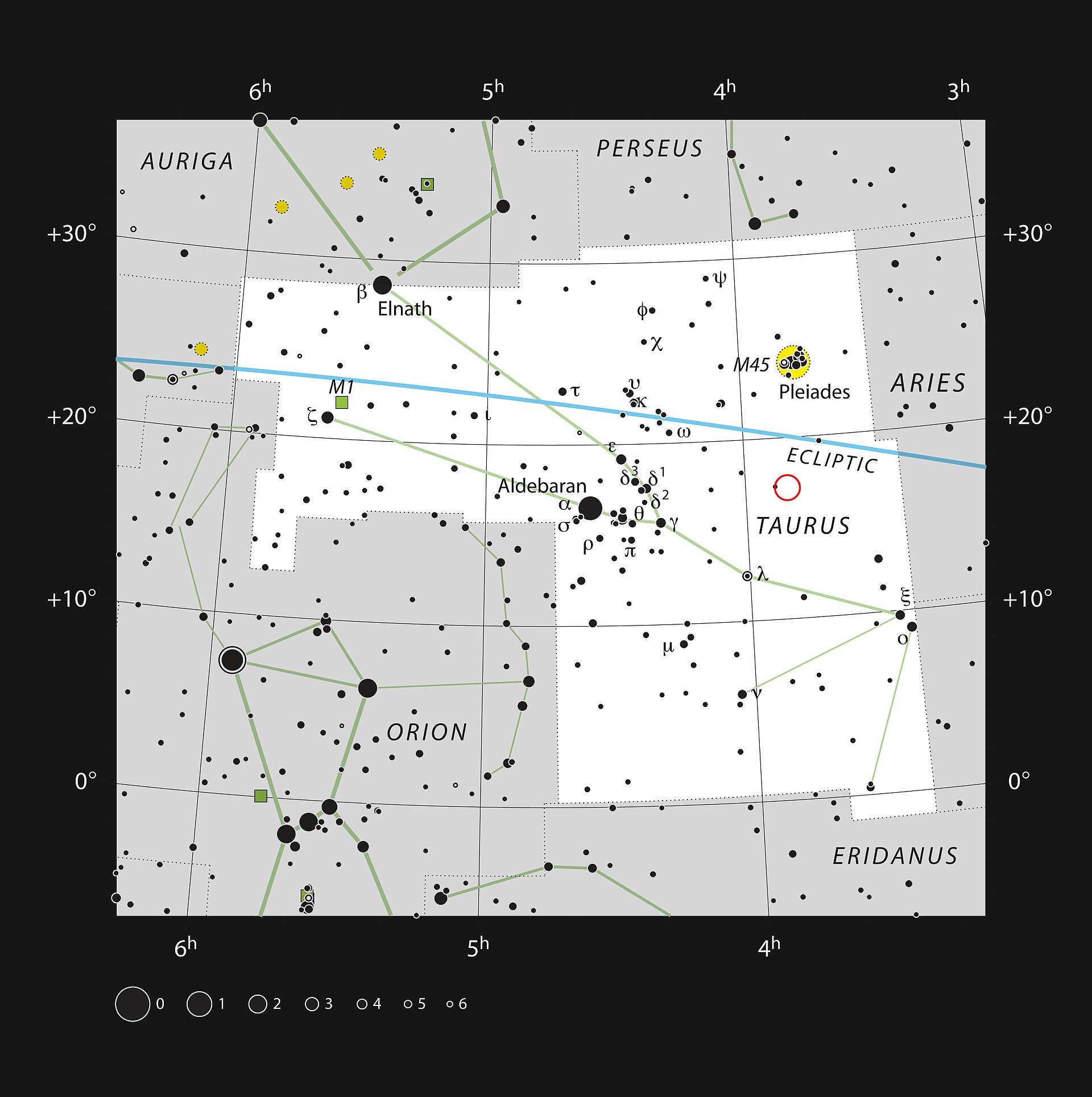
The Taurus constellation (Latin Taurus) is a zodiac constellation of the winter sky, recognisable by its V-shaped face formed by the Hyades with the reddish Aldebaran, and by the Pleiades above it. From Central Europe it stands high in the south in the evening from November to March.
From Central Europe, the Taurus constellation is best seen during the winter months. It belongs to the constellations of the ecliptic, which makes it visible partly in the southern and partly in the northern night sky. Famous deep-sky objects include the Pleiades (the head of the constellation, an open cluster) and the much older Hyades, a very star-rich open cluster. Nebulae and an asterism, along with several clearly visible double stars, are much-described observation targets for amateur and professional astronomers alike. The quickest way to find Taurus is via Orion: extending the three belt stars up and to the right, you reach the reddish Aldebaran, the eye of the bull, after about 21°.
Deep-sky objects and double stars in Taurus
For beginners, Taurus is one of the most rewarding winter constellations: two of the most famous open clusters of all stand here, along with a whole series of double stars that even a small telescope will split. An open cluster is a group of stars that formed together from the same gas cloud and still stay loosely together.
The Pleiades (M45, the Seven Sisters) form the conspicuous little cluster above the bull’s back – six to seven stars to the naked eye, dozens in binoculars. The Hyades make up the V-shaped face of the bull; at around 600 million years they are considerably older, and at 150 light years they are the closest open cluster to us of all. The reddish Aldebaran appears to belong to them, but in reality lies only half as far away and merely happens to sit in the same line of sight.
Theta and Sigma Tauri – double stars in the Hyades
Theta Tauri is the best-known double star of the Hyades and splits with the naked eye already: Theta 1 and Theta 2 stand 337 arcseconds apart. In space, however, some four light years lie between them – they do not orbit each other but both belong to the Hyades cluster and merely happen to lie in almost the same direction. Spectroscopic measurements show that each of the two components is itself a close pair. In the telescope they remain two points; physically they are four stars.
Sigma Tauri is wider still at 429 arcseconds and just as easy to split. Here too: two independent Hyades members some 155 light years away, not a gravitationally bound pair. Both cases nicely illustrate the difference between an optical and a physical double star – a difference you cannot see at the eyepiece, only measure.
Tau, Phi and Delta Tauri – three systems for small telescopes
Tau Tauri is a triple system. The primary, Tau Tauri A, shines at magnitude 4.3 and separates well from its fainter companion Tau Tauri C at 63 arcseconds. The primary itself has a third partner in an orbit so tight that no telescope shows it.
Phi Tauri is easier still: 52.1 arcseconds apart, with a clear brightness difference of more than 3 magnitudes. The primary is an orange giant that far outshines its companion – and it is precisely this contrast that makes the pair rewarding at the eyepiece.
Delta Tauri is more of a family than a double star. Delta 1 carries the traditional name Eudora, an orange giant with 74 times the solar luminosity, and has a merely optical companion at 107 arcseconds – but also a genuine, gravitationally bound partner that circles it every 530 days on a strongly eccentric orbit. Delta 3 Tauri, traditionally Cleeia, is in turn a triple system. All of them belong to the Hyades and therefore carry names from the Greek legend of the rain stars.
NGC 1746 and NGC 1647 – a mirage and a real cluster
NGC 1746 is an instructive case. In 1863 the German-Danish astronomer Heinrich Louis d’Arrest described an open cluster at this spot and entered it in the New General Catalogue. Today it is regarded as an asterism: a chance arrangement of stars that resembles a cluster without being one. The stars do lie in the same line of sight, but in space they are separated by hundreds or even thousands of light years. The group is a fine sight all the same.
NGC 1647, by contrast, is the real thing: a young open cluster 1,800 light years away, only some 150 million years old and thus a quarter the age of the Hyades. It stands near Aldebaran and, at magnitude 6.4, falls just below the naked-eye limit – partly because interstellar dust swallows some of its light on the way. In binoculars it is a rewarding target. It is of research interest because of a system of two red dwarfs that eclipse one another: from the shape of the brightness variation, the radius and mass of these very low-mass stars can be determined directly.
NGC 1807 and NGC 1817 – the unequal pair
These two stand so close together that a wide-field eyepiece takes them in at once – a rewarding target once the bright classics in Taurus have been ticked off.
NGC 1807 is the larger and looser of the two at 17 arcminutes: about eight bright and six to eight fainter stars in an irregular arrangement that observers like to compare to outspread arms. At its centre sits a close double star. At around 100x the structure resolves well. Whether NGC 1807 is a genuine cluster at all, or like NGC 1746 merely a chance grouping, has still not been settled.
NGC 1817 lies barely a degree further east, is more compact but with around 70 stars distinctly richer. Even 50x shows the first individual stars, though many of the fainter ones stay grainy and nebulous. On its western edge three stars stand out, forming a small arc; otherwise the cluster looks evenly oval and equally bright out to the rim.
Which deep-sky objects are visible in which season, and from what telescope aperture the view becomes worthwhile, is gathered in our overview Deep-sky objects: catalogue and visibility. To get started in Taurus, a pair of binoculars is often enough – the Pleiades and Hyades are actually too large for most telescopes.
Interpretations of the Taurus constellation in antiquity
The best-known myth about the Taurus constellation comes from ancient Greece. Zeus, the father of the gods, is said to have abducted Europa, the daughter of King Agenor (Phoenicia), in the form of a bull, taking her to Crete, where he fathered three children with her under an olive tree. According to this mythology, the continent of Europe is named after her. Part of this ancient “family story” is also the deep-sky object of the Hyades, who according to legend are daughters of Atlas and who, as the “rain stars”, still mourn their brother on the ecliptic. The open cluster of the Pleiades, on the other hand, depicts Atlas with his wife and more of his daughters in the night sky.
Other myths surrounding the history-laden Taurus constellation originate with the Sumerians. There, the main stars on the ecliptic depict the battle of the heavenly bull against King Gilgamesh. Later myth researchers name the zodiac sign after “Taurus” in an eternal contest against the hunter “Orion“. There may also be a mythological connection between “Taurus” in the northern night sky and the southern constellation “Centaurus“. This has not, however, been proven so far. The star names in use today, as well as the interpretation of some deep-sky objects (e.g. the striking open clusters of the Pleiades and Hyades), refer to the more recent Greek mythology and are carried forward in this way by modern astronomy.
Significant historical observations in the Taurus constellation
Like most constellations, the Taurus constellation was also used by earlier advanced civilizations to forecast weather and fate. The open cluster of the Hyades also bears the name “rain stars” because of its rising every evening in autumn at the onset of the rainy seasons. The open clusters of the Hyades and Pleiades are furthermore regarded as the “Golden Gate of the ecliptic“. The formation of today’s deep-sky object the “Crab Nebula” (Messier 1) is the result of a “stellar death”. The associated supernova was observed with the naked eye in the night sky and recorded by Chinese astronomers in 1054.
🔭 Currently in Taurus: Uranus reaches its opposition on 26 November 2026, sitting about 5° southeast of the Pleiades. Finder chart and all dates in The night sky in November 2026.