By Alexander Merz · Published on · Details checked on 6 November 2026
In practice, building your own telescope usually means putting bought mirrors and eyepieces into a home-made tube and a home-made mount. The supreme discipline is grinding your own primary mirror; the entry point is a kit or a mini Dobsonian.
If you just want to make a simple telescope for a child’s bedroom, you’ll find the two-lens version further down. Everything about ready-made instruments is in our overview Best telescopes.
⭐ In short: Up to about 12 inches, building is almost never cheaper than buying a telescope – a good mirror on its own often costs as much as a complete instrument. It is worth it for anyone who enjoys building, wants an instrument made to their own wishes or is converting a used Newtonian. If you simply want to start observing quickly, a ready-made Dobsonian serves you better.
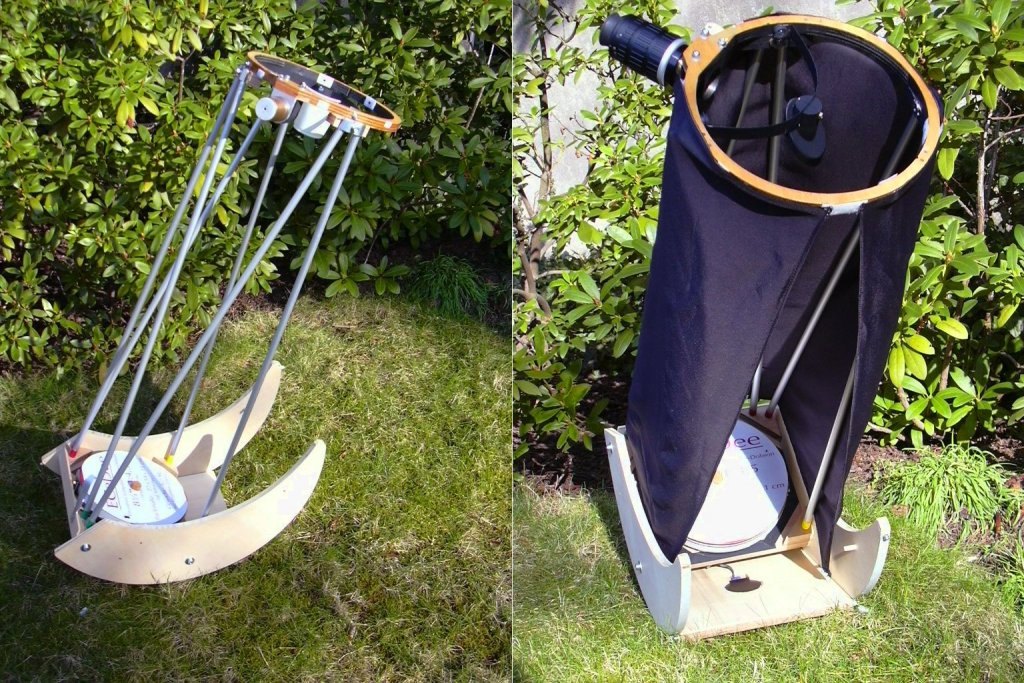

Is it worth building your own telescope?
Financially, mostly not – and the builders say so themselves. In a much-read thread in a German-language forum, the original poster found that a single 8-inch mirror costs almost as much as a complete telescope from the same manufacturer; the replies confirmed that below about 12 inches, building your own rarely pays off financially (forum.astronomie.de, October 2018, in German).
A guide comes to the same conclusion for an 8-inch: the materials cost about as much as a ready-made 200 mm Dobsonian, a price advantage only appears from 12 inches (Sternhimmel über Ulm, Teleskop-Selbstbau – in German). For comparison: the ready-made Apertura AD8 8" Dobsonian TelescopeSkywatcher Dobson Telescope N 200/1200 Skyliner Classic currently costs $649.95€ 479.
| Reason | Build it | Buy it ready-made |
|---|---|---|
| Cost up to 8–10 inches | usually the same or more expensive | cheaper |
| Large travel Dobsonian (12 inches+) | much lighter design possible | heavy or very expensive |
| Build time | weekends to months | one evening to assemble |
| Optical quality | as good as the bought or self-ground mirror | production variation |
| Fun of building | the real reason | – |
The underrated middle way is “cannibalising” a telescope. Experienced builders buy a used Newtonian, take over the mirror, mirror cell, secondary spider and focuser, and only build a new tube or mount – for example a lighter truss-tube Dobsonian (forum.astronomie.de, in German). What to look out for when buying used is covered in our telescope guide.
Four ways to your own telescope
“Building it yourself” ranges from an afternoon’s craft session to a six-month project. The routes differ mainly in how much of the optics you make yourself.
| Route | Effort | What you see | Who it suits |
|---|---|---|---|
| Lens telescope from a cardboard tube | one afternoon | Moon, landscape | Children, school project |
| Kit (cardboard or plastic) | one or two evenings | Moon, Jupiter’s moons, Saturn’s rings depending on the kit | Families, beginners |
| Dobsonian with bought optics | ⭐ The classica few weekends | everything a bought Dobsonian of the same size shows | DIYers with a saw and a drill |
| Grinding your own mirror | 3–12 months | as good as your mirror | Tinkerers with a great deal of patience |
Making a simple telescope with two lenses
A simple lens telescope needs only two converging lenses and two tubes that slide into each other. At the front sits a weak lens with a long focal length as the objective, at the back a strong one with a short focal length as the eyepiece. The magnification is the ratio of the two focal lengths; in a Keplerian telescope the image is upside down.
With a 1,000 mm objective and a 50 mm eyepiece focal length, that gives 20×. Lunar craters are easy to see with it; for more, simple lenses lack aperture and colour correction. The distance between the lenses is roughly the sum of both focal lengths (principle: Keplerian telescope, Wikipedia, in German).
⚠️ Never at the Sun: Looking at the Sun through a telescope without a filter can permanently damage your eye in a fraction of a second. This applies to every home-made telescope just as much as to a large one. Never improvise a solar filter yourself – how to observe the Sun safely is explained in Observing the Sun.
Kits: the safe way in
Kits supply the optics ready-made and let you assemble the rest. A well-known example in Germany is the “Baumarkt-Teleskop” (DIY-store telescope) from Astromedia, which also ranks fourth on German Google for the search “teleskop selber bauen” (Astromedia, in German). For children and school classes, this is the route with the highest success rate.
Building a Dobsonian: what you buy, what you build
A Dobsonian is the most popular home build because its wooden mount needs no precision mechanics. You buy the optics; the rest you saw and screw together yourself. How the finished design works is explained in our Dobsonian guide.
| Part | Buy or build? | Note |
|---|---|---|
| Primary mirror (parabolic) | buy | determines the image quality; fix the focal length before you build the tube |
| Secondary mirror with holder and spider | buy | size to match the mirror and focal length |
| Focuser | buy | a Crayford focuser focuses more precisely |
| Mirror cell | buy or build | must hold the mirror free of stress |
| Tube | build | cardboard tube (Sonotube), plastic pipe or truss tube |
| Rocker box and altitude bearings | build | plywood, Teflon pads sliding on Formica/laminate |
| Finder | buy | red-dot finder or 8×50 |
Where the secondary mirror has to sit
The most important measuring error in a home build is a focus point you cannot reach. The focal point must lie just above the fully retracted focuser. This gives you the distance from the primary mirror to the centre of the secondary.
Rule of thumb: distance primary mirror → centre of secondary = focal length − (half the tube diameter + height of the focuser + 1–2 cm reserve). With a 1,200 mm focal length, a 25 cm tube and a 7 cm focuser you end up at around 1,000 mm.
So only build the tube once the mirror and focuser are on the table. Measure the mirror’s real focal length instead of blindly trusting the nominal figure. A daytime trial run with cardboard and tape saves you building a second tube.
Rocker box: the secret of the bearings
A good Dobsonian moves with one finger and still stays put. That is the job of small Teflon pads sliding on a Formica or laminate surface. According to the guide, the rocker box for a 10-inch can be built in one weekend (Sternhimmel über Ulm, in German).
The altitude bearings belong at the balance point of the finished tube – with finder and heaviest eyepiece fitted. If they are in the wrong place, the tube tips up or down. If you want to stay flexible, attach them with tube rings so you can slide them later (forum.astronomie.de, June 2020, in German).
Tip from the forum: Start small. In 2026 a hobbyist in a German-language forum built a mini Newtonian from a cheap 114 mm f/4 mirror and a drainpipe – the focuser is a plastic tube with threaded rods – and photographed globular clusters with it (forum.astronomie.de, September 2026, in German). A small project teaches you more than an abandoned large one.
Grinding your own mirror: the supreme discipline
You grind a telescope mirror by hand from a glass disc, using a second disc as the tool. With ever finer abrasive grit you first create the spherical shape, then polish with pitch and correct it to a parabola. The aluminium coating is done by a specialist company at the end (process: mirror grinding, Wikipedia, in German).
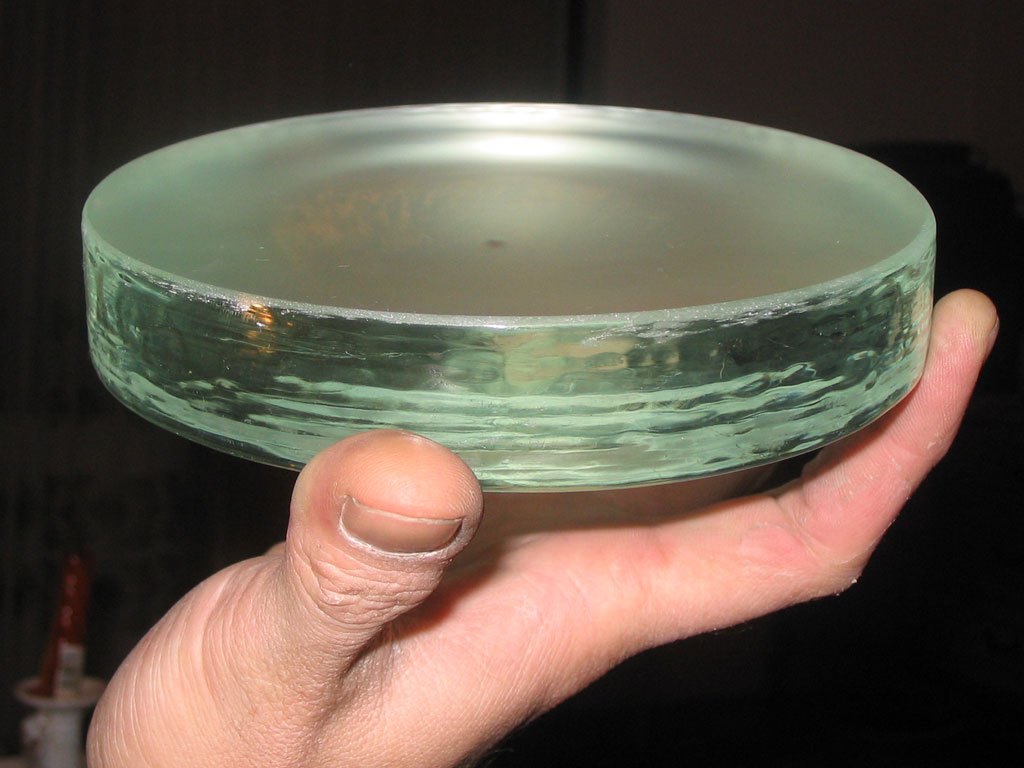

Expect months, not weeks. For an 8-inch mirror the Ulm guide gives three to six months, for 12 inches six to twelve; financially, grinding only pays off from about 10 inches (Sternhimmel über Ulm, in German). Grinding dust and water belong in a cellar or workshop, not in the living room.
Nobody has to start alone. In Germany, the amateur telescope/self-build section of the Vereinigung der Sternfreunde (the German amateur astronomers’ association) helps with optics, mechanics and electronics and collects build reports, supplier lists and literature (VdS self-build section, in German). Current projects with photos run in the “Selbstbau, Reparatur” sub-forum of forum.astronomie.de.
After building: collimate and test
Every home-built Newtonian has to be collimated before its first night. This aligns the secondary and primary mirror with each other until a defocused star shows even rings. The full guide is in Collimation: aligning a Newtonian.
Not all black is equally black. One builder reports that the black paint inside his tube hardly absorbed any stray light; flocking film or an extended dew shield opposite the focuser help more (forum.astronomie.de, in German).
Rather buy after all? Two instruments that come close to a home build
If you want to observe rather than build, a ready-made Dobsonian gives you the same optics without a workshop. Both instruments can be modified later – truss tube, better focuser, your own rocker box.
Start without a workshop: Skywatcher Dobson Telescope N 130/650 Heritage FlexTube
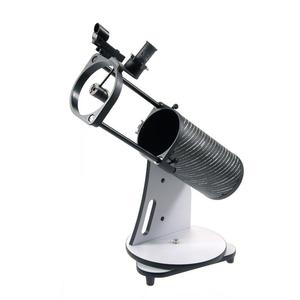
130 mm aperture on a small tabletop Dobsonian mount – set up in minutes. A popular donor and conversion instrument if the urge to build comes later.
Price: € 265
The 8-inch benchmark: Skywatcher Dobson Telescope N 200/1200 Skyliner Classic
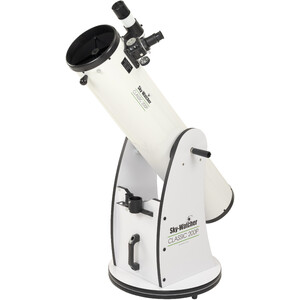
200 mm aperture – exactly the size for which building your own makes the least financial sense. If you want this class, buying it ready-made is usually cheaper.
Price: € 479
FAQ about building a telescope
Can you see planets with a home-made telescope?
Yes, provided the mirror is good and the telescope is properly collimated. A home-built Dobsonian shows the same rings of Saturn and bands of Jupiter as a bought instrument of the same size. A cardboard lens telescope, on the other hand, is usually only good enough for the Moon.
What is the difference between a telescope and a spyglass?
In everyday language, none. “Spyglass” or “refractor” usually means a lens instrument, while “telescope” is used for all astronomical instruments, including reflectors.
What size makes sense for a first build?
A small Newtonian with a 110 to 150 mm mirror. In the German-language forum, exactly that is recommended for practice before you tackle 8 inches and more (forum.astronomie.de, June 2020, in German).
How long does it take to build a Dobsonian?
With bought optics a few weekends, the rocker box alone about one. With a self-ground mirror, several months are added.
How can I build my own observatory?
That is a project of its own, with foundation, pier and roll-off roof. Everything about it is in our guide Build your own garden observatory.
Read more: Dobsonian telescope · Reflector vs refractor · Build your own garden observatory
Links marked with an asterisk (*) are affiliate links. If you buy through them, we receive a small commission – the price stays the same for you.