By Alexander Merz · Published on
A telescope for astrophotography has to deliver a sharp, colour-free image across the whole camera frame, and it has to sit on a motorised tracking mount. For beginners that usually means a small ED refractor with 60 to 80 mm aperture and a focal length of 250 to 500 mm.
⭐ In short: To get started, we recommend the Apertura 72mm FPL-53 Doublet APO RefractorTS-Optics PhotoLine 72/432 FPL53 Apo (OTA) on a Sky-Watcher Star Adventurer GTi Mount KitSkywatcher Star Adventurer GTi Wi-Fi GoTo. The mount matters more than the telescope: a top apo on a shaky mount only gives you star trails. If you want pictures without tinkering, get a smart telescope.
Three ways to an astrophoto
Before we talk about telescopes, it is worth taking a step back. There are three sensible ways in, and they differ mainly in effort.
| Route | What you need | Budget | Effort |
|---|---|---|---|
| Smart telescope | One device, an app, done | lowest, around 500 (euros or dollars) | low |
| Camera + lens on a tracker | Mirrorless or DSLR camera, fast lens, tracking mount | from around 150 for the tracker | medium |
| Telescope + mount + camera | ED refractor, GoTo mount, camera, laptop or ASIAIR | from around 1,200 | high |
For the middle route, the key questions are tracking and choosing a fast camera lens; our astrophotography guide covers both. This page is about the third route.
Why the mount matters most
An astrophoto is made of many exposures lasting from 30 seconds to several minutes. During that time the sky rotates. The mount has to follow it so precisely that stars stay pinpoint.
The rule of thumb from practice: for imaging, use only about half of the stated payload. The manufacturer’s figure is meant for visual use, not for exposures lasting minutes with a camera, finder and cables attached.
Common mistake: putting a large telescope on the mount it came with. The budget belongs in the mount first, then in the optics. Most beginners regret doing it the other way round.
Which telescope for which target?
Focal length decides what fits in the frame. Large nebulae such as the North America Nebula or Andromeda need little focal length, small galaxies and planets need a lot.
| Target | Focal length | Suitable optics |
|---|---|---|
| Milky Way, constellations | 14–50 mm | Camera lens on a tracker |
| Large nebulae, Andromeda, Pleiades | 250–450 mm | Apertura 72mm FPL-53 Doublet APO RefractorTS-Optics PhotoLine 72/432 FPL53 Apo (OTA), William Optics RedCat 51 Gen 3 WIFDWilliam Optics RedCat 51 WIFD Petzval Apo |
| Smaller nebulae and galaxies | 500–1,000 mm | Sky-Watcher Evostar EDX 80 APO Doublet TelescopeSky-Watcher EvoStar 80ED Apo Refractor, 150/750 Newtonian |
| Planets, lunar detail | 1,500–4,000 mm | Maksutov or Schmidt-Cassegrain with a planetary camera |
Our astrophotography calculator works out exactly which field of view your combination gives. For a start, a short focal length is almost always right: it forgives tracking errors, because every error has less effect.
Recommended setups for beginners
The combinations below are matched to each other: the mount carries the optics plus camera with payload to spare.
| Set | Telescope | Mount | Who it suits |
|---|---|---|---|
| Entry | Apertura 72mm FPL-53 Doublet APO RefractorTS-Optics PhotoLine 72/432 FPL53 Apo (OTA) $649.95€ 549 | Sky-Watcher Star Adventurer GTi Mount KitSkywatcher Star Adventurer GTi Wi-Fi GoTo $679.00€ 567 | ⭐ Our recommendationCompact, travel-friendly, wide field. The most sensible way to start with a telescope of your own. |
| Solid base | Sky-Watcher Evostar EDX 80 APO Doublet TelescopeSky-Watcher EvoStar 80ED Apo Refractor $750.00€ 795 | Skywatcher Mount EQM-35 PRO SynScan GoTo about $945€ 945 | More focal length, sturdier mount, grows with you |
| Grab-and-go | William Optics RedCat 51 Gen 3 WIFDWilliam Optics RedCat 51 WIFD Petzval Apo $834.10€ 1,190 | Sky-Watcher Star Adventurer GTi Mount KitSkywatcher Star Adventurer GTi Wi-Fi GoTo $679.00€ 567 | No field flattener needed, very easy to focus |
| No tinkering | ZWO Seestar S50 Pro All-in-One Smart TelescopeZWO Seestar S50 Pro Smart Telescope $999.00€ 999 | built in | For people who want pictures but do not want to make a hobby of the technology |
Links marked with an asterisk are affiliate links.
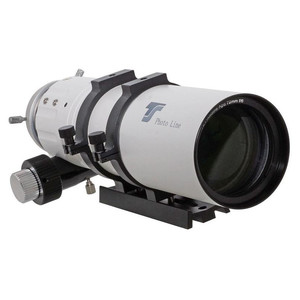
Our beginner apo: TS-Optics PhotoLine 72/432 FPL53 Apo (OTA)
FPL53 doublet 72/432 at f/6 – the classic wide-field optic to start with. Tube only: at 2.18 kg light enough for a small travel mount, flattener and mount come separately.
Price: € 549
Tip: A 72 mm doublet like our beginner apo needs a matching field flattener for sharp stars to the edge. Budget for it from the start, along with a T2 ring for your camera. With the William Optics RedCat 51 Gen 3 WIFDWilliam Optics RedCat 51 WIFD Petzval Apo, the flattener is already built in.
Why not just a normal telescope?
Many telescopes that are excellent for visual observing are unsuitable for imaging. That has nothing to do with quality and everything to do with the design.
- ✘ Dobsonian: no tracking, so long exposures are impossible. For the Moon and planets by video it works.
- ✘ Achromat: violet halos around every bright star that are hard to process away.
- ✘ Long focal length at the start: every tracking error is magnified and the frustration rate goes up.
- ✘ Department-store kits with an EQ-1 mount: it cannot even hold a camera steady.
Planetary imaging is the exception: you film short videos with a fast camera and stack the sharpest frames. How that works is explained under planetary photography.
Not sure whether to go for a smart telescope or your own setup? We will tell you honestly what fits your budget.
Six short questions, an honest answer by email.
What else you need
- Camera: A mirrorless or DSLR camera you already own is enough to start. Our guide to the astrophotography camera compares dedicated astro cameras.
- Control: A laptop or a control computer such as the ZWO ASIAIR Plus (256GB)ZWO ASIAIR Plus 256GB for exposure series and GoTo.
- Power: A power bank with a 12-volt output for the mount and camera.
- Software: Free programs are enough for stacking and processing, see astrophotography software.
Our astrophotography setup shows a complete example with every part.
For advanced users: the next step
After the first year, almost everyone hits the limit of the mount, not of the optics. Longer exposures, heavier cameras, autoguiding: for that you need a larger equatorial mount.
🚀 If you want more: Sky-Watcher HEQ5-R Pro
For years the HEQ5 has been the standard mount for serious astrophotography: enough payload for an 80 to 100 mm apo plus camera and guide scope, an autoguiding port and a huge user community. The extra cost pays off as soon as you regularly expose a single object for several hours.
➜ Sky-Watcher HEQ5-R Pro Computerized Equatorial MountSky-Watcher HEQ5-R Pro SynScan GoTo Mount – $1,399.00€ 1,679
FAQ: astrophotography telescope
Which astrophotography telescope is right for beginners?
An ED refractor with 60 to 80 mm aperture and 250 to 500 mm focal length. It is light, colour-free and forgives small tracking errors. More important than the telescope is a motorised equatorial mount with enough payload.
Can I take pictures with my Dobsonian?
Of the Moon and planets, yes, with a phone at the eyepiece or with a planetary camera in video mode. Of nebulae and galaxies, no, because a Dobsonian does not track and the stars smear after just one second.
Do I need a dedicated astro camera?
Not to start with. A DSLR or mirrorless camera works well. Astro-modified or cooled astro cameras later get more out of red emission nebulae.
How much does it cost to get started with a telescope?
Expect roughly 1,000 to 1,500 (euros or dollars) for telescope, mount and small parts if you already have a camera. A smart telescope starts at around 500, but it can only do what its app allows.
Which telescope is best for planetary imaging?
You need a lot of focal length: a Maksutov or Schmidt-Cassegrain telescope from 127 mm aperture with a fast planetary camera. A simple alt-azimuth GoTo mount is enough, because you only record short videos.
* Affiliate link: if you buy through this link we may earn a small commission from Astroshop, High Point Scientific or another linked retailer, at no extra cost to you.