By Alexander Merz · Updated on · Details checked on 25 September 2026
A star projector is a lamp that throws dots of light, coloured nebulae or pictures onto your ceiling and walls – usually with an LED and a laser, less often via a picture disc and a lens. Only very few of these devices show a real starry sky with constellations.
More in our overview: Astronomy Gifts.
⭐ In short: For atmosphere and falling asleep, a budget galaxy projector is all you need – for a child’s room, ideally one without a laser. For a real starry sky with constellations you don’t need a pricier LED gadget but a home planetarium, starting at about $129€ 129.
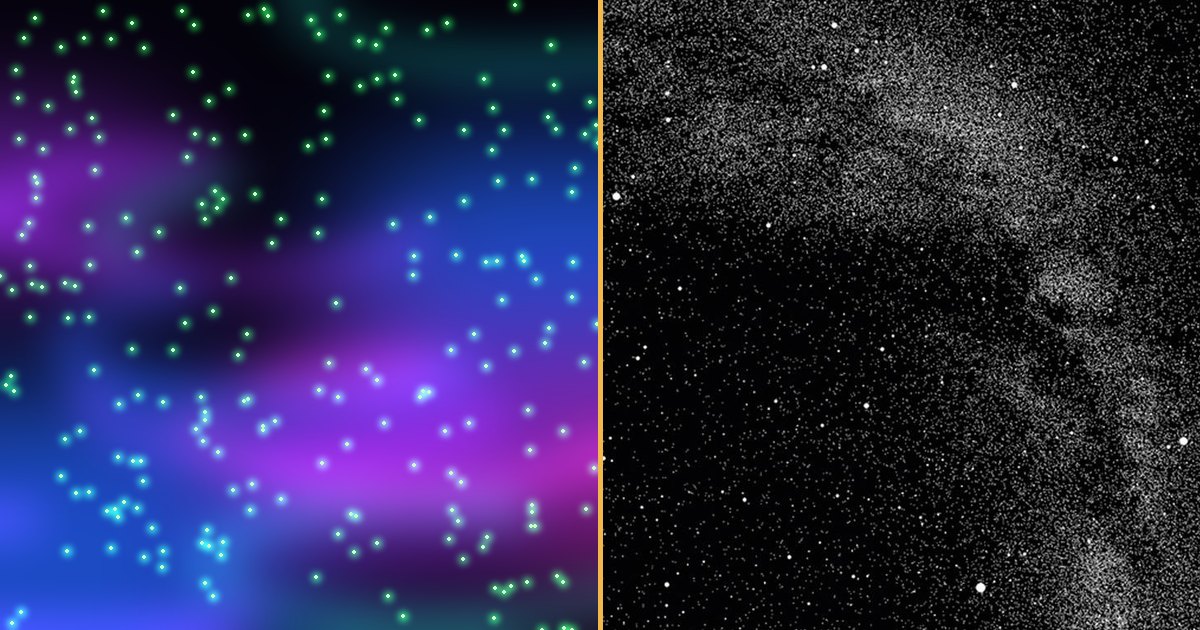
Types of star projector: four devices, one name
Under “star projector”, “galaxy projector” or “starry sky lamp”, shops sell pretty much anything that glows and looks vaguely like outer space. Technically, there are four completely different kinds of device behind the name. Which one you need depends on whether you want atmosphere or want to get to know the sky.
| Type | How it works | What you see | Price |
|---|---|---|---|
| Galaxy projector | Coloured LEDs behind a rotating film, usually plus a green laser with a diffraction grating | Swirling colour haze and hundreds of equally bright dots | budget |
| Star night light | A lamp under a perforated dome or figure | Soft, blurry star shapes, often with music | budget |
| Picture or slide projector | LED, picture disc and lens – like a small slide projector | Photos of planets, the Moon or star maps, adjustable focus | budget to mid-range |
| Home planetarium | Exposed star disc and objective lens | Thousands of stars in their real positions, with the Milky Way | from $129€ 129 |
Galaxy projector: colourful lights instead of constellations
The typical star projector sold online is a galaxy projector: a sphere or astronaut figure that throws blue, purple and green haze onto the ceiling. The “stars” come from a laser whose beam is split into hundreds of dots by a fine grating.
None of this has anything to do with the real night sky – the dots are equally bright, randomly spread and repeat in a pattern. That is not a flaw, just a different purpose: mood lighting for the bedroom, the gaming room or a party.
Tip: The rule of thumb when shopping – if the description says “nebula”, “aurora”, “galaxy” or “RGB” and says nothing about constellations, it is a mood light. A device with a real sky always states a number of stars and comes with interchangeable star discs.
In forums and on Reddit the same pattern comes up again and again: the first week is impressive, then the gadget becomes a bedside lamp. People who knowingly buy decoration are happy; people who hoped for constellations are disappointed.
By the way: Astroshop does not stock galaxy projectors. That is why we don’t link to any here – the choice at the big online retailers is huge and the devices are very similar.
Star projector for kids: laser, timer, age
Most star projectors end up in a child’s room – as a night light or sleep aid. There, three things matter more than any app feature: no dangerous laser, a timer and a quiet motor.
Laser class: the most important label to check
Many galaxy projectors use a Class 2 laser – that is, up to 1 milliwatt of visible light. If you glance at it by accident, your blink reflex protects you, but anyone who stares into the opening on purpose risks damage to the retina.
That is exactly what children do, because the sparkling dot is so exciting. In Europe, electric toys therefore fall under a separate standard (EN 62115) that only allows harmless Class 1 lasers. Galaxy projectors, however, are usually sold as lamps, not toys – so that limit does not apply.
⚠️ Caution: If the device says “Laser Class 2” (or “3R”), it does not belong in children’s hands. Place it out of reach on a cupboard or switch the laser off permanently. For children under eight, a projector with no laser at all is the better choice.
Timer, brightness and noise
A projector that runs all night disturbs sleep – light slows down the release of the sleep hormone melatonin. Look for a timer that switches off after 30 to 60 minutes, and for a dimming function.
The second annoyance is noise: many devices turn the film with a small motor that can whine like a mosquito in a quiet child’s room. Parents mention this strikingly often, as well as patterns that spin too fast and are too colourful and tend to keep small children awake.
And the music? Almost every projector has lullabies or ocean sounds built in, usually with poor sound. All that matters is that you can switch the sound off completely.
Which age suits which device?
| Age | Suitable | Why |
|---|---|---|
| Baby up to 2 years | Night light without laser, dimmed | Only as calm light, never in the cot; cables out of reach |
| 3 to 5 years | Projector without laser, with timer | Calm, slow images – colourful swirls tend to keep kids awake |
| 6 to 8 years | Picture projector with space photos | Children start naming planets and the Moon |
| 8 years and up | Projector with a constellation disc or a home planetarium | Now the real sky pays off, because the child finds the patterns again outdoors |
A star projector does not replace looking up outdoors, by the way. If the interest lasts, a small telescope is the logical next step – which one suits which age is explained in our guide telescope for kids.
Three laser-free projectors at Astroshop
Astroshop does not sell galaxy projectors, but it does stock three small picture projectors for kids – all without a laser. They show photos or maps, not a realistic sky, and are therefore more honest than most advertising promises.
Our tip for children aged eight and up is the Buki Planetarium HD: three discs with the Milky Way, constellations and the solar system, a motor rotates the image, and it switches off after 30 minutes. It runs on three AA batteries and costs about $39€ 39.
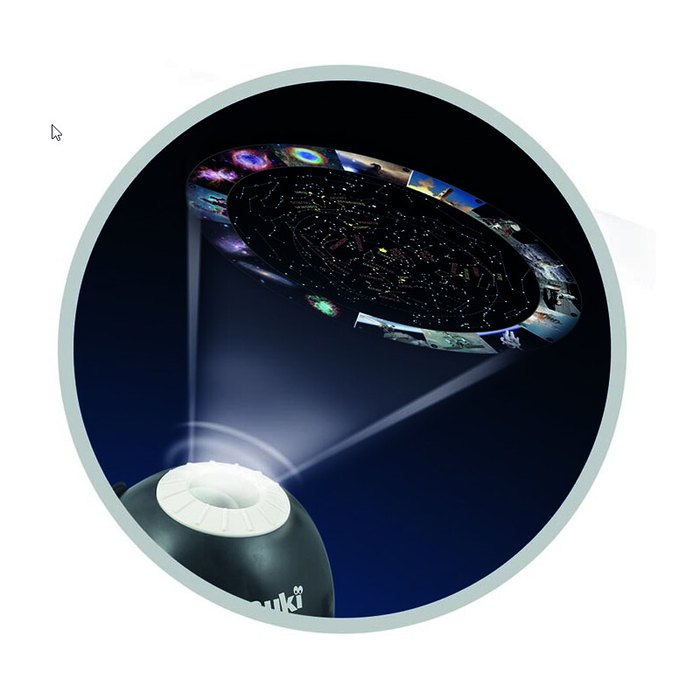
Our tip for kids: Buki Planetarium HD
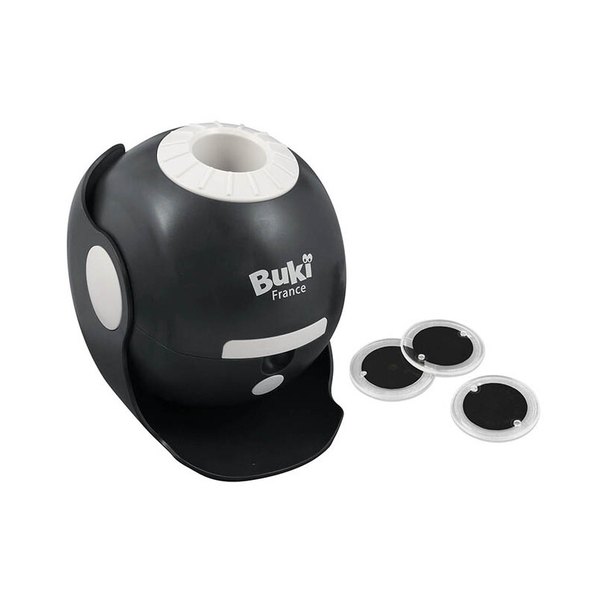
LED projector with lens and three discs – Milky Way, constellations, solar system. Motorised rotation, switches off after 30 minutes. Ages 8+.
Price: € 39
For younger children from six, Bresser makes two space picture projectors, each with 24 images on three discs – from the astronaut to the Sun. The Maxi version throws an image of about 61 × 66 cm from two metres away and costs about $24.90€ 24.90.
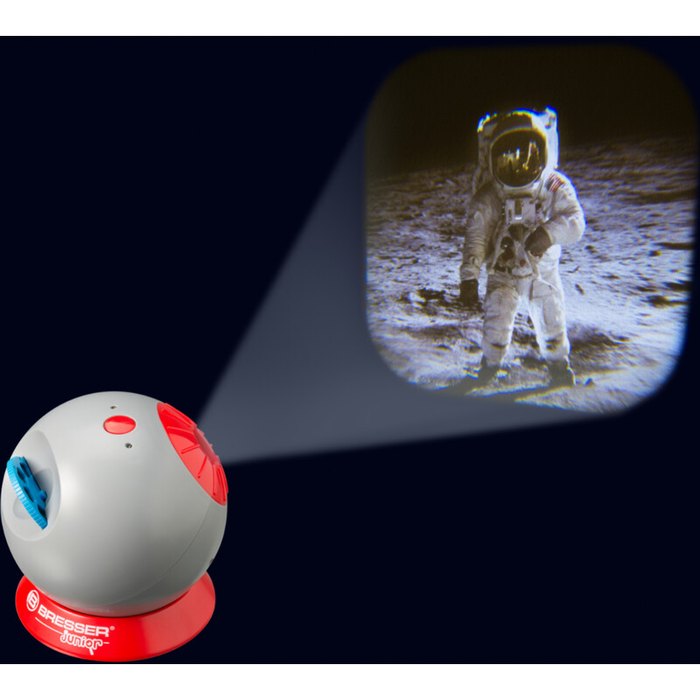
Bresser Junior Science Projector MAXI
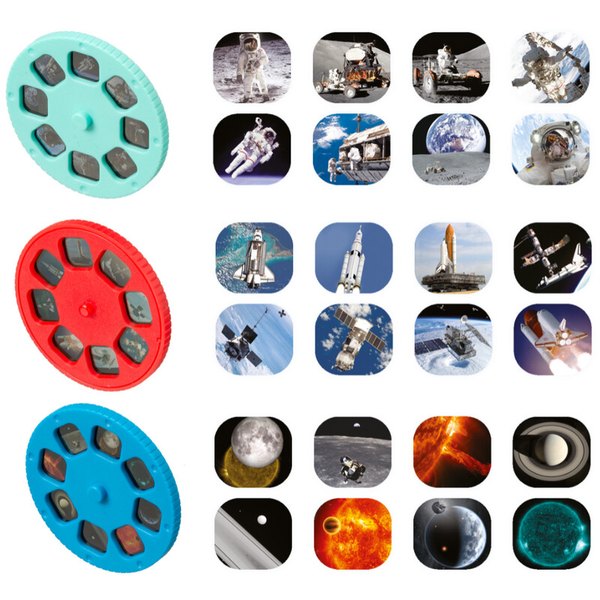
The bigger version: the same 24 space pictures, but about 61 × 66 cm at two metres. No laser, three AA batteries.
Price: € 24.90
Its little sister, the Bresser Junior Science Projector with night light for $19.99€ 19.99, is barely bigger than a torch and runs on button cells. Both are toys for looking at, not a planetarium – but as such they are fairly priced.
Galaxy projector for adults
For adults, a star projector is mainly decoration and relaxing light: in the bedroom, on movie night or at a party. Here the laser galaxy projector is fine, as long as no children in the house can get to it.
The better devices in this category let you set colour, brightness and rotation speed separately and stop the rotation completely. That sounds minor, but it is the difference between calm light and a disco ball.
App, Wi-Fi and speaker
Many projectors can now only be controlled by app, often via Tuya or “Smart Life” apps with a customer account and Wi-Fi access. With no-name brands you have no idea what happens to your data. A simple remote control is therefore not a step backwards but often the better choice.
Almost all models have a built-in Bluetooth speaker. Sound-wise it is no substitute for a proper speaker – treat it as a bonus, not a reason to buy.
Tip: Before buying, ask yourself whether you really need Alexa or Google control. If not, choose a model with a remote – it will still work when the app is no longer maintained in three years.
What to look for when buying
Star projector spec sheets look very much alike. These six points separate a good device from a bad buy.
| Criterion | What to look for |
|---|---|
| Laser | Class 1 or no laser at all for children’s rooms; Class 2 only out of reach |
| Timer and dimmer | Switch-off after 30–60 minutes, several brightness levels |
| Noise | Quiet motor or rotation that can be switched off; music must turn off completely |
| Room and ceiling | White, smooth ceiling, 2–3 metres away, room properly darkened |
| Discs and images | For picture projectors: are extra discs available, and what do they cost? |
| Power and controls | USB-C instead of a proprietary plug; remote control instead of app only |
On room size: a projector needs distance to throw a large image – on a bedside table right under a sloping ceiling, the projection becomes small and distorted. In rooms of normal height, about 2.40 to 2.60 metres, it works if the device sits at table or dresser height and points upwards at an angle.
How much does a star projector cost?
Most galaxy projectors are budget gadgets; only branded models with app control cost noticeably more. Picture projectors with a lens sit in the same range, real home planetariums start well above it.
| Class | Example | Good for | Price |
|---|---|---|---|
| Galaxy projector | many no-name and branded devices | decoration, bedroom, party | budget |
| Small picture projector | Bresser Junior Science Projector | kids 6+, night light | about $19.99€ 19.99 |
| Large picture projector | Bresser Junior Maxi | kids 6+, bigger image | about $24.90€ 24.90 |
| Constellation projector | Buki Planetarium HD | ⭐ Our tip for kidskids 8+, first constellations | about $39€ 39 |
| Home planetarium | Sega Homestar Pro Original | real starry sky, entry level | about $129€ 129 |
| Home planetarium | Sega Homestar Flux | real sky, brightest projection | about $189€ 189 |
With galaxy projectors, more expensive does not mean more realistic – a pricier device usually just has more colours and an app. You only make the leap to a real sky with a home planetarium.
Typical disappointments and how to avoid them
Read comments and forum posts about star projectors and you keep running into the same five disappointments.
- “These aren’t constellations at all.” Galaxy projectors show random dots – if you want constellations, you need a star disc.
- “It looked much brighter in the photo.” Product pictures are long exposures; in the room you need proper darkness.
- “The thing whirs.” The rotation motor is audible in a silent bedroom – can the rotation be switched off? Then it is no problem.
- “Only sharp in the middle.” Cheap lenses blur towards the edge; that also applies to simple picture projectors.
- “After a year the laser stopped working.” Running the projector for hours every night shortens its life – the timer protects the device, too.
How we know: We have not tested any star projectors ourselves. We analysed the comparison test by the German F.A.Z. Kaufkompass (28 devices), three threads on forum.astronomie.de and 12 Reddit threads with 260 comments (including r/Astronomy, r/Parenting, r/gadgets). Whenever someone there was looking for a realistic sky, the name Sega Homestar came up 23 times – no other device was mentioned more than eleven times.
🔭 For advanced users: if you want more – a real starry sky instead of dots of light
The Sega Homestar Flux projects 60,000 stars from an exposed disc, focused through a real objective lens – with the Milky Way, differences in brightness and constellations in the right place. At two metres the image measures around 2.7 metres; the rotation motor is quiet, but audible in a completely silent room.
The extra cost pays off if you or your child want to find the constellations outdoors later. For pure atmosphere it is money wasted. All models, differences and prices are in our home planetarium comparison.
For advanced users: Sega Toys Homestar Flux
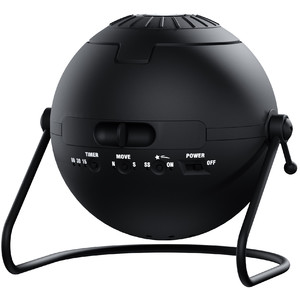
The benchmark among home planetariums: 60,000 real stars, adjustable focus, shooting-star function and sleep timer.
Price: € 189
Alternatives: real stars instead of dots of light
If what you really care about is the sky, there are cheaper ways than any projector. A planisphere (rotating star chart) for $7.95€ 19.90 and one clear evening show you more real constellations than a galaxy projector does in a whole year.
For a child’s room that should look like space all the time, an astronomy poster with constellations or the solar system is often the nicer solution. It doesn’t glow, but it teaches something – and no motor whirs.
A clever in-between is the Universe2go+ handheld planetarium: you slot in your smartphone, look at the real sky through it and see constellations and planets overlaid.
Omegon Universe2go+ Handheld Planetarium
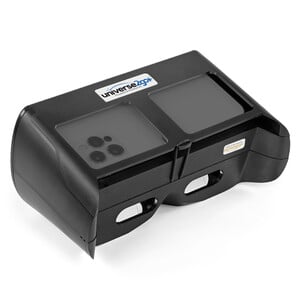
Slide in your smartphone and look up: augmented reality labels constellations, planets and nebulae live as you scan the sky.
Price: € 79
And if you really get hooked: good binoculars or a small beginner’s telescope will show you craters on the Moon, Jupiter’s moons and the Pleiades. That is the moment decoration turns into astronomy.
Frequently asked questions about the star projector
Are laser star projectors dangerous for the eyes?
With a Class 2 laser, a brief accidental glance is covered by the blink reflex. Looking into the opening on purpose, however, can damage the retina. For children’s rooms, choose devices without a laser or with a Class 1 laser.
From what age can a baby have a star projector?
As a dimmed night light without a laser, there is nothing against it even for babies, as long as the device is out of reach and not in the cot. A timer and calm, slow patterns matter more than age.
Which app does a galaxy projector need?
That depends on the manufacturer: many no-name devices use Tuya or “Smart Life” apps, branded devices their own apps. The manual or a QR code on the box names the right app. If you don’t want an app, choose a model with a remote.
Does a star projector show real constellations?
Galaxy projectors don’t – their dots are randomly spread. Only projectors with a constellation disc and, above all, home planetariums whose discs are exposed from real star maps show real constellations.
Can a star projector run all night?
Technically yes, but it rarely makes sense. Constant light disturbs sleep, and laser devices wear out faster. Set the timer to 30 to 60 minutes.
What is the difference between a star projector and a home planetarium?
A star projector is usually a mood light with an LED and a laser. A home planetarium projects a star disc with thousands of stars in their real positions through a lens – it is the only device that teaches you constellations for outdoors.
How big does the room need to be for a star projector?
A normal child’s room or bedroom is enough. Ideal are two to three metres to a light, smooth ceiling and a room you can get truly dark.
Read more
- Buy a home planetarium: models, prices and the best deal compared
- Astronomy posters: constellations and planets for your wall
- Telescope for kids: which device at which age
Links marked with an asterisk (*) are affiliate links. If you buy through them, we receive a small commission – the price stays the same for you.