By Alexander Merz · Updated on · Details checked on 8 November 2026
How do you like this device?
1 reader votes so far – we show the average from 5.
The DWARF 3 is a smart telescope from DWARFLAB: 35 mm of aperture, 150 mm of focal length, no eyepiece. Instead of looking through it, you photograph with it – an 8.3-megapixel sensor collects the light, and the app finds the target by itself.
1.35 kg, $549.00€ 529, fits in a daypack. The question is not whether it works – it does. It is whether it fits what you hope to get from the night sky.
⭐ In a nutshell
For large nebulae and open clusters the DWARF 3 is hard to beat in its price class: a 2.93° × 1.65° field at 2.75 arcseconds per pixel. For planets and small galaxies, 35 mm is simply not enough aperture.
Buy it if you want a light travel instrument, you want to photograph big nebulae, and you also want to film birds or landscapes by day.
Don’t buy it if you want planets to look big, you want to look through an eyepiece, or you want small galaxies resolved.
The DwarfLab DWARF mini Smart TelescopeDWARFLAB DWARF mini Smart Telescope ($419.00€ 429) is not a successor but a smaller sibling. Both are currently available.
Who the DWARF 3 is for
Smart telescopes are not smaller telescopes. They are their own class of instrument. They show you nothing through an eyepiece – they photograph, stack the frames in real time and send the result to your screen.
Anyone who has understood that will be very happy with the DWARF 3. Anyone expecting a classic telescope experience will be disappointed. So here is the honest sorting first.
The DWARF 3 fits you if this is what you want
- You travel a lot. 1.35 kg and 223 × 65 × 142 mm – it fits into any daypack, and the carry bag is included. No other smart telescope in this performance class is easier to transport.
- You want to photograph large objects. With almost three degrees of field, the North America Nebula, the Pleiades and the whole Heart Nebula each fit into a single frame. A classic telescope would need an expensive focal reducer for that.
- You live in a city. The built-in dual-band filter pulls the hydrogen and oxygen lines out of orange street light. Under Bortle 7 it produces images that are impossible there with the naked eye.
- You want to use the device by day as well. The tele channel’s 150 mm of focal length is equivalent to roughly 737 mm on full frame – plus AI object tracking and 4K video.
- Your budget is tight. At around $549.00€ 529 the DWARF 3 offers the finest sampling in its class. The next smart telescope with more aperture is the ZWO Seestar S50 Pro All-in-One Smart TelescopeZWO Seestar S50 Pro Smart Telescope with 50 mm at $999.00€ 999.
Stay away from the DWARF 3 if you expect this
- Planets. At 150 mm of focal length Jupiter is a disc a few pixels across and Saturn’s ring is a hint at best. Planets need focal length and aperture, not software.
- The view through an eyepiece. There isn’t one. The live image on your phone is impressive, but it is an image – not light falling into your own eye. For many stargazers that is half the appeal.
- Small galaxies and globular clusters. M 13 becomes a bright patch with a hint of granulation, not a cloud of stars. The resolution limit is 3.95 arcseconds – an 8-inch Dobsonian manages 0.58.
- A tripod. None is included. You need one rated for at least 3 kg – DWARFLAB’s own costs about $89€ 89.
- Long single exposures out of the box. By default the device works altazimuth, which rotates the field. The 60-second sub-exposures in the tele channel only happen in EQ mode, i.e. tilted over and aligned roughly to your latitude.
Best value: DWARFLAB DWARF 3 Smart Telescope
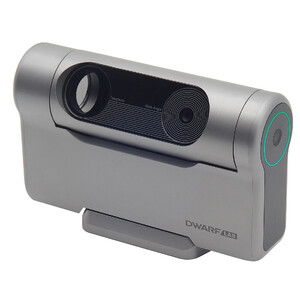
A 1.3 kg smart telescope: it photographs nebulae and galaxies straight to your phone, even from the city. The simplest way into astrophotography.
Price: € 529
If you want more aperture, go for the DWARFLAB Draco SHO ($1,599): 90 mm aperture and a cooled sensor, but a higher price class.If you want more aperture, go for the DwarfLab Draco Smart Telescope - SHO VersionDWARFLAB Draco SHO ($1,599.00€ 1,669): 90 mm aperture and a cooled sensor, but a higher price class.
Transparency: this assessment is based on manufacturer data, verified buyer experience and trade-press reports – sorted with our own experience from more than six years of telescope advice. The optical figures (field of view, pixel scale, resolution limit, light-gathering) we calculated ourselves. This is not an independent lab test.
What is the DWARF 3? A telescope that photographs instead of showing
The DWARF 3 is a rectangular box about the size of a thick book. Inside sit two complete optical systems: a telephoto with 35 mm of aperture and 150 mm of focal length for astrophotography, and a wide-angle with 6.7 mm at f/3.35 covering roughly 45° × 26° that helps with finding targets. Both share the housing with motors for two axes, a 10,000 mAh battery, 128 GB of storage and a Wi-Fi module.
You set it up on an ordinary photo tripod. After that the app takes over: it photographs the sky, matches the star pattern against a catalogue (this is called plate solving), knows to within arcminutes where the device is pointing, and slews to any target you pick.
Then the actual trick begins: instead of one long exposure the DWARF 3 takes hundreds of short ones and adds them up in real time. The picture on your display gets cleaner with every minute.
How that principle works technically and where its limits are, we explain in detail in our smart telescope overview. If you want to compare it with the classic route of camera plus mount, that comparison is under deep-sky astrophotography.
What 2,300 user reports say about the DWARF 3
We do not own a DWARF 3. What we did instead: we went through four astronomy communities systematically and counted how often each point comes up.
That is more robust than a single review. One reviewer has one unit and a few nights – this is hundreds of units and several years of practice.
The rating, criterion by criterion
| Criterion | Rating | What it rests on |
|---|---|---|
| Transport and packed size | ⭐⭐⭐⭐⭐ | By far the most frequent point of praise: 126 Reddit comments, 13 posts on astrotreff, 12 on forum.astronomie.de. The core statement is the same everywhere – the classic rig stays at home, the dwarf comes along. |
| Cold and dew | ⭐⭐⭐⭐⭐ | The most surprising finding. Seven posts document that the device’s own waste heat prevents fogging; sessions down to −25 °C are on record. It needs no dew heater. |
| Large nebulae and wide field | ⭐⭐⭐⭐☆ | Around 50 posts with the posters’ own images. The California Nebula fits into the field without a mosaic – a Seestar S50 cannot do that. |
| Setup and polar alignment | ⭐⭐⭐⭐☆ | 11 mentions, several of them “under 10 minutes” including polar alignment. Several owners of both systems say the DWARF also copes with trees in the calibration field, where the Seestar does not. |
| Manufacturer support | ⭐⭐⭐⭐☆ | In the German community 10 explicitly positive posts, including one replacement unit sent without argument. In the English-speaking community distinctly more mixed – one user had star artefacts dismissed as “within specification”. |
| Tracking and reject rate | ⭐⭐☆☆☆ | Reported reject rates run from 10 % to 50 % – at comparable exposure times. That points to unit-to-unit variation, not to operator error. |
| App and connection | ⭐⭐☆☆☆ | 21 Reddit comments and five users on Cloudy Nights report Wi-Fi drop-outs. On top of that a clearly documented series fault in the autofocus (see below). |
| Battery | ⭐⭐☆☆☆ | 2 to 4 hours in real deep-sky use. A power bank is not an accessory here, it is required kit. |
| Small objects and planets | ⭐☆☆☆☆ | The one point where all four communities say the same thing: the Ring Nebula M 57 turns into a little dot, and planets stay featureless marbles. The device was not built for that. |
The pattern behind it is unambiguous: what gets praised has to do with mobility and handling. What gets criticised has to do with endurance and reliability.
Take the device into the garden for an evening or on holiday and you will be happy. Try to run it through whole nights and you will hit its limits.
The trade press lands in the same place. In a head-to-head against the Seestar S30, heise online rated the DWARF 3 the most versatile device in the $500–600€500–600 class, praising the low-noise IMX678 and a surprisingly mature app. One feature that gets too little attention in the data sheets: the mosaic mode in the app stitches several frames together and widens the field when a target does not fit – that is how M 31 still works. And as with every smart telescope, the JPEGs from the app are good, but anyone who processes the raw data (FITS) themselves visibly gets more out of it.
What owners actually show in their images, sorted by type of target: emission nebulae work best thanks to the dual-band filter – Orion, North America, Rosette and Veil, even under light pollution. Galaxies such as Andromeda or the M 81/82 pair need darker skies, which is exactly where the travel-friendly design pays off twice.
DWARF 3 specifications: every figure at a glance
Some of the following numbers come from the manufacturer, some from our own calculation. Where we calculated, it says so.
| Feature | DwarfLab DWARF 3 Smart TelescopeDWARFLAB DWARF 3 Smart Telescope |
|---|---|
| Aperture (tele) | 35 mm |
| Focal length (tele) | 150 mm |
| Focal ratio | f/4.3 |
| Sensor | Sony IMX678, 1/1.8″, CMOS |
| Resolution | 3840 × 2160 pixels (8.3 MP, 4K) |
| Pixel size | 2.0 µm |
| Field of view, tele (calculated) | 2.93° × 1.65° (3.36° diagonal) |
| Pixel scale (calculated) | 2.75″ per pixel |
| Resolution limit (calculated) | 3.95″ (Rayleigh) |
| Full-frame equivalent (calculated) | around 737 mm |
| Wide-angle | 6.7 mm, f/3.35, roughly 45° × 26° |
| Filters | dual-band (Hα/OIII) and astro filter built in |
| Max. single exposure | 60 s (tele) |
| Storage | 128 GB internal |
| Battery | 10,000 mAh |
| Weight | 1.35 kg |
| Dimensions | 223 × 65 × 142 mm |
| Tripod thread | 1/4 inch (photo standard) |
| Protection rating | IP54 (splash-proof) |
| In the box | carry bag, solar filter, charging cable |
| Price | $549.00€ 529 |
| Buy | DwarfLab DWARF 3 Smart TelescopeDWARFLAB DWARF 3 Smart Telescope |
DWARF 3 magnification: why the figure means nothing here
The DWARF 3 has no magnification. It has no eyepiece, and without an eyepiece there is no magnification factor – what you see is an image on a phone, and its scale is set by the zoom in the app, not by the optics.
The photographic comparison figure: 150 mm of focal length corresponds to roughly 737 mm on full frame. Against a 50 mm standard lens that is a factor of about 15. People who ask for “magnification” out of habit usually mean that.
Two other numbers matter in practice: the field of view of 2.93° × 1.65° – as wide as six full moons side by side – and the pixel scale of 2.75 arcseconds per pixel. Both are in the table above.
And the honest sorting: anyone asking about magnification almost always wants to see planets big. For that the DWARF 3 is the wrong instrument – which telescope suits planets is here.
Weight, size and what really has to go in the backpack
The DWARF 3 weighs 1.35 kg and measures 223 × 65 × 142 mm – roughly the format of a thick hardback. The carry bag is included.
That alone will not get you through a night outdoors, though. Packed realistically:
- DWARF 3 with bag – 1.35 kg
- Photo tripod – 1.2 to 2.5 kg depending on model; rated for 3 kg or more
- Power bank – optional, extends the 3 to 4 hours of battery life
- Phone or tablet – mandatory, the device has no display
That comes to around 3 kg for the complete kit. An 8-inch Dobsonian, for comparison, weighs 20 kg and takes two trips to the car.
The sensor: Sony IMX678 with 8.3 megapixels
The IMX678 is a back-illuminated CMOS sensor in 1/1.8-inch format with 2.0-micrometre pixels. Small – but that is not a drawback here, it is the reason for the good sampling.
A sensor with larger pixels would throw away detail at 150 mm of focal length; one with even smaller pixels would only collect noise. The 2.0 µm are remarkably well matched to this optic.
The price you pay: on very faint objects each individual pixel collects little light, so read noise weighs relatively more. You compensate by stacking – and that takes time. Budget one to two hours on faint nebulae, not ten minutes.
Field of view and pixel scale: our own calculation
Sensor size and focal length determine the field exactly. 3840 pixels of 2.0 µm make a sensor 7.68 mm wide, which at 150 mm of focal length corresponds to 2.93 degrees. Vertically it is 4.32 mm and therefore 1.65 degrees. That leaves 2.75 arcseconds per pixel – for comparison, the full moon is around 1,800 arcseconds wide and so fills about 650 pixels.
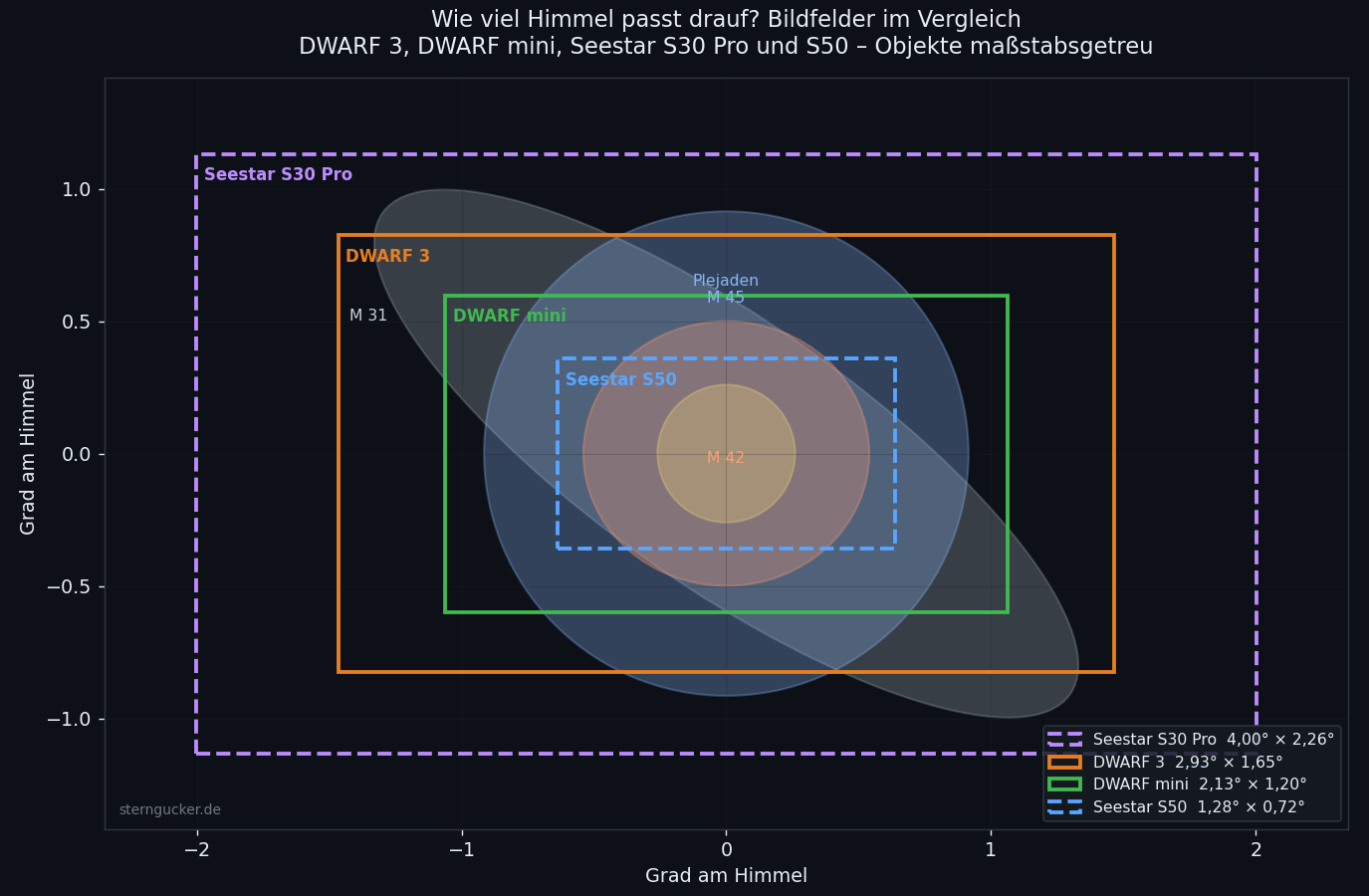
Image quality: what 35 millimetres of aperture can do
Aperture is not everything in photography – but it is the foundation. 35 millimetres collect around 34 times as much light as a dark-adapted human pupil (6 mm). Against a 30 mm device such as the Seestar S30 Pro it is 1.36 times as much; against the 50 mm Seestar S50 only half as much. Those ratios decide how long you have to expose for a given noise level.
Sampling: why the DWARF 3 leads here
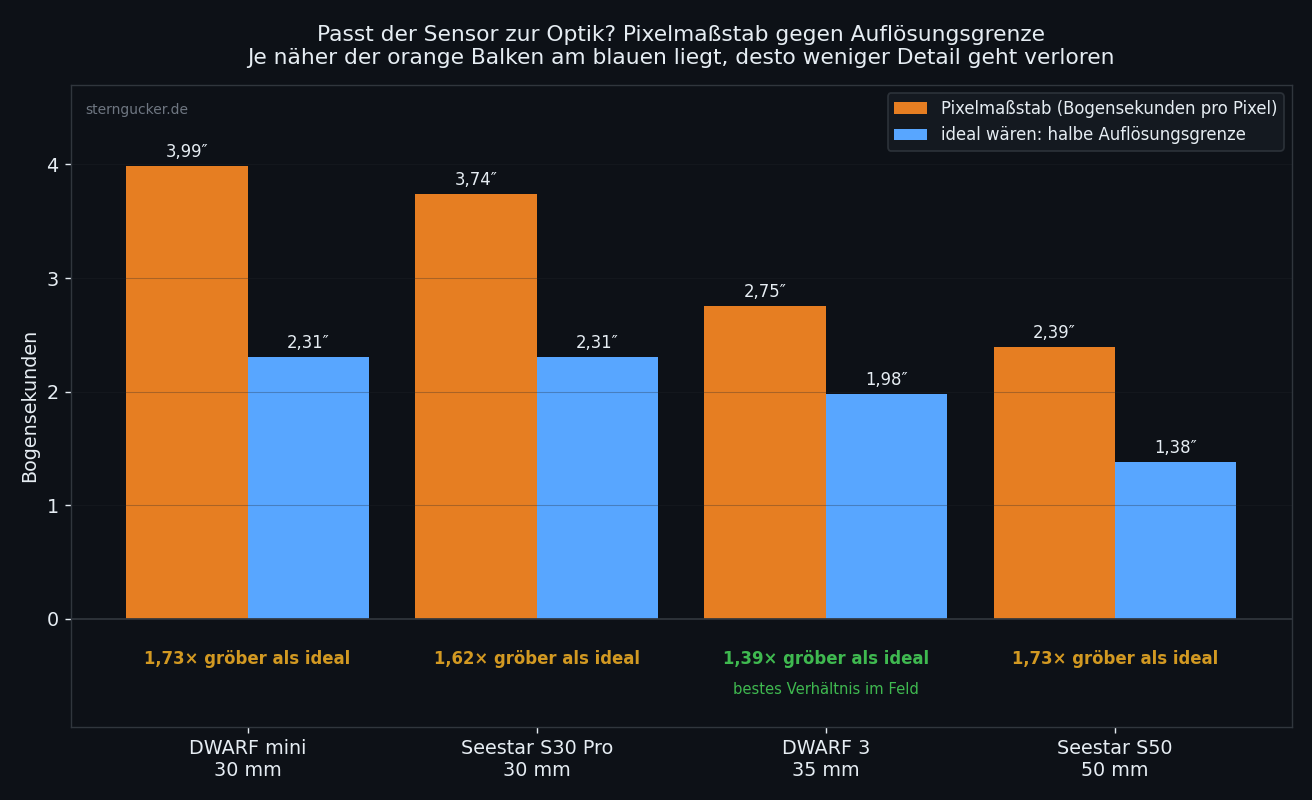
An optic only resolves as much as its aperture allows – for the DWARF 3 that is 3.95 arcseconds. For the sensor to capture that, one pixel should cover about half the resolution limit, i.e. roughly 1.98 arcseconds.
In fact it is 2.75 – that is 1.39 times the ideal and the best value in the field. DWARF mini and Seestar S50 sit at 1.73 times, the S30 Pro at 1.62 times.
Stacking: how long you really have to expose
Signal-to-noise grows with the square root of exposure time. Concretely: against a single one-minute frame, 15 minutes give an improvement by a factor of 7.7, 30 minutes a factor of 11, one hour 15.5 and two hours 21.9. So the step from 15 to 30 minutes buys noticeably more than the step from one hour to two – beyond about 45 minutes the curve flattens out.
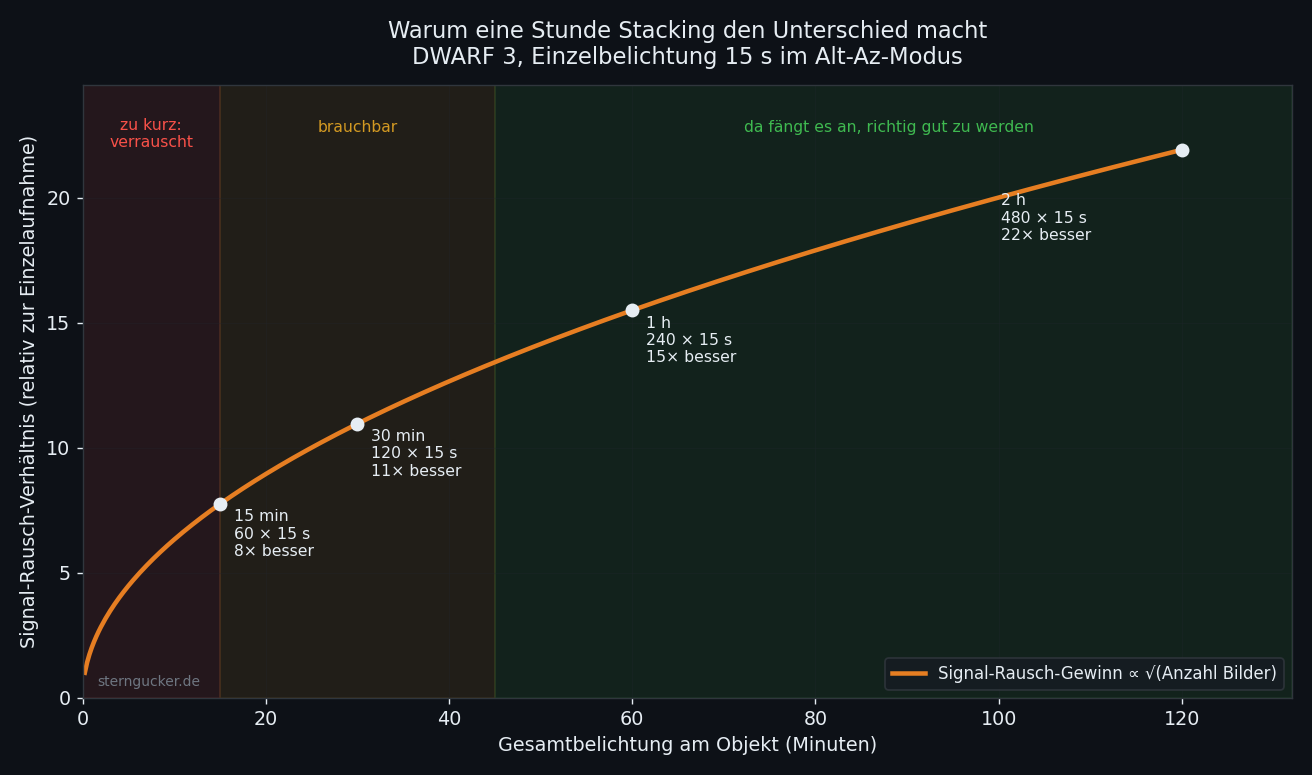
In practice that means: the Orion Nebula, the Dumbbell Nebula and the bright clusters are finished after a quarter of an hour. The North America Nebula, the Horsehead or faint galaxy arms need an hour upwards. If you want to work out the exposure planning yourself, use our astrophotography calculator.
EQ mode and the 60-second limit
Out of the box the DWARF 3 works altazimuth, i.e. with two axes parallel to the horizon. On long exposures that causes field rotation – stars at the edge turn into short arcs.
The software compensates while stacking, but it costs you edge area. In EQ mode the device is tilted over and approximated to a polar axis, which keeps longer sub-exposures clean. The ceiling in the tele channel is 60 seconds.
The built-in filter: city light and its limits
The dual-band filter passes only two narrow bands: hydrogen-alpha at 656 nanometres and doubly ionised oxygen at 500 nanometres. That is exactly where emission nebulae glow, while sodium and LED street lighting mostly radiates elsewhere.
The result under city skies is startling. What the filter cannot do is brighten galaxies and star clusters – those glow across the whole spectrum, and there the filter swallows more signal than stray light. For those targets you switch to the astro filter.
DWARF 3 images: which targets really work
The decisive question before buying is: does what I want to shoot even fit into the frame? At almost three degrees of field width the answer is usually yes – but not always.
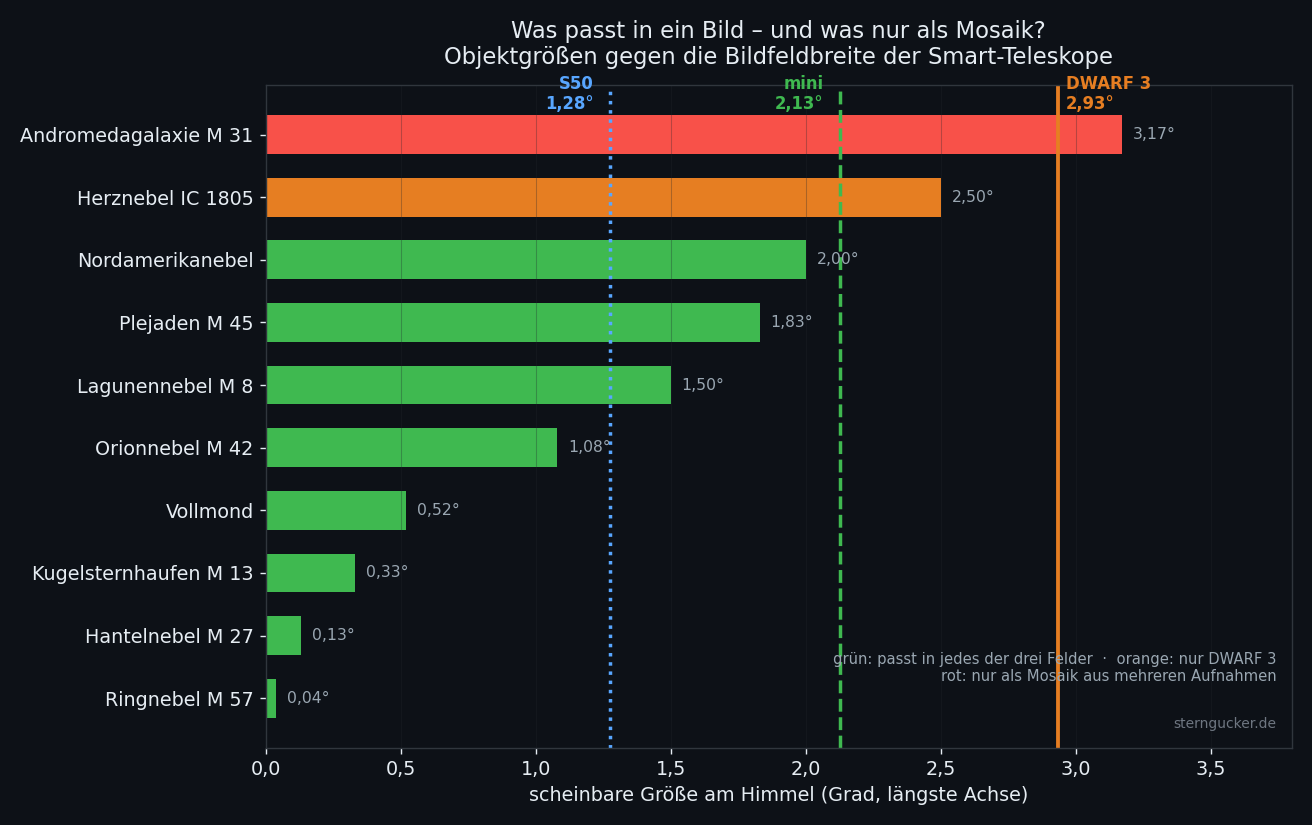
| Object | Size | In the DWARF 3 field | Recommended time |
|---|---|---|---|
| M 42 Orion Nebula | 1.1° | fits comfortably | 15–20 min |
| M 45 Pleiades | 1.83° | fits (not in the S50) | 20–30 min |
| NGC 7000 North America | 2.0° | just fits | 60–90 min |
| IC 1805 Heart Nebula | 2.5° | filled to the edge | 60–90 min |
| M 31 Andromeda | 3.17° | mosaic only | 60 min per tile |
| M 8 Lagoon Nebula | 0.75° | fits comfortably | 20–30 min |
| M 13 globular cluster | 0.33° | small in the field | 15 min |
| M 27 Dumbbell Nebula | 0.13° | very small | 30–45 min |
| M 57 Ring Nebula | 0.02° | tiny | 30–45 min |
| Full moon | 0.52° | fits, very bright | seconds |
The second half of the table is the telling part: small objects do fit, but they barely fill the frame. At 2.75 arcseconds per pixel the Ring Nebula M 57 occupies all of 26 pixels. You can make out the ring, and that is it.
If you specifically want small planetary nebulae and galaxies, you need more focal length. Among the smart telescopes the Seestar S50 had it – but it is no longer being built. New, the route then leads to a classic instrument from our beginner’s guide.
The DWARF 3 and solar eclipses: 2026 and 2027
Yes, the DWARF 3DWARF 3 can photograph solar eclipses – but only with the supplied front-mounted solar filter. Without it, concentrated sunlight destroys the sensor within seconds. Fit it before you point the device at the sun, not afterwards.
Two dates are coming up:
- 12 August 2026 – total over Greenland, Iceland and northern Spain, partial across most of Europe shortly before sunset.
- 2 August 2027 – total over North Africa and southern Spain, with a long duration of totality; partial again across Europe. Details and times
What the device does well here: it finds and tracks the sun by itself, and 2.93 degrees of field leave plenty of room around the solar disc – good for a time lapse across the whole event. What it cannot do: prominences and chromospheric detail, which need an H-alpha filter. Even at totality a camera with interchangeable optics has the advantage, because it can capture the corona across several exposure levels. Our guide to photographing a solar eclipse covers the technique, and what a solar eclipse actually is explains the geometry.
The same rule applies to sunspots on ordinary days: filter on, then it works. How to observe the sun safely is in our guide.
Handling and app: how a night runs
Screw the device onto the tripod, switch it on, connect to the DWARF’s Wi-Fi, open the app. Calibration runs automatically: the device slews, photographs, calculates – after one or two minutes it knows where it stands.
After that you tap a target in the object catalogue, the device slews to it, and within seconds you see the first image. After ten minutes it looks like a photograph.
What is annoying in practice: the connection runs through the telescope’s own Wi-Fi, so your phone has no internet meanwhile. Below about minus five degrees the app occasionally gets sluggish.
And the app’s translations are still rough in places. None of this is a deal-breaker, but these are the points that keep coming up in long-term use.
Battery life: what you actually get
The manufacturer quotes up to 5.5 hours at room temperature, and some dealers list the device at 3.6 hours. Field reports land at 2 to 4 hours in deep-sky use – depending on exposure time and temperature.
If you work in EQ mode with 60-second sub-exposures you are at the lower end. In time-lapse use the 10,000 mAh battery lasts considerably longer.
The battery is built in and cannot be swapped during a session. For a whole night there is no way around a power bank – the voltage trap that goes with it is further down this page.
What else you need for the first night
A phone or tablet is mandatory; without a display there is no way to operate the device. Android and iOS are both supported.
Also sensible: a red head torch so you are not dazzled every time you look at your phone, and a charged reserve battery for the phone itself – the app draws a fair amount of power. For more on combining phone and astronomy, see smartphone astrophotography.
Cold, dew and moisture: the DWARF 3 in winter
This is where the evidence differs most sharply from the common expectation. Dew is practically a non-issue on this device – seven independent posts confirm it.
The reason is deliberate design: waste heat from the electronics is routed to the front lens. Unlike its predecessor, the DWARF II, it needs no dew heater. Dew shields are now used almost exclusively as a baffle against street lights.
On cold, practice goes well beyond the official lower limit of 0 °C. A full night at −29 °C is documented, as is a measurement in which the device held −4 °C inside at −25 °C ambient.
The counter-evidence belongs here too: one user reports a shutdown at around −15 °C internal temperature despite a full battery. And at −18 °C frost started forming on the lens around three in the morning – without damage.
On moisture: the DWARF 3 is rated IP54. Dust, mist and dew are uncritical; rain is not. One user left it outside for a month, while others warn explicitly against that – we side with the warners.
DWARF 3 tripod: which photo tripod actually works
The DWARF 3 has an ordinary 1/4-inch photo thread and weighs 1.35 kg, so in theory it fits on any bargain-bin tripod. In practice that is the most common cause of blurred images: a wobbly tripod transmits every gust straight into the frame, the software rejects the shaken sub-frames, and an hour of exposure effectively becomes twenty minutes.
What matters: a load rating of at least 3 kg, so with plenty of reserve. Use the legs extended without the centre column, which is the wobbliest part of any tripod. Set up as low as you can – a DWARF 3 at knee height stands steadier than one at eye level, and since you are looking at your phone anyway, height is irrelevant. A solid aluminium tripod in the 60-to-$100100-euro range is entirely enough; carbon only pays off if you have to carry it far.
Tip from practice: hang your camera bag or a backpack from the hook under the centre column. The extra weight damps vibration noticeably and costs nothing.
If you have no suitable tripod yet and do not feel like comparing for long: DWARFLAB sells a photo tripod designed for the DWARF 3 (and the mini). It covers exactly the requirements above and saves a second order.
Tripod from the manufacturer: DWARFLAB Tripod DWARF 3 & DWARF mini
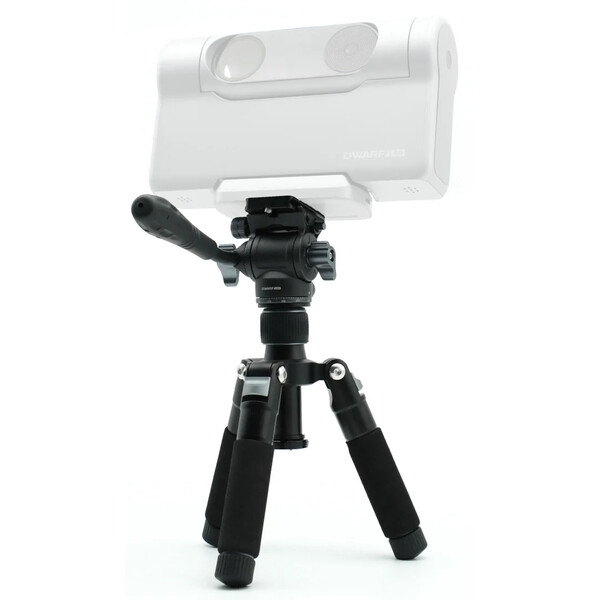
Tripod made by DWARFLAB for the DWARF 3 and DWARF mini – 1/4-inch thread, enough capacity, steady for long stacks. If you don't already own a solid aluminium tripod, this is the direct route.
Price: € 89
DWARF 3 accessories: what makes sense and what does not
Carry bag, solar filter and charging cable are already in the box – more than most competitors include. Only two additions are genuinely needed.
Worth having: a USB-C power bank from 10,000 mAh for long nights, and a stable tripod, see above. A memory card is not needed – the 128 GB internal are good for many nights, and transfers run over Wi-Fi anyway.
Skip: additional clip-on filters – the two that matter are built in and are swung in by software. Third-party dew shields help little, because the front lens sits deep inside the housing; in heavy dew, moving away from the damp meadow helps more. And tripod adapters for “more stability” are no substitute for a good tripod.
On the solar filter: it is certified and included, so sunspots and partial eclipses are straightforward. If you want to look with your own eyes or a second instrument at the same time, you need your own certified filters for that.
Solar film for a second instrument: Baader AstroSolar Safety Film OD 5.0
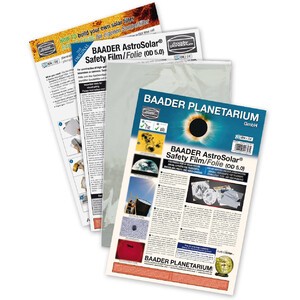
The standard film for safe solar observing: OD 5.0 passes just 1/100,000 of the light. Cut it, mount it – and sunspots snap into razor-sharp view.
Price: € 29
DWARF 3 vs Seestar S30 Pro: the direct comparison
ZWO’s Seestar S30 Pro is the most important competitor – and at $664.00€ 699 distinctly more expensive. It has 30 millimetres of aperture at 160 millimetres of focal length and a Sony IMX585 in 1/1.2-inch format with 2.9-micrometre pixels.
| Feature | DwarfLab DWARF 3 Smart TelescopeDWARFLAB DWARF 3 Smart Telescope | ZWO Seestar S30 Pro Smart TelescopeZWO Seestar S30 Pro Smart Telescope |
|---|---|---|
| Price | $549.00€ 529 | $664.00€ 699 |
| Aperture / focal length | 35 mm / 150 mm | 30 mm / 160 mm |
| Sensor | IMX678, 2.0 µm | IMX585, 2.9 µm |
| Field of view (calculated) | 2.93° × 1.65° | 4.00° × 2.26° |
| Pixel scale (calculated) | 2.75″/px | 3.74″/px |
| Weight | 1.35 kg | 1.65 kg |
| Battery | 10,000 mAh | 6,000 mAh, approx. 6 h |
| Daytime use | yes, with AI tracking | yes, day mode |
| Tripod | needed separately | built in |
| Buy | DwarfLab DWARF 3 Smart TelescopeDWARFLAB DWARF 3 Smart Telescope | ZWO Seestar S30 Pro Smart TelescopeZWO Seestar S30 Pro Smart Telescope |
The S30 Pro delivers the wider field and the more mature ecosystem; the DWARF 3 the finer sampling, the lower weight and the lower price. If you want M 31 in one frame, take the S30 Pro. If you want detail in smaller nebulae and have to save weight, take the DWARF 3. Every difference in detail is in our full head-to-head.
The wider field: ZWO Seestar S30 Pro Smart Telescope

ZWO's benchmark smart telescope: a polished app, mosaic mode and stunning results in minutes.
Price: € 699
DWARF 3 vs DWARF mini: is the extra money worth it?
Since late 2025 there has been the DwarfLab DWARF mini Smart TelescopeDWARFLAB DWARF mini Smart Telescope at $419.00€ 429. At 840 grams it is lighter again, and it uses a sensor with 2.9-micrometre pixels at Full HD resolution. The larger pixels collect more light each, and EQ mode allows sub-exposures up to 90 seconds instead of 60.
The small sibling in detail – the tripod question, the battery in practice and what owners report – is on our DWARF mini page.
| Feature | DwarfLab DWARF 3 Smart TelescopeDWARFLAB DWARF 3 Smart Telescope | DwarfLab DWARF mini Smart TelescopeDWARFLAB DWARF mini Smart Telescope |
|---|---|---|
| Price | $549.00€ 529 | $419.00€ 429 |
| Resolution | 3840 × 2160 (4K) | 1920 × 1080 (Full HD) |
| Pixel size | 2.0 µm | 2.9 µm |
| Field of view (calculated) | 2.93° × 1.65° | 2.13° × 1.20° |
| Pixel scale (calculated) | 2.75″/px | 3.99″/px |
| Max. single exposure | 60 s | 90 s |
| Storage | 128 GB | 64 GB |
| Battery | 10,000 mAh | 7,000 mAh |
| Protection rating | IP54 | not stated |
| Weight | 1.35 kg | 840 g |
| Buy | DwarfLab DWARF 3 Smart TelescopeDWARFLAB DWARF 3 Smart Telescope | DwarfLab DWARF mini Smart TelescopeDWARFLAB DWARF mini Smart Telescope |
What the step up to the DWARF 3 buys is above all resolution: it records four times as many pixels across the same patch of sky. Anyone who later crops or prints large notices that immediately.
On top of that come the bigger battery, twice the storage and the splash-proof rating. Conversely the mini has a real advantage on very faint emission nebulae: larger pixels plus 90-second sub-exposures give quieter backgrounds.
Is the DWARF mini the successor to the DWARF 3?
No. The mini is a smaller sibling, not a successor. Both devices are currently available, and the DWARF 3 sits above the mini in the product line.
A real successor to the DWARF 3 has so far been neither announced nor held out by the manufacturer.
Lighter and cheaper: DWARFLAB DWARF mini Smart Telescope
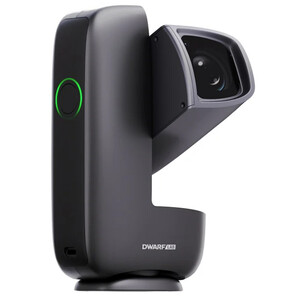
Just 840 g: the lightest smart telescope. Bigger pixels, 90-second exposures – but Full HD instead of 4K.
Price: € 429
DWARF 3 vs Seestar S50: 35 against 50 millimetres
⚠️ Important: the Seestar S50 is no longer in production and our partner no longer stocks it. ZWO confirmed the end of production in April 2026.
The comparison stays useful if someone offers you a used one. New, the Seestar line offers the ZWO Seestar S30 Pro Smart TelescopeZWO Seestar S30 Pro Smart Telescope ($664.00€ 699) and, since August 2026, the successor ZWO Seestar S50 Pro All-in-One Smart TelescopeZWO Seestar S50 Pro Smart Telescope ($999.00€ 999) – all the data in Seestar S50: price and comparison.
How the DWARF mini fares against the Seestar S30 Pro is in our comparison Seestar S30 Pro vs DWARF mini.
Optically the Seestar S50 played in a different league: 50 millimetres of aperture at 250 millimetres of focal length. It collects almost twice as much light as the DWARF 3 and reaches 2.39 arcseconds per pixel – at a field of only 1.28° × 0.72°, though.
That is the decisive difference: the S50 shows small objects bigger and brighter, the DWARF 3 shows large objects completely. The Pleiades simply do not fit into the S50.
The Ring Nebula M 57, on the other hand, is imaged twice as large in the S50. There is no better device here, only a decision about what you want to photograph.
Where all the current models stand next to each other is in The best smart telescopes 2026.
Birdwatching and daytime photography: the second job
Among the smart telescopes the DWARF 3DWARF 3 is the only one that is genuinely fun by day. 150 millimetres of focal length on the small sensor corresponds to roughly 737 millimetres full-frame – a range for which you would otherwise buy a four-figure telephoto lens. Add AI-assisted object tracking that keeps a bird in frame while you stand beside it and watch.
You still have to stay honest: for serious ornithology this does not replace a fast spotting scope. At f/4.3 and in poor light it gets dark quickly, and the shutter lag is too long for birds in flight.
For a stork’s nest, a bird of prey’s eyrie or a garden feeder, though, the result is astonishing. As the second use of an astronomy device, this is currently without competition.
DWARF 3 price: what it costs and when it gets cheaper
The street price has been stable at $549.00€ 529 since spring 2026 (guide figure from our product database; price and availability are on the product page). At launch it was higher; the current level settled once the DWARF mini arrived alongside it as the cheaper alternative.
DWARF 3 Black Friday: is it worth waiting?
In November 2025 the device was noticeably below its normal price for a while. Whether that repeats in 2026 is open – smart telescopes are in strong demand in autumn, which makes discounts less likely.
Five to ten per cent is realistic, so roughly 30 to 60 in your currency. If you want to buy in summer and take the summer sky with you, you lose nothing essential by doing so; if you are only going to start in winter anyway, you can wait out November.
A second reason to wait comes from the same manufacturer: the DWARFLAB Draco is a much larger sibling – 90 instead of 35 millimetres of aperture, a cooled sensor, guiding announced. It plays in a different price league, though ($1,399.00€ 1,499), and does not replace the DWARF 3.
Buying a DWARF 3 used: what to check
The used market is still thin; in Europe prices sit at 450 to $520520 euros. Three things you have to check:
- The battery. It cannot be replaced. On units from the first batch that is a real risk – ask for the purchase date.
- The motors. Nothing should click or judder while slewing.
- What is included. Above all the solar filter, which is hard to get separately.
At a saving of 100 to 150 against a new unit with full warranty, buying used is only worth it if the device is demonstrably young.
The eight problems that only show up in long-term use
None of these points is in a brochure and hardly any in a review – they only appear once you have used the device for months. All eight are documented repeatedly and independently in the forums.
1. The autofocus fails in astro mode
At least five users independently report the same fault: by day the device focuses cleanly, in astro mode it fails – and with it the whole calibration. The night is lost.
At first support had to log into the device over SSH and change the infinity focus value by hand. Since app and firmware version 1.3.21 you can fix it yourself.
2. The power bank trap
If you run the device on external power, you need to know this: if the power bank’s voltage drops abruptly, the DWARF 3 does not fall back to its internal battery. The running session is gone.
What you need is a power bank that lowers its voltage gradually instead of simply switching off. At least 20,000 mAh is recommended – several reports say that gets you through a whole night.
3. Play in the azimuth axis
Five users describe mechanical play in the slewing axis that pushes the maximum exposure time down. In one case it got worse over the time of use – from 60 seconds to a laborious 30.
In none of these cases is a successful repair documented. That also explains the wide spread in reject rates: to a good extent it is a unit lottery.
4. No field rotator
Ten mentions, and several experienced users consider this the biggest design drawback of all smart telescopes in this class. The framing cannot be rotated.
The practical consequence: in EQ mode the Andromeda Galaxy does not fit the field, and you have to take the detour through a mosaic. The Seestar S50 can at least rotate its frame.
5. Stellar Studio has a hard ceiling
The device’s own image processing gets a lot of praise – until you integrate a lot. Above roughly 725 sub-frames the megastack refuses to work.
The way out, from practice: pull the sub-frames off the device over FTP and stack them on a computer. After that the device’s storage does not matter either.
6. The factory darks are useless for cool nights
The supplied dark frames were taken at 30 to 32 °C and are stored in the firmware. On a typical central European night they simply do not match.
The German-speaking community responded with its own dark libraries covering temperature ranges from −4 to +30 °C. If you want to work cleanly, there is no way around taking your own darks.
7. The dew shield collides with the mechanics
Eight posts on the same subject: a dew shield or 3D-printed baffle hits the housing during calibration, because the lens barrel extends and retracts.
8. The device does not notice that it is looking at a wall
Despite a wide-angle camera, a compass and a tilt sensor, the DWARF 3 gives no warning when the target sits behind a tree or a house wall. It exposes into nothing without complaint.
For a device aimed at beginners, that is the most awkward gap. You have to know where the object currently stands – which is exactly what the automation was supposed to take off your hands.
Smart telescope or classic telescope?
This question matters more than any model comparison. For $549.00€ 529 you can also get a very decent classic telescope – it just does something completely different.
The smart telescope clearly wins if you want to photograph, live under city skies, have little space or have to transport the instrument often. An 8-inch Dobsonian shows you precious little nebulosity from a balcony in the middle of a city; the DWARF 3 delivers usable images there.
When the classic telescope is still the better buy
As soon as planets, lunar craters, Saturn’s rings, Jupiter’s moons, double stars or resolving globular clusters are on your list, the case is clear: for those you need aperture and focal length, and in the classic design you get them for a fraction of the money. A 130-millimetre Newtonian resolves 0.89 arcseconds, an 8-inch even 0.58 – the DWARF 3 manages 3.95. On top of that comes the appeal of having the light of a star cluster 25,000 years away land directly in your own eye.
If you can only buy one instrument and you really want to explore the sky, buy a telescope; the smart telescope is the addition, not the replacement. For a start we recommend the Heritage 130/650 – compact, and optically well above what department-store telescopes offer at that price. If you want more aperture and have the space, the Apertura AD8 8" Dobsonian TelescopeSkywatcher Dobson Telescope N 200/1200 Skyliner Classic at $649.95€ 479 offers the best aperture-per-unit-of-money there is – details in our beginner’s guide.
The classic counter-proposal: Skywatcher Dobson Telescope N 130/650 Heritage FlexTube
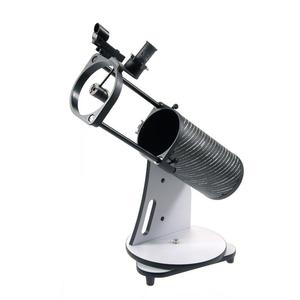
A compact tabletop Dobson with a true parabolic mirror. Folds down, fits in a bag: the Moon, planets and the bright deep-sky classics.
Price: € 265
How much magnification, field of view and resolution a given telescope delivers is worked out by our telescope calculator. And if the budget is tighter, telescope under $300300 euros has the recommendations for the class below.
Verdict: who is the DWARF 3 for?
The DWARF 3 is currently the best smart telescope under $600€700. In its class it has the finest sampling, the second-largest field, the biggest battery, the most storage and, uniquely, a real second use by day. For travellers, city dwellers, balcony astronomers and anyone who wants to be ready to go in five minutes in the evening, it is a clear recommendation. If you want more aperture, go for the DWARFLAB Draco SHO ($1,599)DwarfLab Draco Smart Telescope - SHO VersionDWARFLAB Draco SHO ($1,599.00€ 1,669) – 90 mm instead of 35 mm, but a higher price class.
It is not a recommendation if you want to see planets, look through an eyepiece or image small objects large. There are better routes for that – some cheaper, some more expensive, but in every case more suitable. And it is not a recommendation if the idea of software standing between you and the sky bothers you.
If you are torn between models: more field for more money is the Seestar S30 Pro, more focal length was the discontinued Seestar S50, and less weight with less resolution is the DWARF mini. All four side by side are in The best smart telescopes 2026.
DWARFLAB Draco SHO at High Point Scientific →View the DWARFLAB Draco SHO →
The DWARF 3 is still available at High Point Scientific: DWARFLAB DWARF 3 ($549).The DWARF 3 is still available directly from DWARFLAB: DWARFLAB DWARF 3DWARFLAB DWARF 3 ($549.00€ 529).
DWARF 3 review: frequently asked questions
What does the DWARF 3 cost?
The current price is $549.00€ 529 (guide figure from our product database; price and availability are on the product page). Carry bag, solar filter and charging cable are included; a photo tripod you have to buy separately or already own.
Is a cheap photo tripod enough?
It works, but it costs image quality. At 1.35 kg of device weight the tripod should carry at least 3 kg and be used without the centre column extended. A solid aluminium tripod for 60 to 100 is entirely enough – if it wobbles, the software rejects sub-frames and your effective exposure time drops.
How does it compare to the Seestar?
Against the ZWO Seestar S30 Pro Smart TelescopeZWO Seestar S30 Pro Smart Telescope ($664.00€ 699) the DWARF 3 wins on price, weight and sampling, and loses on field of view and the built-in tripod. Against the Seestar S50 it wins on field of view and loses on light-gathering and focal length – though the S50 is out of production and no longer available new. There is no device that is better across the board, only different targets.
Is a successor to the DWARF 3 planned?
No successor has been announced or hinted at to this day. The DWARF mini, which appeared in late 2025, is explicitly a smaller sibling and does not replace the DWARF 3 – both devices are offered alongside each other.
Is it really good for birdwatching?
For watching from a fixed position yes, for birds in flight no. The 150 millimetres of focal length correspond to roughly 737 millimetres full-frame, and there is AI object tracking. It does not replace a fast spotting scope, but as the second use of an astronomy device it is without competition.
Can the DWARF 3 handle planets?
No. At 150 millimetres of focal length and 3.95 arcseconds of resolution limit, Jupiter stays a disc a few pixels across and Saturn’s ring is a hint. For planets you need aperture and focal length – which telescope suits planets is here.
How long does the battery last?
The manufacturer quotes up to 5.5 hours for the 10,000 mAh battery in astro use at room temperature, dealers 3.6 hours, and field reports land at 3 to 4 hours – less in winter. You can attach a power bank over USB-C while running, which makes a whole night unproblematic.
Does the DWARF 3 work in the city?
Yes, and that is one of its strengths. The built-in dual-band filter passes only the hydrogen and oxygen lines and blocks most street lighting. On emission nebulae this works excellently. On galaxies and star clusters the filter does not help – for those you need darker skies even with a smart telescope.
Do I need a dark sky?
Not for emission nebulae – the dual-band filter does the work there, and usable images are possible under Bortle 7. For galaxies, reflection nebulae and star clusters the filter cannot help, and every magnitude of darker sky shows directly in the result.
Do I need a phone or tablet?
Yes, mandatory. The device has no display of its own and is controlled exclusively through the DWARFLAB app, available for Android and iOS. The connection runs over the telescope’s own Wi-Fi, so your device has no internet access during the session.
Can you photograph the sun with the DWARF 3?
Yes, a certified solar filter is included. That makes sunspots and partial eclipses straightforward. Important: the filter must be fitted and secured before you switch on, and anyone who wants to look at the sun directly alongside needs their own certified eclipse glasses.
Read on at Sterngucker
- Best smart telescope 2026 – every model compared
- Seestar S30 Pro vs DWARF 3 – the direct duel
- Seestar S30 Pro – the wider field
- DWARF mini – lighter and cheaper
- Deep-sky astrophotography – the classic route to the same goal
- Astrophotography calculator – plan your exposure yourself
- Best beginner telescopes – the classic instruments compared
- Buying a telescope – the full guide
How many frames does the DWARF 3 typically reject?
Reports vary widely: from around 10 % at 30 seconds to 50 % at the same settings. A frequently quoted guide figure in EQ mode is about one third rejected. The wide spread comes from unit-to-unit variation in the mechanics, not from operator error – at 90 seconds often only a third of the frames stay usable.
Which exposure time and gain make sense?
30 seconds at gain 60 has established itself as the working point, and in EQ mode 60 seconds also work. Without EQ mode, 15 seconds is the safe value. There is no real consensus on 45 versus 60 seconds – it depends on target altitude, filter and the individual unit. In practice more total time with shorter sub-frames beats longer sub-exposures with a high reject rate.
Can the DWARF 3 go on a plane?
By size, yes – it is carry-on friendly and gets praised for exactly that. DWARFLAB does not state the watt-hour figure that airlines care about, however, and nobody in the forums could supply it reliably either. At 10,000 mAh you are well below the usual 100 Wh limit by calculation; if you want certainty, ask your airline before flying.
Does the DWARF 3 need a dew heater?
No. Waste heat from the electronics is routed to the front lens, and field reports consistently confirm that the optics stay dry – even when everything around them fogs up. On the DWARF 3 a dew shield is mainly a stray-light baffle. One caution only: calibrate first, then fit the shield.
Is the DWARF mini better than the DWARF 3 for deep sky?
On faint deep-sky objects, often yes. The mini has larger pixels, collects more light per pixel and tracks for up to 180 seconds, far longer than the DWARF 3’s real 60 to 90. The DWARF 3 in turn has the larger field, more detail, faster image processing and is clearly superior on the moon and the sun. Several owners of both would pick the mini for pure astrophotography.
Are the images from Stellar Studio real or AI-generated?
They are real exposures. The AI components in Stellar Studio concern noise reduction and star correction, not image content. You can check for yourself: the sub-frames can be pulled off the device over FTP and stacked with free software such as Siril – satellite and aircraft trails are visible in them. What does get criticised in the German-speaking community is that the cloud processing sometimes looks over-sharpened.