By Alexander Merz · Updated on
The Celestron NexStar 4SE is a compact 102 mm Maksutov-Cassegrain on a computerized single-arm GoTo mount. 1325 mm focal length (f/13), 23 lb in total, with a database of about 40,000 objects it slews to on its own.
It is a GoTo telescope built for the Moon and planets, not for faint galaxies.
⭐ In short: The 4SE ($749.00€ 1,120) suits you if you want sharp Moon and planet views, automatic finding and a scope you can carry in one trip. Owners praise exactly that.
For the same money an 8-inch Dobsonian shows four times the light, and for deep-sky photos a smart telescope does far more. The most common owner complaint is hitting the aperture ceiling.
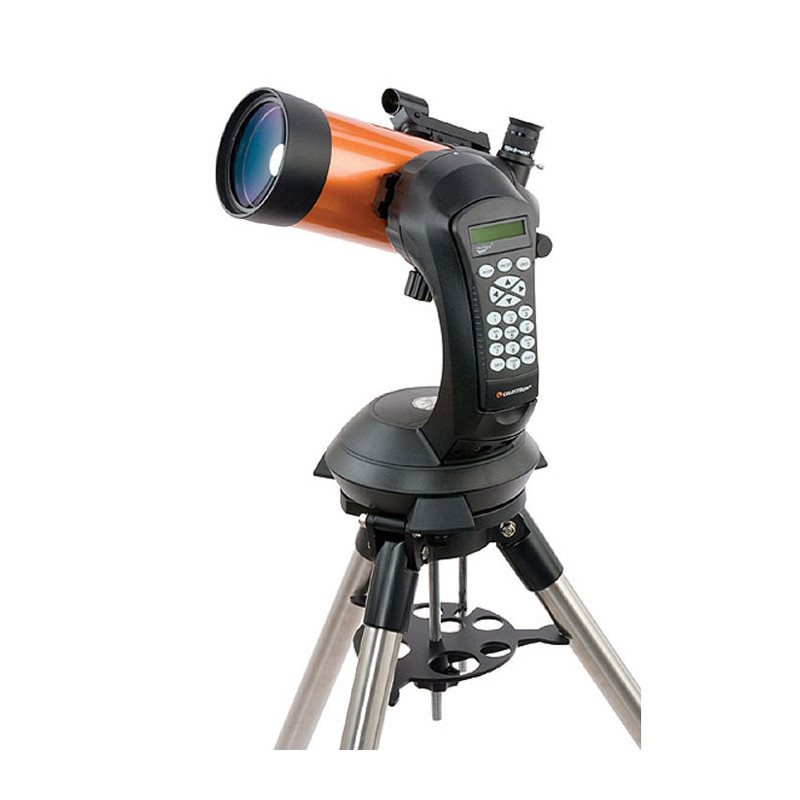
Transparency: we do not own a 4SE. This guide combines Celestron’s specs with a count of 71 owners from 321 Reddit threads. How we review telescopes.
Celestron NexStar 4SE specs
The 4SE packs a long focal length into a short tube: ideal for high magnification, poor for wide fields. Specs as listed by Celestron and High Point Scientific in September 2026:
| Spec | NexStar 4SE |
|---|---|
| Optical design | Maksutov-Cassegrain, StarBright XLT coatings |
| Aperture / focal length | 102 mm / 1325 mm, f/13 |
| Included eyepiece | 25 mm (53x) |
| Diagonal | Built-in flip mirror, camera port at the back |
| Finder | StarPointer red-dot finder |
| Mount | Single-arm alt-az GoTo, NexStar+ hand control |
| Database | 38,181 objects (Celestron) |
| Power | 8 AA or 12 V external |
| Weight | Tube 6 lb, mount 7 lb, tripod 10 lb, total 23 lb |
| WiFi | Only with the optional SkyPortal module |
| Price | $749.00€ 1,120 |
Battery life: Celestron gives no figure. Owners report that a set of AAs drains quickly with a lot of slewing (one measured about two hours), so several switch to a 12 V lithium pack.
What 71 owners report
We searched 321 Reddit threads that mention the 4SE (January 2021 to September 2026) and read 2,904 comments. 71 people clearly own or owned one; each is counted once per topic.
| Topic | Owners | What they say |
|---|---|---|
| Posted own Moon and planet results | 9 | Jupiter, Saturn, Venus and the Moon through the 4SE |
| Portability praised | 6 | Set up in minutes, one trip to the car |
| Optics and planet views praised | 5 | Sharp Moon and planet views |
| GoTo works well | 4 | Once aligned, it finds its targets |
| Aperture ceiling, upgraded | 10 | Deep-sky objects faint, moved to a bigger scope |
| Alignment failures at first | 7 | Usually wrong date, time or time zone |
| Motor or electronics faults | 9 | Mostly on used or 10-year-old units |
| Needed external power | 3 | Power bank or 12 V pack |
| Dew or plastic-gear complaints | 0 | Not reported by owners in our sample |
How to read these numbers: 71 owners give a direction, not a survey. People post when something goes wrong, so problems are over-represented.
The aperture ceiling: what 102 mm can and cannot show
Ten owners outgrew the 4SE, more than for any other topic. The Moon, Jupiter’s bands and Saturn’s rings look crisp, but most galaxies and nebulae stay faint smudges.
At its price, the 4SE competes with scopes that show far more. You pay for the GoTo and the compact size, not for aperture.
Alignment: the first-night hurdle
Seven owners had failed alignments at first, and the cause was almost always the setup, not the scope. The hand control needs exact inputs before it can find anything.
Tip: Level the tripod, enter the date as MM/DD/YYYY, set the correct time zone and daylight saving time, and center each alignment star at high magnification. That fixes most “it points at the wrong spot” reports.
NexStar 4SE vs 6SE, 8-inch Dobsonian and smart telescopes
Which alternative fits depends on what you want to see. The 4SE sits between cheap manual scopes and big GoTo telescopes.
| Alternative | Better than the 4SE at | Worse at |
|---|---|---|
| 8-inch Dobsonian8-inch Dobsonian | 4x the light, galaxies and nebulae | 52 lb, no GoTo |
| NexStar 6SENexStar 6SE | More than twice the light, same GoTo | Heavier, clearly pricier |
| Skymax 127 on AZ-GTiSkymax 127 on AZ-GTi | More aperture, app control | Lighter-duty mount |
| StarSense Explorer DX 130StarSense Explorer DX 130 | More aperture, no batteries | App guidance, no tracking |
| Seestar S50 ProSeestar S50 Pro | Deep-sky photos on your phone | No eyepiece view |
Links with an asterisk are affiliate links.
Not sure between visual and imaging? Our smart telescope or Dobsonian guide compares both.
Buying a used 4SE
About 12 owners bought theirs used, typically for $150 to $300. Most motor and electronics faults in our sample came from older units, so test before paying.
Check before you buy: power it on, slew both axes at full speed and listen for grinding, and make sure the hand control shows no motor errors.
Our recommendation
Buy the 4SE for grab-and-go Moon and planet sessions with automatic finding. If you want galaxies, choose aperture; if you want pictures, choose a smart telescope.
Compact GoTo for Moon and planets: Celestron NexStar 4SE GoTo
102 mm Maksutov on a single-arm GoTo mount: compact and sharp on the Moon and planets, finds 40,000+ objects – but too little aperture for deep sky.
Price: € 1,120
If you want more: the NexStar 8SE
The same one-arm GoTo concept with 203 mm of aperture: four times the light and twice the resolving power of the 4SE. The extra cost pays off if the 4SE would leave you wanting galaxies and more planetary detail, and you can handle a heavier setup.
For advanced observers: Celestron NexStar 8 SE GoTo Telescope
The 203 mm GoTo classic: finds over 40,000 objects at the push of a button — the advanced-level reference.
Price: € 2,149
* Affiliate link: if you buy through this link we may earn a small commission from Astroshop or High Point Scientific, at no extra cost to you.
Frequently asked questions
Is the NexStar 4SE good for beginners?
Yes for the Moon and planets: the GoTo finds targets for you once aligned. The hurdle is the alignment itself, and the aperture limits deep-sky views.
Can you see galaxies with the NexStar 4SE?
Only the brightest, such as Andromeda, as faint smudges. From light-polluted skies most galaxies stay out of reach.
What battery does the 4SE need?
8 AA batteries or 12 V external power. A 12 V lithium pack is more reliable; secure the cable so it does not wrap around the mount.
Can I use a normal star diagonal on the 4SE?
No, the 4SE has a built-in flip mirror. The rear port is threaded for cameras and accessories, not for a slide-in diagonal.
Can I take photos with the 4SE?
The Moon and planets, yes, with a phone adapter or a planetary camera. The alt-az mount and f/13 make deep-sky photos impractical.
Will the whole Moon fit in the view?
Through the 25 mm eyepiece, yes. On most camera sensors, no, because 1325 mm is too long. Observe the Sun only with a certified solar filter over the front of the telescope.
Does the SkyPortal WiFi module work with the 4SE?
Yes, Celestron sells it as an optional add-on, and the SkyPortal app is free.
Verdict: portable, precise and limited by aperture
The 4SE does one thing well: sharp Moon and planet views with automatic finding in a package you can carry in one trip. For deep-sky observing or imaging, other scopes give more for the money.

Who wrote this guide
Alexander Merz writes our telescope guides and answers the reader questions in our free telescope advice. He observes with his own 8-inch Dobsonian (Omegon Advanced 203) and a Unistellar eVscope 2 smart telescope.
Where we have not used a scope ourselves, we say so and show our sources: how we review telescopes.