By Alexander Merz · Updated on · Details checked on 5 November 2026
How does a telescope actually work? The answer is refreshingly simple: a telescope is a light bucket. Its large opening collects far more light than your eye and focuses it to a point – the eyepiece turns that into the magnified image.
Once you understand this basic idea, you also understand what really matters when you buy one.
More in the overview: Best telescopes.
How light travels in a telescope
Every telescope works in four steps, whether it uses a lens or a mirror. Once you know them, you can read any spec sheet.
- Collect light: The opening at the front catches the light of a star. A 130 mm (5.1 in) aperture has roughly 350 times the area of your pupil at night (about 7 mm).
- Focus light: A lens or a concave mirror bends all rays to one point, the focal point. The distance to it is the focal length.
- Magnify the image: The eyepiece works like a magnifying glass and enlarges the small image at the focal point.
- Into your eye: Your eye sees the magnified image. That is why it appears upside down – the optics flip it, and in the night sky that does not matter.
Lens or mirror: the two designs
Lens telescope (refractor): An objective lens at the front of the tube bends the light and brings it to a focus. Advantages: high contrast, low maintenance, robust. Drawback: large lenses are expensive, and cheap ones show colour fringes.
Mirror telescope (reflector): A concave mirror at the back of the tube collects the light and sends it via a small secondary mirror to the eyepiece (Newtonian design). Advantage: lots of aperture for your money. Drawback: occasional alignment (collimation) is part of the deal.
Which type suits you is covered in our comparison reflector vs. refractor.
The third design: catadioptric
Catadioptric telescopes combine both: a thin corrector plate or meniscus sits at the front, a concave mirror at the back. The light path is folded twice, so a long focal length fits into a short tube. The best-known designs are the Schmidt-Cassegrain and the Maksutov.
Advantages: compact, easy to transport and, thanks to the long focal length, strong on the Moon and planets. Drawbacks: the field of view is narrow, and before observing the optics often need 20 to 40 minutes to reach the outside temperature. More in our guide Maksutov vs. Schmidt-Cassegrain.
Telescope parts at a glance
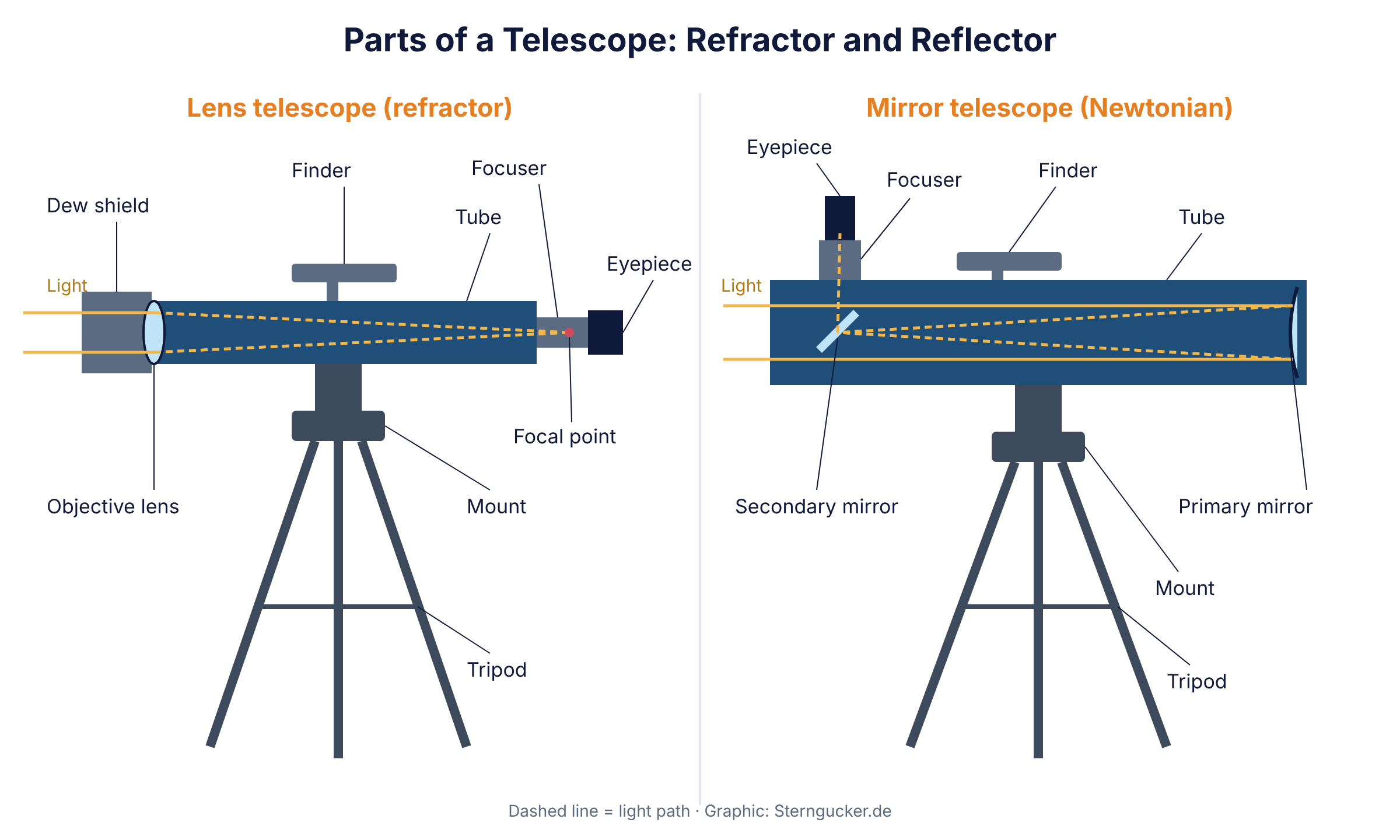
| Part | Function |
|---|---|
| Objective (lens or mirror) | Collects the light – the aperture determines what you can see |
| Tube | Holds the optics and keeps stray light out |
| Eyepiece | Magnifies the image at the focal point; interchangeable for different magnifications |
| Finder / red dot finder | Small helper scope for locating objects |
| Mount | Carries the telescope: altazimuth (simple) or equatorial (for tracking) |
| Tripod | Provides stability – if it wobbles, the whole image wobbles |
Accessories at the eyepiece end
Between the tube and your eye there are usually four more small parts. They help decide whether an observing night is fun.
Focuser
The focuser is the sliding sleeve that holds the eyepiece. With its knobs you move the eyepiece until the image is sharp (focusing). Beginner scopes usually have a rack-and-pinion focuser for 1.25-inch eyepieces, better scopes a Crayford focuser that runs without play and often takes 2-inch eyepieces too.
Finder
The main telescope shows only a tiny patch of sky, which is why a finder sits on top. A red dot finder projects a red dot onto the sky and is the easiest option for beginners. A finder scope (such as 6×30 or 8×50) magnifies slightly and also shows fainter stars.
Important: finder and telescope must point in exactly the same direction. This is easiest in daylight on a distant church spire or mast – never on the Sun.
Star diagonal
A star diagonal bends the light by 90 degrees so you do not have to lie under the telescope for objects high in the sky. It belongs to refractors and catadioptric telescopes, whose eyepiece sits at the back. A Newtonian does not need one, because its eyepiece is already at the side near the top of the tube.
Barlow lens
A Barlow lens is a diverging lens in front of the eyepiece that extends the telescope’s focal length – usually by a factor of two. Example: 900 mm focal length with a 10 mm eyepiece gives 90x, with a 2x Barlow 180x. It doubles the number of magnifications you have but does not replace aperture; more on Barlow lenses and telescope eyepieces.
The three numbers that matter
1. Aperture: The diameter of the lens or mirror – the most important number of all. Double the aperture = four times the light-gathering power.
2. Focal length: The distance the light travels to the focal point; together with the eyepiece it determines the magnification (telescope focal length ÷ eyepiece focal length).
3. Focal ratio (focal length ÷ aperture): fast optics (f/5) for wide fields and photography, slow ones (f/10+) for planets. You can work all of this out with our telescope calculator.
Telescope mounts compared
The mount carries the telescope and moves it to the object. Because the sky turns, every object drifts out of view within minutes – the mount decides how easily you bring it back.
| Mount | How it moves | Good for |
|---|---|---|
| Altazimuth | Up/down and left/right, like a camera tripod | Beginners, the Moon, quick setup |
| Dobsonian | Altazimuth on a wooden box on the ground, pushed by hand | Lots of aperture for the money, visual observing |
| Equatorial | One axis points to the celestial pole; one knob follows the star | Tracking at high magnification, astrophotography |
| GoTo | Motors slew to objects via hand controller or app | Anyone who does not want to find objects themselves |
An equatorial mount has to be polar-aligned before every session, meaning its axis points at Polaris (in the Southern Hemisphere at the south celestial pole).
In our (German-language) telescope advice service, 11 of 38 readers who wrote a free-text note (sample of the last 100 requests, November 2026) ask for easy handling, and 6 ask about GoTo. For that wish, a Dobsonian or an altazimuth mount is usually the better choice than an equatorial one.
Biggest beginner mistake
Department-store telescopes advertise 500x magnification – the physically useful maximum is about twice the aperture in millimetres (about 50x per inch), so a 70 mm telescope manages a usable ~140x. Beyond that the image only gets bigger, dimmer and mushier.
What matters is aperture, not the magnification figure. What good telescopes cost in each price range is shown in How much does a telescope cost?, and you will find the right start in our beginner telescope guide.
In practice this means: as much aperture as possible, on a mount that does not wobble. A Dobsonian delivers the most aperture per dollar – the Sky-Watcher Heritage 130 Tabletop DobsonianSkywatcher Dobson Telescope N 130/650 Heritage FlexTube costs $269.00€ 265 and shows lunar craters, Saturn’s rings and the brighter deep-sky objects. If you want a compact grab-and-go option, look at the Orion SkyScanner 100mm Tabletop Reflector TelescopeSkywatcher N 100/400 Heritage Telescope for $129.95€ 179.
If you want to follow the principle with your own hands, you can build a simple telescope yourself – from a lens telescope to a Dobsonian.
FAQ: parts of a telescope
How does a telescope work?
It collects a lot of light with a large lens or mirror, focuses it to a point, and the eyepiece magnifies that image for your eye.
Aperture or magnification?
Aperture. It determines how much light and detail arrive in the first place. Magnification can be changed with eyepieces – the useful maximum is about twice the aperture in mm.
Why is the image upside down?
The optics flip the image. In astronomy that does not matter, so extra erecting lenses, which would swallow light, are left out.
Newtonian vs. refractor?
The Newtonian collects light with a mirror (lots of aperture for the money, eyepiece at the side), the refractor with a lens (maintenance-free, eyepiece at the back).
What does a Barlow lens do?
It extends the telescope’s focal length, usually by a factor of two. Every eyepiece then magnifies twice as much – the limit of about twice the aperture in mm still applies.
Do I need a star diagonal?
With refractors and catadioptric telescopes, yes – otherwise you observe objects high in the sky in an awkward position. A Newtonian does not need one because its eyepiece sits at the side.
Best mount for beginners?
An altazimuth mount or a Dobsonian: set up, point, observe. An equatorial mount is worth it once you want to track or photograph.
🔭 Ready for the real thing? Telescope under 300 – the three best beginner telescopes for 2026.