By Alexander Merz · Published on
The DWARFLAB DWARF mini is the smallest smart telescope from DWARFLAB: 30 mm aperture, 150 mm focal length, a Full HD camera and a weight of just 840 g. It costs $419.00€ 429, and no tripod is included.
⭐ In short: The DWARF mini is worth it if weight and price come first: for travel, for hiking or as a second scope. It delivers real images of nebulae and galaxies, but only in Full HD, with roughly two to four hours of battery and without a tripod in the box. If you want a scope for home use that comes with everything, a Seestar is the better choice.
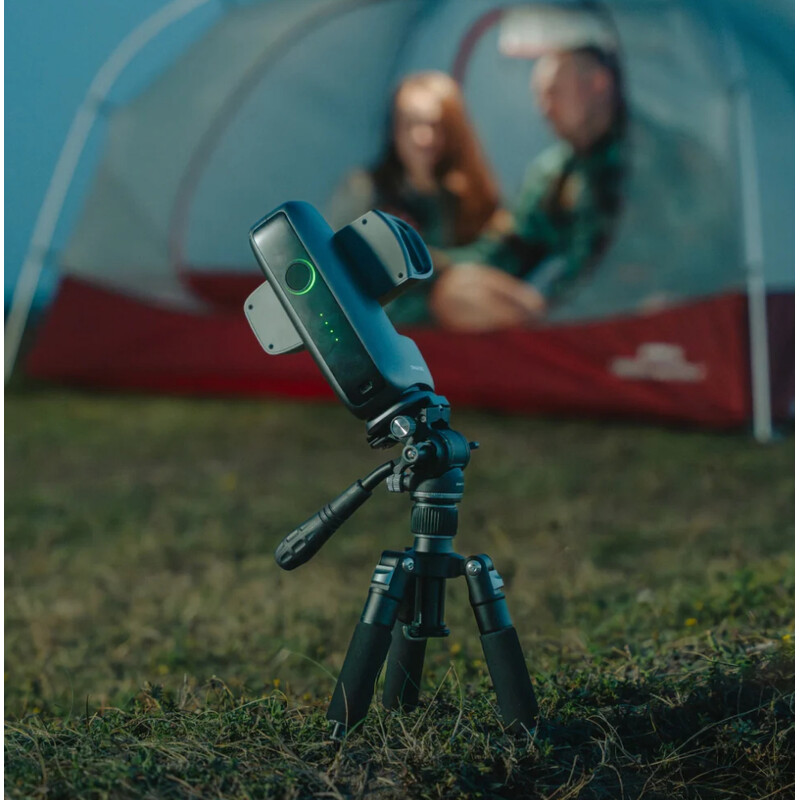
The lightest smart telescope for travel: DWARFLAB DWARF mini Smart Telescope
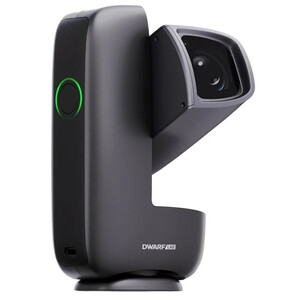
30 mm aperture, Full HD sensor with large 2.9 µm pixels, EQ mode for long exposures, solar filter in the box – and only 840 g. Budget for a tripod separately.
Price: € 429
Not sure yet whether such a small scope is right for you at all? The smart telescope finder takes you from your budget to the right class.
DWARF mini: price, availability and what’s in the box
The DWARF mini costs $419.00€ 429 at Astroshop; the price on this page is updated automatically every day. Current status: ● In stock · ready for shipping in 24 h. The scope has been shipping since the end of November 2025 – the first owner reports on the German forum astronomie.de and on Reddit date from that time.
| In the box | Not in the box |
|---|---|
| DWARF mini with built-in battery | Tripod (with a tilting head for EQ mode) |
| Clip-on ND solar filter | Bag or case |
| USB-C cable | Power adapter and power bank |
| Cleaning cloth | Dew shield |
Contents according to DWARFLAB and Astroshop, as of 30 September 2026.
Factor the tripod in right away. The matching DWARFLAB tripod costs an extra $89€ 89, but any photo tripod you already own with a 1/4-inch thread will do too. More on this below in the tripod section.
DWARF mini specifications
| Feature | DWARF mini |
|---|---|
| Optics | Lens objective (refractor), 30 mm aperture, 150 mm focal length, f/5 |
| Telephoto camera | Sony IMX662, 1/2.8 inch, 1920 × 1080 pixels (Full HD, 2.1 MP), 2.9 µm pixels |
| Field of view (calculated) | 2.13° × 1.20° – about four times as wide as the full Moon |
| Image scale (calculated) | 4.0 arcseconds per pixel |
| Wide-angle camera | OmniVision OS02K10, 2 MP |
| Filters (built-in) | Astro filter (430–690 nm), dual-band Hα/OIII, dark-frame filter; clip-on ND solar filter |
| Single exposure | up to 90 s in EQ mode (manufacturer spec) |
| Battery | 7,000 mAh, approx. 4 h according to the manufacturer, charging time approx. 100 min |
| Storage | 64 GB internal |
| Connectivity | Wi-Fi 2.4 + 5 GHz (range approx. 15 m), Bluetooth, NFC |
| Dimensions / weight | 184 × 101 × 61 mm / 840 g |
| Operating temperature | −10 to +60 °C (manual) |
| Ingress protection | not specified – not waterproof |
| Price | $419.00€ 429 · DWARF miniDWARF mini |
Sources: DWARFLAB product page and manual, Astroshop spec sheet (as of 30/09/2026). Field of view and image scale calculated by us from pixel count, pixel size and focal length. Links marked with an asterisk are affiliate links.
Officially, DWARFLAB quotes 90 seconds as the longest single exposure. Several owners on Cloudy Nights and the review by telescopicwatch.com even expose for up to 180 seconds in EQ mode – with careful polar alignment and few rejected frames. That isn’t guaranteed, but it shows how well the little mount tracks.
What the DWARF mini can do – and what it can’t
The DWARF mini is a deep-sky scope for travel, not a jack of all trades. Reviewers and owners agree remarkably well on its strengths – and on its weaknesses, too.
✅ Does well
- Large nebulae and bright galaxies – Orion Nebula, Rosette Nebula, Andromeda (as a mosaic), M 81/82.
- Long exposures in EQ mode without an extra wedge, as long as the tripod head can tilt.
- Travel: 840 g, smaller than a thick paperback, runs off a power bank.
- Combining data from several nights (MegaStack in the app).
⚠️ Can’t do (well)
- Large images: Full HD is enough for a phone, not for poster prints.
- Planets: Jupiter becomes a disc of about 11 pixels.
- A whole night without external power: two to four hours in practice.
- Rain and moisture: no ingress protection rating given.
Full HD instead of 4K: what that means in practice
The sensor records 1920 × 1080 pixels, while the DWARF 3 and the Seestar Pro models manage 4K. With the DWARF mini the full Moon is about 470 pixels wide, with the DWARF 3 about 680. On a phone you’ll barely notice the difference, but you will as soon as you crop or print.
The flip side has an upside: the large 2.9 µm pixels collect more light per pixel. That’s why the notebookcheck review and owners of both DWARF models report that the mini delivers smoother backgrounds on faint nebulae than the DWARF 3.
Moon, Sun and planets
The Moon and the Sun are rewarding targets, planets are not. The Moon fills just under a quarter of the frame width, and sunspots and partial eclipses work well with the supplied filter. According to telescopicwatch.com, the scope can’t resolve fine structures such as the granulation of the solar surface.
With planets, the small aperture reaches its limit. Jupiter comes out at about 11 pixels, Saturn even smaller: you can make out the belts and the ring, nothing more. If planets are your main interest, you need a classic telescope with more aperture and focal length.
By day: landscapes and birds
Converted to full-frame terms, the telephoto camera corresponds to a telephoto lens of around 1,000 mm focal length. That’s enough for birds or wildlife a few dozen metres away, and there’s a photo and video mode on board.
For daytime shots, though, the DWARF 3 is the better device. Owners miss automatic object tracking on the mini, and the wide-angle camera has no autofocus – its images look soft.
DWARF mini images: what’s possible
The DWARF mini produces real deep-sky images – if you bring time. The rule of thumb from the reviews: one hour for bright objects, six to twelve hours for galaxies and faint nebulae, spread over several nights.
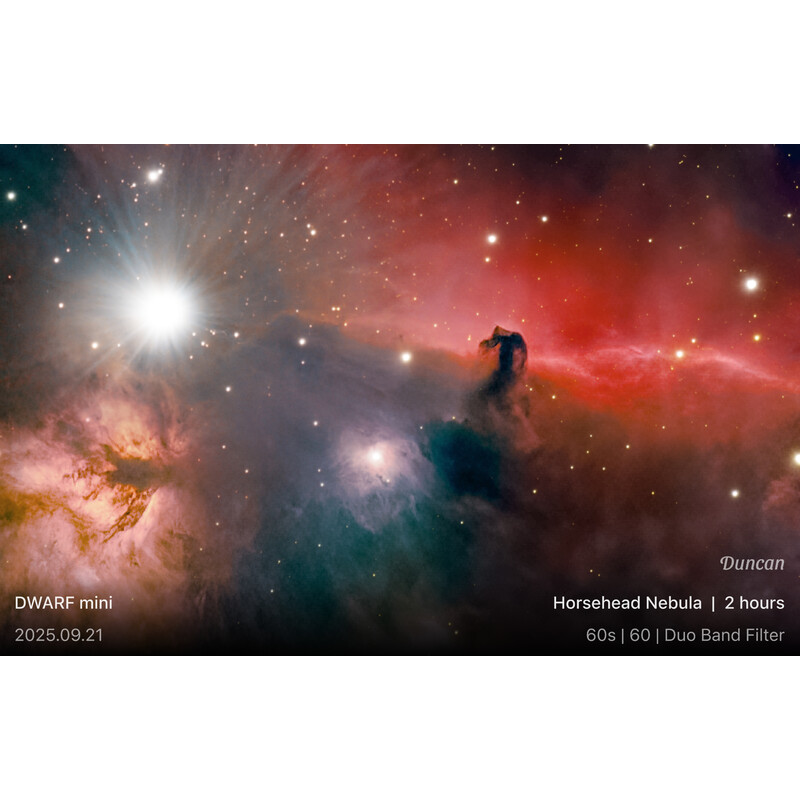
More realistic than any promotional image are the figures owners share themselves. We found these results, with exposure data, in forums and reviews:
| Object | Exposure | Conditions | Source |
|---|---|---|---|
| Orion Nebula (M 42) | 30 × 120 s + 10 × 30 s, dual-band filter | Suburbs (Bortle 7), EQ mode | Owner, German forum astronomie.de |
| Soul Nebula (IC 1848) | 124 × 120 s (just over 4 h) | Bortle 7, EQ mode | Owner, German forum astronomie.de |
| Andromeda (M 31) | Mosaic 1 × 1.8 panels, 25 × 90 s | – | Owner, German forum astronomie.de |
| Andromeda (M 31) | 360 × 15 s (90 min) | without EQ mode | astrobackyard.com |
| Pinwheel Galaxy (M 101) | 177 × 60 s (almost 3 h) | Bortle 7 | Owner, Cloudy Nights |
| Bode’s Galaxy (M 81) with faint dust (IFN) | 384 × 90 s (just over 9.5 h) | – | Owner, Cloudy Nights |
| Rosette Nebula | 301 × 30 s, 15 of them rejected | a beginner’s first attempt | Owner, Cloudy Nights |
Bortle is the scale for sky brightness: 1 is a desert night, 7 is the suburbs, 9 a city centre. That usable nebula images come out even at Bortle 7 is down to the dual-band filter, which lets through almost only the light of the nebulae.
DWARF mini experiences: 401 user threads counted
We have not tested the DWARF mini ourselves. Instead, we analysed what owners have written since launch – in German and English – plus five published reviews.
🔍 How we counted
- Reddit r/DWARFLAB: all 401 posts with “mini” in the title from 20 October 2025 to 30 September 2026, by 216 different users. 111 of them are verifiably owners (showed their own image or explicitly mentioned owning the device). We analysed titles and post text, not the 1,547 comments.
- forum.astronomie.de (German): the thread “Dwarf Mini” (15 posts, 2 owners).
- Cloudy Nights: three owner threads in full and three pages of the big discussion thread (23 pages).
- Reviews: astrobackyard.com, telescopicwatch.com, notebookcheck, laurentwillen.com and blickohnegrenzen.de – all with their own unit.
Bias: r/DWARFLAB is a fan subreddit centred on the manufacturer. Image posts are over-represented there – and people with a problem are more likely to ask there than people who are happy. The numbers are therefore not a failure rate; they show which topics matter to owners.
| What we found | Count |
|---|---|
| Posts with their own images | ⭐ Largest group165 posts by 82 owners |
| Buying decision “mini or DWARF 3?” | 15 threads |
| Buying decision “mini or Seestar S30?” | 1 thread |
| Genuine hardware fault (won’t start, stopped charging, storage error, fogging inside the lens) | 5 threads |
| Shipping damage (front glass broken) | 1 thread |
| Damage from accidents (rain, tripod knocked over) | 2 threads |
| Problems with the app, connection or activation | 6 threads |
The most striking result: most posts are images, not complaints. 82 owners show their own shots, many of them beginners with their very first deep-sky photo. The buying discussions almost always revolve around the question “mini or DWARF 3?”.
Battery: closer to two hours than four
DWARFLAB quotes around four hours. In the reviews, the battery usually lasted only about two hours with stacking running, and in frost only 1.5 to 1.75 hours according to laurentwillen.com. One Reddit owner gets “about four hours”.
Heat, noise and dew
The metal housing gets warm, and that cuts both ways. In summer the uncooled sensor is noisier: telescopicwatch.com and owner reports on skiesandscopes.com mention warm nights from about 24 °C. Then the only remedy is longer total integration time.
In winter, the same warmth keeps the lens free of dew. One German owner measured about 14 °C inside the device at an outside temperature of 0 °C, another just over 18 °C at 4 °C. A dedicated dew heater isn’t listed in the spec sheet – but according to DWARFLAB support, the device automatically warms the lens during operation.
App and Wi-Fi
The mini uses the same DWARFLAB app as the DWARF 3. It offers lots of settings to tweak, but is more complicated than the Seestar app – and according to telescopicwatch.com, a complete manual was still missing in April 2026. The “Stellar Studio” image processing runs in the cloud, so you need an internet connection and sometimes a few minutes of patience.
Your phone connects directly to the telescope’s Wi-Fi, with a range of 10 to 15 metres. On iOS, Bluetooth pairing often only worked on the second attempt in the blickohnegrenzen.de review.
Defects and support
Five genuine hardware faults in eleven months – among 111 verified owners in the subreddit. That’s no cause for concern, but it is a reason to buy from a retailer with a return policy. Two more units were damaged by rain and a fall: the mini has no stated ingress protection.
Experiences with support vary. One owner whose unit was completely dead received a free replacement in September 2026 without having to send it back, while another complained in 2025 about a pre-order that had vanished. At Astroshop you buy with a German retailer as your point of contact and a two-year warranty.
Tripod for the DWARF mini
Without a tripod you’re limited to a table or a wall – for EQ mode you need one. It must have a 1/4-inch photo thread and a head that tilts to your latitude: in Germany, for example, roughly 48 to 54 degrees.
The DWARFLAB tripod has exactly that: a built-in equatorial wedge, a spirit level, 25 to 53 cm height and a weight of 790 g. A sturdy photo tripod you already own with a tilting head works just as well – stability matters more than height.
Fits the DWARF mini and DWARF 3: DWARFLAB Tripod DWARF 3 & DWARF mini
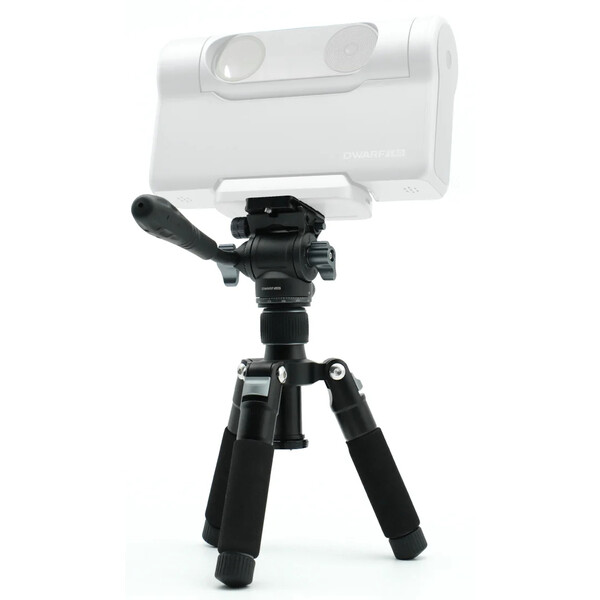
Compact aluminium tripod with integrated equatorial wedge for EQ mode, quick-release plate with 1/4-inch thread and a bag. 790 g, 25–53 cm.
Price: € 89
Who is the DWARF mini for?
The mini is the right choice if it really has to be small and affordable. In every other case, a little more money gets you a scope that does more or comes with more.
| Your situation | Recommendation | Why |
|---|---|---|
| Hiking, cycling trips, flying with hand luggage | DWARF miniDWARF mini | ⭐ This is where the mini is unbeatable840 g, runs off a power bank |
| Second scope alongside a classic telescope | DWARF miniDWARF mini | Captures nebulae on the side while you observe visually |
| First smart telescope, tight budget, used at home | Seestar S30Seestar S30 ($299.00€ 479) | Same sensor as the mini, tripod included |
| Best image at a small step up in price | Seestar S30 ProSeestar S30 Pro ($699.00€ 699) | 4K sensor, much larger field of view, tripod and dew heater |
| Birds and landscapes by day, too | DWARF 3DWARF 3 ($549.00€ 529) | 4K, object tracking, splash-proof |
| Mainly planets | not a smart telescope | 30 mm of aperture is too small for that |
Links marked with an asterisk are affiliate links.
As a gift or for children?
As a gift for adults who travel a lot, the mini is ideal – small, well made, ready to go straight away. But add a tripod and a power bank, or the first night will be shorter than expected.
For children it only works with an adult alongside. There’s no eyepiece to look through, the image builds up slowly on the tablet, and before first use the device has to be activated in the app with an internet connection. On top of that there’s the solar filter, which children should never handle alone.
DWARF mini or DWARF 3?
The mini isn’t a successor but the smaller sibling. Both are sold side by side, and “mini or 3?” is the most common buying question in the DWARFLAB subreddit.
| Feature | DWARF mini | DWARF 3 |
|---|---|---|
| Price | $419.00€ 429 | $549.00€ 529 |
| Aperture / focal length | 30 mm / 150 mm | 35 mm / 150 mm |
| Resolution | 1920 × 1080 (Full HD) | 3840 × 2160 (4K) |
| Field of view (calculated) | 2.13° × 1.20° | 2.93° × 1.65° |
| Single exposure (manufacturer) | up to 90 s | up to 60 s |
| Battery / storage | 7,000 mAh / 64 GB | 10,000 mAh / 128 GB |
| Ingress protection / weight | not specified / 840 g | IP54 / 1.35 kg |
| Product | DWARF miniDWARF mini | DWARF 3DWARF 3 |
Manufacturer specs from DWARFLAB, field of view calculated. Links marked with an asterisk are affiliate links.
Two out of three owners of both devices on Cloudy Nights reach for the mini on about seven out of ten nights – because of its size and smoother tracking. For the Moon, the Sun and daytime shots, all three use the DWARF 3. You’ll find all the details in our DWARF 3 vs. DWARF mini comparison.
DWARF mini or Seestar S30 Pro?
Both have 30 mm of aperture, but the S30 Pro has the four-times-larger 4K sensor. As a result, it shows considerably more sky per frame and comes with a tripod and a dew heater. The mini, in turn, is half the weight and cheaper.
| Model | Sensor | Tripod included | Weight | Price |
|---|---|---|---|---|
| DWARF miniDWARF mini | IMX662, Full HD | no | 840 g | $419.00€ 429 |
| Seestar S30Seestar S30 | IMX662, Full HD | yes | 1.65 kg | $299.00€ 479 |
| Seestar S30 ProSeestar S30 Pro | IMX585, 4K | yes | 1.65 kg | $699.00€ 699 |
Links marked with an asterisk are affiliate links.
The standard Seestar S30 is optically almost a twin of the mini – same sensor, same focal length. How the mini stacks up against the S30 Pro in detail is shown in our comparison Seestar S30 Pro vs. DWARF mini.
🔭 If you want more: Seestar S50 Pro
The real next step isn’t the DWARF 3, it’s more aperture. With 50 mm, the Seestar S50 Pro collects almost three times as much light, shows galaxies larger thanks to its 260 mm focal length and comes with a 4K sensor, tripod, dew heater and up to nine hours of battery. The extra cost is worth it if you mainly shoot from home – at 2.8 kg it’s less suited to a backpack.
Seestar S50 ProSeestar S50 Pro · $999.00€ 999
The next step up: ZWO Seestar S50 Pro Smart Telescope
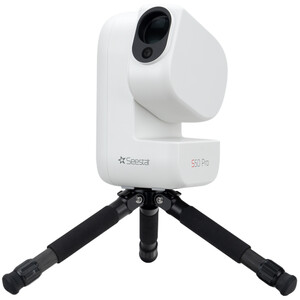
50 mm apochromat, 4K sensor, tripod and dew heater included, up to 9 hours of battery – the complete package for nebulae and galaxies.
Price: € 999
Frequently asked questions about the DWARF mini
How much does the DWARF mini cost?
$419.00€ 429 at Astroshop; the price here is updated automatically every day. No tripod is included – the DWARFLAB tripod costs an extra $89€ 89.
Does the DWARF mini come with a tripod?
No. The box contains the telescope, solar filter, USB-C cable and cleaning cloth. You need a tripod with a 1/4-inch thread; for EQ mode the head must tilt to your latitude (48 to 54 degrees in Germany).
How long does the battery last?
DWARFLAB quotes about four hours. In reviews it was usually around two hours with stacking running, and even less in frost. With a USB-C power bank, the mini runs all night.
Does the DWARF mini record in 4K?
No, the sensor is Full HD with 1920 × 1080 pixels. That’s plenty for your phone and for sharing, but not for large prints or heavy cropping. The DWARF 3 and the Seestar Pro models offer 4K.
Can you photograph the Sun with the DWARF mini?
Yes, with the supplied ND solar filter. It must sit firmly on the lens and be undamaged before every solar session – without the filter, sunlight destroys the sensor within seconds.
Is the DWARF mini waterproof?
No, DWARFLAB doesn’t state any ingress protection rating. One owner lost his unit to rain. In uncertain weather, it belongs indoors or under a cover.
How long can the DWARF mini expose?
Officially up to 90 seconds per frame in EQ mode. Several owners with good polar alignment even use 180 seconds. Without EQ mode, owners usually expose 15 to 30 seconds per frame.
Is the DWARF mini a good gift?
For adults who love to travel, yes – ideally together with a tripod and a power bank. For children only with an adult: there’s no eyepiece, it’s operated via the app, and the device has to be activated online.
Verdict: small, honestly good – with compromises
The DWARF mini delivers astonishing nebula images from a device that fits in your jacket pocket. The large pixels and the long exposures in EQ mode make it stronger on faint nebulae than its 30 mm would suggest.
You pay for that with Full HD, a short battery life, no tripod and no weather protection. If you mainly shoot from home, a Seestar gives you more for your money; if you want to be on the move, you won’t find a lighter smart telescope.
Is the DWARF mini right for you?
- ✔ Yes, if you’re looking for a smart telescope for your backpack, bike or travels.
- ✔ Yes, if you want an affordable second scope for nebulae alongside your telescope.
- ✘ No, if you want large, sharp prints – then go for a 4K device such as the Seestar S30 ProSeestar S30 Pro.
- ✘ No, if you mainly want to see planets – a classic telescope is better for that.
* Affiliate link: if you buy through this link we may earn a small commission from Astroshop or High Point Scientific, at no extra cost to you.