By Alexander Merz · Updated on
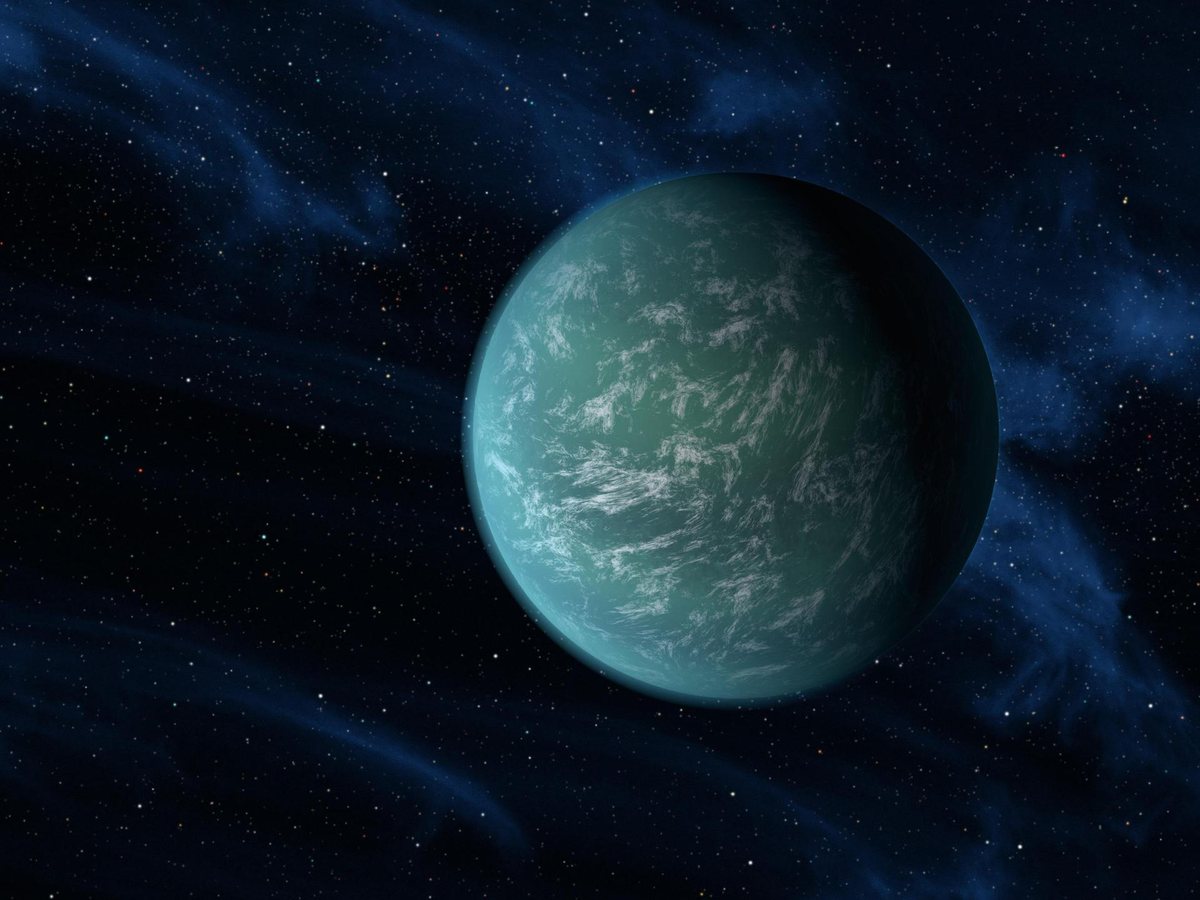
Kepler-22b is an exoplanet in the constellation Cygnus, about 635 light-years away: 2.1 times the size of Earth, it circles a Sun-like star every 290 days – right in the middle of its habitable zone.
More in our overview: Exoplanets.
Fact file: Kepler-22b in numbers
The numbers from 2011 are out of date. The discoverers gave 2.4 Earth radii at the time; a reanalysis from 2023 arrives at 2.1. The table shows the values the NASA Exoplanet Archive lists as its default today.
| Feature | Kepler-22b |
|---|---|
| Radius | 2.10 ± 0.12 Earth radii (diameter about 26,800 km / 16,700 miles) |
| Mass | at most 9.1 Earth masses (upper limit, not measured) |
| Orbital period | 289.9 days |
| Distance from its star | 0.81 AU (Earth: 1 AU) |
| Insolation | 1.01 times as much as Earth |
| Equilibrium temperature | about 279 K (calculated without an atmosphere) |
| Distance | 194.6 parsecs = about 635 light-years |
| Star | Kepler-22, spectral type G5 V, 5,600 K, 0.86 solar masses |
| Brightness of the star | magnitude 11.75 |
| Announced | 5 December 2011 (Kepler space telescope) |
The most important value is the insolation. Kepler-22b receives almost exactly as much light as Earth, even though it orbits closer to its star – Kepler-22 is slightly cooler and smaller than the Sun.
How big is Kepler-22b?
Kepler-22b sits between Earth and Neptune. At 2.1 Earth radii it is larger than any rocky planet in our solar system, but only just over half the size of Neptune.
Exactly this size makes the “Earth twin” unlikely. Analyses of the Kepler data show that most planets above about 1.6 Earth radii carry a thick envelope of hydrogen and helium (Rogers 2015).
The mass would settle the question – but it has not been measured. A series of measurements with the HARPS-N spectrograph could only set an upper limit of 9.1 Earth masses in 2023. Rock, water and gas therefore all remain possible.
How Kepler-22b was discovered
Kepler-22b has never been seen; only its shadow was measured. From 2009 the Kepler space telescope watched about 150,000 stars at once, looking for tiny, regular dips in brightness – the transit method.
When the planet passes in front of its star, the star becomes 0.05% fainter. Kepler recorded this dip three times, 290 days apart. On 5 December 2011 NASA announced the planet – as the first confirmed planet in the habitable zone of a Sun-like star.
Kepler found a total of 2,787 confirmed planets, more than any other instrument. Of the 6,451 confirmed exoplanets known today, more than 40% are thus down to the telescope (NASA Exoplanet Archive, 27 October 2026).
Could life exist on Kepler-22b?
The location is right; about everything else we know nothing. “Habitable zone” only means: at this distance from the star, liquid water could exist on a surface. Whether there is a surface at all is exactly the open question with Kepler-22b.
The equilibrium temperature of about 279 K sounds pleasant – but it is a calculated value. It applies to a planet without an atmosphere that absorbs all light; Earth would come out at almost the same value with the same calculation. How warm it really is depends on the atmosphere and clouds.
| Possibility | What speaks for it | Life? |
|---|---|---|
| Mini-Neptune with a thick gas envelope | Most planets of this size are built like this | Hardly conceivable: high pressure, no solid surface |
| Ocean world | Fits the size and the mass limit | Conceivable, but pure speculation |
| Large rocky world (“super-Earth”) | Not ruled out by the mass limit | Conceivable, but the least likely option |
This will not be investigated any time soon. Kepler-22b is a difficult target for atmospheric measurements: its star is comparatively faint, and a transit only happens every 290 days. Why we still haven’t “heard” anyone despite thousands of planets is covered on our page about the Fermi paradox.
Earth twins compared
Kepler-22b was the first in 2011; today there are more Earth-like candidates. The table puts the best-known ones side by side – with a value you won’t find in any encyclopedia: how bright is the star you would have to look for?
| Planet | Size | Light (Earth = 1) | Star | Distance | Star brightness |
|---|---|---|---|---|---|
| Kepler-22b | 2.1× | 1,01 | Sun-like (G5) | 635 ly | ⭐ Visible yourselfmag 11.8 |
| Kepler-452b | 1.6× | 1,10 | Sun-like (G2) | 1,800 ly | mag 13.5 |
| Kepler-442b | 1.3× | 0,66 | orange dwarf (K) | 1,190 ly | mag 15.3 |
| Kepler-186f | 1.2× | 0,30 | red dwarf (M1) | 580 ly | mag 15.1 |
| TRAPPIST-1e | 0.9× | 0,65 | red dwarf (M8) | 41 ly | mag 17.0 |
Kepler-22 is the brightest star on this list. All the others are too faint for amateur telescopes or need a camera – Kepler-22b is the only famous “Earth twin” whose star you can see with your own eyes.
See the star Kepler-22 yourself
In the series “Pluribus”, Carol looks for the star Kepler-22 through a telescope – and that really works. Nobody can see the planet, but at magnitude 11.75 its star is bright enough for a medium-sized amateur telescope.
It lies in the constellation Cygnus, almost exactly 5.5° south of Kappa Cygni. That is a magnitude 3.8 star at the end of the swan’s western wing. North of about 42° latitude – the UK, central Europe and the northern US – Kepler-22 never sets; it is best placed from July to October, when it stands almost overhead in the evening.
| Month | Altitude at 10 pm | Where in the sky |
|---|---|---|
| May | 28° | northeast |
| June | 43° | east-northeast |
| July | 61° | east, high |
| August | 80° | almost overhead |
| September | 80° | almost overhead |
| October | 61° | west, high |
| November | 35° | northwest |
| December to April | 9–21° | low in the north |
From about 5 inches (13 cm) of aperture it works under a dark sky; it becomes easy from 8 inches (20 cm). According to the rule of thumb for limiting magnitude, a 130 mm telescope shows stars down to about magnitude 12.7, a 200 mm instrument down to about 13.6. In a city you lose roughly one magnitude of that.
For finding it by hand, an 8-inch Dobsonian is the tool of choice. It shows stars well below magnitude 12, is easy to use and is also the best all-round choice at this price for the Moon, planets and galaxies.
Our pick: Skywatcher Dobson Telescope N 200/1200 Skyliner Classic
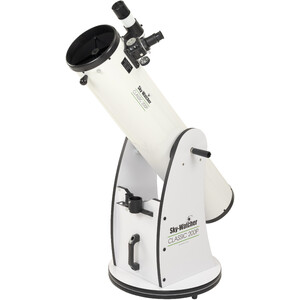
An 8-inch Dobsonian shows stars down to about magnitude 13.6 – Kepler-22 is an easy catch even under a mediocre sky. To be honest: you have to find it yourself, there is no GoTo.
Price: € 479
If you would rather take photos, choose a smart telescope. It slews to the region automatically and records stars well below magnitude 12 within seconds.
Which dot is Kepler-22 you can only tell with a chart there, too. All models compared: smart telescopes.
For photos: ZWO Seestar S50 Pro Smart Telescope
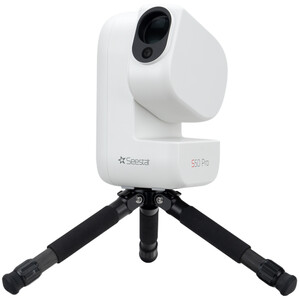
Slews to the region around Kepler-22 via the app and photographs the star field automatically – no prior knowledge needed. It is not made for planets or visual observing.
Price: € 999
Measure the transit yourself?
Amateurs manage it with large planets, but not with Kepler-22b. On the German Astronomie.de forum an amateur measured the transit of the hot Jupiter WASP-43b with a 76 mm mini Newtonian and a camera costing about $200€200 – total cost under $500€500.
Kepler-22b takes about 50 times less light from its star. A 0.05% dip in brightness is drowned out by the shimmer of Earth’s atmosphere – and it only comes every 290 days. That is exactly why it took a telescope in space.
Kepler-22b in film and TV
Kepler-22b is probably the best-known exoplanet in pop culture. In the series “Raised by Wolves” (HBO Max, 2020–2022, produced by Ridley Scott), two androids raise human children on it; the planet’s landscapes were filmed in South Africa.
In “Pluribus” (Apple TV, since November 2025), a radio signal from there changes humanity. That is fiction: no such signal has ever been received. What is real, though, is that you can find the star in a telescope.
FAQ about Kepler-22b
Could life exist on Kepler-22b?
Nobody knows. Kepler-22b lies in the habitable zone of its star, but at 2.1 Earth radii it is probably a mini-Neptune with a thick gas envelope or an ocean world. For humans it would be out of reach anyway.
How far is Kepler-22b from Earth?
About 635 light-years (194.6 parsecs). Light therefore takes 635 years to reach us. A space probe travelling at the speed of Voyager 1 (about 17 km/s) would be on its way for roughly 11 million years.
How big is Kepler-22b?
It has 2.1 times Earth’s radius, i.e. a diameter of about 26,800 km (16,700 miles). Older sources give 2.4 Earth radii – that was the discoverers’ value from 2011.
Is there a real photo of Kepler-22b?
No. All images of the planet are illustrations. Kepler-22b was only detected indirectly – through the tiny dip in brightness when it passes in front of its star.
How many Kepler planets are there?
The Kepler space telescope found 2,787 confirmed exoplanets (NASA Exoplanet Archive, as of 27 October 2026). In total, 6,451 exoplanets are confirmed.
Does the signal in “Pluribus” really come from Kepler-22b?
No, that is made up. Only the planet and its star in the constellation Cygnus are real – you can see the star yourself with a telescope of about 5 inches (13 cm) aperture.
Read more: The Cygnus constellation: stars, deep-sky objects and the Kepler field · Kepler-22b in the NASA catalogue
* Affiliate link: if you buy through this link we may earn a small commission from Astroshop or High Point Scientific, at no extra cost to you.