By Alexander Merz · Updated on
The Fermi paradox is the contradiction between the high estimated number of alien civilizations in the Milky Way and the fact that we don’t know of a single sign of them. It is named after the physicist Enrico Fermi, who asked over lunch in 1950: “Where is everybody?”
⭐ In a nutshell
The Milky Way is about 13 billion years old, while colonizing it would take only a few million years. So someone should have shown up here long ago – yet nobody has. Either technological life is extremely rare, or it is too far away, too quiet or too cautious – the question remains unsolved.
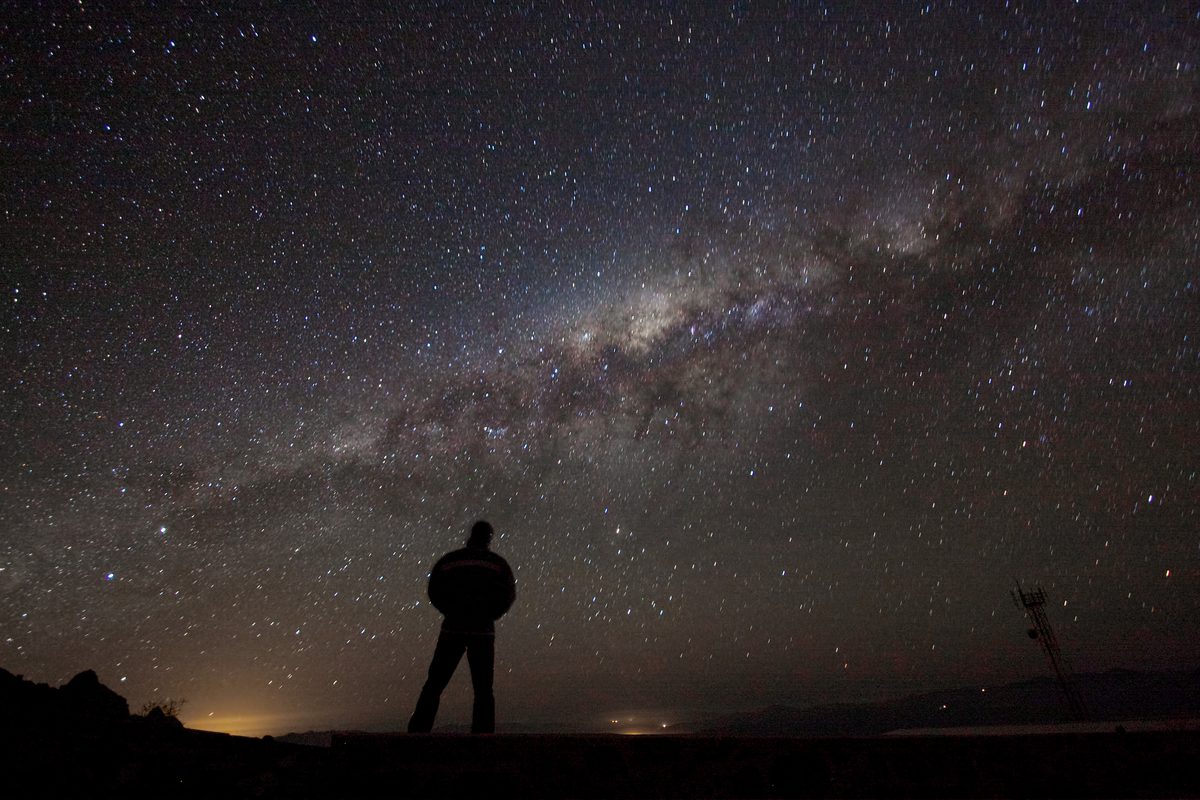
What Is the Fermi Paradox? Simply Explained
The paradox isn’t a formula but a chain of four assumptions that each sound harmless on their own. Taken together, they lead to a result that doesn’t match what we observe.
- There are unimaginably many stars. The Milky Way holds 100 to 400 billion of them, and many are billions of years older than the Sun.
- Planets are the norm. Almost every star has them, and billions lie in the habitable zone.
- Colonization would be fast. Even with spaceships that reach only 1 to 10% of the speed of light, the galaxy could be settled in 1 to 10 million years.
- And yet: nothing. No probes, no signals, no structures, no visitors.
So the paradox isn’t whether aliens exist. The paradox is that the obvious calculation and the empty sky don’t add up. At least one of the four assumptions must be wrong – the only open question is which one.
| Quantity | Value |
|---|---|
| Age of the Milky Way | about 13 billion years |
| Age of Earth | 4.6 billion years |
| Stars in the Milky Way | 100 to 400 billion |
| Diameter of the Milky Way | about 100,000 light-years |
| Confirmed exoplanets | more than 6,000 |
| Time to colonize the galaxy | 1 to 10 million years |
| Alien signals found | 0 |
Where Does the Fermi Paradox Come From? The Los Alamos Lunch
Summer 1950 in Los Alamos: Enrico Fermi heads to lunch with Edward Teller, Herbert York and Emil Konopinski. On the way, they joke about UFO reports and a cartoon in “The New Yorker” showing aliens stealing trash cans from New York City.
At the table, Fermi suddenly asks: “Where is everybody?” According to witnesses, he then runs a quick mental estimate of how likely travel between the stars is. But Fermi never published a worked-out paradox – he died in 1954.

The strict version comes from Michael Hart. In 1975 he argued that because colonization would be so fast, the absence of visitors proves there are no other civilizations. Frank Tipler followed up in 1980 with self-replicating probes, which is why it’s also called the Hart–Tipler argument.
Good to know: As Herbert York remembered it, Fermi mainly doubted that travel between stars is feasible – not that aliens exist. That’s why many historians consider the name “Fermi paradox” misleading.
The Drake Equation: How Many Civilizations Are Out There?
In 1961, radio astronomer Frank Drake wrote a formula on the board for a meeting in Green Bank that breaks the problem down into seven factors. The Drake equation doesn’t give an answer – it gives a list of what we don’t know.
| Factor | Meaning | What we know |
|---|---|---|
| R* | New stars per year in the Milky Way | well known: about 1.5 to 3 |
| fp | Fraction of stars with planets | well known: almost 1 |
| ne | Earth-like planets in the habitable zone per system | roughly known: about 0.1 to 0.4 |
| fl | Fraction of those on which life arises | unknown |
| fi | Fraction of those with intelligent life | unknown |
| fc | Fraction of those that send detectable signals | unknown |
| L | How many years a civilization keeps transmitting | unknown; for us: about 100 so far |
Over the past 20 years, star counts and space telescopes such as Kepler have pinned down the first three factors reasonably well. The last four are pure guesswork – and they span many orders of magnitude. Try it yourself:
🧮 Drake Calculator
With the optimistic values, you get about 30,000 transmitting civilizations, the nearest one just over 600 light-years away. With cautious values, you end up below one – and suddenly the silence is no surprise at all.
The 2018 Oxford study: Anders Sandberg, Eric Drexler and Toby Ord didn’t calculate with single estimates but modeled the full uncertainty of the factors. Result: there is a 53 to 99.6% probability that we are alone in the Milky Way. If you’re honest about the uncertainty, the empty sky is much less of a puzzle.
Why the Silence Is So Strange – and Why Maybe It Isn’t
The Sun is 4.6 billion years old, and many stars in the Milky Way are billions of years older. A civilization just one million years ahead of us would have had more than enough time to fill the entire galaxy. That’s the heart of the paradox.
Our own footprint, on the other hand, is tiny. Radio and TV have been leaking into space for about 100 years, so Earth’s “radio bubble” reaches only about 100 light-years. It contains a good 10,000 star systems – a mere fraction of the Milky Way.
On top of that, ordinary broadcast signals fade into the noise after just a few dozen light-years, even for a giant radio telescope. And we’ve barely searched so far. An estimate by Jason Wright and colleagues (2018) compared the search to date with a hot tub of water scooped from all of Earth’s oceans.
The Main Solutions to the Fermi Paradox
Astrophysicist Stephen Webb collected 75 proposed solutions in his book. Almost all of them fit into one of three drawers.
| Basic idea | Examples |
|---|---|
| 🚫 They (almost) don’t exist | Great Filter, Rare Earth, we’re the first, self-destruction |
| 🤫 They exist but stay silent | Dark Forest, zoo hypothesis, too far and too expensive |
| 🔭 They exist but we don’t notice them | searched too briefly, wrong frequency, alien technology |
The Great Filter
In 1996, economist Robin Hanson proposed: between dead matter and a civilization that colonizes the galaxy, there is at least one step that almost nobody makes it past. The only open question is where this filter lies.
If it lies behind us, say at the origin of life or of the complex cell, then we are a rare stroke of luck. If it lies ahead of us, the hardest part is still to come. That’s why philosopher Nick Bostrom said simple life on Mars would be bad news – it would push the filter forward.
Rare Earth: Our Planet Is a Lucky Break
Peter Ward and Donald Brownlee argued in 2000: simple life may be common, but complex life needs a long chain of coincidences. These include plate tectonics, a large Moon as a stabilizer, Jupiter as a shield and a calm star.
An argument from the amateur astronomy community fits in nicely here: even the amount of water has to be just right. An ocean world without land knows no fire and therefore no metalworking, while a desert world has hardly any life.
We Are the First
Rocky planets and life need heavy elements that first had to be forged by generations of stars. Maybe we’re simply early. Robin Hanson even argues that we must be early: if expanding civilizations already existed, they would have taken our spot long ago.
Self-Destruction: The Short L
The last factor of the Drake equation is the creepiest. If civilizations wipe themselves out with nuclear weapons, climate collapse or their own technology, they never overlap in time. We’ve been transmitting for about 100 years – whether it will be 10,000, nobody knows.
The Dark Forest Theory
It became famous through Liu Cixin’s novel “The Dark Forest”, part of the trilogy that Netflix adapted in 2024 as the series “3 Body Problem”. The idea: the galaxy is a dark forest full of hunters, and anyone who reveals themselves gets wiped out. So everyone stays silent.
The catch: the theory only works if truly every civilization behaves the same way forever. We ourselves gave ourselves away long ago with our radio signals.
The Zoo Hypothesis
In 1973, John Ball suggested that advanced civilizations deliberately leave us alone, like animals in a nature reserve. Star Trek fans know this as the “Prime Directive”. Here, too, a single rule-breaker in billions of years would be enough.
Too Far, Too Slow, Too Expensive
The nearest star, Proxima Centauri, is 4.2 light-years away. The Voyager 1 space probe would need about 74,000 years to cover that distance. A journey spanning generations brings nothing back to whoever launched it – no trade, no return on investment, no message back within their lifetime.
Then there’s an uncomfortable possibility: Earth may simply not be interesting. Anyone looking for raw materials will find them more easily in asteroid belts than on a planet with an atmosphere and a biosphere.
We’re Searching the Wrong Way
SETI mainly listens for radio waves because we use radio ourselves. A civilization a million years ahead of us might communicate in a way we wouldn’t even recognize as a signal. And “intelligence” doesn’t have to mean that someone does mathematics or wants to talk.
⚠️ What about UFOs? The claim “they’re already here” doesn’t solve the paradox, it just asserts that there isn’t one. In a major 2024 report, the US Department of Defense found no evidence of alien technology.
What Amateur Astronomers Say About the Fermi Paradox
On the large US forum Cloudy Nights, the 2018 Oxford study sparked a discussion with more than 120 replies. Three arguments come up again and again.
- Travel doesn’t pay off: Colonies centuries of travel away bring the home planet nothing, and Earth isn’t a worthwhile target.
- We think of intelligence in too human a way: Alien intelligence might communicate chemically, build no technology or simply have no interest in contact.
- Life common, intelligence rare: Evolution has no goal, and intelligence isn’t an inevitable outcome.
In the German-language forum astronomie.de, the discussion is more pragmatic, for example on whether we should reply to the Wow! signal. The consensus: a single signal that was never repeated isn’t proof, but replying isn’t a danger either. A reply would take centuries to arrive anyway.
Our take: The arguments from the community are strong because they attack the assumptions behind the paradox instead of inventing new aliens. Only one answer is honest: we don’t know, and our search has only just begun.
The Fermi Paradox in Your Own Sky: 4 Targets
The best thing about this topic: you can find the key locations of the search yourself, two of them with the naked eye or binoculars.
M13 in Hercules: Target of the Arecibo Message
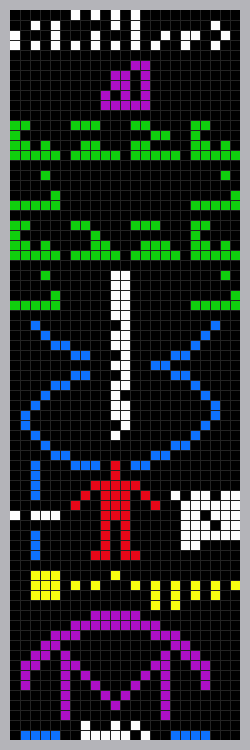
On November 16, 1974, the Arecibo radio telescope sent a message of 1,679 bits toward the globular cluster M13. It will be traveling for about 24,000 years, so a reply could arrive in 48,000 years at the earliest. Among other things, the message shows numbers, DNA building blocks, a human figure and the solar system.
M13 shines at magnitude 5.8 and shows up in binoculars as a small fuzzy ball, while a telescope with an aperture of about 150 mm or more resolves the outer stars. In fall it sits in the west in the evening; for help finding it, see our page on the Hercules constellation.
The Wow! Signal in Sagittarius
On August 15, 1977, the Big Ear radio telescope in Ohio picked up a 72-second, narrowband signal near the hydrogen line at 1,420 MHz. Astronomer Jerry Ehman circled it on the printout and wrote “Wow!” next to it. It was never received again.
In 2024, a research team proposed a natural explanation: a hydrogen cloud that briefly brightened. The source lies in the Sagittarius constellation, northwest of the globular cluster M55, and is best seen in summer low in the south.
Tau Ceti in Cetus: The First Eavesdropping Attempt
In 1960, in “Project Ozma”, Frank Drake pointed a radio telescope at Tau Ceti and Epsilon Eridani – the very first search for alien signals. Tau Ceti is a Sun-like star only 11.9 light-years away and, at magnitude 3.5, visible to the naked eye. You’ll find it in fall around midnight, low in the south in the constellation Cetus.
The Kepler Field Between Cygnus and Lyra
From 2009 to 2013, the Kepler space telescope stared at a single patch of sky, monitoring about 150,000 stars. We owe more than 2,600 confirmed planets to Kepler and its follow-up mission K2 – it’s the reason we know today that planets are the norm.
The field lies between the bright stars Deneb and Vega. In fall it stands high in the west in the evening; our pages on the Cygnus constellation and Lyra will help you get your bearings. You can read more about these distant worlds in our guide to exoplanets.
Tip: For M13 and the stars around Deneb and Vega, a good pair of binoculars is enough. If you want to resolve the globular clusters M13 and M55 into individual stars, you’ll need a telescope – our guide to the best telescopes shows which one is right for getting started.
How the Search Works Today
Today, the search for extraterrestrials goes well beyond listening for radio signals. Besides technosignatures such as radio transmissions or laser flashes, astronomers look for biosignatures: gases in planetary atmospheres that hint at life.
- Breakthrough Listen: Funded with 100 million dollars, this program has been listening to thousands of nearby stars and the center of the Milky Way since 2016.
- James Webb Space Telescope: It studies the atmospheres of exoplanets. A possible sign of life on K2-18b reported in 2025 is considered unproven by experts.
- New giant telescopes: ESO’s Extremely Large Telescope and the radio arrays of the Square Kilometre Array are set to search with much greater sensitivity from the end of the decade.
Frequently Asked Questions About the Fermi Paradox
What is the Fermi paradox in simple terms?
There are so many stars and so much time that there should really be many alien civilizations. Yet we haven’t discovered a single one. The Fermi paradox is the question of how both can be true.
What question does the Fermi paradox raise?
The core question is: Where is everybody? Behind it lies the question of which of our assumptions about life, intelligence and spaceflight is wrong.
Has the Fermi paradox been solved?
No. However, the 2018 Oxford study shows that if you honestly account for all the uncertainties, the silence isn’t all that surprising. That’s why many researchers see the paradox more as an open question than a real contradiction.
What is the Great Filter?
A developmental step, proposed by Robin Hanson, that almost no civilization makes it past. It may lie behind us, for example at the origin of life, or ahead of us.
What does the Dark Forest theory say?
It was made famous by the science fiction author Liu Cixin. All civilizations hide, because any that reveals itself would be wiped out by others as a threat.
What does the Wow! signal have to do with the Fermi paradox?
The 1977 Wow! signal is the best-known candidate for an alien signal. Because it never showed up again, it remains unconfirmed and doesn’t solve the paradox.
What is the Kardashev scale?
In 1964, astronomer Nikolai Kardashev classified civilizations by their energy use. Type I uses the energy of its planet, Type II that of its star, Type III that of an entire galaxy. Humanity is still below Type I.
Do aliens exist?
Nobody knows. So far there is no evidence of alien life, neither simple nor intelligent. But with billions of planets in the Milky Way, most astronomers consider it likely that at least simple life exists elsewhere.