By Alexander Merz · Published on · Details checked on 22 September 2026
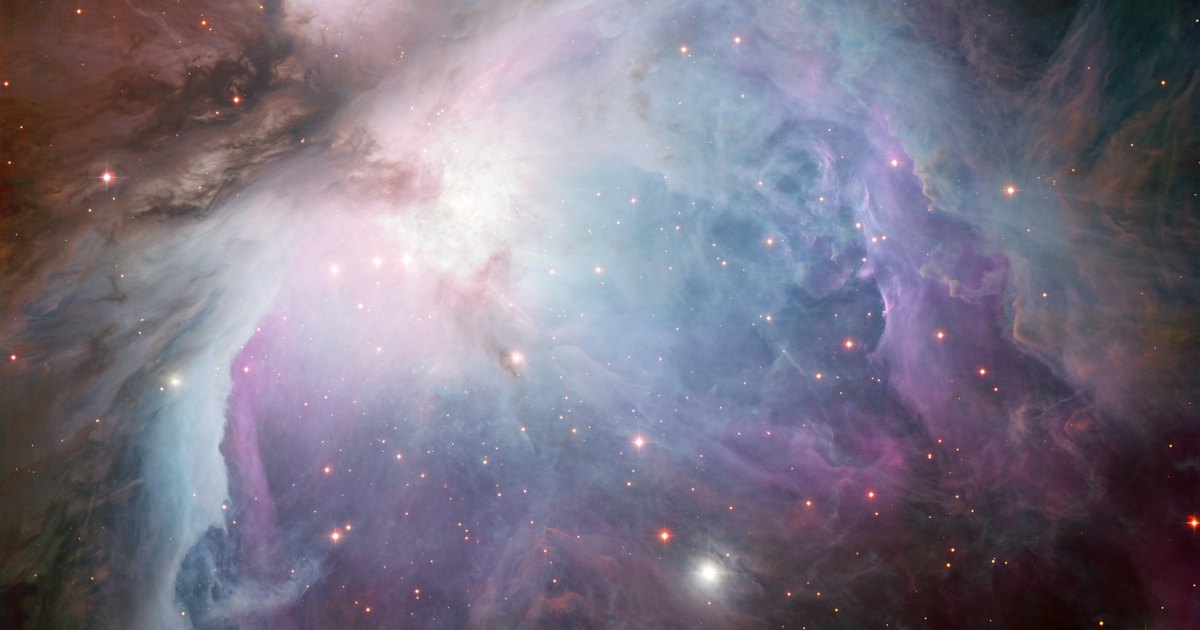
The Orion Nebula (M 42) is a glowing cloud of gas in the constellation Orion in which new stars are forming right now: about 1,350 light-years away and magnitude 3.7 – one of the few nebulae you can see with the naked eye from mid-northern latitudes.
What is the Orion Nebula? A stellar nursery
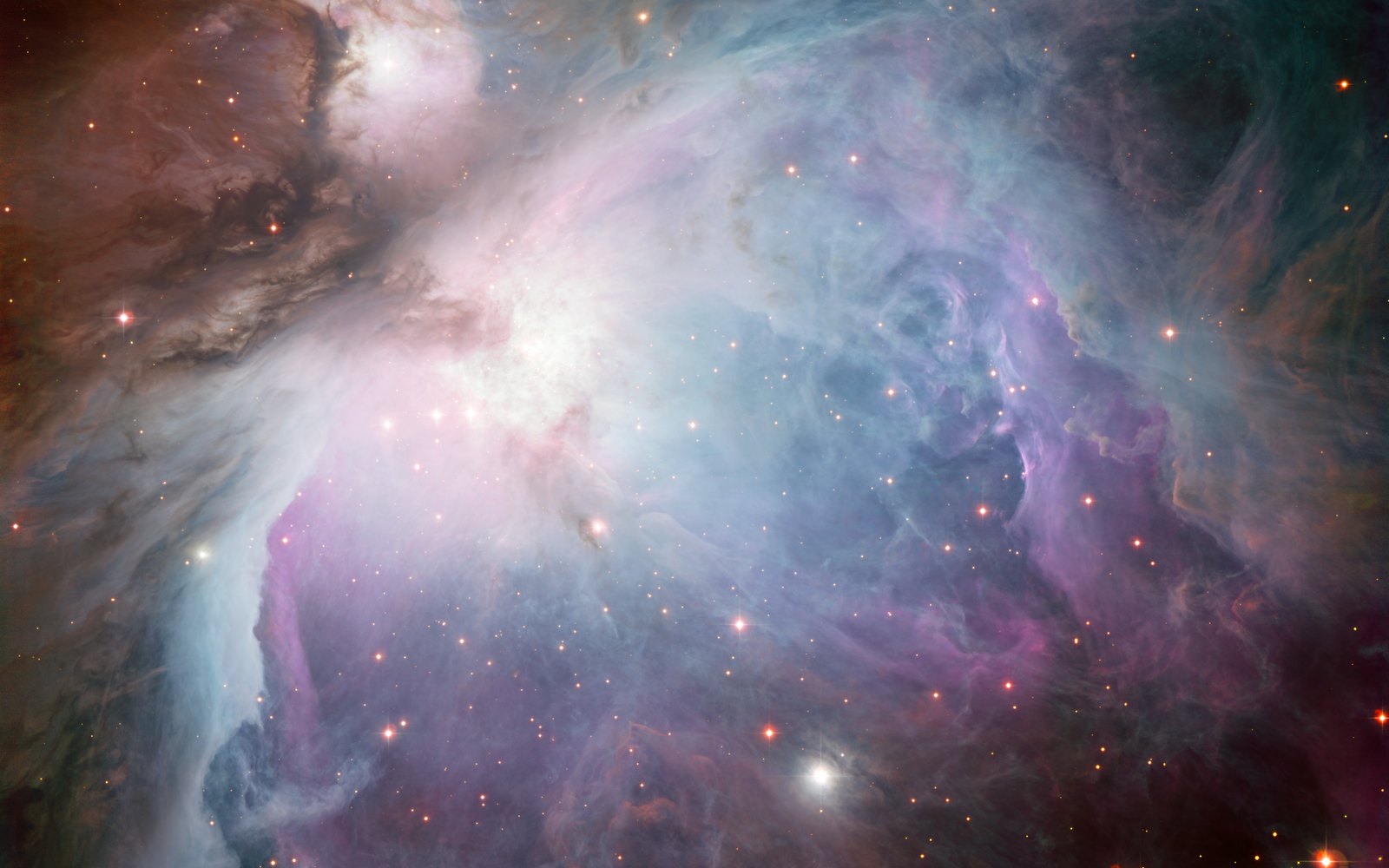
The Orion Nebula is a huge cloud of hydrogen, helium and dust in which gas is contracting into new suns. It is about 24 light-years across and only the brightly glowing front side of a much larger region, the Orion molecular cloud complex. It contains around 3,500 young stars, many of them younger than one million years.
What makes it glow is a handful of extremely hot stars at its center, the Trapezium. Their ultraviolet light strips the electrons from the hydrogen atoms. When the atoms capture them again, they emit light in specific colors – mainly red and green.
M 43 is not a separate nebula but part of the same cloud. A dark lane of dust visually separates it from the large Orion Nebula, which is why it received its own number in the Messier catalog. It is energized by a single young star, NU Orionis.
Emission nebula or reflection nebula?
M 42 and M 43 are primarily emission nebulae: they produce their own light. A reflection nebula, on the other hand, does not glow itself but scatters the light of nearby stars off dust – much like fog in a car’s headlights. Because blue light is scattered more strongly, reflection nebulae look bluish in photos.
The Orion Nebula contains both. The delicate bluish veils at the edge are dust reflecting starlight, and directly to the north lies NGC 1977, the “Running Man Nebula”, a typical reflection nebula. Our overview of nebulae in space shows what other types of nebula there are.
Orion Nebula fact sheet: the key data
| Feature | Value |
|---|---|
| Designation | M 42 / NGC 1976 (M 43 = NGC 1982) |
| Type | Emission nebula (H II region) with reflection components |
| Constellation | Orion, in the “Sword” below the Belt |
| Distance | about 1,350 light-years (414 ± 7 parsecs) |
| Brightness | magnitude 3.7 (M 43: magnitude 9.0) |
| Apparent size | 65′ × 60′ – a good two full-Moon widths |
| True size | about 24 light-years |
| Stars in the nebula | about 3,500, mostly younger than 1 million years |
| Mass of the star cluster | 700 to 2,100 solar masses |
| Coordinates (J2000) | RA 5h 35m, Dec −5° 23′ |
| Altitude at culmination | about 33° from London, 44° from New York (90° minus your latitude minus 5.4°) |
| First description | Nicolas-Claude Fabri de Peiresc, 1610 |
Sources: Wikipedia (Orion Nebula), ESO; altitudes calculated by us for each latitude.
Orion Nebula distance: how far away is M 42?
The Orion Nebula is about 1,350 light-years away from us. This value comes from a 2007 measurement with a network of radio telescopes that tracked the tiny yearly shift of young stars in the nebula. The light entering your eye tonight therefore set off around the year 676.
Other measurements land between about 1,270 and 1,350 light-years. The differences arise because the nebula itself has depth and different methods measure different stars. For observing it makes no difference: it is the closest large star-forming region to Earth.
Finding the Orion Nebula: three fingers down from the Belt
First look for the three Belt stars – three equally bright stars in a short, slanted row. On winter evenings they stand in the south, flanked by reddish Betelgeuse at upper left and bluish-white Rigel at lower right.
Below the Belt hangs a smaller, vertical chain of stars: the Sword. Its middle “star” is the Orion Nebula, about 4 degrees below Alnilam – roughly three finger-widths at arm’s length. Even on a reasonably dark night it doesn’t look like a point but slightly fuzzy.
When is the Orion Nebula visible? The observing season
The Orion Nebula is a winter object, but it already appears in the morning sky in late summer. From mid-September it stands high enough before dawn, in November from late evening. It becomes really comfortable from December to February, when it is already in the southeast at dinner time.
The best time to observe it is around its highest point, the culmination. Then you look through the least amount of air, and the view is steadier and more contrasty. The table shows when that is and when it stands at least 15 degrees high in darkness.
| Date | Highest point | Well visible (dark) | Tip |
|---|---|---|---|
| September 15 | 6:55 a.m. (twilight) | 3:05–5:20 a.m. | First look in the morning |
| October 1 | 5:55 a.m. (twilight) | 2:05–5:50 a.m. | Early-riser time |
| November 1 | 2:50 a.m. | 11:00 p.m.–5:40 a.m. | Around midnight, once the clocks have gone back |
| December 1 | 12:55 a.m. | 9:05 p.m.–4:40 a.m. | Good in the evening from now on |
| December 15 | 12:00 midnight | 8:10 p.m.–3:45 a.m. | Above the horizon all night |
| January 15 | 9:55 p.m. | 6:05 p.m.–1:45 a.m. | Best evening time |
| February 15 | 7:55 p.m. | 6:30–11:45 p.m. | Right after dusk |
| March 15 | 6:05 p.m. (twilight) | 7:15–9:55 p.m. | End of the season approaching |
| April 1 | 5:55 p.m. (twilight) | 8:50–9:45 p.m. | Only low in the west now |
Calculated for 51.5° north near the reference meridian of the time zone (London), in local clock time including daylight saving time as observed in Europe; “dark” = Sun more than 12° below the horizon. The times repeat almost to the minute every year. Elsewhere at mid-northern latitudes your clock times differ by up to about 30 minutes, depending on where you are within your time zone; further south the nebula climbs higher and stays in the dark sky longer. In North America daylight saving time starts in mid-March, so add one hour to the March 15 row there.
The Orion Nebula cannot be seen in summer. From May to July it is in the daytime sky near the Sun. If you read about “Orion in the morning sky” in July, that means the last few minutes before sunrise – not enough for the nebula.
Observing the Orion Nebula: naked eye, binoculars, telescope
With the naked eye: the fuzzy star in the Sword
To the naked eye the Orion Nebula is a small, milky smudge instead of a sharp star. In the countryside you see it immediately, on the edge of town only after a few minutes in the dark. Tip: look slightly to the side of it – this so-called averted vision gets more light out of it.
In binoculars: bright core and two wings
A pair of 10×50 binoculars turns the smudge into a distinct nebulous cloud with two curved wings. Stars sparkle in the middle, and M 43 appears as a small appendage. Braced against a wall or from a deck chair, the view becomes much steadier.
With a 15×70 the nebula gets bigger and brighter, but it needs a tripod. No binocular resolves the Trapezium – for that you need at least 30 to 50× magnification. How to find the right pair is explained in our binoculars guide.
Binocular tip for nebulae: Omegon Nightstar 15x70 Binoculars
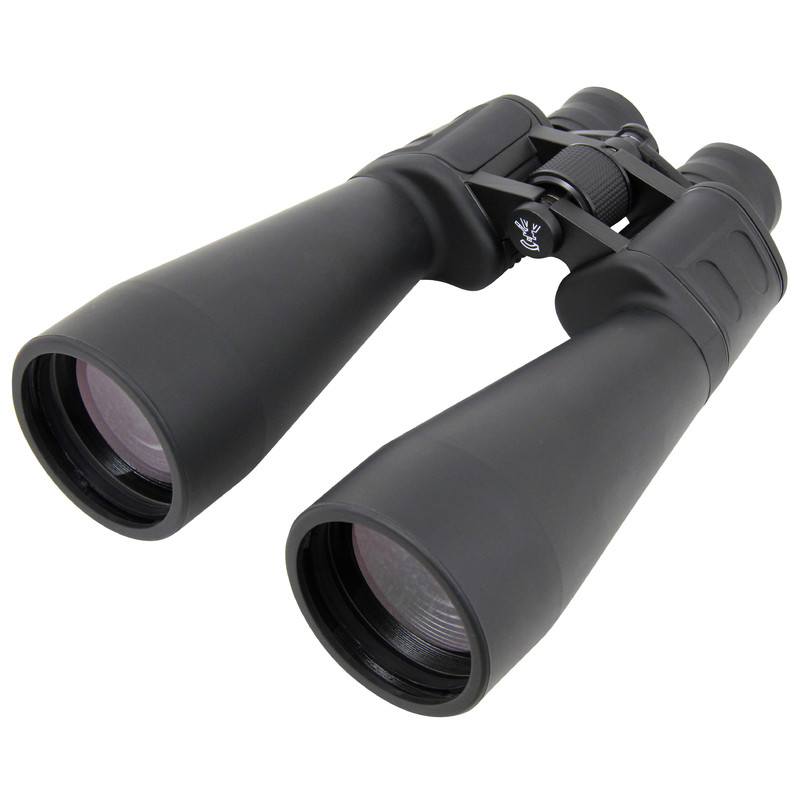
70 mm of aperture gathers twice as much light as 50 mm – the Orion Nebula becomes noticeably bigger and brighter. At 1.4 kg it is too heavy for hand-held observing, though, so plan on a photo tripod.
Price: € 119
In a telescope: what each aperture shows
Aperture, meaning the diameter of the lens or mirror, decides almost everything with nebulae. Twice the aperture gathers four times as much light, and that is exactly what extended, faint objects lack. The values apply to a dark rural sky without the Moon.
| Aperture | Example instrument | What you see | Price |
|---|---|---|---|
| 70 mm | Celestron AstroMaster 70AZ RefractorOmegon Telescope AC 70/700 AZ-2 | Bright core, wings hinted, Trapezium as three to four stars | $199.95€ 119 |
| 130 mm | Sky-Watcher Heritage 130 Tabletop DobsonianSkywatcher Dobson Telescope N 130/650 Heritage FlexTube | Wings with structure, dark “Fish’s Mouth” bay, M 43 clearly visible, Trapezium clearly four stars | $305.00€ 265 |
| 200 mm | Apertura AD8 8" Dobsonian TelescopeSkywatcher Dobson Telescope N 200/1200 Skyliner Classic | ⭐ Our recommendationCloudy veils out to the edge of the field, greenish glow, Trapezium stars E and F in steady air | $699.95€ 479 |
| 254 mm | Apertura AD10 10" Dobsonian TelescopeOmegon Dobson Telescope Advanced X N 254/1250 | Fine filaments, nebula fills the eyepiece, Horsehead with a filter at very dark sites | $949.95€ 622 |
Links marked with an asterisk are affiliate links.
The Trapezium: four stars, six with luck
In the brightest part of the nebula sits the Trapezium, four young stars within only about 20 arcseconds. Even at 40 to 60× magnification a small telescope splits them into a skewed quadrilateral. The brightest of them, θ¹ Orionis C, makes almost the entire nebula glow.
Two more stars of about magnitude 11, called E and F, are the classic challenge for steady nights. Experienced observers on the German astronomie.de forum report that in very steady air it works from about 100 mm, while in average conditions it can be difficult even with 300 mm. What matters is the seeing, meaning the turbulence of the air, not the size of the telescope.
Colors in the eyepiece: why it looks gray-green
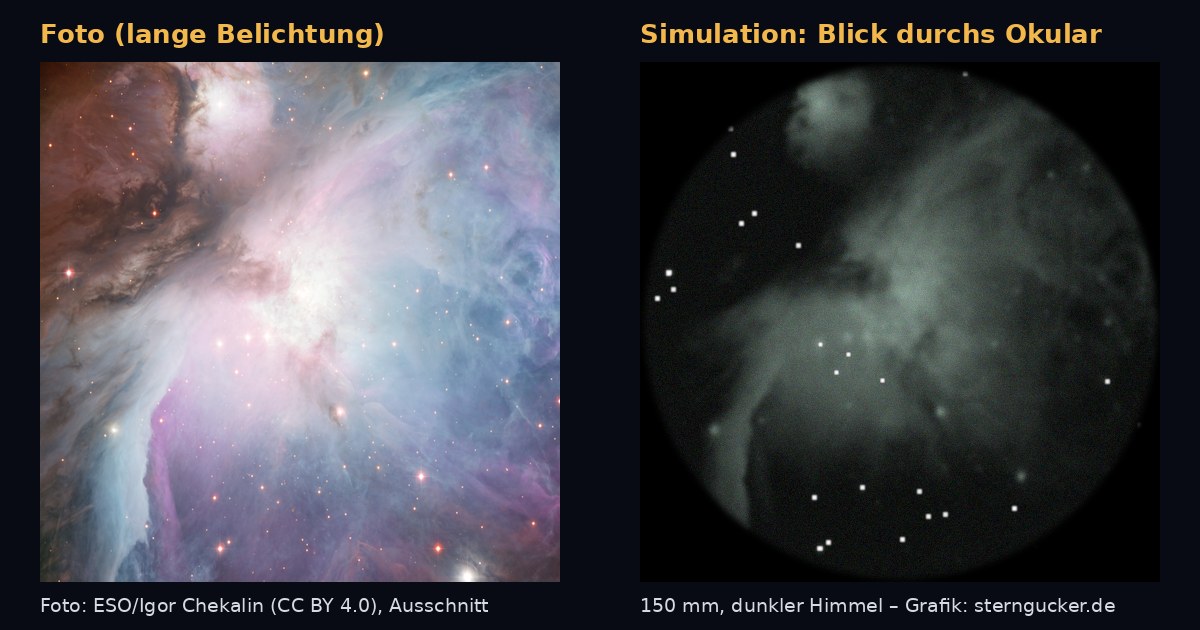
To be honest: you won’t see the vivid colors of the photos in the telescope. In low light only the rods in your eye are working, and they barely see color. The Orion Nebula therefore appears gray, with some luck slightly greenish-turquoise.
The green is real: it comes from oxygen, which glows in exactly the color range where the eye is most sensitive at night. Some owners of large Dobsonians of 300 mm and up also report a hint of pink. The structure, on the other hand, is overwhelming even without color – many observers find M 42 more impressive in the eyepiece than in any photo.
Which instrument for the Orion Nebula? Recommendations by budget
For the Orion Nebula, aperture counts more than anything else. A simple Dobsonian – a reflecting telescope on a rotating wooden base – delivers the most light to your eye for the money. You don’t need a GoTo system that slews to objects by itself here: you can find M 42 with the naked eye anyway.
Budget entry: Celestron UpClose G2 10x50 Porro Binoculars
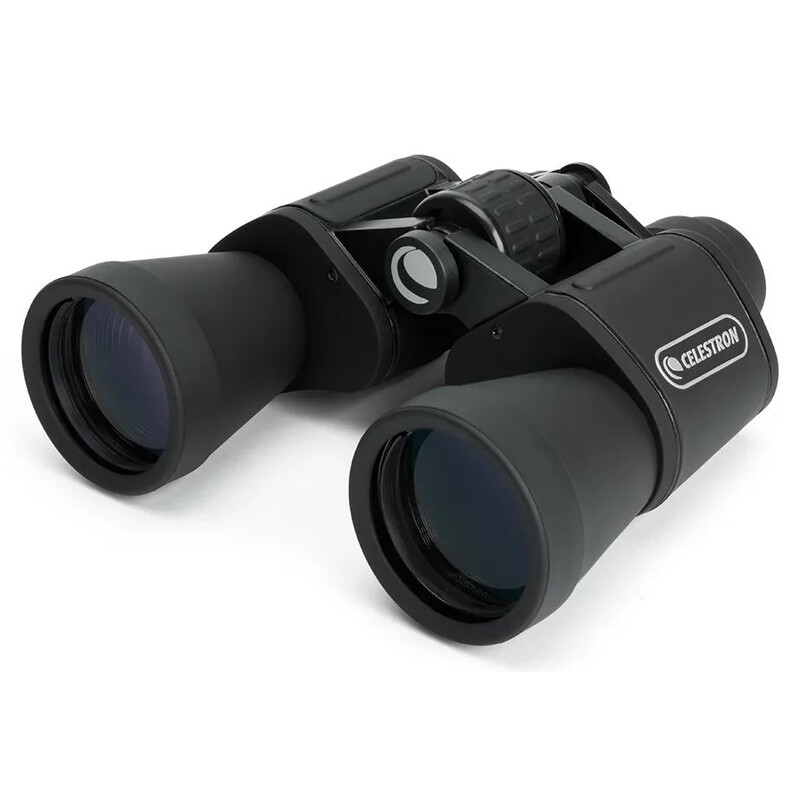
A simple 10×50 Porro binocular: shows the Orion Nebula with its wings, plus star clusters and the Milky Way. Eyeglass wearers struggle with its short eye relief.
Price: € 62
First telescope: Skywatcher Dobson Telescope N 130/650 Heritage FlexTube
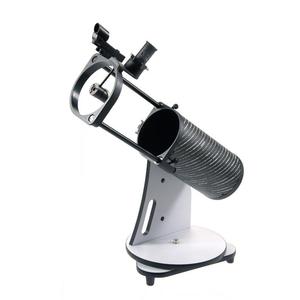
130 mm aperture on a compact tabletop Dobsonian: it reliably shows the Trapezium, the wings and M 43. It needs a table or stool as a base, and under a city sky mostly the core of the nebula remains.
Price: € 265
Our recommendation: Skywatcher Dobson Telescope N 200/1200 Skyliner Classic
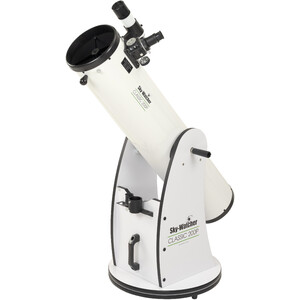
200 mm aperture gathers almost 2.4 times as much light as the 130 mm – for the Orion Nebula that is the step from “patch with structure” to “cloud with veils”. The price is size: the tube is 1.2 m long and doesn’t fit in every car trunk.
Price: € 479
The Apertura AD10 10" Dobsonian TelescopeOmegon Dobson Telescope Advanced X N 254/1250 gathers about 60 percent more light than a 200 mm. On the Orion Nebula it reveals fine filaments and veils far out into the surroundings, and together with an H-beta filter even the Horsehead Nebula becomes possible under a very dark sky. The extra cost is worth it if you regularly drive to a dark site and have enough space for transport – from a city balcony it gives you hardly more than the 200 mm.
For advanced observers: Omegon Dobson Telescope Advanced X N 254/1250
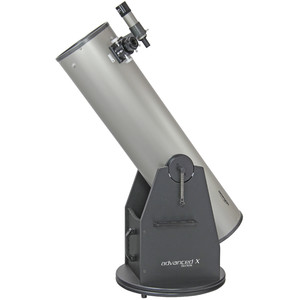
10 inches of aperture for the price of many 8-inch scopes: the cheapest way to reach much fainter objects.
Price: € 622
Which instruments are suitable for nebulae and galaxies in general is compared in our guide Telescope for galaxies and nebulae. It also covers Andromeda and other faint targets where aperture matters even more.
Orion Nebula pictures: why photos are so colorful
Every color picture of the Orion Nebula is a long exposure, often over many hours. The camera sensor collects light until even faint areas become visible, and in doing so it sees the colors our eyes are blind to at night. On top of that comes image processing, which enhances contrast and color.
The colors themselves are not made up, though. Red comes from hydrogen, green-turquoise from oxygen, blue from dust scattering starlight. Professional images like the ESO photo above additionally use filters for individual color ranges and assign colors to them.
Photographing the Orion Nebula: from phone to smart telescope
Smartphone photo of the Orion Nebula
With the night mode of a current smartphone on a tripod, you can capture Orion including the pink spot in the Sword. Without tracking you won’t get more than a small colored dot. If you hold the phone to the eyepiece with an adapter, you’ll see the core and the Trapezium, but hardly any color.
For phone photos at the eyepiece: Omegon Smartphone Adapter 25–48 mm
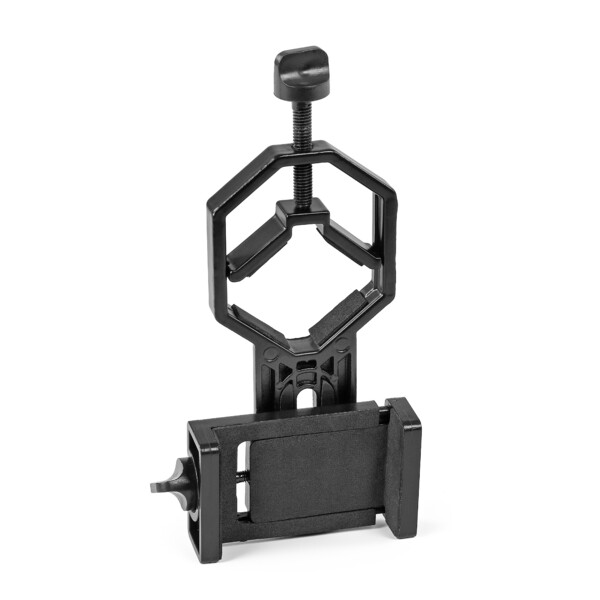
Holds your smartphone centered and steady at the eyepiece. Without a holder every shot wobbles and you’ll hardly find the nebula on the display again.
Price: € 14.90
How to set exposure time, ISO and focus on your phone is shown in our guide Smartphone astrophotography. Most of the tips there apply to M 42 just as they do to the Milky Way.
Camera and tripod: the first color photo
A mirrorless or DSLR camera with a 50 to 135 mm lens on a solid tripod is enough for a first real color photo. Depending on the focal length, expose for 2 to 8 seconds at ISO 1600 to 3200, otherwise the stars turn into trails. Take 50 to 100 such single frames and stack them on the computer into a low-noise image.
A small tracking mount that compensates for Earth’s rotation brings much more. It allows 30 to 60 seconds per frame, and the nebula gains wings and color. Our guide to deep-sky astrophotography describes the complete workflow.
Smart telescope: color at the push of a button
The easiest way to get a color picture of the Orion Nebula is with a smart telescope. You select the target in the app, the device slews to it by itself and stacks the exposures live. After 10 to 20 minutes you see a nebula with color and wings on your phone – even from a balcony on the edge of town.
The catch: you’re looking at a screen, not through an eyepiece. If you want to see the real light, a Dobsonian serves you better. Which models are worth it is compared in our overview of the smart telescope.
Color nebula photos without prior knowledge: ZWO Seestar S50 Pro Smart Telescope
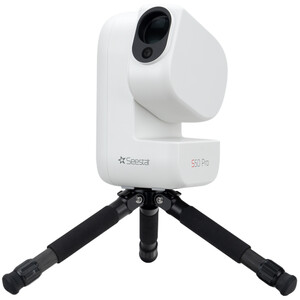
50 mm aperture, a built-in light-pollution filter and automatic tracking: the Orion Nebula is one of its showpiece targets. For planets, on the other hand, the image is very small.
Price: € 999
Horsehead Nebula and Flame Nebula: the Orion Nebula’s neighbors
Around the Orion Nebula lie more nebulae that you can take in during the same observing night. In photos they are spectacular; visually the range goes from easy to extremely hard. The overview shows what is realistic.
| Object | Type | Where? | Visual from |
|---|---|---|---|
| M 43 | Emission nebula | directly north of M 42 | 50 mm |
| NGC 1977 “Running Man” | Reflection nebula | 0.5° north of M 42 | 80 mm, dark sky |
| NGC 2024 Flame Nebula | Emission nebula | directly east of Alnitak | 100–150 mm, dark sky |
| B 33 Horsehead Nebula | Dark nebula | 0.5° south of Alnitak | 250 mm + H-beta filter |
The Horsehead Nebula is a cloud of dust that stands out as a dark silhouette against a faintly red-glowing strip of gas. It is about 1,500 light-years away and only a few arcminutes in size. Visually it is considered one of the most difficult objects in the sky; photographically even a smart telescope shows it after half an hour.
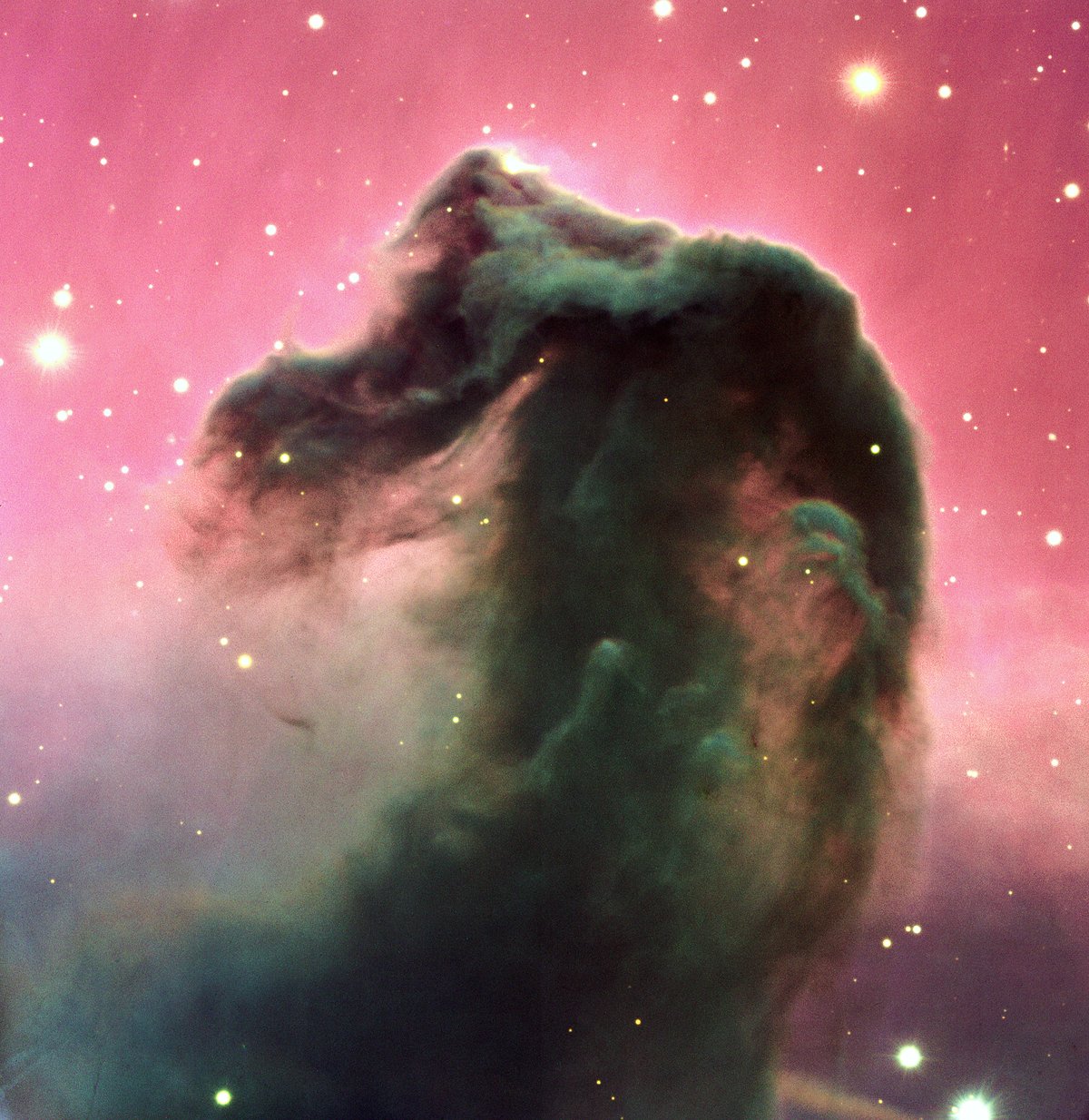
The Flame Nebula is visually easier than its reputation suggests. The problem is Alnitak, which outshines the nebula with its glare. Nudge the star just out of the field of view, and a dark dust lane with bright edges appears.
Frequently asked questions about the Orion Nebula
How many light-years away is the Orion Nebula?
About 1,350 light-years. Depending on the measurement method, figures range between about 1,270 and 1,350 light-years. That makes it the closest large star-forming region to Earth.
Can you see the Orion Nebula from the city?
Yes, at least the core. With the naked eye you need patience and some dark adaptation on the edge of town; in binoculars and a small telescope it is easy to see even in the city. The delicate wings, however, disappear into the sky background – a UHC filter helps here.
Is the Orion Nebula visible in summer?
No. From May to July it is in the daytime sky. From mid-September it appears in the morning before dawn, and it is well visible in the evening from December to March.
How big is the Orion Nebula really?
The brightly glowing part measures about 24 light-years. In the sky it covers about 65 × 60 arcminutes, a good two full-Moon widths. On long-exposure photos the faint nebulosity extends considerably further.
What is the difference between M 42 and M 43?
Both belong to the same gas cloud. M 43 is the small, comma-shaped part north of the main nebula, visually separated by a dark dust lane. It is energized by its own young star and, at magnitude 9.0, is considerably fainter.
Can you see the Horsehead Nebula with a telescope?
Only under a very dark sky, with at least 250 mm of aperture and an H-beta filter – and even then only as a faint hint. Many experienced observers have never seen it. Photographically, on the other hand, it is easy, even with a camera and tracking mount or a smart telescope.
* Affiliate link: if you buy through this link we may earn a small commission from Astroshop or High Point Scientific, at no extra cost to you.