By Alexander Merz · Published on
Lagrange points are five places in the gravitational field of two bodies where a small third body can orbit in lockstep with them, such as a satellite in the Sun–Earth system. There, gravity and centrifugal force balance exactly.
The five Lagrange points
Three points lie on the line joining the two bodies, two form an equilateral triangle with them. The table shows them for the Sun and Earth.
| Point | Location (Sun–Earth) | Stable? | Known for |
|---|---|---|---|
| L1 | about 1.5 million km in front of Earth, towards the Sun | no | SOHO, DSCOVR, Aditya-L1 |
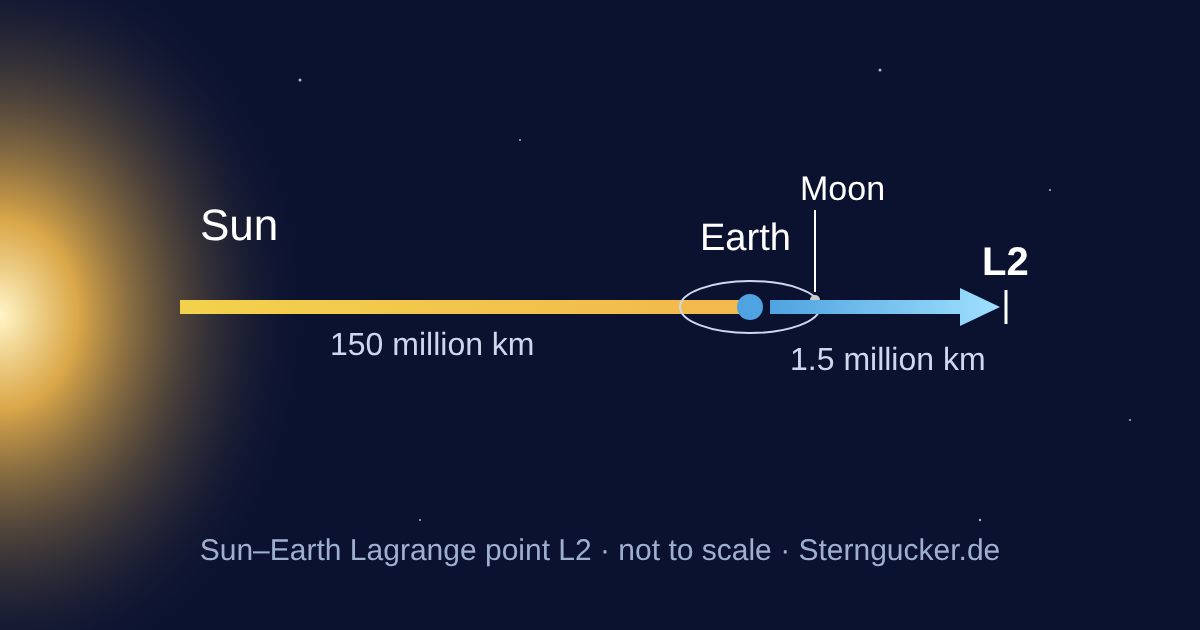
| L2 | about 1.5 million km behind Earth, away from the Sun | no | James Webb, Gaia, Euclid |
| L3 | opposite Earth, behind the Sun | no | science fiction (“counter-Earth”) |
| L4 | on Earth’s orbit, 60° ahead of Earth | yes | Earth trojan 2010 TK7 |
| L5 | on Earth’s orbit, 60° behind Earth | yes | no object confirmed so far |
1.5 million km is roughly four times the distance to the Moon and only about 1 % of the distance to the Sun. L3, by contrast, lies almost 300 million km from Earth, on the far side of the Sun.
Explained simply: why it works
A body orbiting closer to the Sun than Earth is actually faster than Earth – that is what Kepler’s third law says. At L1, however, Earth pulls in the opposite direction and slows it down just enough to keep pace with Earth.
Behind Earth, at L2, it is the other way round: on its own, a body there would be too slow. Now the Sun and Earth pull in the same direction, and their combined force is exactly enough for one orbit per year.
Which points are stable?
L1, L2 and L3 are unstable: they sit on saddles of the gravitational field. A satellite that drifts slightly keeps moving further away and has to correct with small thruster burns at regular intervals.
L4 and L5 are stable as long as the larger body is at least about 25 times as massive as the smaller one. The Sun and Earth (a factor of about 333,000), the Sun and Jupiter (about 1,000) and even Earth and the Moon (about 81) meet this easily.

Sun–Earth Lagrange points
L1 is the box seat for watching the Sun: from there a probe sees the Sun without interruption and measures the solar wind up to an hour before it reaches Earth. That is why space-weather sentinels such as SOHO (since 1996), ACE and DSCOVR are stationed there.
L2 is the favourite spot of space telescopes: seen from there, the Sun, Earth and Moon are always on the same side. A single sunshield is enough to keep the instruments cold and dark.
Earth–Moon Lagrange points
Earth and the Moon also have five Lagrange points. L1 lies on average about 58,000 km in front of the Moon towards Earth, L2 about 64,500 km beyond the Moon.
The Earth–Moon L2 point has made spaceflight history: in 2018 China placed the relay satellite Queqiao in a halo orbit there. It kept the radio link to the Chang’e 4 probe, which in early 2019 became the first to land on the far side of the Moon.
Missions at L1 and L2
| Mission | Point | Period | Purpose |
|---|---|---|---|
| SOHO (ESA/NASA) | L1 | since 1996 | solar observation |
| ACE (NASA) | L1 | since 1998 | solar wind |
| DSCOVR (NOAA/NASA) | L1 | since 2015 | space weather, Earth images |
| Aditya-L1 (ISRO) | L1 | since 2024 | solar observation |
| WMAP (NASA) | L2 | 2001–2010 | cosmic microwave background |
| Planck and Herschel (ESA) | L2 | 2009–2013 | cosmic background, infrared |
| Gaia (ESA) | L2 | 2014–2025 | star catalogue of the Milky Way |
| James Webb (NASA/ESA/CSA) | L2 | since 2022 | infrared space telescope |
| Euclid (ESA) | L2 | since 2023 | dark matter and dark energy |
Even so, the telescopes at L2 are not crowded: their orbits around the point are hundreds of thousands of kilometres across. The James Webb Space Telescope needs about half a year for one loop and briefly fires its thrusters about every three weeks.
Trojans at L4 and L5
Where a point is stable, material collects over billions of years. The best-known examples are the trojans of Jupiter: in early 2023 about 13,000 of these asteroids were known, about 8,300 at L4 and 4,700 at L5.
NASA’s Lucy probe has been on its way to them since 2021 and is to take a close look at several Jupiter trojans. Earth also has two confirmed trojans: 2010 TK7 and 2020 XL5, about one kilometre across, both at L4.
In the Earth–Moon system, faint dust clouds have been reported at L4 and L5, the Kordylewski clouds. Whether they exist permanently is still disputed.
How to calculate Lagrange points
For L1 and L2 there is a good rule of thumb: the distance from the smaller body is roughly its distance from the large body times the cube root of one third of the mass ratio.
Sun–Earth: 149.6 million km · ∛(1 / 1,000,000) ≈ 1.5 million km
Earth–Moon: 384,400 km · ∛(1 / 243) ≈ 61,500 km (exact: about 58,000 and 64,500 km)
For L4 and L5 you do not need to calculate at all: they always lie 60° ahead of and behind the smaller body on its orbit. The exact position of L1 to L3, on the other hand, requires solving a fifth-degree equation, which computers handle.
Joseph-Louis Lagrange
The points are named after Joseph-Louis Lagrange (1736–1813), a Turin-born mathematician who worked in Berlin and Paris. He studied the three-body problem: how do three masses that attract each other move?
Leonhard Euler had already found the three points on the line around 1767. In 1772 Lagrange added the two triangle points L4 and L5 – proof that something really orbits there came only in 1906 with the first Jupiter trojan, (588) Achilles.
Can you observe them?
The points themselves are empty space and invisible. Whatever orbits there is tiny and far away: even in large amateur telescopes the James Webb Space Telescope shows up only as a faint dot on camera images.
The brightest Jupiter trojans are within reach – with a larger telescope, a camera and a star chart showing their position. If you are just getting started with observing, our overview of the best telescopes helps you find the right instrument.
FAQ about Lagrange points
How many Lagrange points are there?
Every pair of two celestial bodies has five, L1 to L5. So the Sun and Earth have five, Earth and the Moon another five, and so do the Sun and Jupiter.
How far are the Lagrange points from Earth?
L1 and L2 each lie about 1.5 million km (930,000 miles) from Earth. L4 and L5 are as far from Earth as the Sun is, about 150 million km. L3 lies behind the Sun, almost 300 million km away.
Which Lagrange points are stable?
Only L4 and L5, and only if the large body is at least about 25 times as massive as the small one. L1, L2 and L3 are unstable; satellites there have to correct their orbit regularly.
Why is the James Webb Space Telescope at L2?
From L2, the Sun, Earth and Moon are always on the same side. A single sunshield keeps the infrared telescope permanently cold, and the radio link to Earth is never interrupted.
Is there a counter-Earth at L3?
No. A planet behind the Sun would long since have been noticed through its gravity on other planets and by space probes that look at Earth’s orbit from the side. L3 is also unstable.
Sources: ESA – an exclusive observing post for astronomers (article in German), NASA – What is a Lagrange Point?, NASA – Webb’s orbit at L2.