By Alexander Merz · Published on · Details checked on 22 September 2026
Yes, the Moon rotates: it spins once on its axis every 27.3 days – exactly as long as one orbit around Earth takes. This synchronous rotation, also called tidal locking, is why we always see the same side of the Moon from Earth.
⭐ In short: The Moon does rotate, just very slowly: a point on its equator moves at about 16.7 km/h (roughly 10 mph), about the speed of a bicycle. Around Earth, on the other hand, it travels at a good 3,680 km/h, anticlockwise as seen from the north. And because its orbit is elliptical and tilted, over time we see not 50 but about 59 percent of its surface.
The Moon’s own rotation: the classic misconception
Many people conclude from the never-changing view: if the same side always faces us, the Moon can’t be spinning. The opposite is true. A Moon without its own rotation would show us every side in turn over the course of a month.
The diagram makes it visible. The orange dot is a fixed crater on the lunar surface: if it points at Earth at all four positions of the orbit, the Moon has turned exactly once on its axis after one orbit.
⚠️ Test the misconception: Walk once around a table while always looking at its centre. After one lap you have turned around completely yourself, your gaze pointed in all four compass directions in turn. That is exactly what the Moon does.
Strictly speaking, the answer depends on the frame of reference. Relative to the stars, the yardstick of astronomy, the Moon rotates once every 27.3 days. It only stands still in a coordinate system that turns along with the Earth–Moon line.
Tidal locking: why we always see the same side
That rotation and orbit take exactly the same time is no coincidence but the work of tides. Earth pulls harder on the side of the Moon facing it than on the far side and has stretched the Moon slightly along that line.
The young Moon spun much faster than it does today. Its tidal bulges therefore ran ahead of Earth, and Earth’s gravity pulled them back like a lever. This brake kept working until rotation and orbit took the same time.
Since then the Moon’s long axis has, on average, always pointed at Earth. Tidal locking is a stable end state; there is no longer a bulge for Earth to brake against. It was reached very early in the Moon’s roughly 4.5-billion-year history.
💡 Not a special case: Almost all large moons in the Solar System are tidally locked, for example Io, Europa, Ganymede and Titan. Pluto and its moon Charon even always show each other the same side. Mercury, by contrast, is caught in a 3:2 resonance: three rotations for every two orbits of the Sun.
How fast does the Moon rotate? Spin and orbit in numbers
All values in the table are our own calculations, based on the mean lunar radius of 1,737.4 km and orbital data from NASA’s DE421 ephemeris. The Moon’s rotation is astonishingly slow, its orbit on the other hand is fast.
| Quantity | Value | Context |
|---|---|---|
| Rotation (relative to the stars) | 27.32 days (27 d 7 h 43 min) | same as one orbit around Earth |
| Synodic month | 29.53 days | from new moon to new moon |
| Rotation speed at the lunar equator | 4.6 m/s ≈ 16.7 km/h | about cycling speed |
| Earth at the equator (comparison) | ≈ 1,674 km/h | about 100 times faster |
| Orbital speed around Earth | avg. 1.02 km/s ≈ 3,680 km/h | in 2026 between 0.97 and 1.10 km/s |
| Distance from Earth | 356,650 to 406,419 km | extremes in 2026, mean ≈ 384,400 km |
| Motion against the stars | ≈ 0.55° per hour | a little more than one Moon diameter (0.52°) |
Why two month lengths? During the 27.32 days of one orbit Earth has moved on around the Sun, so the Moon needs a good two extra days to line up between Earth and Sun again. Only then is it new moon again.
Individual lunar months vary noticeably. In 2026 the gap between two new moons ranges from 29.28 to 29.74 days, because the Moon moves at different speeds along its elliptical orbit.
This leads to a curious day length. A day on the Moon, from sunrise to sunrise, lasts 29.53 Earth days. About two weeks of sunshine alternate with two weeks of night.
The Moon’s direction: why it still sets in the west
The Moon moves prograde, in the same direction in which Earth spins and orbits the Sun. Seen from above the North Pole it travels anticlockwise around Earth and also spins in that sense on its own axis.
In the sky you see this as an eastward drift. Against the stars the Moon moves about 0.55 degrees per hour, a little more than its own diameter. That adds up to about 13 degrees per day.
Even so it rises in the east and sets in the west, like the Sun and the stars. Earth’s rotation carries the whole sky westward at 15 degrees per hour, almost 30 times faster than the Moon’s own motion. That is why the Moon rises only about 50 minutes later each day on average.
💡 Try it yourself: In the evening, pick a bright star or planet close to the Moon and note the gap. After an hour or two the Moon has visibly shifted eastward, so to the left when you face south from the northern hemisphere. Your naked eye is enough.
Lunar libration: how we get to see 59 percent of the surface
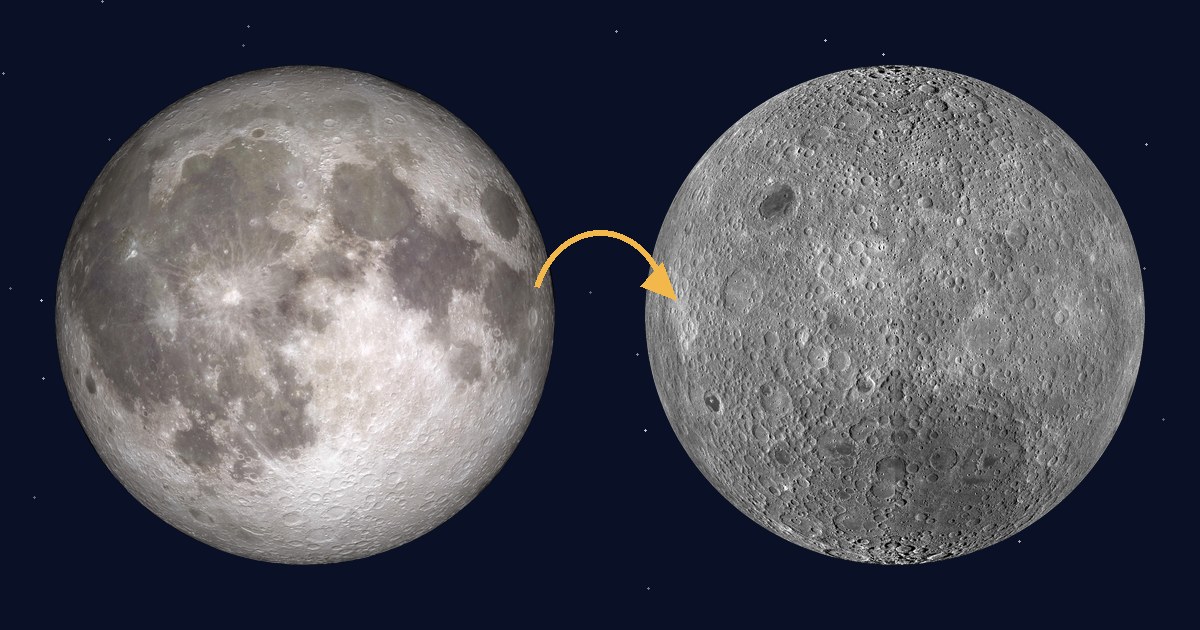
The Moon does not show us its near side completely rigidly. Over a month it seems to nod and rock slightly, and this libration reveals about 9 percent more of the surface. In total we see around 59 percent from Earth, while 41 percent always stays hidden.
| Libration | Cause | Amount |
|---|---|---|
| in longitude | rotation is uniform, but the orbital speed on the ellipse varies | up to ±7.9° |
| in latitude | lunar axis tilted 6.7° to the orbital plane | up to ±6.7° |
| diurnal | we look from Earth’s edge, from a different angle in the morning and evening | about ±1° |
Libration in longitude is the most elegant proof that the Moon rotates. The rotation runs as evenly as clockwork, the orbit does not, so the rotation sometimes gets ahead and sometimes lags behind. This offset lets us peek a little way around the eastern and western limbs in turn.
The side facing away is often called the “dark side”, but that is wrong. The far side gets just as much sunlight as the near side, at new moon it is even fully lit. It was first photographed in 1959 by the Soviet probe Luna 3, and in 2019 China became the first nation to land there, with Chang’e 4.
Why the far side has hardly any dark maria and how its craters formed is explained in our article on the Moon’s surface. In short: its crust is thicker, so little lava reached the surface there.
Observing libration: limb craters with binoculars and a telescope
You can see libration for yourself, best at Mare Crisium near the Moon’s eastern limb. Depending on libration, the dark oval sits clearly away from the edge or almost glued to it. Compare the Moon at the same phase in two consecutive months; binoculars are enough for this.
It gets more exciting at the limb with magnification. With favourable libration, Mare Orientale in the west or Mare Humboldtianum in the northeast appear as narrow strips that otherwise lie beyond the lunar limb. For that you need a telescope at 50 to 100 times magnification and the right date, which free software such as Stellarium will show you.
Our honest advice: you don’t need to buy anything just for libration. But if you want a closer look at the Moon anyway, a compact Dobsonian like the Heritage 130P is a safe choice.
For the Moon and limb craters: Skywatcher Dobson Telescope N 130/650 Heritage FlexTube
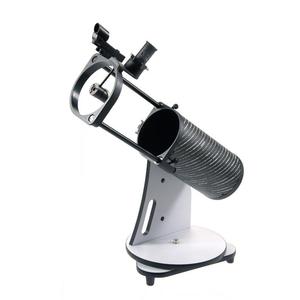
Compact tabletop Dobsonian with 130 mm aperture: set up in seconds, shows limb craters, Mare Crisium and, with good libration, even Mare Orientale.
Price: € 265
Around full moon the Moon is dazzling in a telescope. A moon filter such as the Apertura 1.25" Moon FilterOmegon Premium Moon Filter 1.25″ dims the brightness, but it isn’t essential. More practical tips are in our guide to observing the Moon with a telescope.
Links marked with an asterisk (*) are affiliate links. If you buy through them we receive a small commission; the price stays the same for you.
The Moon is drifting away: what tides do in the long run
Tides brake not only the Moon but Earth as well. As a result, Earth’s day gets longer by about 2 milliseconds per century. The angular momentum Earth loses is gained by the Moon in its orbit.
The consequence can be measured. The Moon is moving away from Earth by about 3.8 centimetres per year, determined with laser pulses bounced back by the reflectors left by the Apollo missions.
In theory Earth would eventually become tidally locked too and always show the Moon the same side, like Pluto and Charon. It won’t come to that, because the Sun will swell into a red giant long before.
💡 Did you know? Around 400 million years ago a year had roughly 400 days. Growth rings in fossil corals show this, as they laid down a thin layer day by day.
Frequently asked questions about the Moon’s rotation
Does the Moon also orbit the Sun?
Yes. The Moon accompanies Earth on its path around the Sun and so circles it once a year as well. Its path around the Sun is curved so gently that it never forms a loop; it bulges towards the Sun everywhere.
How long does the Moon take to spin once on its axis?
27 days, 7 hours and 43 minutes, measured against the stars. On average that matches exactly the time of one orbit around Earth, the sidereal month.
How long does the Moon take to orbit Earth?
27.32 days relative to the stars, 29.53 days from new moon to new moon. Which figure is meant depends on whether you count the orbit or the lunar phases.
Does the Moon orbit Earth clockwise?
No. Seen from the north it moves anticlockwise, just like Earth’s spin. Only if you looked at the whole system from below the South Pole would the same motion appear clockwise.
Is there a dark side of the Moon?
Only in the sense of “invisible to us”. The far side is lit just as often as the near side; at new moon it is even completely in sunlight.
Will the Moon ever stop rotating?
No. As long as it orbits Earth, it keeps rotating along with it. Because it is slowly moving away, its orbit gets longer and its rotation slows down to the same extent.