By Alexander Merz · Published on · Details checked on 6 November 2026
The Golden Handle is a light-and-shadow effect on the waxing Moon: the peaks of the Jura Mountains (Montes Jura) on the rim of the Bay of Rainbows (Sinus Iridum) are already lit by the morning sun while the floor of the bay still lies in shadow. You can see it about 10 to 11 days after New Moon for a few hours (Wikipedia, in German).
⭐ In short: Binoculars are enough to find it; the handle looks three-dimensional in a telescope at medium magnification. In 2027 there are seven good evenings as seen from Central Europe – the dates are right below. Look at the edge of the light-shadow boundary, at the upper left of the Moon’s disc.
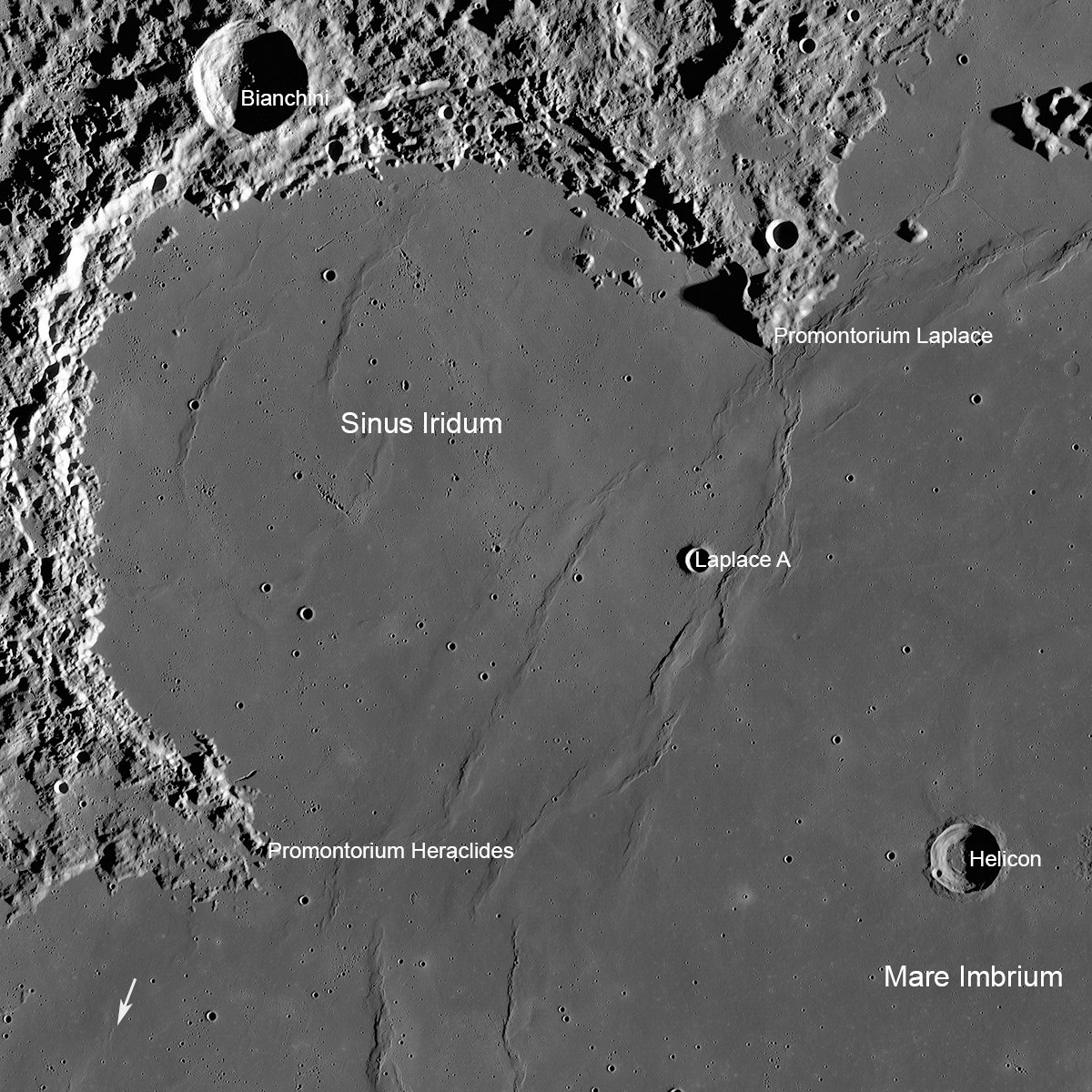
Golden Handle 2027: all dates for Central Europe
We calculated when the morning sun on the Moon stands exactly above the Jura Mountains while the Moon is also high enough in a dark sky over Central Europe. Feel free to start half an hour earlier, because the prediction is accurate to within one or two hours.
| Date 2027 | Time window | Moon altitude (max.) |
|---|---|---|
| Sun 17 / Mon 18 January | 11:30 pm – 2:40 am CET | 40° |
| ⭐ Best eveningTue 16 February | 6:20 pm – 9:30 pm CET | 67° |
| Fri 16 / Sat 17 April | 8:50 pm – 1:10 am CEST | 48° |
| Mon 14 / Tue 15 June | 10:20 pm – 0:10 am CEST | 21° |
| Thu 12 August | 9:30 pm – 10:10 pm CEST | 12° (just) |
| Sun 10 October | 7:20 pm – 10:00 pm CEST | 27° |
| Wed 8 / Thu 9 December | 5:00 pm – 0:40 am CET | 50° |
As a rough rule of thumb for any month: the handle appears about two and a half to three days after First Quarter. As First Quarter comes about a week before Full Moon, our full moon calendar 2026 & 2027 helps you plan.
Where to look
On the waxing Moon the light-shadow boundary, the terminator, runs along the left side. At the upper left, look for the large, dark Sea of Showers (Mare Imbrium) and, on its upper edge, a semicircular bay – that is Sinus Iridum.
In a telescope with a star diagonal the image is mirror-reversed; in a Newtonian it is upside down. So orient yourself by Mare Imbrium, not by “upper left”.
What you see: Bay of Rainbows and Jura Mountains in numbers
The Bay of Rainbows is an old, lava-filled impact crater on the northwestern edge of the Sea of Showers. It measures about 250 km across, and the Jura Mountains curve around it for a good 420 km (IAU/USGS Gazetteer).
| Formation | Value | Source |
|---|---|---|
| Sinus Iridum (Bay of Rainbows) | 249 km diameter, centre 45.0° N, 31.7° W | IAU/USGS |
| Montes Jura (Jura Mountains) | 421 km long, named after the Jura Mountains on Earth | IAU/USGS |
| Height of the Jura peaks | several kilometres; figures vary between 2.7 and 6 km | Wikipedia (de), der-mond.de |
| Ends of the arc | Cape Heraclides (southwest), Cape Laplace (northeast) | Wikipedia (en) |
The bay is so flat and smooth that it was considered as a landing site. The Chinese probe Chang’e 3 was meant to touch down there in 2013 and eventually landed in the neighbouring Sea of Showers (LROC/NASA, Wikipedia).
Why the handle only shines for a few hours
At the terminator, the Sun is just rising on the Moon. High mountain peaks catch the low morning light first, while the deep plain in front of them still lies in darkness – just like on Earth, where the Alpine peaks glow before the valley does.
Then the terminator moves on and the bay fills with light. After about seven hours the effect is over, and the arc no longer stands out from the illuminated floor (der-mond.de, in German). How the terminator moves across the Moon over the phases is explained on our page about the phases of the Moon.
Common mistake: In a German-language forum, an observer took a bright formation on the fourth evening after New Moon for the handle – it was the western edge of the Sea of Nectar with the craters Theophilus, Cyrillus and Catharina. An AI image description had even confirmed the error (forum.astronomie.de, in German). Count the days after New Moon: fewer than about ten is too early.
Binoculars or telescope: the equipment you need
Binoculars are enough to find the handle as a small bright arc. Only a telescope shows its full relief with cast shadows, already at 50 to 100 times magnification (der-mond.de; magnification range: our recommendation).
More magnification does not automatically show more. Experienced observers in a German-language forum name about 380× on 19 cm and 600× on 46 cm of aperture as a sensible upper limit in very steady air; they consider more than 1,000× on an 8-inch telescope utopian (forum.astronomie.de, in German).
Ideal for the Moon: Skywatcher Dobson Telescope N 130/650 Heritage FlexTube
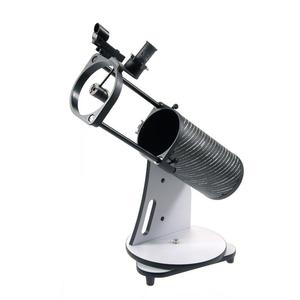
130 mm aperture on a small tabletop mount: shows the Golden Handle, the Jura Mountains and the craters along the terminator even with the supplied eyepieces.
Price: € 265
Tip: Take your time and look several times. Because the terminator moves visibly every hour, the handle changes during the evening – from a single arc of light to a bay filled with light. More targets for the same night can be found on our page about the waxing Moon.
Photographing the Golden Handle
Even a telephoto lens captures the handle (Wikipedia, in German). Expose for the bright peaks, not for the whole lunar disc, otherwise the handle will be blown out.
At the telescope, many single frames are better than a video from the camera. The camera’s internal video compression swallows fine detail; one user of a German-language forum therefore shoots more than 1,000 burst frames and uses the best 30 percent (forum.astronomie.de, in German).
Golden Handle FAQ
When can you see the Golden Handle?
About 10 to 11 days after New Moon, once a month for a few hours. From Central Europe the best evening in 2027 is 16 February; all dates are in the table above.
Can you see the Golden Handle with the naked eye?
Wikipedia and der-mond.de name small binoculars as the minimum equipment. They show the handle as a bright arc at the terminator; a telescope makes it look three-dimensional.
What is Sinus Iridum?
The “Bay of Rainbows”, a lava-filled crater bay about 250 km across on the edge of the Sea of Showers. Its rim mountains, the Jura Mountains, form the handle.
How long is the Golden Handle visible?
About seven hours; after that the bay fills with light (der-mond.de). Whether you can watch the whole time depends on how long the Moon stays above your horizon.
Links marked with an asterisk (*) are affiliate links. If you buy through them, we receive a small commission – the price stays the same for you.
Sources: Wikipedia: Goldener Henkel (in German) · der-mond.de (in German) · IAU/USGS: Sinus Iridum · IAU/USGS: Montes Jura · LROC · USNO Moon phases · forum.astronomie.de (German-language, linked above) · Table of dates: our own calculation. Accessed on 28 October 2026.
Read more on Sterngucker
- The Moon – facts, phases and what you see at the terminator
- Waxing Moon – observing tips
- Moon surface – seas, craters, mountains
- Full moon calendar 2026 & 2027