By Alexander Merz · Published on · Details checked on 14 September 2026
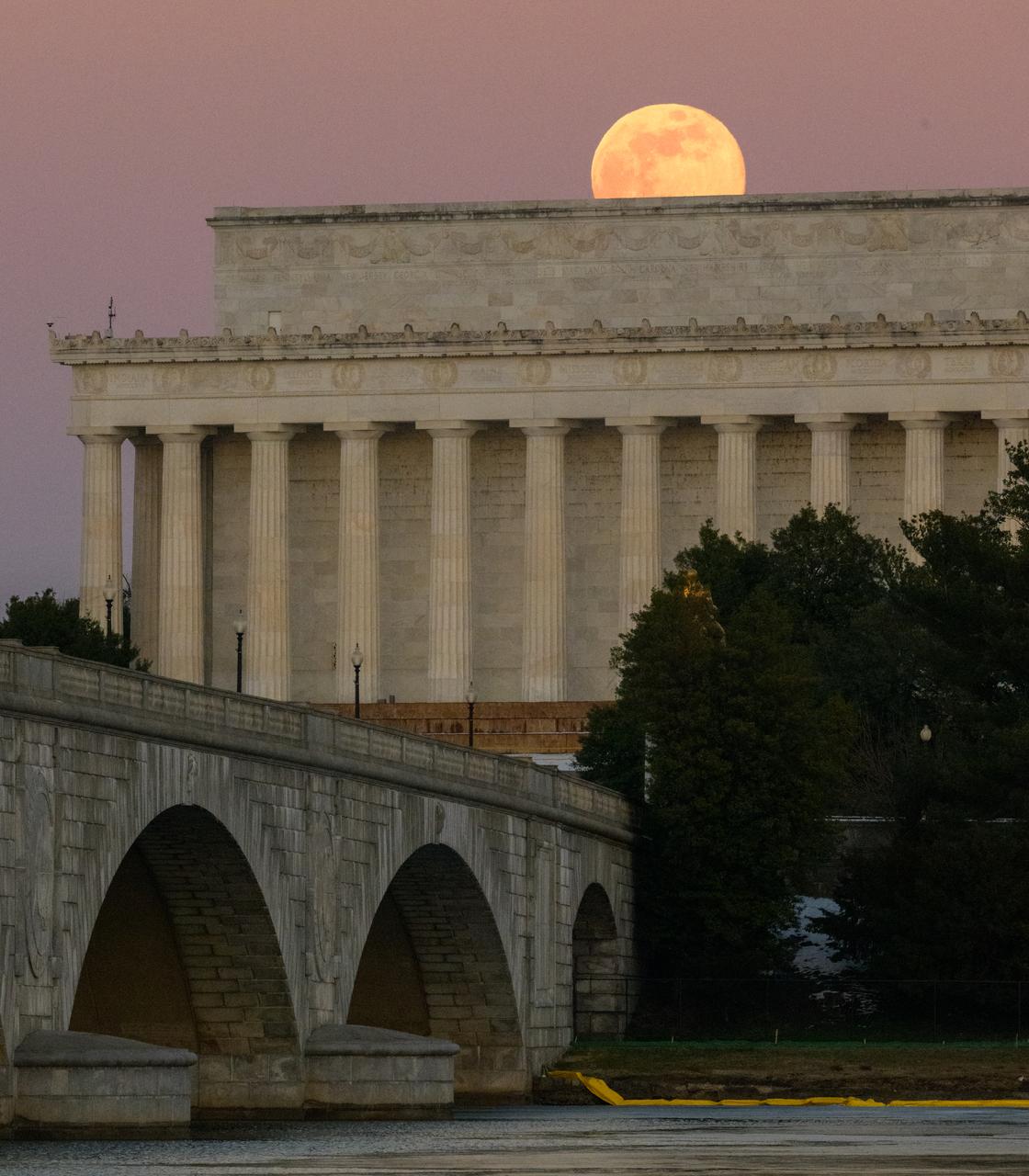
You come around the corner in the evening – and there it hangs: a huge, orange-red Moon just above the rooftops, seemingly three times bigger than usual. Two hours later it stands high in the sky and looks completely normal again. What happened? The answer is one of the most fascinating illusions your brain can produce – plus a little physics. Here you get both explained.
⚡ The quick answer: Near the horizon the Moon is not actually bigger – that is the famous Moon illusion, an optical illusion created by your brain. The lunar disc always stays about the same size (roughly 0.5 degrees). The reddish or orange colour, on the other hand, is real physics: low on the horizon the moonlight passes through far more atmosphere, which scatters out the blue light – leaving red-orange behind, just like at sunset.
The Moon illusion: your brain plays a trick on you
The astonishing part first: photograph the “giant Moon” on the horizon and compare it with a photo of the high-standing Moon (same focal length) – the disc is exactly the same size. The enlargement happens purely in your head.
Why has been disputed for over 2,000 years – even Aristotle puzzled over it. The most common explanations today:
- Reference objects: On the horizon you see the Moon next to houses, trees and mountains – your brain “knows” these things are far away and large, and scales the Moon up accordingly. High in the empty sky, any yardstick is missing.
- The flattened sky dome: We perceive the sky not as a hemisphere but as a flattened bowl – so the horizon seems “further away” than the zenith. An equally large object that appears further away is interpreted by the brain as bigger (related to the Ponzo illusion).
🧪 The self-test: Look at the “giant” horizon Moon through a small hole between your fingers, so the surroundings disappear – the illusion collapses instantly. Even more astonishing: look at it upside down (between your legs) – then too the Moon shrinks back to normal size. Your brain needs the familiar landscape in order to be fooled.
Why is the Moon red, orange or yellow on the horizon?
Unlike the size, the colour is real physics: when the Moon is low, its light travels up to 40 times farther through the atmosphere. Air molecules then preferentially scatter the short-wavelength blue light out of the beam (Rayleigh scattering) – exactly the effect that makes the sky blue and sunsets red. What remains is the long-wavelength part: yellow, orange all the way to deep red, depending on haze, dust and humidity. The colours become especially intense after wildfires or during Saharan dust events.
As the Moon climbs higher, the light path shortens – the colouring fades and the Moon shines silvery-white again. Not to be confused: during a “blood Moon” in a total lunar eclipse, the Moon turns red even high in the sky – then only the light refracted by Earth’s atmosphere reaches it.
And what about the supermoon?
A real size difference does exist – it is just much smaller than it feels: the Moon’s distance varies between roughly 356,000 and 407,000 kilometres. When the full Moon coincides with perigee (“supermoon”), the disc appears up to 14 % larger and around 30 % brighter than at the smallest full Moon. With the naked eye this is barely noticeable – the “wow effect” of the supermoon on the horizon is, once again, largely: the Moon illusion. You will find all full-Moon dates in the full-Moon calendar.
The Moon illusion needs no equipment at all – just a clear horizon.
Craters, the terminator and the rest of the sky are a different question: six short questions, an honest answer by e-mail – including when binoculars are the better choice.
The best moment for Moon fans (and photographers)
The combination of a low, golden full Moon and a landscape is the most rewarding Moon photo of all: at moonrise on the full-Moon day (dates + times in the full-Moon calendar) you get twilight light AND the grand entrance on the horizon. With a telephoto lens and a striking foreground, the “giant Moon” then really does become big photographically – through focal length instead of illusion. More on this in the guide photographing the Moon.
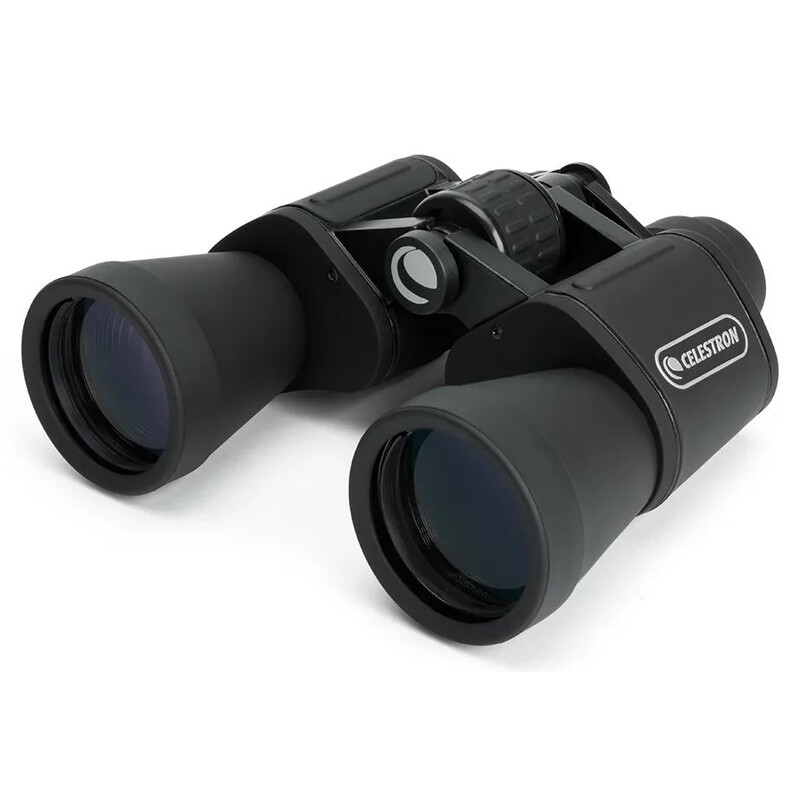 🌕 Experience the Moon in detail: Even in binoculars, the “big Moon” turns into craters, mountains and lunar seas – the Celestron UpClose G2 10x50 Porro Binoculars are the perfect entry point. And in a telescope with a Moon filter (included in the eyepiece starter kit, $89.95€ 89), the terminator becomes a mountain landscape.
View binoculars* → View starter kit* →
*Affiliate link: if you buy through it, we receive a small commission – the price does not change for you.
Frequently asked questions about the “big Moon”
Why is the Moon so big and orange today?
Big: the Moon illusion – an optical illusion near the horizon. Orange: the atmosphere scatters out the blue light when the Moon is low. Both disappear as soon as the Moon rises higher.
Is the Moon closer to Earth today?
The distance really does vary (356,000–407,000 km), but the difference accounts for at most 14 % of the disc size – the perceived “giant Moon” on the horizon is over 90 % illusion.
Why does the Moon look so small in photos?
Because the camera is not fooled! With your smartphone’s wide-angle lens the 0.5-degree lunar disc appears tiny. You only get the “big Moon” onto the image with a telephoto lens (from about 200 mm).
When is the next supermoon?
The full Moons closest to Earth in 2026 fall in late autumn – on 24 November and 24 December the full Moon is especially close to Earth. All dates: full-Moon calendar.
Do other people see the illusion too?
Yes, the Moon illusion works on practically everyone – and has since antiquity. Only its explanation has not yet been conclusively settled: an active research topic in the psychology of perception.
🌙 More about the Moon: Blood Moon explained · Supermoon 2026 · Full-Moon calendar 2026/27 · Lunar eclipse & blood Moon · Everything about the Moon · Photographing the Moon