By Alexander Merz · Updated on · Details checked on 14 September 2026
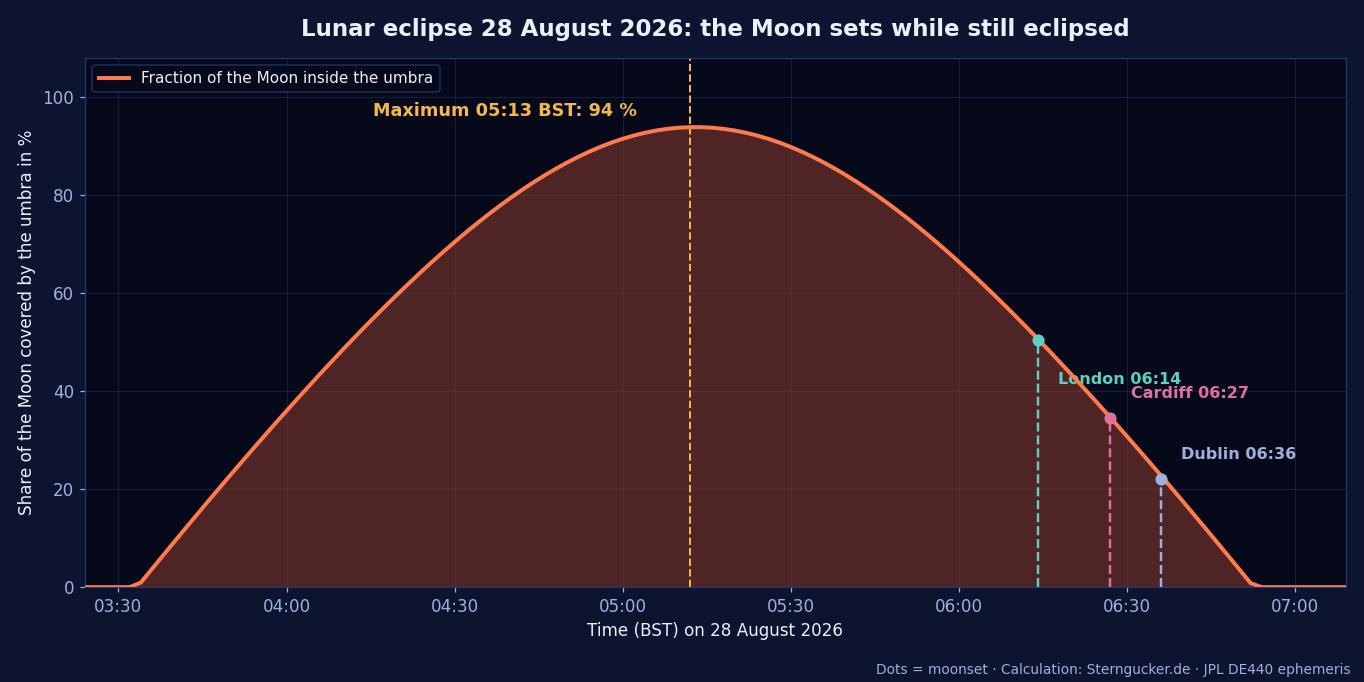
On the morning of 28 August 2026 the Moon slid almost entirely into the shadow of the Earth. At maximum, 93.8 % of its diameter was buried in the umbra – six per cent short of a total eclipse. From the UK and Ireland the show ended early, because the Moon set while it was still deeply eclipsed. This page gives you the full account with the exact times, the moonset for eleven cities, and every lunar eclipse through 2032 – the next one visible from Britain is on 20 February 2027 – all of it calculated here with the JPL DE440 ephemeris rather than copied from a table.
⚡ The quick answer: The deep partial eclipse of 28 August 2026 is over. The umbral phase started at 03:34 BST and peaked at 05:13 BST with 93.8 % coverage; the Moon then set between 06:13 (Newcastle) and 06:36 (Dublin), still 22 to 51 % in shadow. Next up is the deep penumbral eclipse of 20 February 2027 – visible in full from Britain and high in the sky, but subtle. The next total lunar eclipse over Britain is the New Year’s Eve Blood Moon of 31 December 2028.
🔭 A quick word on gear – before you read on
You need nothing at all for a lunar eclipse: no filter, no instrument, no protective glasses. The eclipsed Moon is dimmer than an ordinary full Moon and perfectly safe to watch with the naked eye for hours. If you do want more detail, binoculars are the more honest recommendation than a telescope – they show the whole Moon at once and are aimed in seconds even when it sits low above the horizon. Our pick is the Celestron UpClose G2 10x50 Porro Binoculars at € 62.
If you are looking to get into observing for the long run, a telescope serves you better – we compare both further down, and our guide to the best beginner telescopes goes into detail.
The lunar eclipse of 28 August 2026: what happened
This eclipse fell on the Sturgeon Moon. Times for that full moon in eight time zones, plus the dates of every full moon through 2027, are in our full moon calendar.
Just over two weeks after the great solar eclipse of 12 August, the sky delivered the counterpart. Same lunar node, same orbital geometry – only this time it is the Earth that stands between the Sun and the Moon. With a magnitude of 0.938 the eclipse of 28 August 2026 is one of the deepest partial lunar eclipses of the decade. A little over six per cent of the lunar diameter stays outside the umbra; had the Moon passed a fraction closer to the shadow axis, this would have been a total eclipse.
For Britain and Ireland that was both good news and bad news. Good, because a Moon more than ninety per cent covered looks genuinely dramatic – a thin bright rim with a huge rust-brown shadow above it. Bad, because the maximum falls almost exactly together with moonset and sunrise. By then the Moon stands less than ten degrees above the western horizon and the sky is already bright.
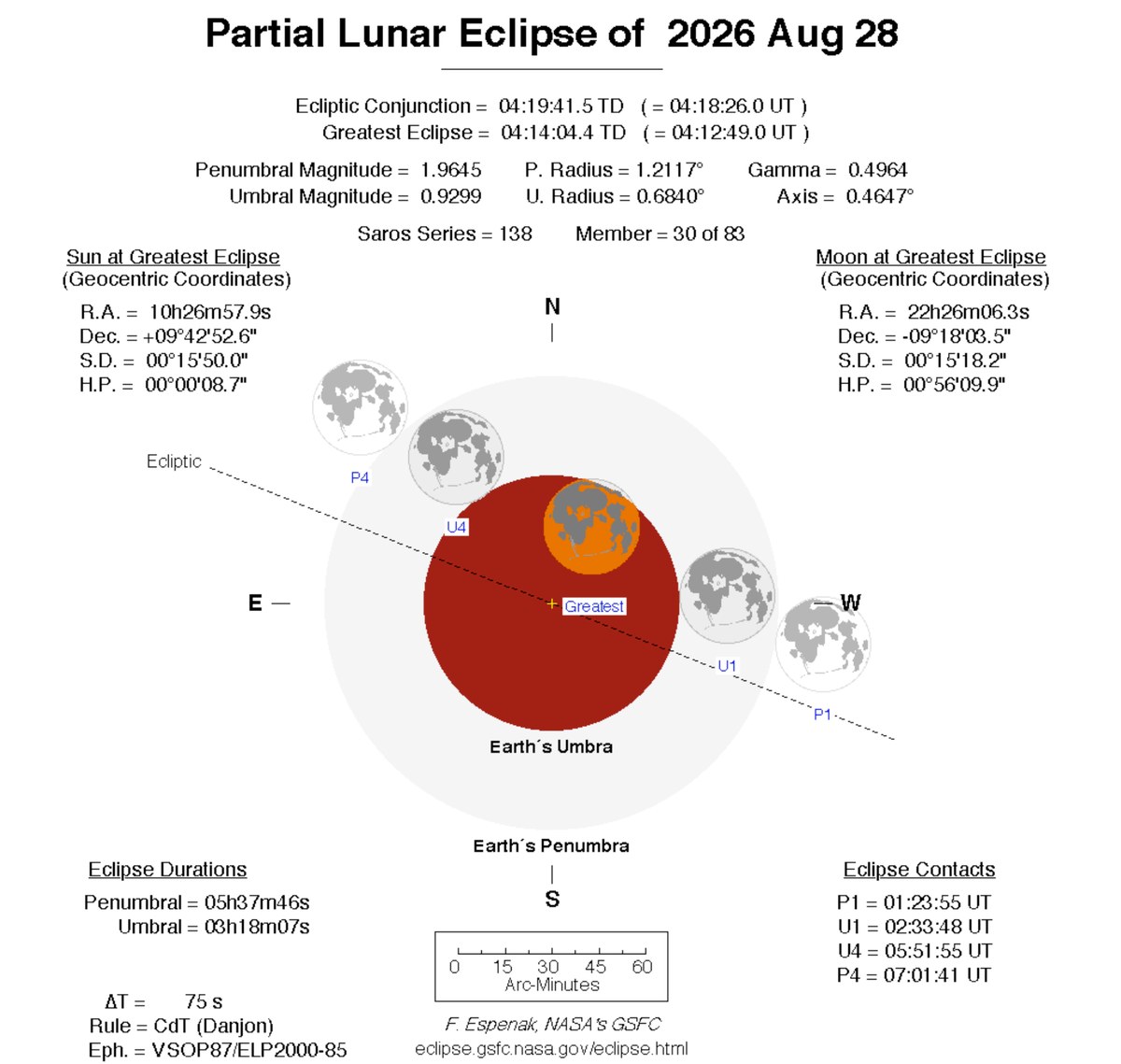
The eclipse minute by minute
All times in BST (British Summer Time). The passage through the shadow itself happens simultaneously everywhere on Earth – only the horizon differs from place to place. Readers in continental Europe simply add one hour (CEST).
| Phase | Time (BST) | What happens |
|---|---|---|
| Penumbra begins (P1) | 02:23 | The Moon enters the outer shadow. Nothing visible yet. |
| First shading noticeable | approx. 03:00 | The upper limb starts to look dirty grey. |
| Umbra begins (U1) | 03:34 | Now the real show starts: a sharp, curved edge bites into the lunar disc. |
| Half covered | approx. 04:15 | Half the Moon lies in the umbra; the shaded part turns visibly reddish. |
| Maximum | 05:13 | 93.8 % of the lunar diameter is inside the umbra – for us already low down in the twilight. |
| Moonset in the UK and Ireland | 06:13 – 06:36 | This is where the eclipse ends for us. The Sun rises at the same moment. |
| Umbra ends (U4) | 06:52 | No longer visible from Britain. |
| Penumbra ends (P4) | 08:03 | End of the eclipse – visible only further west. |
The umbral phase therefore lasts 3 hours and 18 minutes, the whole eclipse including the penumbra 5 hours and 40 minutes. From the UK you catch a little less than half of it – but it is exactly the half in which something happens.
What there actually was to see
Honestly: not a deep red Blood Moon hanging in a black sky. This was a twilight eclipse. Between 03:34 and roughly 04:45 the Moon still stood ten to twenty degrees high in the west with the sky dark blue – that was the window. After that the Moon drops faster than the shadow grows, and the morning twilight washes out more and more of the contrast.
The one tip that decides between success and failure: find your spot in advance, in daylight, with a genuinely clear view to the west and west-south-west. No tree line, no terraced houses, no hill. With the Moon below ten degrees, a row of trees 300 metres away is enough to hide the entire eclipse. A footpath across open fields, a lakeshore or a bit of high ground is worth its weight in gold.
Moonset and eclipse magnitude across the UK and Ireland
Because the Moon sets during the eclipse, everything depends on where you stand. The further west you live, the longer the Moon stays up – but the smaller the remaining bite out of it. The further east, the deeper the eclipse still is at moonset, and the shorter your window. The figures below are our own calculations with the JPL DE440 ephemeris.
| City | Moonset | Covered at moonset | Moon altitude at 03:34 | Moon altitude at 05:13 |
|---|---|---|---|---|
| Newcastle | 06:13 BST | 51.3 % | 17° | 7° |
| London | 06:14 BST | 50.5 % | 19° | 8° |
| Leeds | 06:15 BST | 48.7 % | 18° | 8° |
| Edinburgh | 06:17 BST | 45.9 % | 17° | 7° |
| Birmingham | 06:19 BST | 43.7 % | 19° | 8° |
| Manchester | 06:19 BST | 44.3 % | 19° | 8° |
| Glasgow | 06:22 BST | 40.1 % | 18° | 8° |
| Bristol | 06:24 BST | 37.7 % | 20° | 9° |
| Cardiff | 06:27 BST | 34.5 % | 21° | 10° |
| Belfast | 06:32 BST | 27.4 % | 19° | 9° |
| Dublin | 06:36 BST | 22.1 % | 20° | 10° |
Take Newcastle as the eastern extreme: the Moon sets at 06:13 with 51.3 % of its diameter still in shadow, but it spends the whole maximum barely seven degrees up. Dublin is the western extreme: the Moon stays up until 06:36 and reaches its highest point of the umbral phase at ten degrees – but by then only 22 % of it is still covered. In London you get the middle road: moonset at 06:14 with almost exactly half the disc in the umbra.
One number in that table matters more than the others: the altitude at 05:13. Nowhere in Britain does the Moon reach ten degrees at maximum. Ten degrees is roughly a clenched fist held at arm’s length above the horizon – that is all the room you have. Plan for it.
In practical terms: at eight degrees, a two-storey house fifty metres away is enough to hide it completely. A tall hedge is enough. A line of trees is enough.
So the decisive step is not setting an alarm, it is finding the spot – and you do that the evening before, in daylight. Stand where you plan to watch and look west: can you see the horizon, or can you see rooftops?
A field edge, a bridge, a car park on the edge of town, a hill to the west – that is all it takes. If you live in a valley or face a wall of buildings, you will see nothing at all, however clear the sky is.
What you actually need – and what you don’t
No eclipse glasses, no filter, no telescope. Unlike a solar eclipse, a lunar eclipse is completely safe to watch with the naked eye – and the naked eye sees the edge of the shadow perfectly well.
There is one point, though, where binoculars earn their keep more than usual: when only a bright sliver of the Moon is left, low down and already washed out by dawn, the contrast collapses. A fast 10×50 pair such as the Celestron UpClose G2 10x50 Porro Binoculars (€ 62) still shows detail where the eye sees a flat grey disc – and it helps you find the low Moon between the rooftops in the first place.
The fast 10×50 pair for that morning: Celestron Cometron 7x50 Binoculars
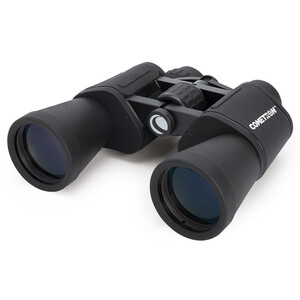
The astronomy classic among affordable binoculars: 7×50 with a large exit pupil for bright handheld views of the Moon and Milky Way – the ideal first step before a telescope.
Price: € 65
If you already own a telescope, the full equipment advice and photo tips are further down.
And if you don’t own one: you don’t need one for this eclipse – the naked eye is the better instrument here, and we would rather say so. But if the Moon has made you curious, our guide to beginner telescopes explains calmly what actually matters in a first instrument, with no pressure to buy.
And if the Moon has made you curious: which telescope suits you?
Six short questions, an honest answer – including when binoculars would be the better choice.
The eclipse on 28 August is over, and the next worthwhile dates are months apart. So you do not miss any of them:
One short email, in good time – with the times and an honest take on whether it is worth getting up for.
You will get a confirmation email in a moment. Your address stays with us – no sharing, no third-party ads.
How a lunar eclipse happens
Like every body lit by the Sun, the Earth casts a shadow into space – a cone more than 1.3 million kilometres long. The Moon orbits at an average distance of only 384,400 kilometres, so whenever it meets that cone it plunges deep inside it. That can only happen at full Moon, because only then are the Sun, the Earth and the Moon lined up in that order.
Even so, we do not get an eclipse every month. The Moon’s orbit is tilted by about 5.1 degrees against the plane of the Earth’s orbit, so most full Moons pass above or below the shadow. Only when full Moon happens to coincide with the Moon being near one of the two points where the orbital planes cross – the nodes – does it run into the shadow. That happens two or three times a year, and because the same geometry produces a solar eclipse two weeks earlier or later, solar and lunar eclipses almost always come in pairs. August 2026 is exactly such a pair.
The three kinds of lunar eclipse
Earth’s shadow has two zones: the umbra, where no direct sunlight reaches at all, and the penumbra, where the Sun is only partly hidden by the Earth. How deep the Moon dips in decides what kind of eclipse you get.
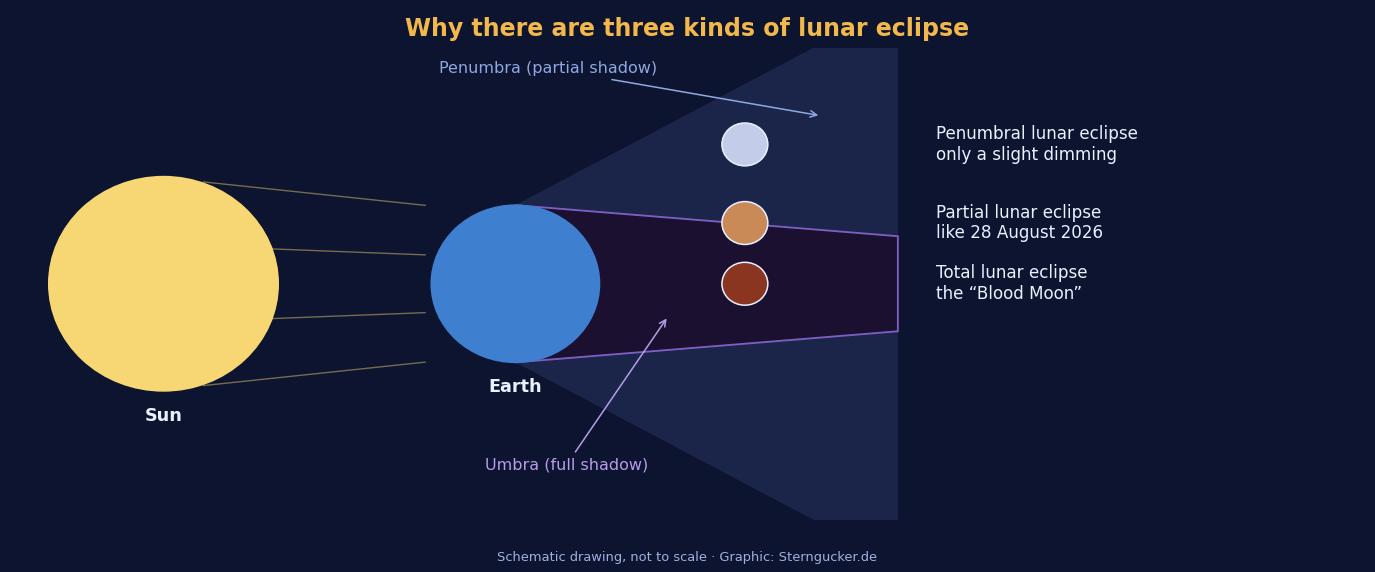
Total lunar eclipse: the Blood Moon
The Moon is swallowed completely by the umbra. It does not disappear, though: it turns a coppery red, which is why people call it a Blood Moon. Totality can last anything from a few minutes to more than 100 minutes, depending on how centrally the Moon crosses the shadow. The eclipse of 26 June 2029 is a textbook central one with 102 minutes of totality – frustratingly, the Moon sets over Britain just as totality begins.
Partial lunar eclipse: what 28 August 2026 will look like
Only part of the lunar disc enters the umbra; the rest stays in the penumbra and remains brightly lit. The visual effect depends enormously on the magnitude. A 7 % eclipse like the one on 12 January 2028 is a curiosity you have to look for. A 94 % eclipse like 28 August 2026 is unmistakable even to someone glancing out of a window – and the shaded part already shows the red of a Blood Moon.
Penumbral lunar eclipse: the one you almost miss
The Moon only passes through the outer shadow. Nothing bites into the disc; the Moon merely dims slightly and unevenly. Below about 70 % penumbral magnitude, most people see nothing at all. Two of them are worth a look anyway because they are unusually deep: 20 February 2027 (95 %) and 9 December 2030 (97 %). Both are fully visible from the UK and both sit high in the sky – you will notice one limb looking distinctly greyer than the other.
Why does the Moon turn red?
Inside the umbra no direct sunlight reaches the Moon at all – and yet it stays visible. The light that gets there has been bent around the Earth by our atmosphere. On the way it is filtered: the atmosphere scatters short wavelengths away much more strongly than long ones, which is the same reason our sky is blue and our sunsets are red. What survives the detour and lands on the Moon is overwhelmingly red light.
Put differently: during totality the Moon is lit by every sunrise and every sunset happening on Earth at that moment, all at once. If you stood on the Moon you would see the Earth as a black disc ringed by a thin, glowing red band. That ring is the light source, and it explains the colour perfectly.
How red exactly varies from eclipse to eclipse, because it depends on our own atmosphere. After large volcanic eruptions, when the stratosphere is loaded with aerosols, eclipsed Moons have turned almost charcoal grey. In clean air they glow a bright orange-copper. Astronomers grade the effect on the five-step Danjon scale, from L=0 (nearly invisible) to L=4 (bright coppery-red with a bluish rim). There is more on the colour and the folklore in our article on the Blood Moon.
Every lunar eclipse through 2032
Seventeen lunar eclipses fall between 2026 and 2032. Only a minority of them are worth setting an alarm for: some are total but happen on the far side of the planet, others are visible from here but so faint that nothing shows. The table lists all of them with the magnitude and what you can realistically expect from the UK. Dates and times are local (GMT or BST) for London.
| Date | Type | Magnitude | Maximum (London) | Visible from the UK? |
|---|---|---|---|---|
| 3 March 2026 | Total | 1.159 | 11:34 | ❌ No – the Moon is below the horizon |
| 28 August 2026 | Partial | 0.938 | 05:13 | (✅) Partly – the Moon sets during the eclipse |
| 20 February 2027 | Deep penumbral | 0.955 | 23:13 | ✅ Yes, in full – up to 47° high |
| 12 January 2028 | Partial | 0.075 | 04:13 | ✅ Yes, in full – up to 39° high |
| 6 July 2028 | Partial | 0.397 | 19:20 | ❌ No – the Moon is below the horizon |
| 31 December 2028 | Total | 1.255 | 16:52 | (✅) Partly – the Moon sets during the eclipse |
| 26 June 2029 | Total | 1.852 | 04:22 | (✅) Partly – the Moon sets during the eclipse |
| 20 December 2029 | Total | 1.125 | 22:42 | ✅ Yes, in full – up to 61° high |
| 15 June 2030 | Partial | 0.511 | 19:33 | ❌ No – the Moon is below the horizon |
| 9 December 2030 | Deep penumbral | 0.971 | 22:28 | ✅ Yes, in full – up to 60° high |
| 25 April 2032 | Total | 1.200 | 16:14 | ❌ No – the Moon is below the horizon |
| 18 October 2032 | Total | 1.112 | 20:03 | ✅ Yes, in full – up to 33° high |
Own calculation with the JPL DE440 ephemeris. Five very faint penumbral eclipses (July and August 2027, May, June and October 2031), in which nothing whatsoever can be seen with the naked eye, are left out of the table.
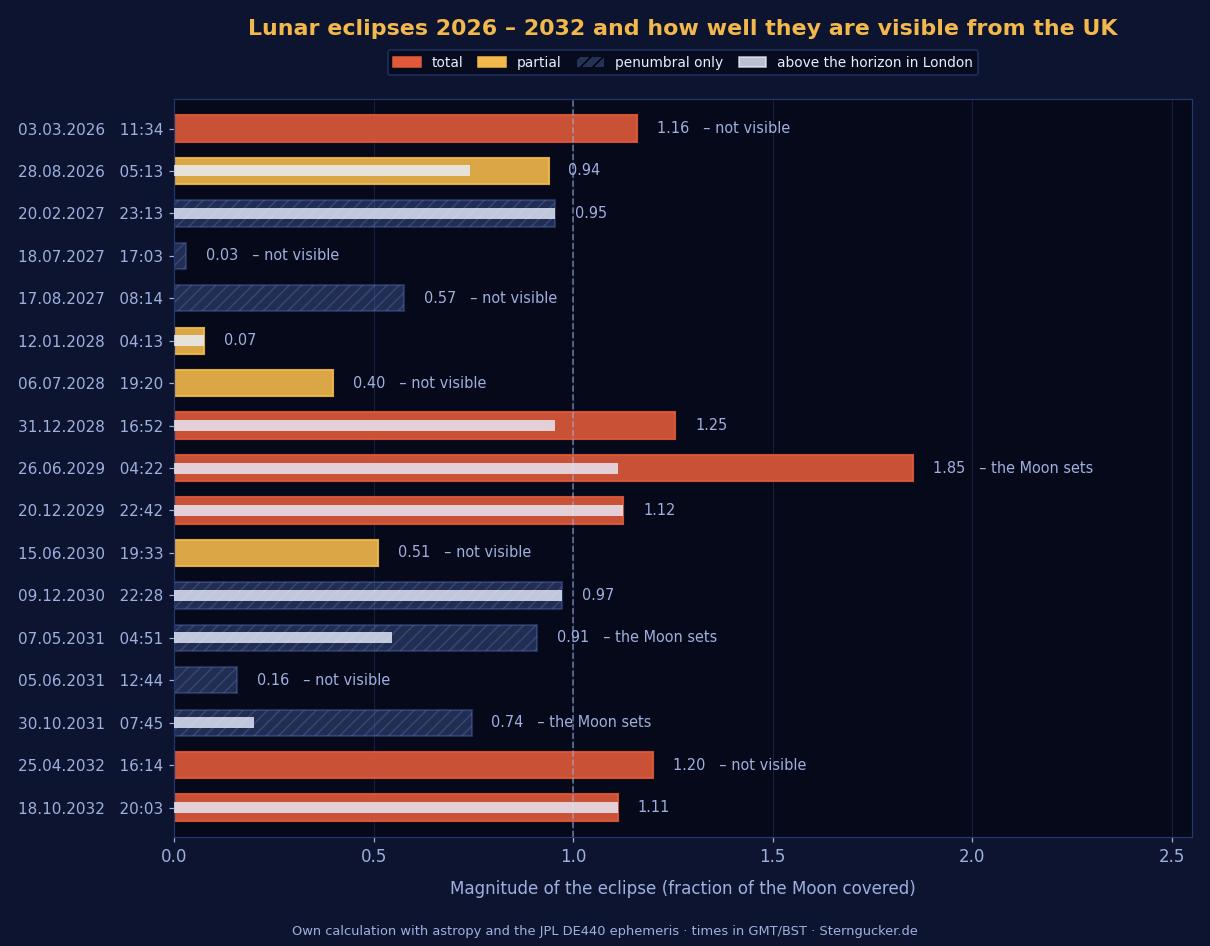
The four eclipses actually worth waiting for
Out of seventeen, four deserve a place in the calendar. Two of them are the best total lunar eclipses Britain will see for a generation.
- 28 August 2026 – deep partial, 93.8 %. The only drawback is the timing: it happens at moonset in bright twilight. The compensation is the photographic setting, with the eclipsed Moon sitting on the horizon next to landscape.
- 31 December 2028 – total, and it happens on New Year’s Eve. Totality runs from 16:16 to 17:28 GMT, and the Moon rises during it: from two degrees at the start to eleven at the end. A Blood Moon climbing out of the horizon haze on the last evening of the year is about as photogenic as this hobby gets.
- 20 December 2029 – total, and this is the good one. Totality from 22:15 to 23:09 GMT with the Moon 61 degrees above the horizon, in the middle of the longest nights of the year. Nothing between now and 2032 comes close.
- 18 October 2032 – total, totality from 19:38 to 20:27 BST at 33 degrees altitude, fully visible and at a civilised hour. A good one to end the decade on.
New Year’s Eve 2028: the Blood Moon at moonrise
It is worth pausing on this one. On 31 December 2028 the Moon enters the umbra at 15:08 GMT – below the horizon for us. It rises already eclipsed, and by the time it clears the rooftops it is a dark red disc rather than a full Moon. Totality lasts 72 minutes, from 16:16 to 17:28, and the Moon climbs from 2° to 11° during it. Sunset in London is around 16:00, so the sky darkens through the whole event.
The practical consequence is the same as for August 2026, only pointed the other way: you need a clear eastern horizon. And because the Moon is so low, you can frame it against a skyline, a church tower or a range of hills with a telephoto lens – the kind of shot that is impossible when an eclipse happens overhead. Put the date in the calendar now; it lands conveniently on a Sunday evening.
How to watch a lunar eclipse
A lunar eclipse is the least demanding event in the sky. No filter, no permit, no special equipment – and unlike a solar eclipse it is completely safe to look at with the naked eye. What you do need is a clear horizon in the right direction and, ideally, something to steady your view.
With the naked eye
This is how an eclipse is meant to be watched. The whole disc, the colour and the curved edge of Earth’s shadow are all easily visible without any optics – and the shadow’s curvature is the oldest surviving proof that our planet is a sphere; Aristotle argued exactly that around 350 BC. For 28 August 2026 the naked eye is genuinely the best instrument, because the Moon will be low and set against landscape.
When the telescope is the better buy anyway
Binoculars are the right tool for this particular event, and we would rather say so than sell you something bigger. But if you are choosing one instrument and you actually want to explore the sky, the honest answer is different. Saturn’s rings, Jupiter’s cloud belts, the craters of the Moon in relief, the Orion Nebula, double stars – none of that opens up in binoculars, and all of it is routine in a small telescope. Whoever can only buy one instrument and really wants to explore the sky should buy the telescope; binoculars are the complement, not the substitute.
Our recommended first telescope: Skywatcher Dobson Telescope N 130/650 Heritage FlexTube
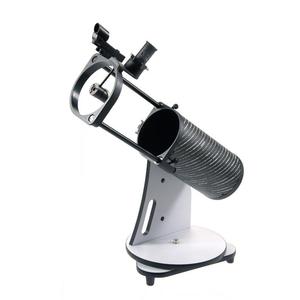
A compact tabletop Dobson with a true parabolic mirror. Folds down, fits in a bag: the Moon, planets and the bright deep-sky classics.
Price: € 265
If you want more: the tabletop Dobsonian is deliberately an entry point. If you already suspect this will stick, it makes sense to go straight to 200 mm of aperture – that is more than twice the light-gathering area of the 130 mm and exactly the threshold at which globular clusters stop being fuzzy patches and resolve into individual stars. Along the shadow edge of a lunar eclipse, the larger mirror also shows noticeably finer structure.
The extra cost is worth it if you have a permanent spot for an instrument weighing a good 25 kg and are willing to carry it outside in two parts. For a quick look from the balcony the 130 mm remains the more practical choice – a telescope that is in the way once assembled gets used less than one you can carry out in two minutes.
For more advanced observers: Skywatcher Dobson Telescope N 200/1200 Skyliner Classic
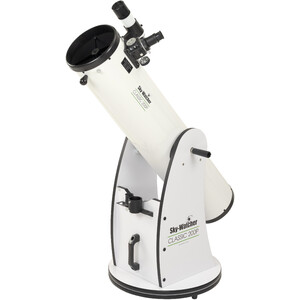
200 mm of aperture — the most sky for your money. Set it on the ground, point by hand: nebulae, clusters and galaxies for years to come.
Price: € 479
Still weighing up which instrument suits you? Our beginner telescope guide walks through what actually matters in a first telescope – with no rush to buy.
And a telescope pays off on eclipse night too – not for the eclipse itself, but for the hours around it. Between 03:00 and 03:30 on 28 August 2026 the sky is still dark and Saturn stands well placed in the south; it reaches opposition five weeks later. The eclipse gives you a reason to be outside at that hour. A telescope gives you something to do with it.
The one accessory that genuinely helps in the days around the eclipse is a moon filter. The full Moon in a telescope is uncomfortably bright – it wrecks your dark adaptation and floods out the finer contrast. A grey filter costs very little and makes the difference between squinting and observing.
Against the glare before and after: Omegon Premium Moon Filter 1.25″
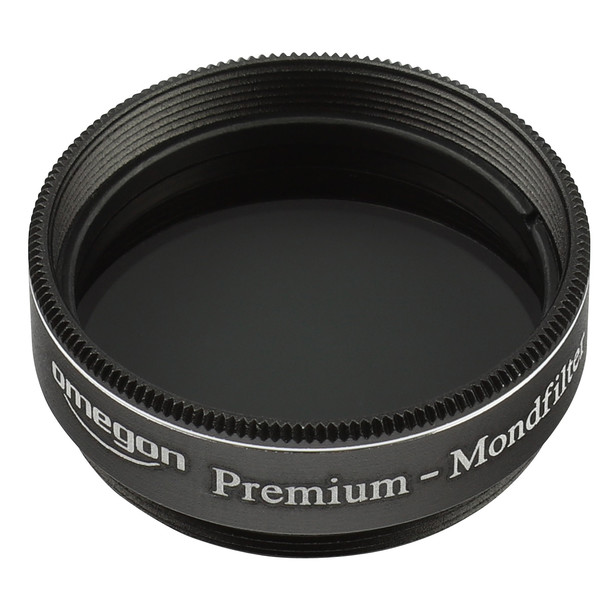
Dims the harsh moonlight, is easy on the eyes and brings out far more contrast and detail – our best-selling filter and the number-one pick to start with.
Price: € 19.90
And the binoculars?
A pair of 10×50 binoculars is the single most useful upgrade for an eclipse. The magnification is enough to show the ragged, slightly fuzzy edge of the umbra creeping across individual craters, and the colour gradient inside the shadow – deep red near the centre, brighter orange towards the rim – becomes obvious. Handheld is fine; if you can prop your elbows on a wall or a car roof, better still.
The pair we recommend is the same one listed further up, under “What you actually need”: Celestron UpClose G2 10x50 Porro Binoculars at € 62.
Photographing a lunar eclipse
The eclipsed Moon is roughly 10,000 times fainter than the full Moon, and your camera has to be ready for that. A telephoto lens from about 200 mm upwards fills the frame on full-frame. What matters is a solid tripod, manual focus (autofocus reliably fails on a dark Moon) and the willingness to open up by several stops as the eclipse deepens.
On 28 August 2026 you also get a compositional gift: the eclipsed Moon sits low over the horizon during the blue hour. That allows frames with landscape, a church tower or a ridge line in the same shot – pictures that are simply impossible when an eclipse happens high overhead. Bringing a wide-angle lens alongside the telephoto is not a bad idea at all.
* Affiliate link: if you buy through this link we may earn a small commission from Astroshop or High Point Scientific, at no extra cost to you.
Frequently asked questions about lunar eclipses
When is the next lunar eclipse in the UK?
It is the deep penumbral eclipse of 20 February 2027 – visible in full from Britain and Ireland and high in the sky, but subtle: the Moon stays out of the full shadow and merely turns noticeably grey on one side. The last umbral eclipse was the one on 28 August 2026, a Friday morning: umbral phase from 03:34 BST, maximum at 05:13 with 93.8 % coverage, moonset between 06:13 (Newcastle) and 06:36 (Dublin), still 22 to 51 % in shadow. The next total lunar eclipse over Britain is the one on 31 December 2028.
What time is the lunar eclipse on 28 August 2026?
The whole eclipse runs from 02:23 to 08:03 BST, the umbral phase from 03:34 to 06:52, with the maximum at 05:13. From the UK you can only follow the first part of it: from 03:34 until moonset, so roughly 160 to 180 minutes depending on where you are. The genuinely useful window is shorter still – about 03:34 to 04:45, before twilight and the low horizon take over. In continental Europe add one hour (04:34 to 07:52 CEST).
Is the August 2026 lunar eclipse visible from the USA?
Only from the very eastern edge, and only barely. The eclipse happens during the European morning, which is the middle of the night in North America – but by the time the umbral phase starts at 22:34 EDT on 27 August, the Moon has not risen for most of the continent. Eastern Canada and the Atlantic seaboard catch the beginning at moonrise; the west coast misses it entirely. North America gets its compensation on 3 March 2026, when a full total lunar eclipse plays out over the Americas and the Pacific while Europe sees nothing at all.
Do you need eye protection for a lunar eclipse?
No, and eclipse glasses would in fact be useless here, because you would see absolutely nothing through them. A lunar eclipse is entirely safe: you are looking at reflected, heavily attenuated sunlight, not at the Sun. Eye protection is needed only for solar eclipses.
When is the next blood moon?
A Blood Moon is the copper-red Moon seen during a total lunar eclipse. The next one visible from Britain is the New Year’s Eve Blood Moon of 31 December 2028, with 72 minutes of totality between 16:16 and 17:28 GMT. There is nothing before it: the total eclipse of 3 March 2026 is invisible from Europe, and after that almost three years pass without a single one. More on the phenomenon in our article on the Blood Moon.
How often do lunar eclipses happen?
On a long-term average there are two to three lunar eclipses a year, in rare years as many as four – but most of them are inconspicuous penumbral events. Of the 17 eclipses between 2026 and 2032, only six are total and four partial. Then there is the question of where you stand: a lunar eclipse is only visible from the night side of the Earth. Of those 17 dates, five can be followed from start to finish in Britain. A really good total lunar eclipse over your own back garden is therefore a once-in-a-few-years event.
Why is a lunar eclipse called a blood moon?
Because of the colour, and only because of the colour. During totality the Moon is lit exclusively by sunlight refracted through the Earth’s atmosphere, which filters out the blue and leaves the red – so the Moon glows copper instead of going black. The term is modern popular usage rather than an astronomical one; astronomers simply say total lunar eclipse and grade the colour on the Danjon scale. It applies only to total eclipses: on 28 August 2026 the shaded part will show a reddish tinge, but the bright remaining rim keeps it from being a Blood Moon in the proper sense.
Read more on Sterngucker.de
- Solar eclipse of 12 August 2026 – the counterpart two weeks earlier, total across northern Spain and Iceland
- Blood Moon: why the Moon turns red – the physics behind the colour, explained in detail
- Moon calendar – every lunar phase and full Moon of the year
- Astronomical events – the calendar of everything worth looking up for
- Astronomy binoculars – what to look for, and what the numbers on the barrel mean
- Photographing the Moon – from a phone at the eyepiece to a proper telephoto setup