By Alexander Merz · Published on · Details checked on 14 September 2026
Is the ISS visible tonight – or not? That does not depend on the weather alone, but on whether the station is currently in a visibility phase over your location. The table below works that out for the next seven nights, for your location, to the minute.
⚡ In short: You can only see the ISS at twilight – roughly one to two hours after sunset or before sunrise. It then crosses the sky as a very bright, calmly moving point within two to six minutes, usually from west to east. No blinking, no sound. You do not need a telescope.
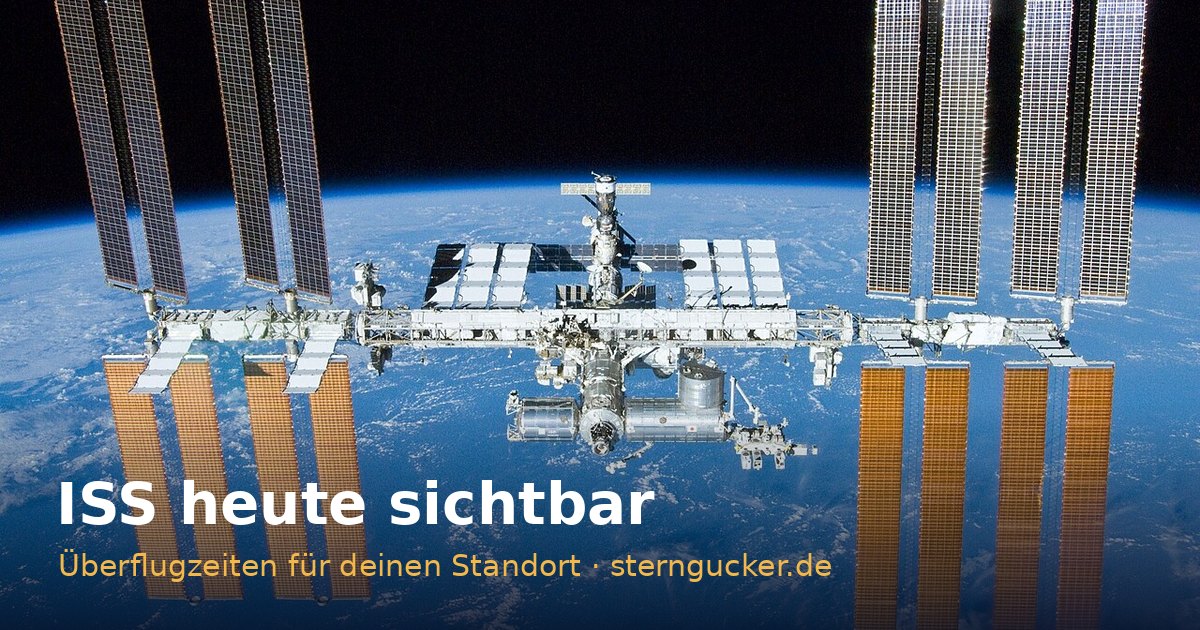
ISS passes over the next 7 nights
Calculated for Frankfurt am Main. We derive your approximate location from your IP address – that is enough for times accurate to the minute.
| Night | From–to | Duration | Direction | Max. elevation |
|---|---|---|---|---|
| Tuesday, 22 September | 21:19–21:22 | 3 min | west → south-west | 47° (good) |
| Wednesday, 23 September | 20:31–20:36 | 5 min | west → south-east | 65° (very bright) |
| Thursday, 24 September | 21:21–21:23 | 3 min | west → south-west | 23° (medium) |
| Friday, 25 September | 20:33–20:38 | 5 min | west → south-east | 33° (medium) |
| Saturday, 26 September | 19:46–19:51 | 5 min | west → south-east | 47° (good) |
| Saturday, 26 September | 21:24–21:25 | 1 min | south-west → south-west | 11° (low) |
| Sunday, 27 September | 20:35–20:39 | 4 min | west → south | 16° (low) |
| Monday, 28 September | 19:47–19:52 | 5 min | west → south | 23° (medium) |
The best date: Wednesday, 23 September at 20:31 – the ISS climbs to 65° above the horizon (very bright). The higher the value, the brighter and longer you see it.
All times in Central European Summer Time (CEST), not in your own time zone. We only show passes where the ISS stands higher than 10°, the Sun is at least 6° below the horizon and the station itself is still in sunlight – so only what you can really see.
How to read the table
Three values decide whether going outside is worth it:
- Max. elevation – the most important value. It says how high the ISS stands above the horizon (90° would be exactly overhead). Anything from 40° up is a fine sight, from 60° up a very bright pass. Below 20° the station easily disappears behind houses and trees.
- Direction – where it appears and where it disappears. The ISS almost always comes from a westerly direction and moves east. Find a clear view in that direction beforehand.
- Duration – two to six minutes. Short passes often end with the station simply fading in mid-sky: that is the moment it enters the Earth’s shadow.
Why is the ISS not visible every evening?
The ISS does not shine by itself. What you see is sunlight reflected off its large solar panels. For a pass to become visible, three things therefore have to be true at the same time:
- The station crosses your horizon at all – it circles the Earth in about 93 minutes on an inclined orbit, so central Europe sometimes lies within the strip and sometimes does not.
- It is dark enough where you are (the Sun at least 6° below the horizon).
- The ISS itself, at an altitude of 400 km, is still in sunlight – up there the Sun sets later than it does for you on the ground.
That combination comes in phases: for one to two weeks there are passes almost every day, then follows a break of a similar length. In summer the phases are longer, because the nights are short and bright – around June the ISS can even stay visible in the middle of the night in Germany.
How to identify the ISS reliably
Mix-ups are the most common reason for disappointment. This table helps:
| What you see | What it is |
|---|---|
| Very bright point, calm and steady, no blinking, moving for 2–6 minutes | ISS |
| Blinking red or green lights, engine noise | Aircraft |
| A string of pearls made of many small points in a row | Starlink satellites |
| A streak of light that burns up within fractions of a second | Shooting star |
| A faint point moving slowly | another satellite – there are thousands of them |
A tip from practice: take your position two to three minutes before the time given and look towards the direction it starts from. The ISS appears there faintly at first and then brightens quickly – anyone who arrives late is often already searching the wrong spot.
Do you need binoculars or a telescope?
For the pass itself: no. The naked eye is even better, because you take in the whole field of sky. Binoculars are still worth having – not for the ISS, but for everything else you discover in the sky while you wait: lunar craters, the moons of Jupiter, open star clusters. Anyone following the ISS in binoculars sees a brighter, slightly golden point, but no structure.
A telescope only shows the shape of the station from about 150× magnification – and then you have to track an object that races through the field of view within seconds. That is a discipline for advanced observers, not a beginner’s project.
For the start: the classic 10×50: Celestron UpClose G2 10x50 Porro Binoculars
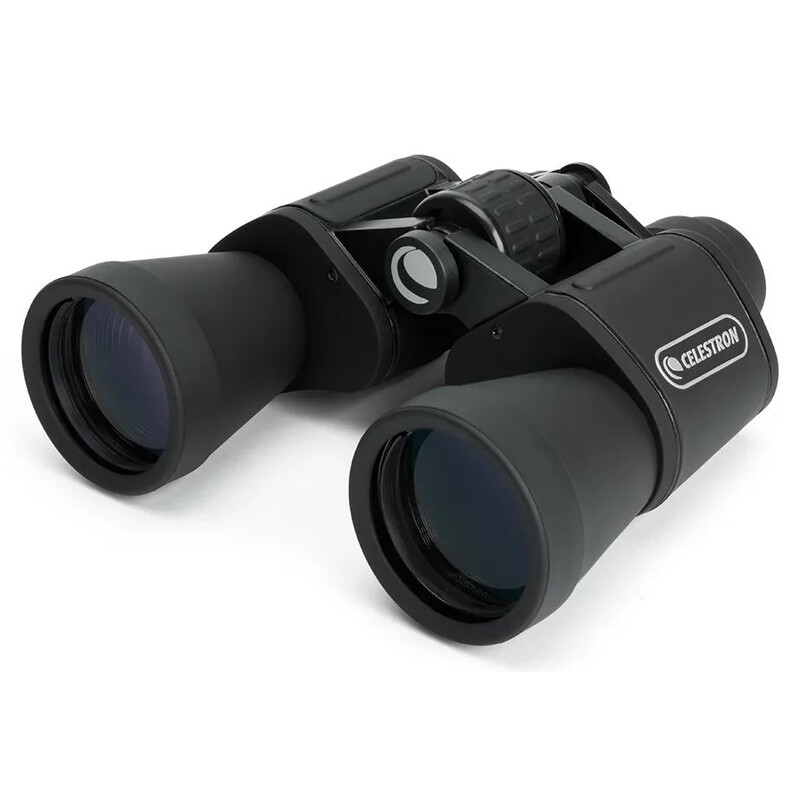
The honest entry point: 10x50 with a 5 mm exit pupil, rubber-armoured, under 80 euros. Shows the Moon, the Pleiades and Jupiter’s moons.
Price: € 62
If you want more: the Nikon Action 10×50 CF
The next step is not a more powerful pair, but a better 10×50: the Nikon shows stars as pinpoints out to the edge, is waterproof and fog-free – in cold nights exactly the difference between “quickly back inside” and “another hour outdoors”. The extra cost pays off if you observe regularly or also use the binoculars during the day.
For advanced observers: Nikon Action 10x50 CF Binoculars
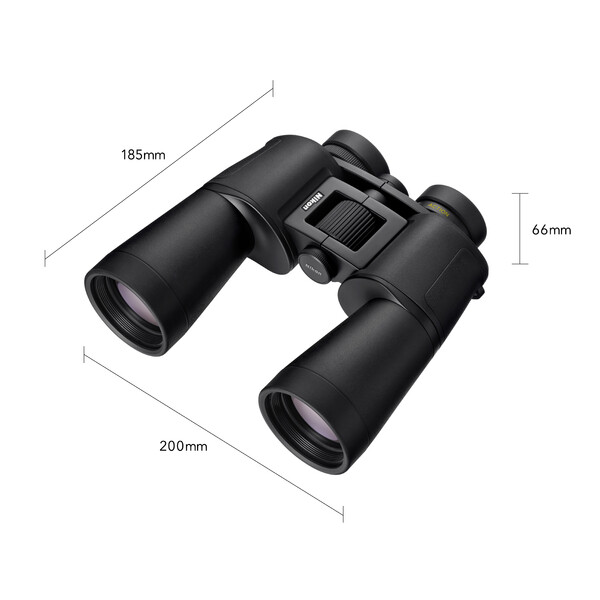
The brand-name 10x50 classic: rugged, all-weather, solid optics at a fair price.
Price: € 149
Frequently asked questions about ISS visibility
Why does the ISS disappear in mid-sky?
It enters the Earth’s shadow. Within about ten seconds the bright point turns faint, then it is gone. That always happens in the eastern part of the sky, because that is where the night side of the Earth lies – and it is the finest moment of a pass.
How fast is the ISS?
Around 28,800 kilometres per hour, so about 7.7 kilometres per second. It needs roughly 93 minutes for one orbit of the Earth – the crew experiences 16 sunrises and sunsets per day.
Can I also see the ISS during the day?
In practice, no. In theory it is bright enough, but without exact coordinates and an optical aid you will not find it in the daytime sky. Stick to twilight.
Are your times as accurate as NASA’s?
Yes – we calculate with the same method (SGP4) and the official orbital data, which are updated daily. If our times differ from other sites by one or two minutes, that is down to the location: even 50 kilometres of distance shift a pass noticeably. If our orbital data are older than three days, we prefer to show no times at all.
How do you know my location?
The approximate place is derived from your IP address – without a login, without storage. That is enough for times accurate to the minute. If the place shown is not right, the times are still usable for your region as long as the distance stays below about 100 kilometres.
How much longer will the ISS exist?
According to current planning the station will be operated until about 2030 and afterwards brought down in a controlled re-entry over the South Pacific. More on this on our page International Space Station ISS.