By Alexander Merz · Updated on · Details checked on 14 September 2026
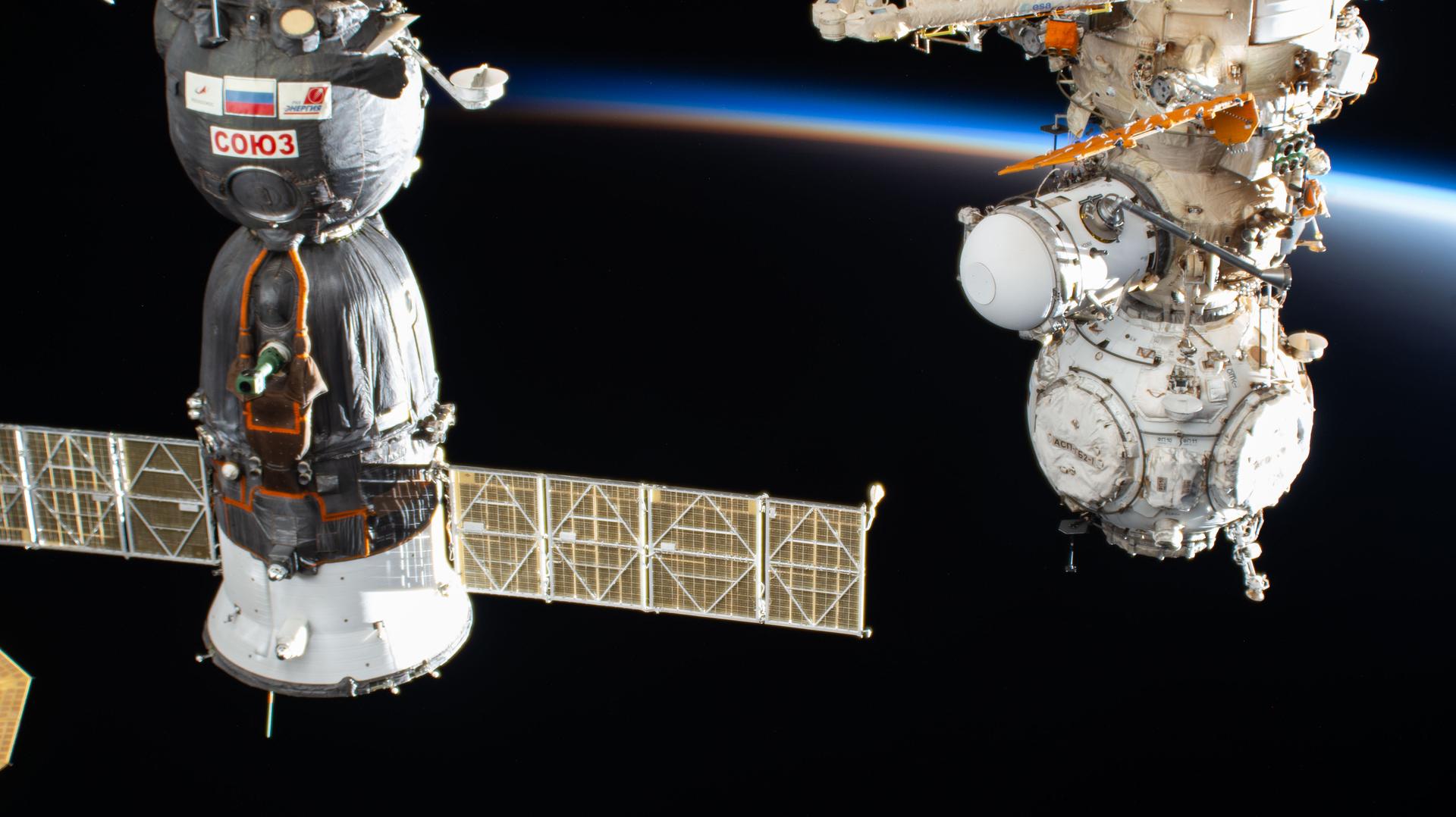
The International Space Station (ISS) is the largest structure humankind has ever built in space – and one of the brightest objects in the night sky. The best part: to see the ISS you need no equipment at all. With the naked eye, you just have to know when and where to look to spot the space station gliding overhead.
⚡ The quick answer: You can see the ISS with the naked eye, no telescope needed, during twilight – within the 1 to 2 hours after sunset or before sunrise. It looks like a very bright point of light that does not blink, moving steadily from west to east in 2 to 6 minutes. To find the exact pass time over your location, use a free service such as Heavens-Above or NASA Spot The Station.
The ISS at a glance: a lab racing overhead
The ISS is a joint project of the USA, Russia, Europe (ESA), Japan and Canada. Assembled module by module in orbit since 1998, it has been continuously crewed since November 2000: people – usually six or seven at a time – live and carry out research there that would be impossible on Earth, from materials science in weightlessness to long-term medical studies for future missions to Mars. Under current plans the station is expected to stay in service until around 2030, after which it will be brought down in a controlled re-entry over the Pacific.
| The ISS in numbers | Value |
|---|---|
| Orbital altitude | about 400 km |
| Speed | about 28,800 km/h |
| One orbit of Earth | about 93 minutes (≈ 16 orbits per day) |
| Wingspan | about 109 metres |
| Continuously crewed since | November 2000 |
When and where to see the ISS
The ISS does not shine on its own: it reflects sunlight off its huge solar panels. That is why it is only visible at twilight, within a narrow window: the sky has to be dark enough for you, yet the station, 400 km up, must still be lit by the Sun. Those conditions line up in the one to two hours after sunset and before sunrise.
A pass is easy to recognise: a very bright, perfectly steady “star” appears in the west, crosses the sky in two to six minutes, then fades toward the east – often abruptly, as the station slips into Earth’s shadow. The key to spot the space station without confusion: the ISS does not blink (aircraft do) and can grow brighter than any star. Only the Moon and Venus outshine it.
Finding pass times for your location
You cannot guess a pass in advance – it depends entirely on your position and the station’s orbit. Fortunately, free services give the timing down to the second. The most thorough is Heavens-Above: set your observing location, choose “ISS”, and you get a list of passes with time, direction and height in the sky. NASA Spot The Station adds an alert system by email or notification, and apps such as ISS Detector do the same job on your phone. Rule of thumb: passes come in runs. For several weeks you get near-daily passes in the evening or morning, followed by a gap of a few weeks.
How the ISS is put together
The station is not a single spacecraft but a kit of around 16 pressurised modules, carried into orbit one after another between 1998 and 2021 and joined up there.
Its backbone is a 109-metre truss carrying eight solar arrays. Those arrays are exactly what makes the station visible to us – they reflect sunlight.
The habitable volume is roughly that of a Boeing 747. Europe contributes the Columbus laboratory, Japan the Kibo module, the United States the Destiny lab, Russia the Zvezda service module among others.
| Figure | Value | For comparison |
|---|---|---|
| Altitude | about 400 km | roughly 35× an airliner’s cruising altitude |
| Speed | 28,800 km/h | 7.7 km per second |
| One orbit | 93 minutes | 16 orbits per day |
| Span | 109 metres | a little longer than a football pitch |
| Mass | about 420 tonnes | roughly 280 mid-size cars |
| Crew | usually 7 people | typically six months on board |
Why the ISS has to be boosted again and again
At 400 kilometres the atmosphere has not ended – it is merely extremely thin. It still slows the station down, which loses several kilometres of altitude every month.
So the ISS is raised regularly, usually by a docked supply craft. Without those manoeuvres it would come down within about two years.
The orbit: why never over the North Pole
The ISS circles the Earth on an orbit inclined by 51.6 degrees. That number is no accident: it allows launches both from Florida and from the Russian cosmodrome at Baikonur.
For you as an observer it means two things. First: the station never passes straight overhead in Scandinavia – north of about 52 degrees latitude it always stays a little to the south. Second: it flies over almost every inhabited region on Earth, because the Earth turns underneath its orbit.
Each orbit therefore shifts the ground track about 22 degrees of longitude westward. That is why pass times move roughly 20 to 25 minutes earlier from one night to the next.
Who is on board
Usually seven people live on the station at the same time, normally for six months. Since November 2000 the ISS has not been empty for a single day.
Europe’s long-duration crew members have included Thomas Reiter (2006, the first ESA astronaut on a long-duration stay), Alexander Gerst (2014 and 2018, ISS commander on his second flight) and Matthias Maurer (2021/22).
What happens to the ISS in 2030?
Operations are committed until around 2030. After that the station is to be brought down in a controlled re-entry – over the South Pacific, in the spacecraft cemetery around Point Nemo, the point on Earth farthest from any land.
NASA is building a dedicated de-orbit vehicle for the job: 420 tonnes cannot simply be left to burn up on their own. Commercial stations from private operators are planned as successors, but their schedules are not yet dependable.
For observers that means: the years up to 2030 are the last in which this bright object passes over us regularly. A good reason to go and look – the times are in our pass table.
Do you need a telescope to see the ISS?
For the experience: no – the naked eye is more than enough, and it is genuinely the best way to enjoy a pass. Through a pair of binoculars the point of light grows brighter and takes on a golden tint (those solar panels!), but it stays a point. Only in a telescope, from around 150x magnification, can you make out the station’s shape – though manually tracking such a fast-moving object is a real test of skill. The most ambitious observers attempt ISS transits: the station crossing in front of the Moon or Sun, photographed with techniques borrowed from lunar photography (in front of the Sun, only with a certified solar filter!).
Our pick for getting started
If you want to push the observation a little further without buying a telescope, a good pair of binoculars is the ideal accessory: light, ready in a second, and just as useful for the ISS as for the Moon, star clusters or the Milky Way.
Best for beginners: Celestron Cometron 7x50 Binoculars
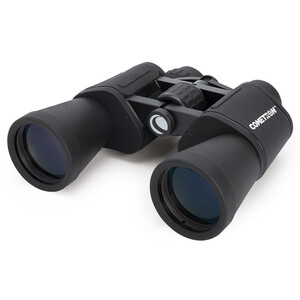
The astronomy classic among affordable binoculars: 7×50 with a large exit pupil for bright handheld views of the Moon and Milky Way – the ideal first step before a telescope.
Price: € 65
* Affiliate link: if you buy through this link we may earn a small commission from Astroshop or High Point Scientific, at no extra cost to you.
Frequently asked questions
How do I recognise the ISS in the sky?
A very bright light moving steadily from west to east, not blinking, crossing the sky in a few minutes. Brighter than any star.
Why can’t you see the ISS in the middle of the night?
In the middle of the night the station sits in Earth’s shadow and is no longer lit by the Sun, so it stays dark. It is only visible during the twilight hours.
How many people are on the ISS?
Usually six to seven crew members, and briefly more during crew handovers.
How much longer will the ISS stay in orbit?
Under current plans, until around 2030. The station will then be de-orbited in a controlled re-entry over the South Pacific, making way for commercial space stations.
How long does the ISS take to circle the Earth?
About 93 minutes. That works out at roughly 16 orbits a day – so the crew sees 16 sunrises and sunsets in 24 hours.
How high does the ISS fly?
Around 400 kilometres above the surface. The altitude varies by a few kilometres, because the residual atmosphere slows the station down and it therefore has to be boosted regularly.
Can the ISS collide with space debris?
The risk is real, which is why the orbit is monitored and the station moves out of the way when needed – on average once or twice a year. If a warning comes in at very short notice, the crew takes shelter in the docked spacecraft as a precaution.
Do you need a telescope to spot the space station?
No. The naked eye is plenty. Binoculars make the point brighter, but only a telescope with tracking lets you make out its shape.
Read next:
- Best beginner telescopes
- A string of lights in the sky? The Starlink satellites
- The night sky this month
This article in other languages: Deutsch · Français · Italiano