By Alexander Merz · Published on · Details checked on 29 October 2026
Aries (the Ram) is a small zodiac constellation of the fall and winter sky. At its core it consists of just four noticeable stars, led by Hamal at magnitude 2.0. Covering 441 square degrees, it ranks 39th of the 88 constellations and sits between the Pleiades and the Great Square of Pegasus.

At a glance
| Latin name | Aries (genitive Arietis, abbreviation Ari) |
| Area | 441 square degrees (rank 39 of 88) |
| Brightest star | Hamal, magnitude 2.00 |
| Main stars of the figure | Hamal, Sheratan, Mesarthim, Bharani |
| Best time to observe | November and December evenings |
| Hamal’s culmination altitude | 66° in Seattle, 73° in New York, 81° in Dallas |
| Sun in the constellation | April 19 to May 14 |
| Neighbors | Triangulum, Perseus, Taurus, Cetus, Pisces |
| Best-known target | Double star Mesarthim (γ Ari) |
What Aries looks like in the sky
Don’t expect to spot a ram with horns. What you actually see is a gently curved line of four stars: Mesarthim, Sheratan, Hamal and, farther to the left, Bharani.
The first three sit close together and form the animal’s head. Hamal and Sheratan are only 3.9 degrees apart, Sheratan and Mesarthim just 1.5 degrees – together roughly three finger-widths at arm’s length.
Bharani lies noticeably farther from Hamal, at 10.4 degrees. The rest of the figure is made of 4th- and 5th-magnitude stars that you will only piece together under a dark country sky. Magnitude (mag) is the measure of brightness: the smaller the number, the brighter the star.
How to find the Aries constellation
Aries itself is inconspicuous, but its neighbors are not. The surest route starts at the Pleiades in Taurus: from this small, tight star cluster, move just over two hand-widths to the right, that is, to the west.
After 23 degrees you reach the brightest star far and wide. Hamal and the Pleiades have almost the same declination – the sky coordinate that corresponds to latitude on Earth. That is why both stand at nearly the same height in the south.
The second route comes from above. Almach, the bright eastern star of the Andromeda chain, sits almost exactly 19 degrees above Hamal. Halfway along you pass the small constellation Triangulum.
A common beginner mistake is ignoring the Moon. Aries lies on the ecliptic, the path of the Sun, Moon and planets – when the Moon is there, it completely drowns out the faint stars. So plan for moonless nights; our monthly guides under Astronomical events show when the Moon is out of the way.
The stars of the Aries constellation
| Star | Magnitude | Distance | Type |
|---|---|---|---|
| Hamal (α Ari) | 2.00 | 66 light-years | orange giant K2 III |
| Sheratan (β Ari) | 2.64 | 59 light-years | white main-sequence star A5 V |
| Bharani (41 Ari) | 3.63 | about 165 light-years | blue-white star B8 V |
| Mesarthim (γ Ari) | 3.9 (combined) | about 164 light-years | double star, two white stars |
| Botein (δ Ari) | 4.35 | about 170 light-years | orange giant K2 III |
Hamal comes from the Arabic word for lamb or sheep. The star is an orange giant, about 15 times the size of the Sun – with the naked eye you can see its warm tint next to the white Sheratan.
A planet around Hamal was announced in 2011. It has at least nearly twice the mass of Jupiter and was found through the star’s slight wobble, not seen directly.
Sheratan is itself a close binary system. Its two stars orbit each other in 107 days and cannot be split by any amateur telescope – the companion was detected only with special techniques such as spectroscopy.
Mesarthim: a double star for small telescopes
Mesarthim is the real highlight of Aries. At just 50x magnification it splits into two almost equally bright white stars of magnitude 4.6 and 4.7, just under 8 arcseconds apart.
It also has a place in history. Robert Hooke discovered in 1664 that Mesarthim is double – more or less by accident, while following a comet. That makes it one of the first double stars ever resolved in a telescope.
When you can see the Aries constellation
Aries is a fall and winter constellation. From October to January it is well placed in the evening sky, highest in November and December – Hamal then culminates around 10:30 and 8:30 p.m. respectively. Culmination means the star reaches its highest point, due south.

| Month | Altitude of Hamal at 10 p.m. | Culmination |
|---|---|---|
| September | 22° | 3:28 a.m. EDT |
| October | 44° | 1:30 a.m. EDT |
| November | 72° | 10:24 p.m. |
| December | 64° | 8:26 p.m. |
| January | 42° | 6:23 p.m. |
| February | 19° | 4:21 p.m. |
| March | 10° | 3:31 p.m. EDT |
| April to August | at or below the horizon | during the day |
You don’t need to worry about a clear view down to the horizon. Hamal climbs to 73 degrees in New York and still reaches 66 in Seattle – so Aries rides high above the haze near the horizon, unlike Canis Major, for example.
Aries zodiac sign vs. Aries constellation: the difference
The zodiac sign is a fixed slice of the calendar; the constellation is a real region of the sky. Depending on the source, the sign of Aries runs from about March 21 to April 20, but the Sun is actually in the constellation from April 19 to May 14 – we recalculated that using the official constellation boundaries.
The reason is precession, the slow wobble of Earth’s axis. A little over 2,000 years ago the vernal equinox point still lay in Aries; today it lies in Pisces. The zodiac signs were fixed back then and never adjusted – more on this in Zodiac signs and constellations.
While the Sun is in Aries, by the way, you cannot see the constellation. During that time, never point binoculars or a telescope anywhere near the Sun – without a certified front-mounted solar filter you risk permanent eye damage.
Mythology: the ram with the Golden Fleece
In Greek legend, a flying ram rescues the royal children Phrixus and Helle from their stepmother. Its golden coat later becomes the Golden Fleece, which Jason brings back with the Argonauts.
The figure is much older than the Greeks, though. This group of stars was already known in ancient Mesopotamia, where it was seen as a farm laborer rather than a ram.
Highlights: NGC 772 and Teegarden’s Star
Aries lies far from the Milky Way, so it has hardly any bright star clusters. Its best-known deep-sky object is NGC 772, a spiral galaxy 1.4 degrees east of Mesarthim. At a good magnitude 10, it shows up in a telescope as an oval smudge with a bright core.
Invisible to the eye but fascinating is Teegarden’s Star. This red dwarf is only 12.5 light-years away and has at least two planets of roughly Earth mass. At about magnitude 15 it stays unremarkable even in beginner telescopes – you’ll find more about such worlds under Exoplanets.
Binoculars or telescope
For Aries the answer is clear. Its targets are a close double star and a small galaxy – both need magnification, not a wide field of view. Binoculars gain you nothing here; a small telescope does.
A compact tabletop Dobsonian is enough to start. With 130 mm (5.1 in) of aperture you split Mesarthim effortlessly and see NGC 772 as a faint smudge under a dark sky. Aperture is the diameter of the main optic – it determines how much light the telescope collects.
The right choice for Mesarthim: Skywatcher Dobson Telescope N 130/650 Heritage FlexTube
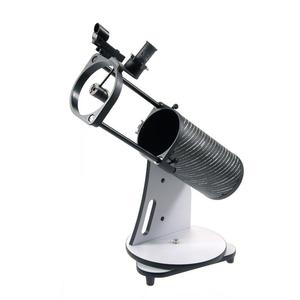
A compact tabletop Dobson with a true parabolic mirror. Folds down, fits in a bag: the Moon, planets and the bright deep-sky classics.
Price: € 265
The Apertura AD8 8" Dobsonian TelescopeSkywatcher Dobson Telescope N 200/1200 Skyliner Classic collects more than twice as much light as a 130 with its 200 mm (8 in) aperture. Here that means NGC 772 becomes a distinct galaxy with a bright core, and more, fainter galaxies turn up around it. The extra cost is worth it if deep-sky observing keeps drawing you in – for Mesarthim alone you don’t need it.
For advanced observers: Skywatcher Dobson Telescope N 200/1200 Skyliner Classic
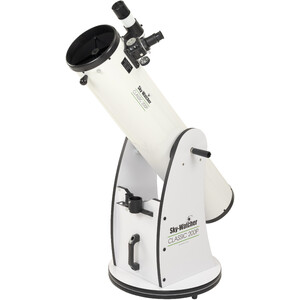
200 mm of aperture — the most sky for your money. Set it on the ground, point by hand: nebulae, clusters and galaxies for years to come.
Price: € 479
Which other instruments suit a beginner is covered in our guide to the best beginner telescopes.
Frequently asked questions about the Aries constellation
What is the Latin name of the Aries constellation?
Aries itself is the Latin name – in crosswords, the five-letter answer for “the Ram constellation”. Its genitive form is Arietis, hence star names like Alpha Arietis. The official abbreviation is Ari.
What is the brightest star in the Aries constellation?
Hamal, a five-letter crossword answer. It shines at magnitude 2.00 and is 66 light-years away. Other possible answers for “star in Aries” are Sheratan (8 letters), Bharani (7) and Mesarthim (9).
What does the Aries constellation look like?
Like a gently curved chain of four stars: Mesarthim, Sheratan, Hamal and Bharani. The first three sit close together, Bharani a little apart. You have to imagine the outline of a ram yourself.
What should I keep in mind for an Aries constellation tattoo?
Copy the four main stars with their real spacing: Hamal–Sheratan 3.9 degrees, Sheratan–Mesarthim 1.5 degrees, Hamal–Bharani 10.4 degrees. Make Hamal the largest dot, because it is the brightest. The symbol ♈︎, by the way, is the zodiac sign, not the star pattern.
What is the difference between the Aries zodiac sign and the constellation?
The zodiac sign is a fixed section of the calendar, roughly March 21 to April 20. The constellation is a region of the sky, and today the Sun is in it from April 19 to May 14. The shift comes from the precession of Earth’s axis.
When is the best time to see the Aries constellation?
On moonless evenings in November and December. Around 10 p.m. Hamal then stands 64 to 72 degrees high in the south as seen from New York. From April to August Aries cannot be observed in the evening.
Can you see Aries from the city?
Hamal and Sheratan yes, the rest usually not. Mesarthim at magnitude 3.9 quickly disappears under a bright city sky, Botein even sooner. For the whole figure, find a dark spot outside town.
Further reading
- Taurus constellation – home of the Pleiades, your signpost to Aries
- Andromeda constellation – the northern neighbor with Almach
- Zodiac signs and constellations – why your sign has shifted
- Identify constellations – the method that really works
- All constellations – our catalog at a glance
* Affiliate link: if you buy through this link we may earn a small commission from Astroshop, High Point Scientific or another linked retailer, at no extra cost to you.