By Alexander Merz · Published on · Details checked on 14 September 2026
The identification of visible stars possibly developed immediately after, or even at the same time as, the development of human language. The very earliest structures grouped certain stars into simple imaginative formations, mainly representing animals, mystical figures, or deities. 88 of them are still part of the officially recognized catalog of constellations today, among them Andromeda.
It is not only their widely differing shape, size and mutual interaction that make them so fascinating. In the constellation Andromeda, several galaxies, seen from the side, directly from above, or from an oblique position, repeatedly pose an astrophotographic challenge for the world’s top telescopes.
Famous since ancient times: the constellation Andromeda
In antiquity, for example, Ptolemy knew of 48 recognized constellations. He described Andromeda as a chain of 4 stars in the northern sky, beginning at the great square of « Pegasus ». In his time, the name of the constellation, like all celestial figures of that era, arose from a mystical tradition.
The basic version of the story tells how Perseus rescued Andromeda, the daughter of the Ethiopian king Cepheus and his wife Cassiopeia, from a sea monster in the form of a whale. For this heroic deed, all those involved in the legend were immortalized in the sky as constellations.
According to the modern astronomical definition, Andromeda is one of the 88 currently recognized constellations. At the same time, this 4-star figure is a constellation of the Milky Way and is very close to us, at 1,200 light-years. Yet even more famous than the constellation Andromeda itself is the nebulous patch slightly north of the star « Andromedae », a red giant at a distance of 200 light-years.
This nebulous patch is the « Andromeda Nebula », listed as M31 in the Messier catalog. This spiral galaxy resembles our Milky Way and, at an estimated distance of 2.7 million light-years, is the most distant object humans can perceive with the naked eye under good conditions.
The princess’s stars
Between the right ascension coordinates 22h 57m 22s and 2h 39m 33s, and declination +21° 40′ 36″ to D. +53° 11′ 13″, the stars of the constellation Andromeda stretch almost perfectly in a line. « Sirrah » is the brightest of them and a variable star of the « Alpha² Canum Venaticorum » type. Right next to it moves a faint companion star of the 11th magnitude class. « Mirach » and « Alamak » also form the outline of the « celestial princess ».
If you follow the great square of « Pegasus » in search of Deep Sky objects, you will find a chain of four very well-known stars. Alamak, Mirach and Sirrah stand in a straight line one behind the other and form the brightest stars of the quite prominent constellation Andromeda. Its main stars are not always equally visible in the northern sky, but even in non-circumpolar months they remain fully visible for at least one hour every day.
Deep Sky object Andromeda
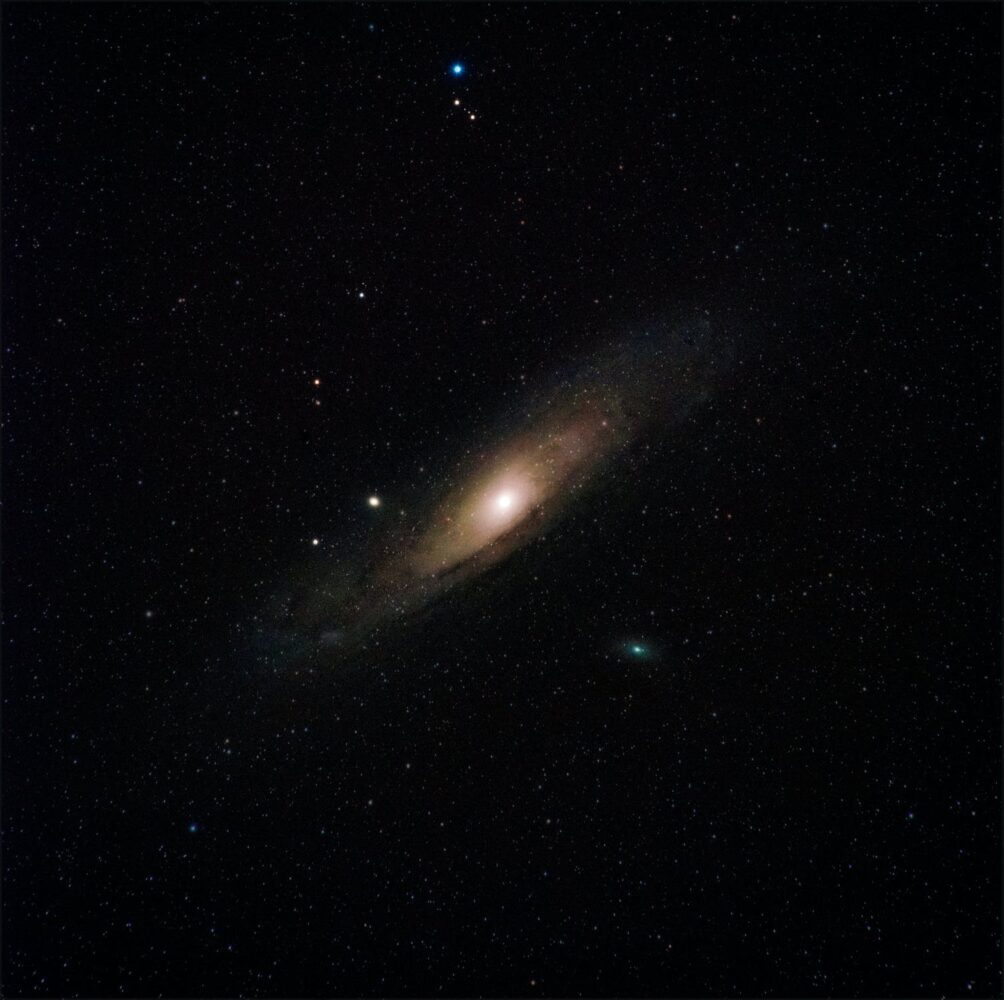
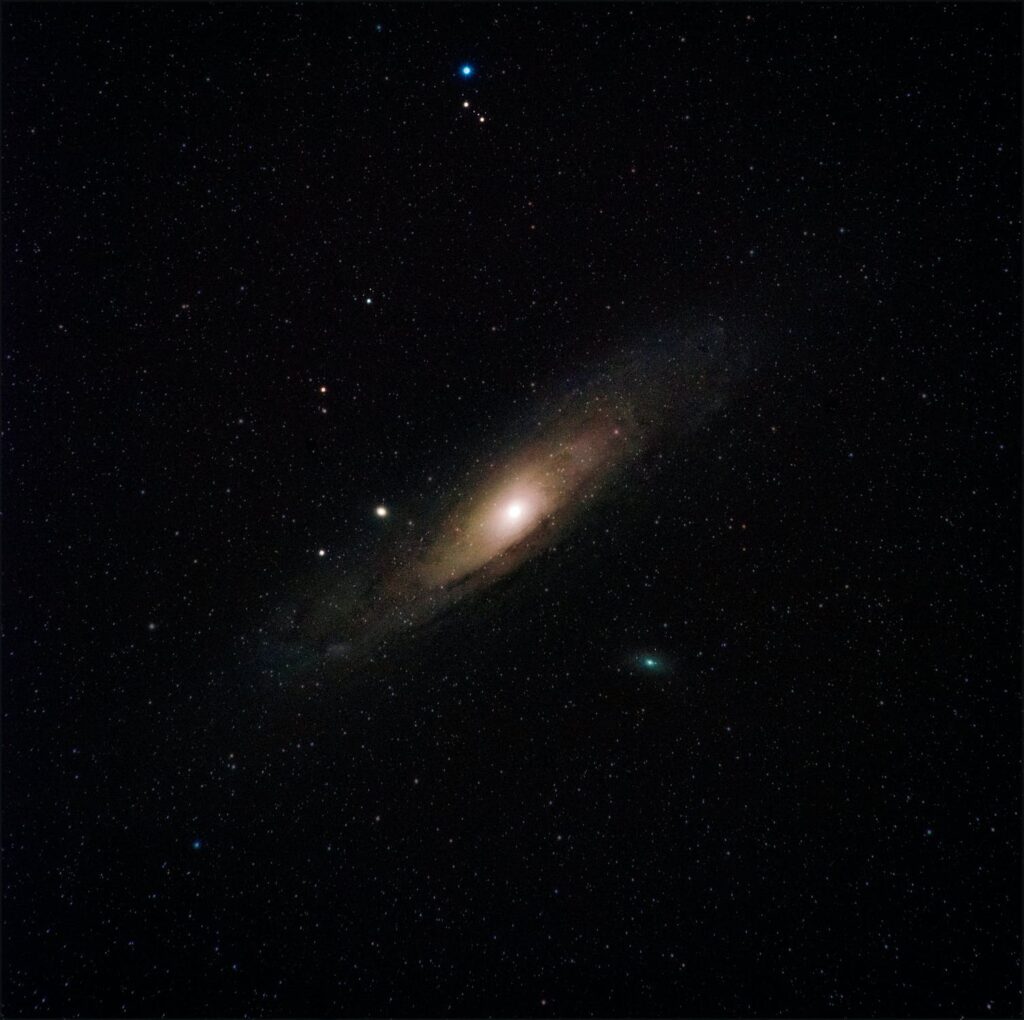
As if positioned above Andromeda’s « neck », an extended Deep Sky object is visible at a small observational distance from Mirach, the second main star of the constellation Andromeda. Because of this nebula, amateur astronomers know the constellation very well. That’s because M31, a spiral galaxy like our Milky Way, has long fired the astronomical and literary imagination as the « Andromeda Galaxy ».
The apparent connection between the Deep Sky object M31 and the constellation Andromeda is an optical illusion. Andromeda is part of the Milky Way and only 1,200 light-years from Earth. M31, on the other hand, is an independent neighboring galaxy and 2.7 million light-years away. Even the assignment of stars has not always been the same throughout history.
Thus Alpha Andromedae was originally called « Sirrah » (horse’s navel) and in some historical star charts is counted as Delta Pegasi, part of the constellation « Pegasus ». Sirrah is actually a binary star system, whose brighter component shines 110 times more brightly than our Sun, thereby practically outshining the tiny companion star of the 11th magnitude class.
Other bright stars of Andromeda
The Andromeda Galaxy M31 is accompanied by the dwarf galaxy M32.
The chain mentioned above contains a number of exciting Deep Sky objects. But the star Mirach (« loins »), « blazing » at about 3,300 Kelvin, can also be observed well thanks to its proximity (199 light-years from Earth). Alamak (« desert lynx ») is the third-brightest star on the line of the constellation Andromeda.
Amateur astronomers easily recognize its nature as a binary star system. At higher resolution, the « B component » reveals itself to be its own triple system, making Alamak, altogether – with very different force ratios – a quadruple star system of the northern sky.
No fewer than eight Andromeda stars, at less than 4 mag, illuminate the Deep Sky objects found there very well. Observers will find another special feature in the constellation Andromeda when they look at the system « 56 And » with good binoculars. Instead of one very bright star, two components of a binary star system become visible here as well. Likewise, « 59 And » appears as a pair, at a distance of 300 light-years from the Sun.