
By Alexander Merz · Updated on · Details checked on 14 September 2026
The North Star (Polaris) sits almost exactly above the celestial north pole, which is why it marks north all year round. It belongs to Ursa Minor, lies about 430 light-years away and is fairly faint at around magnitude 2.0.
Look north on a clear night and one star seems to stand perfectly still while the entire sky wheels slowly around it: that’s Polaris, the North Star. Learning to find the North Star is the first skill every stargazer picks up, because this fixed point always marks true north and works like a compass built into the sky.
⚡ The quick answer: To find Polaris, locate the Big Dipper, then follow the two stars on the front edge of its bowl (the “pointer stars”) upward by about five times their separation. You’ll land right on the North Star. It marks north, and its height above the horizon equals your latitude — roughly 40–50° across the northern United States and Europe.
Polaris at a glance
| Magnitude | ≈ 2.0 (fairly modest) |
| Distance | ≈ 430 light-years |
| Constellation | Ursa Minor (tip of the handle) |
| Position | Less than 1° from the north celestial pole |
| Visibility | Year-round from the Northern Hemisphere |
The anchor of the northern sky
The North Star isn’t the brightest star in the sky — not by a long shot — but it’s the most useful one for orientation. It sits less than a degree from the north celestial pole, the point around which the whole sky appears to spin. While every other star traces a wide arc through the night, Polaris stays almost perfectly put and always points north. Even better, its altitude above the horizon matches your geographic latitude, so a quick glance tells you roughly how far north you are.
How to find the North Star step by step
The classic route runs through the Big Dipper, the easily recognized “saucepan” of seven stars. Find the two stars that form the outer edge of the Dipper’s bowl — these are the pointer stars. Draw an imaginary line through them and extend it upward about five times the gap between them. You’ll arrive almost exactly at Polaris, which sits at the tip of the Little Dipper’s handle. This works on any clear night of the year, because both constellations are circumpolar from mid-northern latitudes: they never set below the horizon.
No Big Dipper in view?
If trees or buildings block the Dipper, use Cassiopeia instead — the bright W (or M) of stars on the opposite side of the pole. Polaris lies roughly halfway between Cassiopeia and the Big Dipper. Because these two patterns sit on opposite sides of the pole, when one rides low the other rides high, so you always have a signpost.
Why does it always point north?
The answer lies in Earth’s rotation. Our planet spins like a top, and its axis happens to point almost exactly at Polaris. Every other star therefore appears to circle around that spot, while the North Star — sitting nearly on the axis — barely moves at all. That’s what made it the trusted guide of sailors and travelers for centuries: find the North Star and you’ve found north, no instrument required.
A star more surprising than it looks
Beyond its role as a signpost, Polaris is a remarkable object in its own right. It’s a yellow supergiant and a pulsating Cepheid variable — the type of star whose brightness rises and falls so predictably that astronomers use it to calibrate cosmic distances. It’s also a triple system: the companion Polaris B (magnitude 9) is already visible in a small telescope. For astrophotographers the area around Polaris is essential — it’s what you align an equatorial mount on during polar alignment, and star-trail images circling the pole rank among the most popular shots in the hobby.
You don’t need serious gear for a first look, though. A decent pair of binoculars is enough to pick out the neighboring stars and enjoy the rich field around the pole.
Great for beginners: Celestron Cometron 7x50 Binoculars
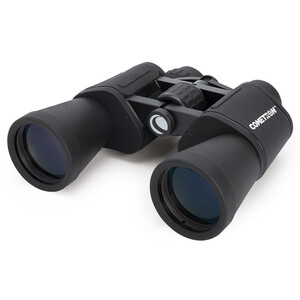
The astronomy classic among affordable binoculars: 7×50 with a large exit pupil for bright handheld views of the Moon and Milky Way – the ideal first step before a telescope.
Price: € 65
* Affiliate link: if you buy through this link we may earn a small commission from Astroshop or High Point Scientific, at no extra cost to you.
Frequently asked questions
Is the North Star the brightest star in the sky?
No. At magnitude 2.0 it ranks only around 48th in brightness. Its fame comes entirely from its position at the north celestial pole, not from how bright it shines.
Why doesn’t Polaris move across the sky?
Because it lies almost exactly along the extension of Earth’s rotational axis. Earth’s spin makes every star circle that point, but Polaris — sitting essentially on the axis — stays nearly fixed.
How do I find the North Star without the Big Dipper?
Use Cassiopeia, the big celestial W: Polaris sits roughly halfway between it and the Big Dipper. Alternatively, face north with a compass and look up to an altitude equal to your latitude.
Has Polaris always been the North Star?
No. Because of the precession of Earth’s axis, the pole star changes over millennia. In the age of the pyramids it was Thuban in Draco; in about 12,000 years it will be Vega.
Read next: