By Alexander Merz · Published on · Details checked on 14 September 2026
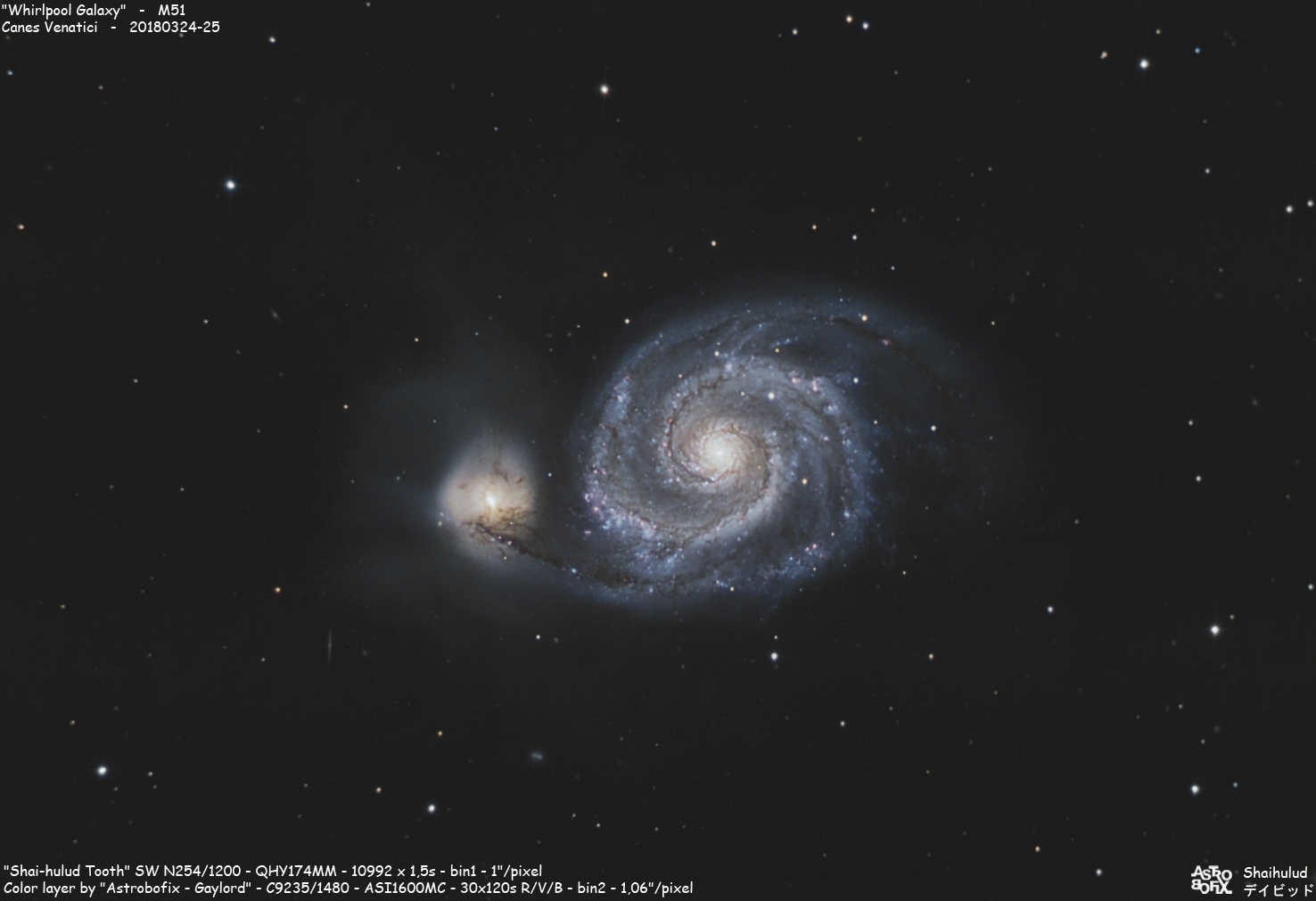
Some of the “modern” 88 constellations (modern because recognised) are ancient or have a long history. Others arose only in later periods of seafaring or entered the celestial atlases as independent constellations in the 17th century. What stands out about many constellations is either their size, the special brightness of the stars that connect them, or their plain geometry, as in the example of Canes Venatici.
A late arrival: the constellation Canes Venatici
In 1690, the Polish astronomer Johannes Hevelius introduced independent constellations in his “celestial atlas”. Among them was also the constellation Canes Venatici, whose only special feature is its simple geometry. Originally, its brightest stars belonged to the “Big Dipper” (also the “Great Bear“). Even now, a little below the “wagon’s shaft”, that is, beneath the tail of the “Great Bear”, one finds the two brightest stars α Cor Caroli and β Canum Venaticorum (Asterion).
Other constellations were certainly better suited to navigation. But for amateur astronomers, the coordinates of Canes Venatici (right ascensions 12h 06m 22s to 14h 07m 33s / declinations +27° 50′ 38″ to +52° 21′ 35″) are still a true treasure trove of galaxies even today. Charles Messier had already discovered many of them and included them in his eponymous catalogue. A globular cluster is also listed among the deep-sky objects.
The stars of Canes Venatici
The main star of the constellation Canes Venatici, α Canum Venaticorum (distance: 110 light-years), can already be observed with telescopes from an aperture of 5 cm. It is in fact a double star and was formerly part, under the name “Cor Caroli”, of the historical constellation “Cor Corali”.
The main star, in turn, of the double system in the constellation Canes Venatici is the prototype of the α2 Canum Venaticorum stars, a class of variable stars in its own right. The particularly strong magnetic field of stars of this class produces gigantic starspots (similar to sunspots), causing their brightness to vary strongly in fixed rotation cycles.
The second star, Asterion (β Canum Venaticorum), shines much more faintly. Among the objects of the constellation Canes Venatici, it is the closest to us, at 27 light-years from the Sun. Like our Sun, Asterion is a yellow dwarf.