By Alexander Merz · Published on · Details checked on 30 September 2026
Alpha Centauri is the star system closest to our Sun: three stars at a distance of 4.25 to 4.34 light-years. With a combined magnitude of −0.27 it is the third-brightest star in the night sky – and it sits in the constellation Centaurus, deep in the southern sky.
At a glance
| Constellation | Centaurus (the Centaur) |
| Distance | 4.34 light-years (A and B), 4.25 light-years (Proxima) |
| Brightness | magnitude −0.27 combined, third place after Sirius and Canopus |
| Declination | −60.9° (deep in the southern sky) |
| Visible from | south of about 29° N; circumpolar south of 29° S |
| Highest point in the US | 12° below the horizon in New York, 5° below in Los Angeles, 3° above in Miami |
| Best time on a trip south | May to July, high in the south in the evening (Southern Hemisphere) |
How far away is Alpha Centauri?
The two bright stars Alpha Centauri A and B are 4.34 light-years from us. That is about 25 trillion miles (41 trillion km) – their light travels a little over four years before it reaches us.
Proxima Centauri, the third star in the system, is slightly closer. At 4.25 light-years it is the nearest star after the Sun. We explain exactly what a light-year is – the distance light travels in one year – on a page of its own.
Can you see Alpha Centauri from the US?
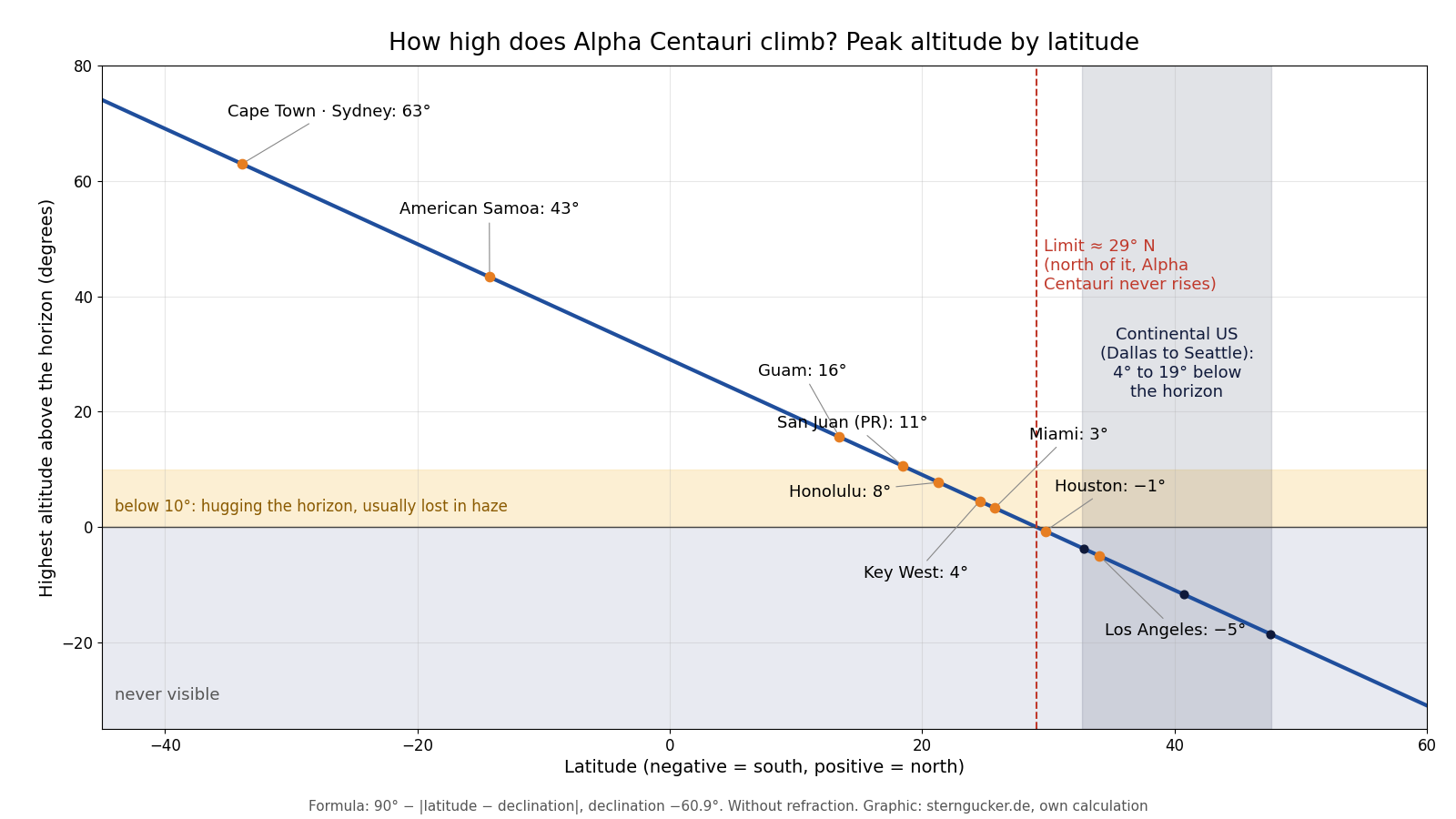
From most of the country, no – and even the darkest sky will not change that. Alpha Centauri has a declination of −60.9 degrees, meaning it sits about 61 degrees south of the celestial equator, the imaginary projection of Earth’s equator onto the sky.
A star’s highest altitude above the horizon works out as 90° minus latitude plus declination. In New York that puts Alpha Centauri at −12 degrees, so even at its best it stays 12 degrees below the horizon.
| City | Highest point | City | Highest point |
|---|---|---|---|
| Seattle | −18.6° | Washington, DC | −9.9° |
| Minneapolis | −15.9° | San Francisco | −8.7° |
| Boston | −13.3° | Los Angeles | −5.0° |
| Chicago | −12.8° | Dallas | −3.7° |
| New York | −11.7° | Miami | +3.3° |
| Denver | −10.7° |
The limit is 90° − 60.9° = 29 degrees north, roughly a line from San Antonio and Houston to Daytona Beach. North of it, Alpha Centauri never rises.
Finding Alpha Centauri in the Southern Hemisphere
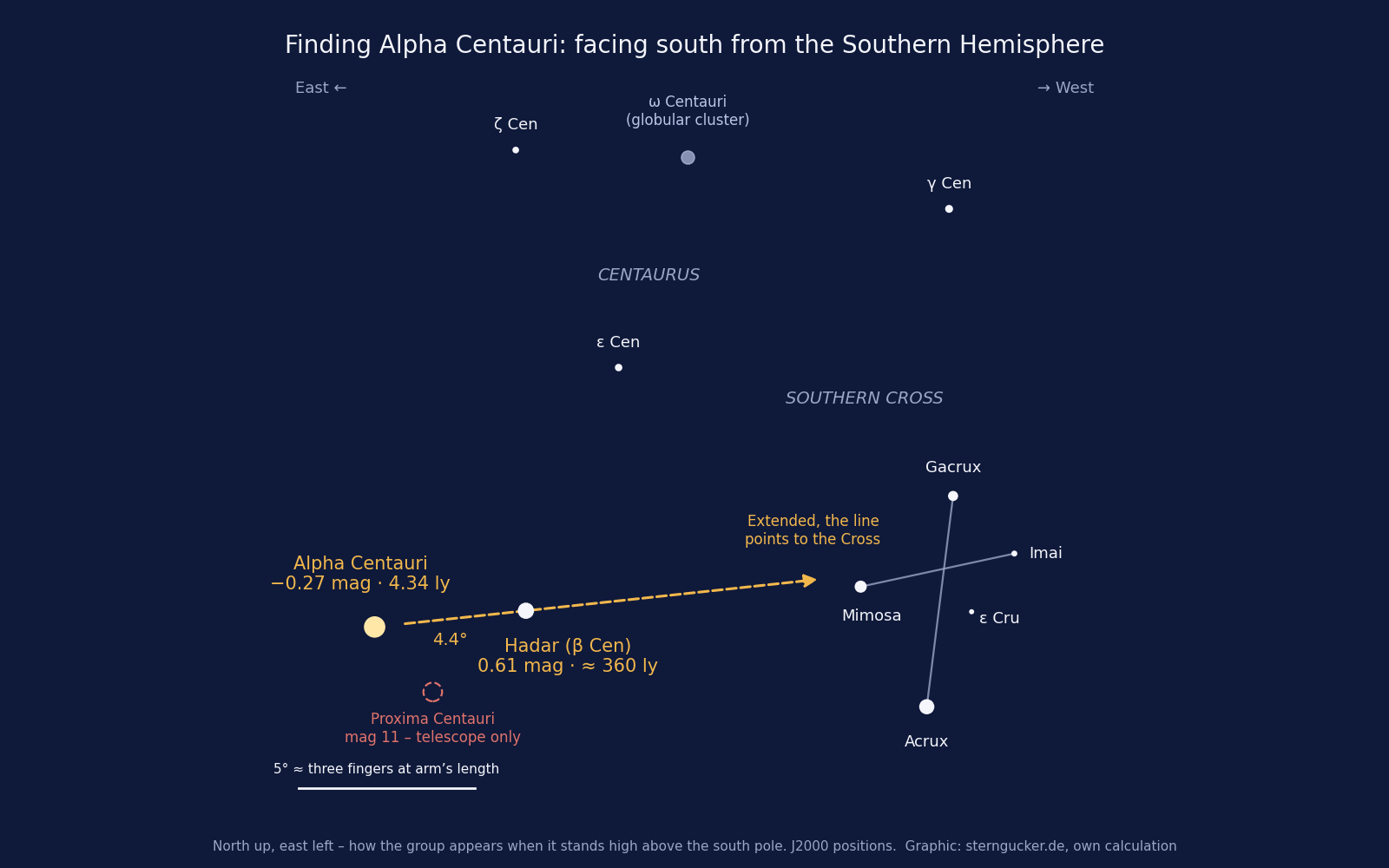
Once you are far enough south, it is hard to miss. Alpha Centauri and its neighbor Hadar (Beta Centauri) form a striking pair of two bright stars, only 4.4 degrees apart – about three fingers at arm’s length.
The brighter, slightly yellowish one of the two is Alpha Centauri. Extend the line from Alpha through Hadar and after just under a fist’s width you hit the Southern Cross: from Hadar to Mimosa, the left star of the crossbar on the chart, it is 9.5 degrees.
You will not find Proxima Centauri this way. It sits 2.2 degrees from Alpha Centauri, but at magnitude 11 it is about 100 times too faint for the naked eye – you need a telescope and a detailed chart.
When and where to see it on your travels
Just south of the limit, it is disappointing. In Orlando and Tampa Alpha Centauri climbs only about 1 degree above the horizon, in Miami 3 and in Key West 4.5 degrees – at that height haze swallows almost any star. Hawaii does better with 7.7 degrees in Honolulu and 9.3 in Hilo, highest around 11:37 p.m. in mid-May and 9:36 p.m. in mid-June (HST).
It gets realistic from Puerto Rico (11°) and Guam (16°) southward. In Cape Town or Sydney it stands 63 degrees high.
| Month | Altitude at 10 p.m. in Cape Town | Altitude at 10 p.m. in Sydney | Highest point (Cape Town) |
|---|---|---|---|
| March | 30° | 29° | 3:54 a.m. |
| April | 44° | 50° | 1:52 a.m. |
| May | 57° | 61° | 11:54 p.m. |
| June | 63° | 61° | 9:52 p.m. |
| July | 56° | 51° | 7:54 p.m. |
| August | 43° | 37° | 5:52 p.m. |
| September | 28° | 23° | 3:51 p.m. |
| October to February | 5° to 18°, low in the south | 5° to 17°, low in the south | during the day or in morning twilight |
In Cape Town and Sydney, Alpha Centauri never sets. South of 29 degrees south it is circumpolar, circling the south celestial pole and never sinking lower than about 5 degrees there.
The Sun, by the way, never passes through Centaurus. It never comes closer to Alpha Centauri than 42.6 degrees, because the constellation lies far away from the zodiac constellations.
Three stars: Alpha Centauri A, B and Proxima
| Star | Magnitude | Distance | Type |
|---|---|---|---|
| Alpha Centauri A (Rigil Kentaurus) | 0.01 | 4.34 light-years | yellow main-sequence star G2 V, 1.08 solar masses |
| Alpha Centauri B (Toliman) | 1.33 | 4.34 light-years | orange dwarf K1 V, 0.91 solar masses |
| Proxima Centauri (Alpha Centauri C) | 11.05 | 4.25 light-years | red dwarf M5.5 Ve, 0.12 solar masses |
| for comparison: Hadar (β Cen) | 0.61 | about 360 light-years | blue giant B1 III |
Alpha Centauri A is almost a twin of our Sun. It has the same spectral type, G2 – the class that describes a star’s color and temperature – but is somewhat more massive and about 1.5 times as luminous.
A and B orbit each other every 79.8 years. Their separation varies between 11 and 35 astronomical units (one AU is the Earth–Sun distance) – roughly from Saturn’s distance to beyond Neptune’s.
In the sky the two are currently just under 10 arcseconds apart. Any small telescope splits them easily, but by the late 2030s they close in to less than 2 arcseconds.
Proxima follows its orbit far out. It is about 13,000 AU from the pair, or 0.2 light-years, and takes well over half a million years for one orbit.
Proxima Centauri: the nearest star
Proxima Centauri is a red dwarf, a small, cool star. It has only 12 percent of the Sun’s mass and just under 0.2 percent of its luminosity, with a surface temperature of about 3,000 kelvins (about 2,700 °C / 4,900 °F).
It is anything but calm, though. Proxima is a flare star that keeps producing violent bursts of radiation. During the 2016 superflare it briefly became about 68 times brighter than usual.
At least two planets orbit Proxima. Proxima b has at least about one Earth mass and circles its star every 11.2 days at a distance of only 7.3 million km (4.5 million miles). That is within the habitable zone, where liquid water would be conceivable – but whether the flares have left it an atmosphere, nobody knows.
The second planet, Proxima d, is even smaller. With at least about a quarter of an Earth mass, it orbits Proxima every 5.1 days and was independently confirmed in 2025. A third candidate, Proxima c, remains disputed.
A planet might also orbit Alpha Centauri A. In 2025 the James Webb Space Telescope reported a possible gas giant, but it has not been confirmed. You can read more about the search for other worlds on our exoplanets page.
How long does a trip to Alpha Centauri take?
With today’s technology: extremely long. Voyager 1, the fastest probe on its way out of the solar system, travels at about 17 kilometers per second (38,000 mph). At that speed it would need about 75,000 years to reach Proxima – although it is not even heading in that direction.
| How | Speed | Travel time to Proxima |
|---|---|---|
| Light, radio signal | 300,000 km/s (186,000 mi/s) | 4.25 years |
| Breakthrough Starshot (concept) | 20% of the speed of light | a little over 21 years |
| Voyager 1 | about 17 km/s (38,000 mph) | about 75,000 years |
| Car on the interstate | 70 mph (113 km/h) | about 41 million years |
The Breakthrough Starshot project wanted to use lasers to push tiny probes to 20 percent of the speed of light. Since 2025, however, it has been on hold, and no launch date is in sight.
The constellation Centaurus
Alpha Centauri is the brightest star in Centaurus, the Centaur. At 1,060 square degrees it is the ninth-largest of the 88 constellations and depicts the wise centaur Chiron, half human, half horse.
Its greatest treasure is Omega Centauri. The brightest globular cluster in the sky gathers several million stars at a distance of about 17,000 light-years and, at magnitude 3.9, is visible to the naked eye as a fuzzy star.
Unlike Alpha Centauri, you can catch it from much of the US. It rises south of about 42 degrees north and reaches about 2 degrees in New York, 8 in Los Angeles, 10 in Dallas and 17 in Miami – best on spring evenings, low in the south.
Binoculars or telescope
To be honest: from most of the US you need nothing at all for Alpha Centauri, because it never rises. If you travel to the Southern Hemisphere, a pair of binoculars is the best companion – it fits in your carry-on and shows Omega Centauri and the Milky Way around the Southern Cross.
For your southern sky trip: Celestron Cometron 7x50 Binoculars
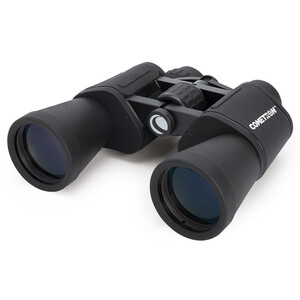
The astronomy classic among affordable binoculars: 7×50 with a large exit pupil for bright handheld views of the Moon and Milky Way – the ideal first step before a telescope.
Price: € 65
When bigger binoculars pay off
At home the same principle applies to the Milky Way and large star clusters. More aperture brings more stars there, not more magnification.
The Celestron 15 x 70 SkyMaster Pro Waterproof BinocularsOmegon Nightstar 15×70 collects about twice as much light as a 10×50 with its 70 mm (2.8 in) aperture: Omega Centauri appears larger and brighter, and far more stars show up in the Milky Way. The extra cost pays off if you observe regularly and bring a tripod – handheld, 15× binoculars shake too much.
For advanced observers: Omegon Nightstar 15x70 Binoculars
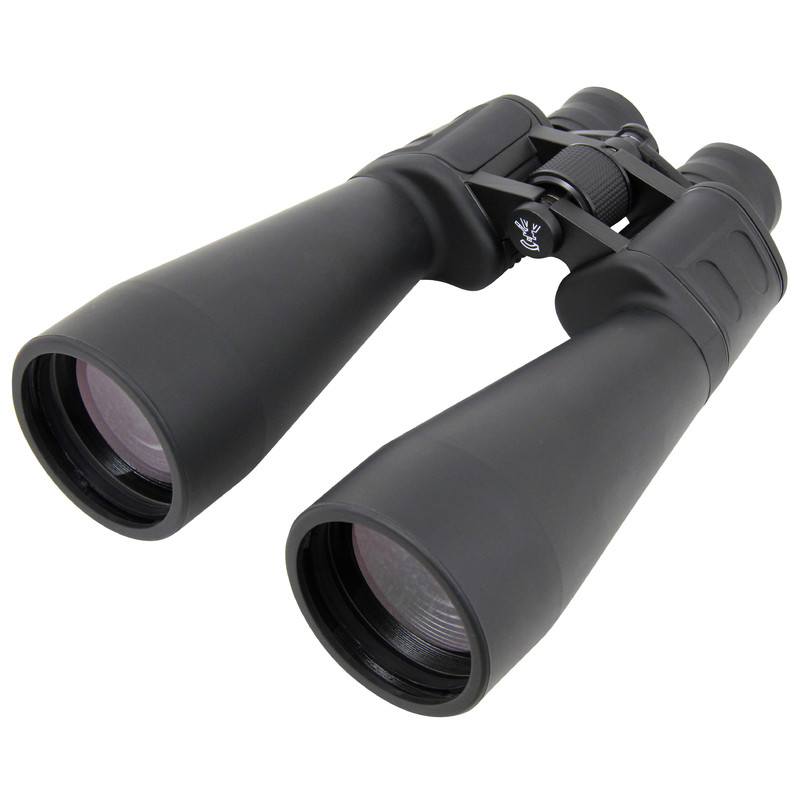
The classic astronomy binocular: 70 mm gathers twice the light of a 50 mm, and 1.5 kg is still manageable when braced.
Price: € 119
Frequently asked questions about Alpha Centauri
How far is Alpha Centauri from Earth?
Alpha Centauri A and B are 4.34 light-years away, about 25 trillion miles (41 trillion km). Proxima Centauri, the system’s third star, is slightly closer at 4.25 light-years, making it the nearest star after the Sun.
Can you see Alpha Centauri from the US?
From most of the country, no. With a declination of −60.9 degrees it always stays 4 to 19 degrees below the horizon between Dallas and Seattle. It only rises south of about 29 degrees north – low over the horizon in South Texas, Florida and Hawaii, and well placed in the Southern Hemisphere.
What is Proxima Centauri?
A small red dwarf with 12 percent of the Sun’s mass and the nearest star of all. It belongs to the Alpha Centauri system, but at magnitude 11 it is visible only in a telescope. At least two planets orbit it, including Proxima b in the habitable zone.
How long would it take to travel to Alpha Centauri?
At Voyager 1’s speed, about 75,000 years. The Breakthrough Starshot concept would have gotten tiny probes there in a little over 21 years, but it has been on hold since 2025.
Which constellation is Alpha Centauri in?
In Centaurus, the Centaur – “Alpha Centauri” means “Alpha of the Centaur”. The constellation lies in the southern sky right next to the Southern Cross.
Is Alpha Centauri the brightest star in the sky?
No, at magnitude −0.27 it is the third-brightest. Only Sirius at −1.46 and Canopus at −0.74 are brighter – and Canopus, too, only shows up low in the south from the southern US, below about 37 degrees north.
Keep reading
- Southern Cross constellation – the Cross that Alpha Centauri points to
- Sirius – the brightest star, which you see in winter
- Light-year – how far 4.3 light-years really is
- Exoplanets – planets around other stars
- All stars – our star profiles at a glance
* Affiliate link: if you buy through this link we may earn a small commission from Astroshop or High Point Scientific, at no extra cost to you.