By Alexander Merz · Published on · Details checked on 29 October 2026
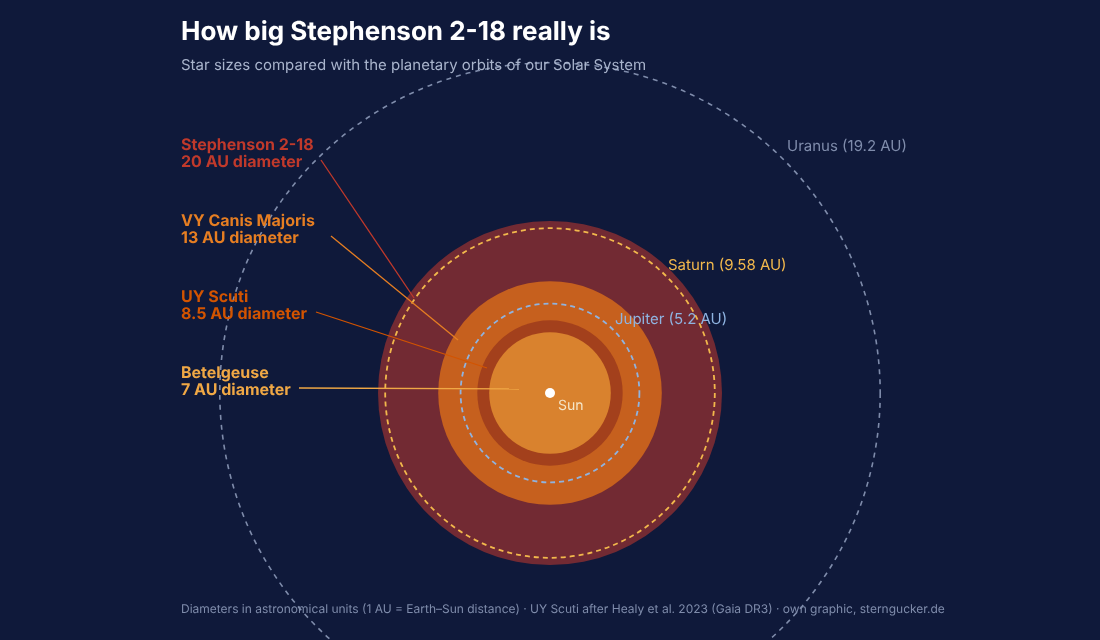
Stephenson 2-18 is a red supergiant in the constellation Scutum and is considered the largest known star of all. Its radius is estimated at around 2,150 solar radii – if it stood in place of our Sun, its surface would reach out beyond the orbit of Saturn.
More in our overview: Stars.
Stephenson 2-18 in numbers
| Type | Red supergiant (hypergiant) |
| Constellation | Scutum (the Shield) |
| Distance | around 19,000 light-years |
| Radius | around 2,150 solar radii ≈ 1.5 billion km |
| Diameter in AU | around 20 astronomical units |
| Luminosity | about 440,000 times the Sun’s luminosity |
| Surface temperature | around 3,200 kelvin |
| Apparent magnitude | about 15 mag in visible light |
| Membership | star cluster Stephenson 2 |
What 2,150 solar radii mean
Numbers of this size only mean something once you convert them. The diameter of Stephenson 2-18 is about 20 astronomical units – twenty times the distance between Earth and the Sun.
In place of the Sun it would swallow Mercury, Venus, Earth, Mars, Jupiter and Saturn. Only somewhere between Saturn and Uranus would you reach its surface.
Even so, it is no heavyweight. Red supergiants are bloated stars with an extremely thin envelope – their outer layers are thinner than any vacuum we can create on Earth.
Why the record is shaky
This is where it gets uncomfortable, and that is why it is here: a star’s radius cannot be measured directly, only calculated from brightness, temperature and distance. Of these three, the distance is the least certain.
The record figure assumes that Stephenson 2-18 belongs to the star cluster of the same name and therefore shares its distance. Several studies doubt exactly that – the star’s velocity does not fit neatly with the other cluster members.
If it were actually closer, it would be considerably smaller and the record would fall. Until the distance is confirmed independently, “the largest known star” remains a well-founded assumption and not an established fact.
The competition for first place
| Star | Radius (solar radii) | Distance | Constellation |
|---|---|---|---|
| Stephenson 2-18 | around 2,150 | around 19,000 ly | Scutum |
| VY Canis Majoris | around 1,420 | around 3,900 ly | Canis Major |
| UY Scuti | around 900 | around 5,900 ly | Scutum |
| Betelgeuse | around 760 | around 550 ly | Orion |
The pattern is striking: the less certain the distance, the larger the estimate tends to be. UY Scuti is the best example: for years it was listed as the largest known star at around 1,700 solar radii – until the Gaia distance (around 5,900 instead of 9,500 light-years) shrank it to roughly 900 (Healy et al. 2023). A reason to read the top of the list with caution.
That is why the best-studied one is the neighbour: Betelgeuse in Orion. It is much smaller, but close enough that its surface can actually be imaged.
Can you observe Stephenson 2-18?
Honest answer: no, at least not visually. At about 15 mag in visible light it is theoretically within reach of larger amateur telescopes – but it sits in a region of the Milky Way packed with stars and dust.
In practice that means an inconspicuous reddish point of light among thousands, identifiable only by its catalogue coordinates. The star is a target for infrared telescopes, not for the eyepiece.
If you want to see giant stars with your own eyes, start with Betelgeuse instead. It stands high in the winter sky and is visible to the naked eye – and you can follow its changes in brightness yourself over weeks.
Our beginner recommendation: Skywatcher Dobson Telescope N 130/650 Heritage FlexTube
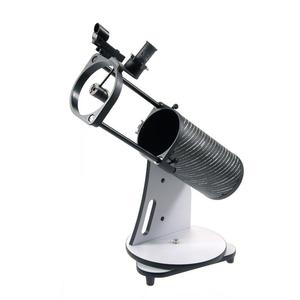
A compact tabletop Dobson with a true parabolic mirror. Folds down, fits in a bag: the Moon, planets and the bright deep-sky classics.
Price: € 265
With the Apertura AD8 8" Dobsonian TelescopeSkywatcher Dobson Telescope N 200/1200 Skyliner Classic and its 200 mm aperture you reach roughly 14 mag – that is what first brings distant red giants in the winter Milky Way within range. The extra cost pays off if you want to seek out faint objects specifically; for bright stars like Betelgeuse you don’t need it.
* Affiliate link: if you buy through this link we may earn a small commission from Astroshop, High Point Scientific or another linked retailer, at no extra cost to you.
Stephenson 2-18: FAQ
How big is Stephenson 2-18?
Its radius is estimated at around 2,150 solar radii, which is about 1.5 billion kilometres. Its diameter is therefore around 20 astronomical units – in place of the Sun it would extend beyond the orbit of Saturn.
Is Stephenson 2-18 really the biggest star?
The biggest known one, yes – but with a caveat. Its size follows from the assumed distance, and whether the star really belongs to the cluster Stephenson 2 is disputed. If it were closer, it would be smaller.
Where is Stephenson 2-18 in the sky?
In the constellation Scutum, a small constellation in the southern summer Milky Way between Aquila and Sagittarius. From mid-northern latitudes this region stands low in the south in summer.
What will happen to Stephenson 2-18?
Red supergiants of this mass end as a supernova. When that will happen cannot be predicted – astronomically speaking it is at the end of its life, which can mean tens of thousands to hundreds of thousands of years.
How can a star be bigger than a planetary orbit?
Because a red supergiant is almost empty. At the end of its life a massive star swells enormously, while most of its mass stays concentrated in the core. The outer envelope is extremely thin – huge, but barely there.
Further reading
- Betelgeuse – the red supergiant you can see for yourself
- Canis Major constellation – home of VY Canis Majoris
- Supernova – how stars like this end
- How big is the Sun? – the yardstick for every stellar measurement
- Stars – our overview of their structure and evolution