By Alexander Merz · Published on · Details checked on 25 October 2026
The Sun is the only star whose size we can measure directly – and yet the web is full of at least two different diameters, three different masses and only rarely a circumference. This page collects all the key figures of our central star in one place: exact, recalculated and with an explanation of where the differences come from.
⚡ The Sun in five numbers
- Diameter: 1,392,700 km (109 times Earth)
- Circumference: 4,375,000 km at the equator
- Mass: 1.989 · 1030 kg – 333,000 Earth masses
- Volume: 1.41 · 1018 km³ – room for 1.3 million Earths
- In the sky: only about 0.53 degrees, so half a degree
That means the Sun holds 99.86 percent of the entire mass of the Solar System – all eight planets together make up the rest.
You can measure the apparent diameter yourself with a pinhole camera – it costs nothing and is explained step by step further down. If you actually want to look at the Sun, however, you absolutely need a certified solar filter: which one suits which aperture is in the filter overview, and the buying guide for beginners names the instruments to go with it.
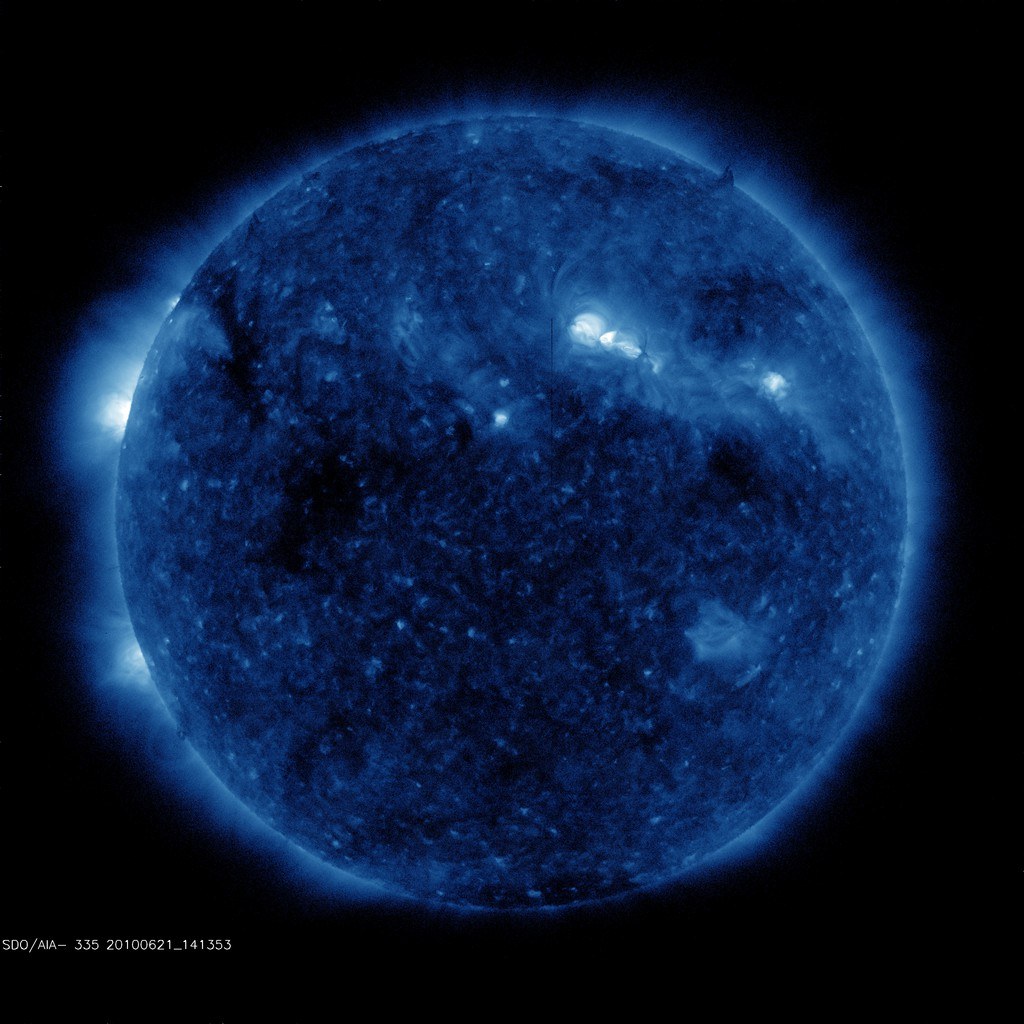
Diameter: 1,392,700 kilometres
The diameter of the Sun is about 1,392,700 kilometres, so its radius is 696,342 kilometres. That is 1.3927 million kilometres or 1.3927 billion metres – a number that is hard to picture, which is why several scale models follow further down.
This diameter is measured at the photosphere, the layer only about 400 kilometres thick from which visible light comes. The Sun has no solid surface: it consists of plasma throughout and simply gets thinner and thinner towards the outside. The sharp edge on every photo of the Sun is an optical effect – the density drops so steeply within a few hundred kilometres that the gas becomes transparent almost instantly.
| The Sun’s diameter in … | Value |
|---|---|
| kilometres | 1,392,700 km |
| metres | 1,392,700,000 m |
| centimetres | 1.3927 · 1011 cm |
| miles | 865,374 mi |
| Earth diameters | 109.3 × |
| Moon diameters | 401 × |
| Jupiter diameters | 9.7 × |
| light-seconds | 4.65 light-seconds |
Why two different solar diameters are in circulation
If you look it up, you will find sometimes 1,392,700 km, sometimes 1,391,400 km. Both numbers are correct – they just answer different questions. 1,392,700 km is the measured photospheric diameter (radius 696,342 km, Emilio et al. 2012, derived from transits of Mercury). 1,391,400 km is the nominal value set by the International Astronomical Union in 2015 (radius exactly 695,700 km) – a rounded convention so that all research groups calculate with the same constant.
The difference is 1,300 kilometres, less than one part in a thousand. For any practical question it is irrelevant; this page uses the measured value throughout.
Circumference, surface, volume
From the radius, everything else follows by pure geometry. The circumference of the Sun is 2 · π · radius and comes to 4,375,246 kilometres, about 4.375 million kilometres. For comparison: Earth’s circumference is 40,075 kilometres – you would have to circle Earth 109 times at the equator to get once around the Sun.
The surface area (4 · π · r²) covers 6.09 trillion square kilometres, 11,946 times Earth’s surface. The volume (4/3 · π · r³) is 1.41 · 1018 cubic kilometres or 1.41 · 1027 cubic metres. Around 1.3 million Earths would fit inside – why three different numbers are correct depending on the yardstick is worked out in detail in the big Sun–Earth size comparison.
| Quantity | Value | Ratio to Earth |
|---|---|---|
| Radius | 696,342 km | 109.3 × |
| Diameter | 1,392,700 km | 109.3 × |
| Circumference (equator) | 4,375,246 km | 109.3 × |
| Surface area | 6.09 · 1012 km² | 11,946 × |
| Volume | 1.41 · 1018 km³ | 1,305,000 × |
| Mass | 1.989 · 1030 kg | 333,000 × |
| Mean density | 1.41 g/cm³ | 0.26 × |
| Flattening | 9 · 10-6 | Earth: 3.4 · 10-3 |
| Share of the Solar System’s mass | 99.86 % | – |
Mass: 1.989 octillion tonnes
The Sun weighs 1.989 · 1030 kilograms. Written out, that is 1,989,000,000,000,000,000,000,000,000,000 kilograms or – in tonnes – about 1.989 octillion tonnes. That equals 333,000 Earth masses.
This mass is not weighed directly but inferred: from Earth’s orbital period and orbital radius, Kepler’s third law and the gravitational constant give the mass of the central body straight away. Astronomers therefore know the product of the gravitational constant and the solar mass (the so-called heliocentric gravitational parameter) far more precisely than the mass itself – the uncertainty lies almost entirely in the gravitational constant.
The solar mass is so handy in astronomy that it serves as a unit of its own: stars, black holes and entire galaxies are given in solar masses. The Milky Way comes to around 1.5 trillion of them.
The Sun loses 5.7 million tonnes every second
In the core, about 600 million tonnes of hydrogen fuse into 596 million tonnes of helium every second. The missing four million tonnes or so are converted into energy according to E = mc². On top of that, around 1.4 million tonnes stream into space as solar wind. Together that makes about 5.7 million tonnes of mass loss per second.
That sounds dramatic, but it isn’t: in the 4.6 billion years since it formed, the Sun has lost only about 0.03 percent of its mass this way. It simply has a great deal of it.
Density: denser than water
Dividing the mass by the volume gives a mean density of 1.41 grams per cubic centimetre. So the Sun is denser than water, but only about a quarter as dense as Earth (5.51 g/cm³). A star made of gas against a planet made of rock and iron – the result is no surprise.
The average hides enormous contrasts, though. In the photosphere the plasma is around 10,000 times thinner than the air you are breathing right now. In the core, by contrast, the weight of the layers above squeezes the material to about 150 grams per cubic centimetre – a good thirteen times denser than lead, and still a gas, because at 15 million degrees no atom holds together any more.
The core of the Sun
The fusion furnace extends to about 25 percent of the solar radius. Its diameter is therefore around 348,000 kilometres – the core alone is 27 times as large as the whole Earth and contains a good half of the Sun’s mass in just two percent of its volume.
How the diameter is measured
The diameter of the Sun cannot be determined with a tape measure, only calculated. You need exactly two quantities: the angle at which the Sun appears in the sky and the distance. The formula is:
D = 2 · d · tan(α / 2)
With d = 149,597,871 km (distance) and α = 0.5334° (apparent diameter), D = 1,392,700 km.
Historically, the difficult part was the distance. Aristarchus of Samos tried to determine it in the 3rd century BC from the angle between the Sun and the half Moon and was off by a factor of twenty – but he was the first to realise at all that the Sun must be much larger than Earth. Usable values only came with the transits of Venus in 1761 and 1769, for which expeditions travelled halfway around the world. Today the astronomical unit is measured by radar echoes from Venus and Mercury to within a few metres.
Measure the Sun’s diameter yourself: the pinhole camera
You can recreate the principle with cardboard and a folding ruler – completely safely, because you never look at the Sun. Prick a clean hole about two millimetres across in a piece of card, hold it in the sunlight and catch the image on a second card behind it. The greater the distance, the larger and fainter the image of the Sun.
Measure the distance between the cards and the diameter of the projected solar disc. At a distance of 1.08 metres the spot of light is exactly 1 centimetre across – the ratio is always about 1 : 108. Multiply this ratio by the Earth–Sun distance and you get the Sun’s diameter. That is exactly how generations of astronomers did it, only with better instruments.
Apparent size: half a degree
In the sky, the Sun measures only about 0.53 degrees or 32 arcminutes. That is roughly the size of a penny two metres away – or half the width of your little fingernail at arm’s length. A star 1.4 million kilometres across simply shrinks to a small disc at a distance of 150 million kilometres.
This value is not constant. Because Earth’s orbit is an ellipse, Earth is about five million kilometres closer to the Sun in early January than in early July. The apparent diameter therefore varies between 32.55 arcminutes in January and 31.48 arcminutes in July – a difference of just over three percent, unnoticeable to the naked eye but decisive for eclipse calculations.
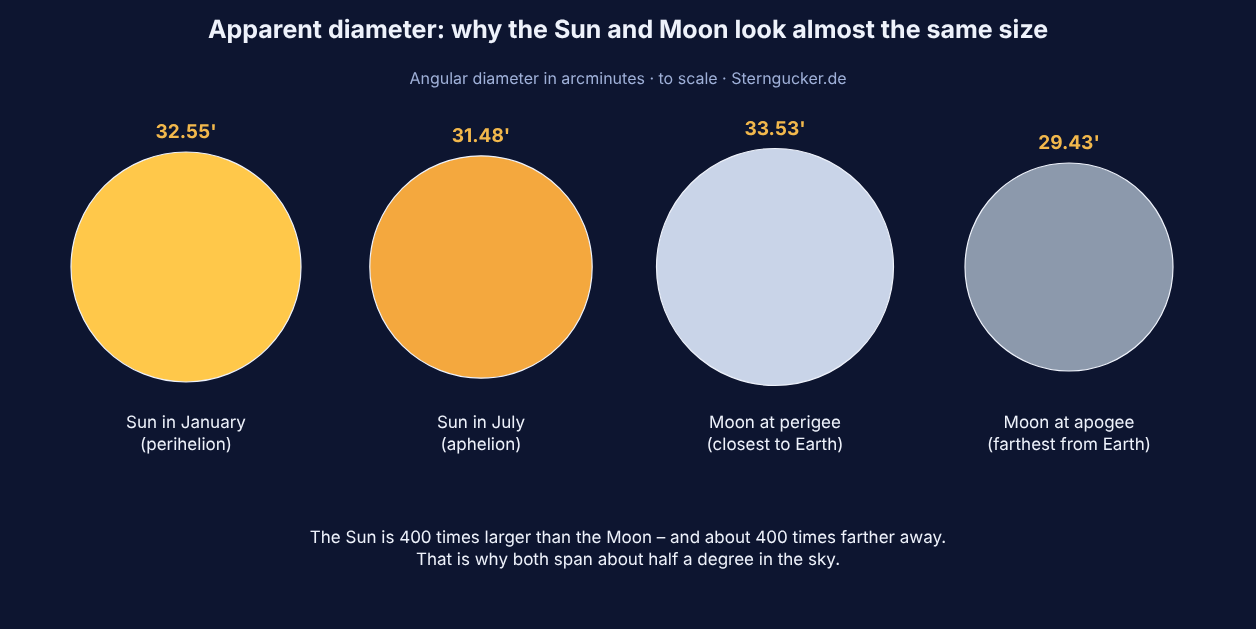
The Moon varies more, between 29.43 and 33.53 arcminutes. Only when a large Moon meets a small Sun does it cover it completely – then there is a total solar eclipse like the one on 12 August 2026. When a small Moon meets a large Sun, a ring of light remains: the annular eclipse. That both appear the same size at all is pure coincidence – the Sun is 400 times larger than the Moon and, by chance, also about 400 times farther away.
The Sun to scale: three models
Numbers with twelve zeros say little. Scale models help more – above all because they show that not only is the Sun big, but the space in between is mostly empty.
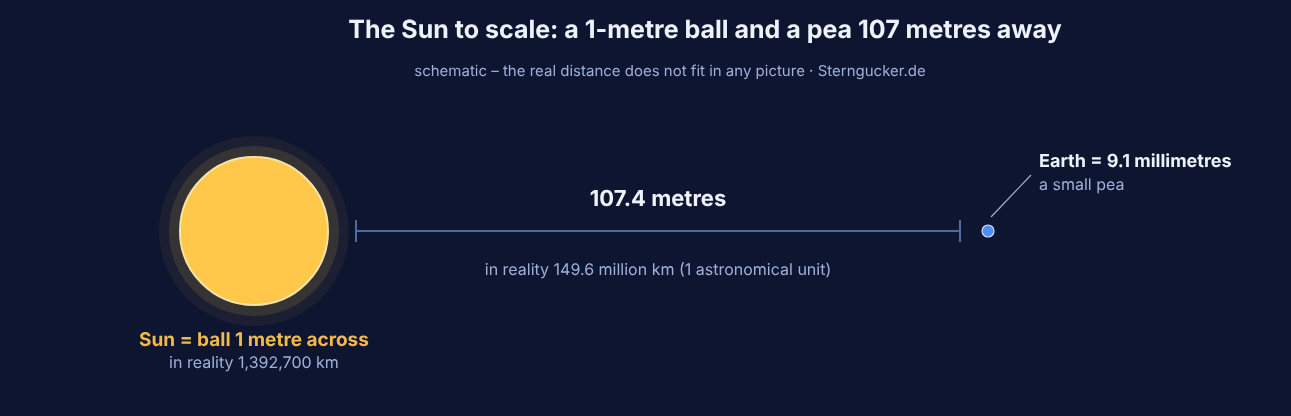
- Sun = soccer ball (22 cm): Earth would be a pinhead 2 millimetres across, 23.6 metres away – roughly the length of a swimming pool.
- Sun = ball 1 metre across: Earth would be a pea of 9.1 millimetres, 107 metres away. Jupiter would be a walnut 560 metres away.
- Sun = 1 millimetre (a grain of sand): Earth would be invisibly small, yet the whole Milky Way would still be as wide as Earth’s Moon. At this scale the nearest star would be 30 kilometres away.
The size of the Sun explained for kids
For children, the comparison with marbles and an exercise ball works best. The ball is the Sun, the marble is Earth – and then you walk away with the marble until the others can barely see the ball. That is exactly the point: the Sun is not only huge, it is also unimaginably far away. Anyone who wanted to count all 1.3 million Earths that fit into the Sun would need a good two weeks without a break at one Earth per second.
The Sun among the stars
As huge as the Sun seems compared with Earth – among the stars it is average. It belongs to spectral class G2V and is technically called a yellow dwarf. Around three quarters of all stars in the Milky Way are red dwarfs and therefore smaller; the really big stars are rare, but unimaginably larger.
| Star | Radius in solar radii | Note |
|---|---|---|
| Proxima Centauri | 0.15 | red dwarf, our nearest neighbouring star |
| Sun | 1 | yellow dwarf, G2V |
| Sirius A | 1.7 | brightest star in the night sky |
| Pollux | 8.8 | red giant in Gemini |
| Arcturus | 25 | red giant in Boötes |
| Rigel | 79 | blue supergiant in Orion |
| Antares | 680 | red supergiant in Scorpius |
| Betelgeuse | 750 | red supergiant, supernova candidate |
| UY Scuti | 909 | long regarded as the largest star |
| Stephenson 2-18 | 2,150 | currently the largest known star |
Put in place of the Sun, Stephenson 2-18 would have its surface beyond the orbit of Saturn. Conversely, the sheer number of stars puts things into perspective: the Milky Way holds a few hundred billion of them, and most are smaller than our Sun.
The Sun’s future
The Sun is growing – slowly but unstoppably. Because hydrogen fuses into helium in the core, the number of particles decreases, the core contracts and heats up, and the Sun shines more strongly. Since it formed, it has become about 30 percent brighter as a result. Roughly another ten percent is added every billion years.
In about a billion years the radiation will be so strong that Earth’s oceans evaporate. In about five billion years the hydrogen in the core runs out and the Sun swells into a red giant – to more than a hundred times its present diameter. It will swallow Mercury and Venus, probably Earth as well. Finally it sheds its envelope and remains as a white dwarf: about the size of Earth, but with half the mass of the Sun.
Observing the Sun safely
You can check the size of the Sun in the sky yourself – but never unprotected. Even a brief look through unfiltered binoculars or a telescope burns the retina irreversibly, and painlessly, because the retina has no pain receptors. Sunglasses, rescue blankets, exposed film or sooted glass are not filters.
Two ways are safe: projection through a pinhole camera as described above – or a certified objective filter that sits in front of the optics and blocks 99.999 percent of the light. The cheapest option, and optically excellent, is solar filter film that you mount yourself to fit your own instrument.
Solar filter film to build your own: Baader AstroSolar Safety Film OD 5.0
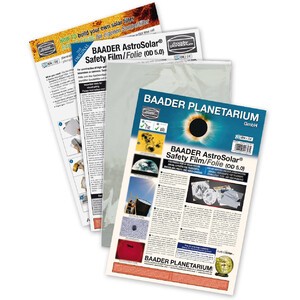
The standard film for safe solar observing: OD 5.0 passes just 1/100,000 of the light. Cut it, mount it – and sunspots snap into razor-sharp view.
Price: € 29
With a filtered telescope the Sun only really becomes interesting: sunspots can be followed over days, large groups reach ten times Earth’s diameter and still cover only fractions of a percent of the solar disc. In steady air the granulation of the photosphere becomes visible too.
To get started, a solid telescope with enough aperture is all you need – it shows the Sun by day and the Moon and planets by night. If you can only buy one instrument and really want to explore the sky, go for the telescope; binoculars are a complement, not a replacement.
Beginner telescope for Sun, Moon and planets: Skywatcher Dobson Telescope N 130/650 Heritage FlexTube
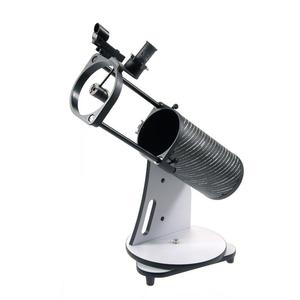
A compact tabletop Dobson with a true parabolic mirror. Folds down, fits in a bag: the Moon, planets and the bright deep-sky classics.
Price: € 265
More choice in the same class is in our comparison of telescopes under 300, and the matching accessories are in the overview of telescope filters.
* Affiliate link: if you buy through this link we may earn a small commission from Astroshop, High Point Scientific or another linked retailer, at no extra cost to you.
How big is the Sun? FAQ
How big is the Sun in kilometres?
The diameter is about 1,392,700 kilometres, the radius 696,342 kilometres. The International Astronomical Union uses the nominal value of 1,391,400 kilometres – the difference is less than one part in a thousand.
What is the circumference of the Sun?
The equatorial circumference is 4,375,246 kilometres, about 4.38 million kilometres. That equals 109 times Earth’s circumference.
How much does the Sun weigh in tonnes?
About 1.989 · 1027 tonnes, i.e. 1.989 octillion tonnes or 1.989 · 1030 kilograms. That is 333,000 Earth masses.
What is the volume of the Sun?
1.41 · 1018 cubic kilometres or 1.41 · 1027 cubic metres. By volume, Earth fits inside about 1.3 million times.
How big is the Sun compared with the Moon?
The Sun’s diameter is about 400 times that of the Moon (1,392,700 km versus 3,475 km). Because the Sun is also about 400 times farther away, both appear almost the same size in the sky.
How big is the Sun’s core?
The fusion core extends to about 25 percent of the solar radius, so its diameter is around 348,000 kilometres – a good 27 Earth diameters. Temperatures there reach 15 million degrees and the density is about 150 g/cm³.
Is the Sun a perfect sphere?
Almost. Its flattening is only 9 millionths: the equatorial diameter is just about 12 kilometres larger than the polar diameter. That makes the Sun the roundest known natural object – Earth, with a 21-kilometre difference, is relatively almost four hundred times more flattened.
How big is the largest known star?
Currently Stephenson 2-18 is considered the largest known star, with around 2,150 solar radii. Put in place of the Sun, its surface would reach beyond the orbit of Saturn. The figures are uncertain, however, because such supergiants have no sharp edge.
How do you calculate the diameter of the Sun?
With D = 2 · d · tan(α/2). You need the distance d (149.6 million kilometres) and the apparent diameter α (0.5334 degrees). You can measure the angle yourself with a pinhole camera: the ratio of projection distance to image size is about 108 to 1.
What percentage of the Solar System’s mass is in the Sun?
99.86 percent. Of the remainder, two thirds is Jupiter. All the planets, moons, asteroids and comets together make up less than 0.14 percent of the Solar System’s mass.
Further reading
- Observing the Sun safely: filters, technique and what you must never do
- All about the Sun: structure, activity and observation
- How many Earths fit in the Sun? The big size comparison
- How long does light take from the Sun to Earth?
- Solar eclipses: dates, times and safety
- Sunspots: formation, cycle and observation
- The light-year: astronomy’s most important unit of distance
- Stars: structure, types and how many there are
- The astronomy quiz: 10 questions about the night sky