By Alexander Merz · Published on · Details checked on 14 September 2026
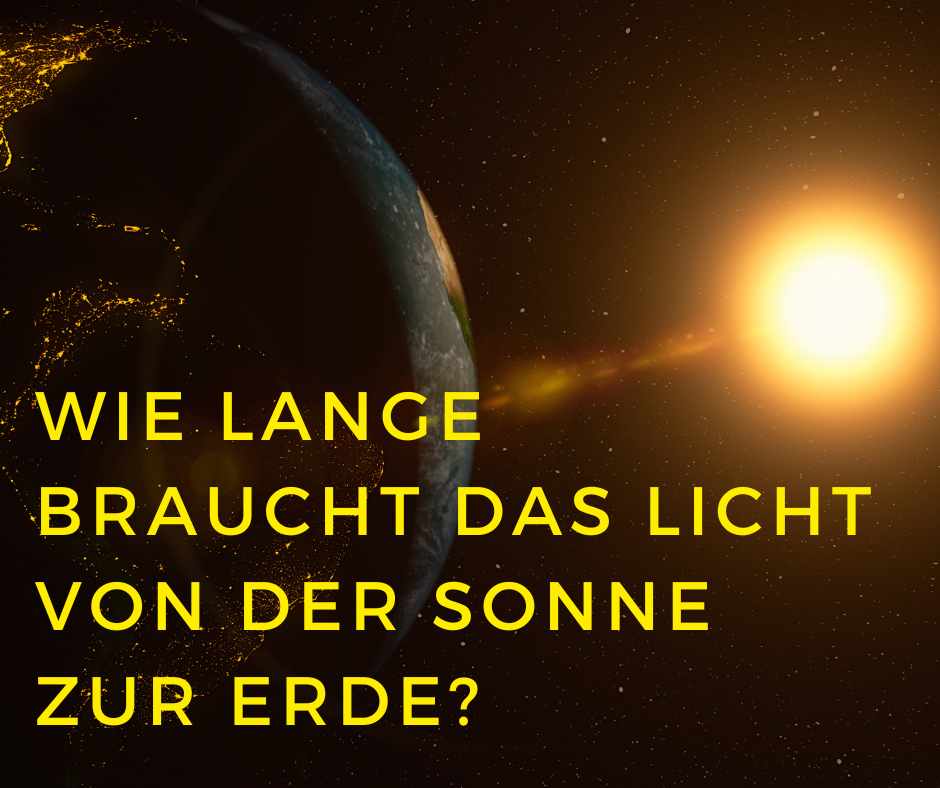
When you squint into the Sun in the morning, you are not seeing the present. The light now reaching your skin left the Sun’s surface while you were still having your coffee. It has been travelling for a little over eight minutes – at 300,000 kilometres per second.
Those eight minutes, however, are only the last, unspectacular part of a much longer story. Before the light could even set off, the energy behind it fought its way through the interior of the Sun for around 170,000 years. This article gives the exact figure, the full calculation, the range of variation over the year – and the table for all the other celestial bodies.
⚡ The answer in numbers
- On average, light takes 8 minutes 19 seconds (499 seconds) to travel from the Sun to the Earth.
- Because Earth’s orbit is an ellipse, the value varies between 8:11 minutes (early January) and 8:27 minutes (early July).
- The basis is 149.6 million kilometres and a speed of light of exactly 299,792.458 km/s.
- The energy in this light had previously been travelling for around 170,000 years inside the Sun.
In short: if the Sun went out right now, we would only notice 8 minutes and 19 seconds later.
Light travel time Sun–Earth: 8 minutes and 19 seconds
The mean distance between the Sun and the Earth is 149,597,870.7 kilometres. This value is so fundamental that astronomers have defined it as a unit of its own: the astronomical unit (AU). In a vacuum, light covers 299,792.458 kilometres every second – a value fixed by definition, because since 1983 the metre has been defined via the speed of light, and not the other way round.
Dividing one by the other leaves 499.0 seconds. That is 8 minutes and 19 seconds. If you want to keep the rounded figure in your head, take “a good eight minutes” – if you need it precise, take 8:19 or 499 seconds.
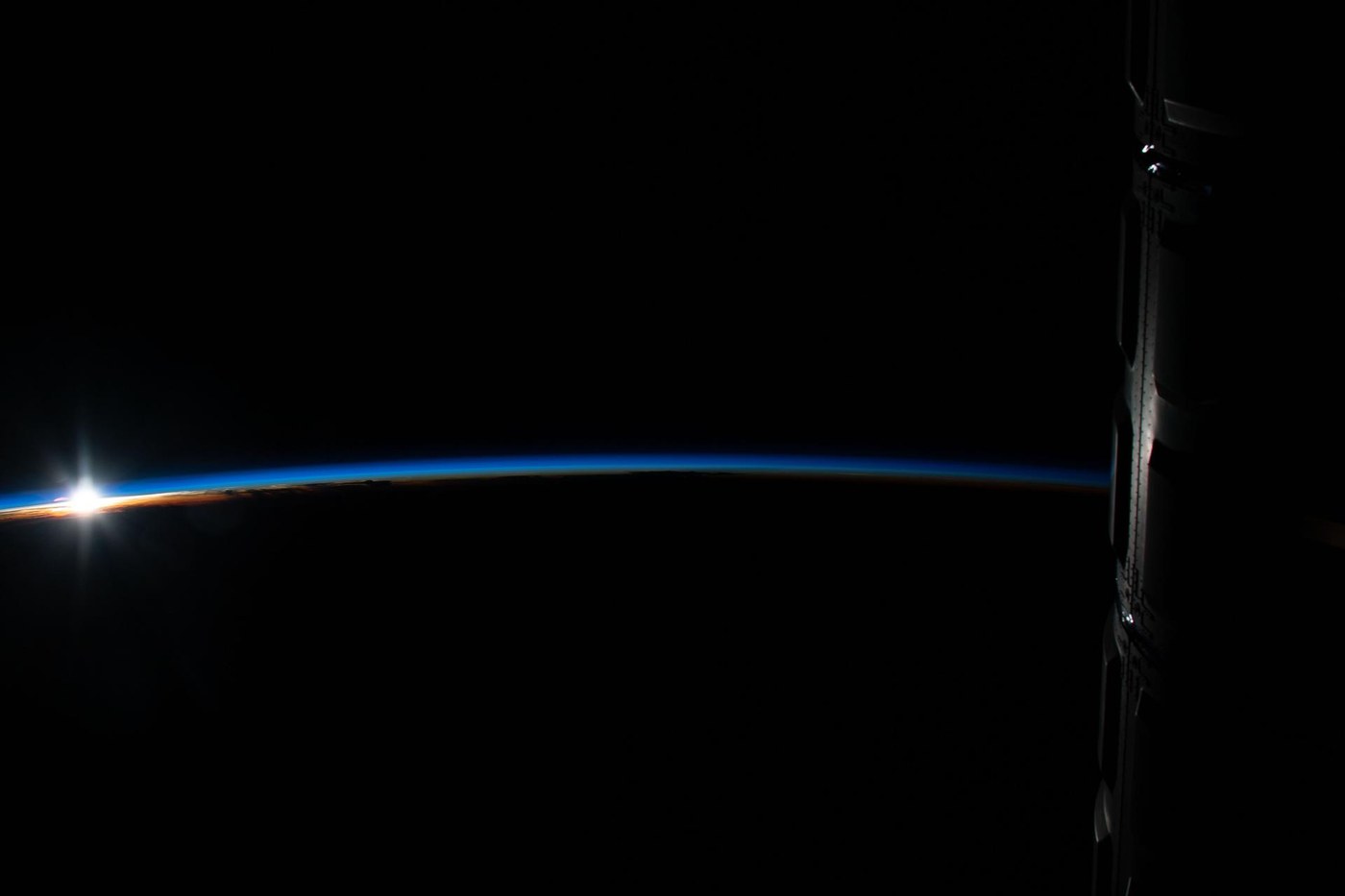
This time applies to the path through the vacuum of interplanetary space. The final roughly 100 kilometres through Earth’s atmosphere cost only about a ten-thousandth of a second extra, because light is marginally slower in air than in a vacuum. For the answer, that plays no role.
The calculation step by step: how you arrive at 499 seconds
The formula behind it is the simplest in physics: time = distance ÷ speed. To follow the calculation yourself, you only need two numbers and a calculator.
The calculation in detail
Distance s = 149,597,870.7 km
Speed of light c = 299,792.458 km/s
t = s ÷ c = 149,597,870.7 ÷ 299,792.458 = 499.005 s
499.005 s ÷ 60 = 8.3167 minutes → 8 minutes and 0.3167 × 60 = 19.0 seconds.
The units check is essential: kilometres divided by kilometres-per-second yields seconds. Anyone who instead calculates with 300,000 km/s – the usual school approximation – ends up at 498.7 seconds and thus likewise at 8 minutes 19 seconds. The rounding is therefore entirely uncritical for this question.
Conversely, the distance can be confirmed from this: 499 seconds × 299,792.458 km/s = 149.6 million kilometres. This is exactly how spaceflight measures distances in the Solar System today – via the travel times of radio signals, which also propagate at the speed of light.
Why the light time varies: between 8 min 11 s and 8 min 27 s
The Earth does not travel on a circle around the Sun, but on a slightly squashed ellipse. The point closest to the Sun is called perihelion and is passed in early January, the point farthest away aphelion in early July. Between the two lie five million kilometres of difference – and therefore also a noticeable difference in the light travel time.
| Point in time | Distance Sun–Earth | Light travel time |
|---|---|---|
| Perihelion (approx. 3 January) | 147.10 million km | 8 min 10.7 s |
| Mean distance (1 AU) | 149.60 million km | 8 min 19.0 s |
| Aphelion (approx. 5 July) | 152.10 million km | 8 min 27.3 s |
The difference is therefore 16.7 seconds between January and July. That sounds like little, but in measurement terms it is huge: anyone wanting to determine a planet’s position to within a few kilometres has to factor out the light travel time exactly. It was precisely this effect that in 1676 led the Danish astronomer Ole Rømer to realise that light has a finite speed at all – he had noticed that the eclipses of Jupiter’s moons occurred too early or too late depending on Earth’s position.
A common misconception here: the fact that the Earth is closer to the Sun in January has nothing to do with the seasons. Those arise from the tilt of the Earth’s axis, not from the distance.
Before the eight minutes: 170,000 years inside the Sun
The really astonishing figure appears in no school textbook. Because the journey of sunlight does not begin at the surface, but 700,000 kilometres deeper, in the Sun’s core. There, at 15 million degrees, hydrogen nuclei fuse into helium and in doing so release energy in the form of gamma radiation.
This radiation, however, does not get far. The plasma inside the Sun is so dense that a photon travels on average only 0.92 millimetres before being absorbed by a particle and re-emitted in a random direction. The result is a meandering path of an estimated 1025 individual steps – a so-called random walk, in which the energy advances outwards by less than a centimetre per second on average.
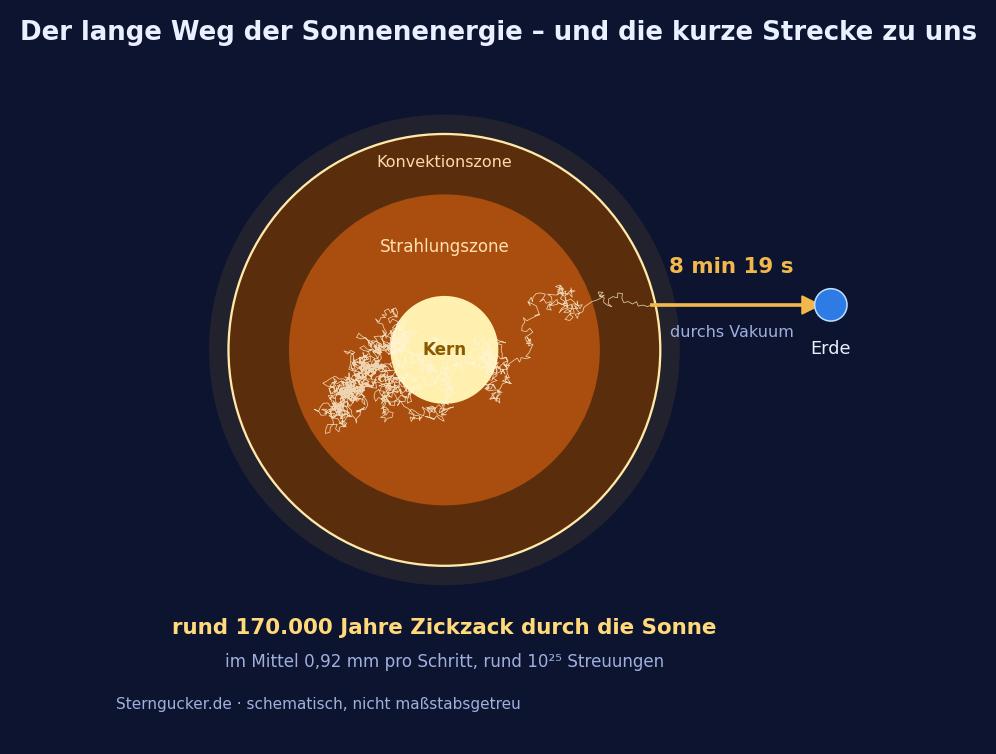
The most careful calculation of this travel time comes from the astrophysicists Romas Mitalas and Kenneth Sills, who in 1992 arrived at around 170,000 years in the Astrophysical Journal. Older estimates range from 10,000 to several million years, depending on the model assumptions – the order of magnitude “a few hundred thousand years” is regarded as settled today.
Why the light itself is nonetheless not 170,000 years old
Precision pays off here, because a shortened claim circulates online that the sunlight on our skin is “170,000 years old”. That is not quite right. At every absorption the original photon is destroyed and a new one emitted – usually with less energy. A single gamma quantum in the core becomes, on its way outwards, millions of visible light particles.
The specific photon that hits your eye is therefore only a few minutes old and was produced in the photosphere. What is ancient is the energy it carries. This is not a hair-splitting distinction, but the heart of the process: the Sun stores energy for hundreds of thousands of years before releasing it.
The cross-check: neutrinos
Besides radiation, nuclear fusion also produces neutrinos. These barely react with matter at all and therefore leave the Sun practically unhindered – from the core to the Earth they need only the famous 8 minutes 19 seconds. Neutrino detectors such as Super-Kamiokande in Japan thus see the Sun’s core in real time, while the visible light carries in energy from the Sun’s Stone Age.
Light travel time to the Moon and planets: the complete table
The Sun is only one value in a series. Because the distances between the planets change constantly, two columns are given here: the travel time from the Sun to the respective planet, and the travel time from there to the Earth when the planet is closest to us.
| Celestial body | Light from the Sun | Light to the Earth (closest approach) |
|---|---|---|
| Moon | – | 1.3 seconds |
| Mercury | 3 min 13 s | 4 min 18 s |
| Venus | 6 min 1 s | 2 min 18 s |
| Earth | 8 min 19 s | – |
| Mars | 12 min 41 s | 3 min 2 s |
| Jupiter | 43 min 17 s | 34 min 57 s |
| Saturn | 1 h 19 min | 1 h 11 min |
| Uranus | 2 h 39 min | 2 h 31 min |
| Neptune | 4 h 11 min | 4 h 1 min |
| Pluto | 5 h 28 min | 3 h 58 min |
| Proxima Centauri | – | 4.25 years |
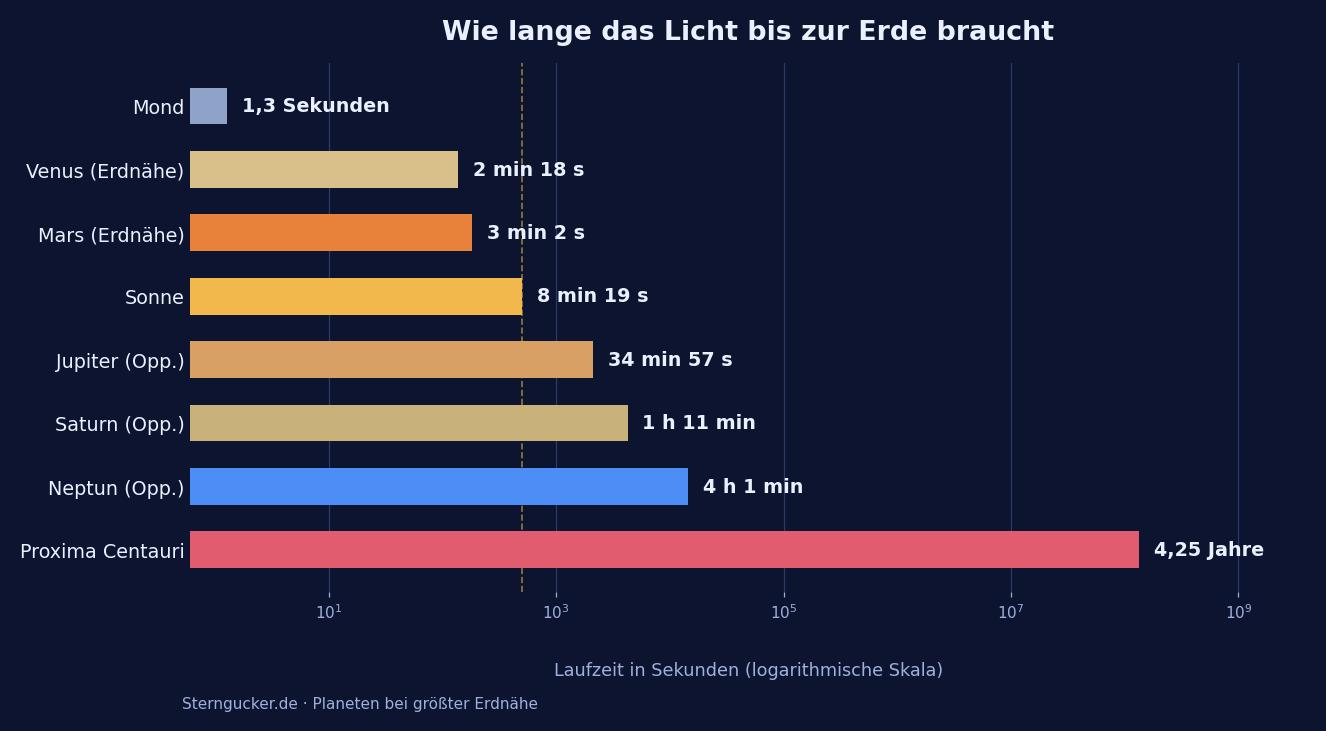
Two values are worth a second look. The Moon is so close, at 1.3 seconds, that radio conversations with the Apollo astronauts had only a noticeable but bearable delay. For Mars, on the other hand, a radio command takes between 3 and 22 minutes depending on the configuration – which is why rovers there cannot be driven like remote-controlled cars, but must largely decide for themselves.
And the last entry puts everything into perspective: even to the nearest star after the Sun, light takes 4.25 years. Right across our Milky Way it would be around 100,000 years.
Once around the Earth: 7.5 laps in one second
To get a feel for 299,792 km/s, it helps to look down rather than up. The Earth’s circumference at the equator is 40,075 kilometres. Light covers this distance in 0.134 seconds – so 7.5 trips around the Earth in a single second.
| What | Distance per second | Time for Sun–Earth |
|---|---|---|
| Sprinter (world record) | 10 m | around 474 years |
| Formula 1 car | 100 m | around 47 years |
| Rifle bullet | 1,000 m | around 4.7 years |
| ISS in orbit | 7,660 m | around 226 days |
| Parker Solar Probe (fastest probe) | 191,000 m | around 9 days |
| Light | 299,792,458 m | 8 min 19 s |
Even the Parker Solar Probe, the fastest object ever built, reaches only around 191 kilometres per second. It would need a good nine days for the journey from the Sun to the Earth – over 1,500 times as long as light.
Light-second, light-minute, light-year: the units behind it
Because the light travel time is such a vivid quantity, astronomy uses it directly as a measure of distance. A light-second is the distance light covers in one second: 299,792.458 kilometres. Everything else follows from it.
| Unit | Equals | Example |
|---|---|---|
| 1 light-second | 299,792 km | Moon: 1.28 light-seconds away |
| 1 light-minute | 17.99 million km | Sun: 8.32 light-minutes away |
| 1 light-hour | 1.079 billion km | Saturn: around 1.3 light-hours |
| 1 light-year | 9.461 trillion km | Proxima Centauri: 4.25 light-years |
The Sun is therefore exactly 8.32 light-minutes, or 499 light-seconds, away. Expressed in light-years, that would be 0.0000158 – a number that shows why the light-year is the wrong unit for distances within the Solar System. There, you count in astronomical units, and 1 AU is by definition the mean Sun–Earth distance.
How long a human would take: 19 years on a scheduled flight
One of the most common follow-up questions is how long you yourself would be travelling to the Sun. The answer is sobering – and makes it instantly clear just how fast light really is.
- On foot (5 km/h): around 3,400 years
- By car on the motorway (130 km/h): around 131 years
- On a passenger aircraft (900 km/h): around 19 years
- With a Saturn V rocket (39,000 km/h): around 5.3 months
- With the Parker Solar Probe (690,000 km/h): around 9 days
- At the speed of light: 8 minutes 19 seconds
In practice the question is academic anyway: at just a few million kilometres’ distance the radiation becomes so intense that no crewed vehicle could survive. The Parker Solar Probe came within 6.1 million kilometres of the Sun in 2024 – protected by a heat shield that withstands 1,400 °C. How long humans take to the nearest destination is covered in the article How long does it take to travel to the Moon?
What the eight minutes mean in practice: three consequences
The light travel time is not a curiosity, but has tangible consequences – including for everyone who observes or photographs the Sun.
We always see the Sun in the past
Every observation of the Sun is a look 8 minutes and 19 seconds into the past. A sunspot that becomes visible in the telescope now was already eight minutes old at that moment. The same applies to a solar eclipse: the beginning you see is already history – this is factored into the prediction.
Solar storms are slower than light
A flare shows up in light and X-rays after 8:19 minutes. The particle cloud thrown out in the process (a coronal mass ejection) is, by contrast, considerably slower and takes one to three days to reach the Earth. It is precisely this time window that space weather forecasting exploits: the flash of light is the warning, the particles are the actual event – and the reason for auroras. More on this on our page about solar activity and the solar wind.
GPS only works with travel-time calculation
Satellite navigation measures nothing other than the travel times of radio signals, which propagate at the speed of light. An error of one millionth of a second means a 300-metre position error. Without exact knowledge of the speed of light there would be no navigation in the car.
Observing the Sun without risk: the filter is mandatory
Anyone who, after this article, feels like looking at the source of the light themselves must know one rule – and it applies without exception: never look at the Sun unfiltered, and certainly not through binoculars or a telescope. One glance through an unprotected telescope is enough for permanent retinal damage, and it is painless, because the retina has no pain receptors.
What is safe – and what is not
Safe: certified eclipse glasses to EN ISO 12312-2 for the naked eye; objective filters made of solar film that sit in front of the optics and are firmly screwed on.
Not safe: sunglasses, sooted glass, CDs, emergency blankets, exposed film – and above all the small eyepiece solar filters that come with some cheap telescopes. They sit behind the concentrated heat and can crack.
An objective filter made of AstroSolar film is the cheapest safe solution and fits practically any device – you build yourself a mount to the diameter of the telescope or binoculars. It makes sunspots and granulation visible, that is, precisely the structures on which you can follow solar activity yourself.
Solar film for telescope and binoculars: Baader AstroSolar Safety Film OD 5.0
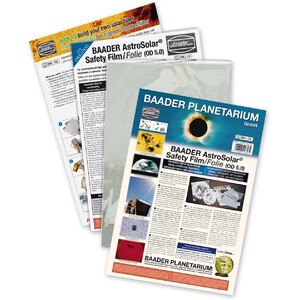
The standard film for safe solar observing: OD 5.0 passes just 1/100,000 of the light. Cut it, mount it – and sunspots snap into razor-sharp view.
Price: € 40
If you don’t yet have any instrument at all: for the Sun a small aperture is enough, large telescopes bring no advantage here – the daytime air turbulence limits the image anyway. A solid beginner’s instrument covers the Sun, Moon and planets equally.
Beginner telescope for the Sun, Moon and planets: Skywatcher Dobson Telescope N 130/650 Heritage FlexTube
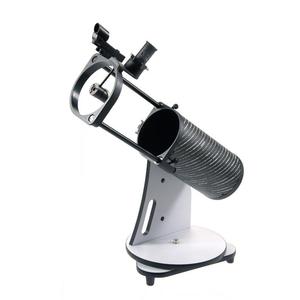
A compact tabletop Dobson with a true parabolic mirror. Folds down, fits in a bag: the Moon, planets and the bright deep-sky classics.
Price: € 265
For context, because the question comes up regularly: binoculars are the better choice for comets, large star clusters and the Milky Way. For sunspots, lunar craters, Saturn’s rings and Jupiter’s moons, they are clearly inferior to the telescope. Anyone who can buy only one instrument and really wants to explore the sky should go for the telescope; the binoculars are the supplement, not the replacement. An overview of suitable filters can be found in the filter guide, and tested instruments under Telescope under 300 euros.
* Affiliate link: if you buy through this link we may earn a small commission from Astroshop or High Point Scientific, at no extra cost to you.
Questions about light travel time: answered briefly and exactly
How long does light take from the Sun to the Earth?
On average 8 minutes and 19 seconds, that is 499 seconds. Depending on the Earth’s position in its orbit, the value varies between 8:11 minutes in early January and 8:27 minutes in early July.
How long do the Sun’s rays take to reach the Earth?
Exactly the same time – “the Sun’s rays” is just another word for the Sun’s light. All parts of the spectrum, from UV through visible light to infrared, travel at the same speed and arrive after 8 minutes 19 seconds. The particles of the solar wind, by contrast, are travelling for one to three days.
How long does light take from the Moon to the Earth?
Around 1.3 seconds at a mean distance of 384,400 kilometres. Because the Moon has no light of its own, this is reflected sunlight: in total it had then been travelling for about 8 minutes 20 seconds.
How long does light take from Mars to the Earth?
Between 3 minutes near opposition and 22 minutes when Mars is on the other side of the Sun. This range is the reason why Mars rovers have to work autonomously.
How long does light take to travel around the Earth?
0.134 seconds for the 40,075 kilometres of equatorial circumference. In one second light thus manages 7.5 trips around the Earth.
How far is the Earth from the Sun?
On average 149.6 million kilometres – exactly 149,597,870.7 km, defined as one astronomical unit. The distance varies between 147.1 million km in January and 152.1 million km in July.
How many light-minutes is the Sun from the Earth?
8.32 light-minutes, or 499 light-seconds. In light-years it would be 0.0000158 – which is why the light-year is not a sensible unit for distances in the Solar System.
How long does it take to reach the Sun by rocket?
At Saturn V speed around 5.3 months, with the Parker Solar Probe about 9 days. A passenger aircraft would be travelling for 19 years, a car at 130 km/h around 131 years.
How long does light take from a star to the Earth?
That depends on the star. From the nearest, Proxima Centauri, it is 4.25 years, from Sirius 8.6 years, from Betelgeuse around 550 years. When you look at the sky, you see every star as it was at the moment it emitted its light.