By Alexander Merz · Updated on · Details checked on 14 September 2026
How many times does the Earth fit into the Sun? A question many people ask themselves. Here are a few vivid examples…
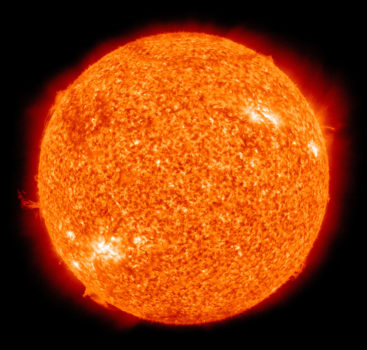
The Sun is about 109 times larger than the Earth and has a diameter of roughly 1.4 million kilometres. Accordingly, the Earth fits into the Sun about 109 times.
The Earth, on the other hand, has a diameter of “only” about 12,742 kilometres. To “fit” into the Sun, it would therefore have to be about 87 times smaller.
Vivid comparisons: Sun – Earth
- Diameter: the Sun’s diameter is about 109 times larger than that of the Earth. To illustrate: imagine the Earth were the size of a basketball. In this comparison, the Sun would be as big as a football field!
- Volume: the Sun’s volume is so large that you could fit about 1.3 million Earths inside it. Think of a small marble (the Earth) compared to a large cube containing 1.3 million marbles!
- Mass: the Sun accounts for about 99.86% of the total mass of our solar system, which means it is over 330,000 times as massive as the Earth. It is like comparing the weight of 330,000 cars (average weight of a car about 1.5 tonnes) with the weight of just one car.
- Surface temperature: the Sun’s surface temperature is about 5,500 degrees Celsius; by comparison, the Earth’s average surface temperature is about 15 degrees Celsius. That is roughly like comparing the temperature of an oven (the Sun) with that of a normally warm cup of coffee (the Earth).
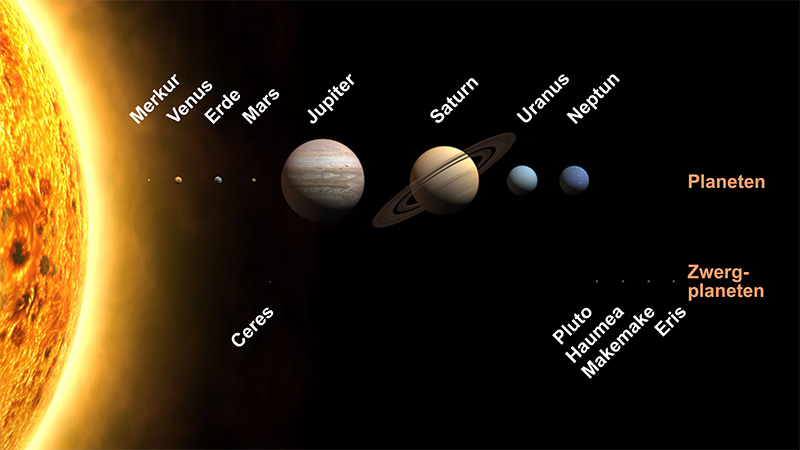
Compared to the Sun, the Earth is a relatively small planet. The Earth has a diameter of about 12,742 kilometres (7,917 miles). It is therefore about 109 times smaller than the Sun. The Sun has a diameter of roughly 1.4 million kilometres (870,000 miles (approx. 1,400,129 km)).
The planet Earth is also 330,000 times lighter than the Sun. The Sun has a mass of almost 1.989 x 10^30 kilograms.
☀️ Observing the Sun yourself – but safely
The Sun is the one object that can take your eyesight in seconds, painlessly and permanently. Neither sunglasses nor a smoked glass nor a camera filter are enough. Two things make it safe:
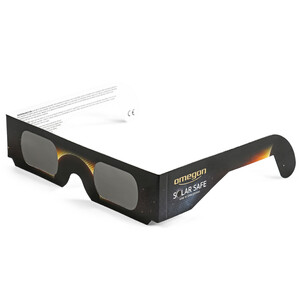 Certified eclipse glasses – for looking at the Sun with the naked eye: sunspot groups, a partial eclipse, a transit. High Point sells the Celestron EclipSmart Solar Eclipse Glasses* for $1.95 (checked 31 Aug 2026).In Europe we use the Omegon Solar Eclipse Glasses Solar Safe at € 5.
Check availability* →Check availability* →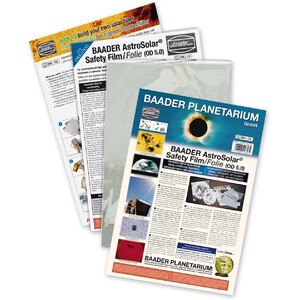 A proper solar filter for the front of the telescope – never on the eyepiece, where the concentrated heat can crack the filter while you are looking through it. The Baader AstroSolar Visual Film OD 5.0 (Sheet)Baader AstroSolar Safety Film OD 5.0 ($36.00€ 40) is the reference: one sheet is enough for several filters, and it is the same film professionals use.
Check availability* →
The full guide, including what H-alpha adds and how the projection method works without any filter: Observing the Sun safely. Links marked * are affiliate links – buying through them earns us a small commission at no extra cost to you.
How many times does the Earth fit into the Sun? A visual thought experiment
To better understand the size relationship between the Earth and the Sun, you can imagine that the Earth is about the size of a marble, while the Sun is about the size of a basketball.
Or you can imagine that you could place the Earth on the tip of a needle, while you could place the Sun in a swimming pool. So the Earth really is very small compared to the Sun.
Want to buy your first telescope? Here’s a quick check.
Even more comparisons between Earth and Sun
The Earth is a planet of the solar system, and the Sun is the star that orbits our planet. The Sun is much larger than the Earth. It is almost a thousand times as large and has almost a thousand times as much mass. The Sun is also much hotter than the Earth. It has an average temperature of about 5,500 degrees Celsius (9,932 degrees Fahrenheit).
Atmosphere
The Earth also has an atmosphere, whereas the Sun does not. The Earth’s atmosphere consists mainly of nitrogen, oxygen and carbon dioxide, keeps us warm and protects us from the harmful radiation of space. The Sun, however, has a very hot, plasma-like atmosphere called the corona, which extends beyond the star’s surface.
Role in the solar system
One of the most important differences between the Earth and the Sun is their role in the solar system. The Sun is the star that forms the centre of the solar system and gravitationally attracts all the planets and other celestial bodies around it.
The Earth is one of these planets and is attracted by the Sun, which keeps it in its orbit. You can easily remember the order of the planets at any time with the planet mnemonic.
The Sun is also the main source of energy for life on Earth, as it emits light and heat that are absorbed by the Earth.
 Our partner shop: a trusted US astronomy retailer – telescopes, binoculars & accessories.Visit High Point Scientific* →
Overall, there are many differences between the Earth and the Sun, but they are also connected in many ways and depend on each other. Without the Sun, the Earth would not be able to support the life we know today, and without the Earth and the other planets of the solar system, the Sun would be just one star among many in the universe.