By Alexander Merz · Updated on · Details checked on 14 September 2026
On 12 August 2026, Europe hosted its biggest celestial event in decades: a total solar eclipse that swept across Greenland, western Iceland and northern Spain. From the UK and Ireland the Sun was not fully covered, but the 2026 solar eclipse was still a dramatic partial eclipse — with up to around 90 % of the Sun hidden in the far west, low over the evening horizon. Here is the recap: where and when it was visible, and how to get ready for the next one on 2 August 2027.
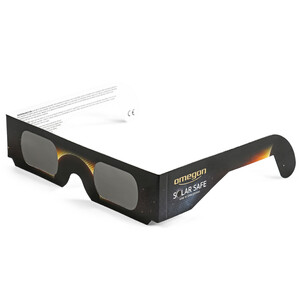
⚡ The quick answer: The eclipse is over. On 12 August 2026 the UK and Ireland saw a deep partial solar eclipse in the evening (from roughly 19:00 BST). The next one is the deep partial eclipse of 2 August 2027; before that, the next event in the sky is Saturn at opposition on 4 October 2026. The Moon covers around 80–90 % of the Sun, with the highest figures in the west and north-west — western Ireland and the Scottish coast come off best. The Sun sits low over the west–north-west horizon, so you need a clear, unobstructed view and, without exception, certified ISO 12312-2 eclipse glasses. Never look at the Sun with the naked eye.
When and where: the partial eclipse over the UK and Ireland
Across Britain and Ireland the eclipse begins around 19:00 BST and reaches its maximum near 20:00 BST, with the Sun already sinking towards the horizon. Because the Moon’s shadow passes to the west, coverage grows the further north-west you are: London sees roughly 85 %, Edinburgh around 88 %, and the west coast of Ireland — from Galway to Donegal — climbs towards 90 %. In parts of Scotland and the Hebrides the partially eclipsed Sun actually sets before the eclipse ends, making a low, clear horizon essential.
The decisive tip: find a spot with a completely open view to the west–north-west — a hill, a coastal path, a viewpoint or an open field. The Sun stays low throughout, so buildings or trees on the horizon will hide the whole show. That thin crescent Sun resting just above the sea is also a striking photo subject.


Where it turns total: Iceland and Spain
The Moon’s umbra crosses Greenland, western Iceland and the northern half of Spain. On Iceland’s Westfjords peninsula totality lasts up to two minutes; for Spain it is the first total solar eclipse since 1905, and accommodation along the path of totality — from Galicia through Zaragoza to Valencia — is filling fast. For anyone in Britain or Ireland wanting to witness the black Sun and its corona, Iceland or northern Spain is the closest opportunity of the decade. Book early and keep an eye on the forecast.
What you’ll see, region by region
The figures below are approximate (local times in BST) and can shift by a few minutes depending on your exact location.
| Location | Max. coverage | Maximum (approx., BST) |
|---|---|---|
| London | ~85 % | 20:00 |
| Cardiff | ~87 % | 19:58 |
| Manchester | ~87 % | 20:02 |
| Edinburgh | ~88 % | 20:05 |
| Dublin | ~89 % | 19:56 |
| Galway (W. Ireland) | ~90 % | 19:54 |
Even at 90 % coverage, daylight does not vanish the way it does during totality: the sky takes on a steely, silvery cast, the temperature dips and shadows sharpen strangely. It’s a memorable experience in its own right — but remember that only a total eclipse plunges the landscape into an eerie twilight.
Protecting your eyes: how to watch safely
A Sun that is 90 % covered is still dangerously bright: an unprotected glance can permanently burn the retina — painlessly and without you noticing. The rules are therefore absolute:
- Use only certified eclipse glasses (ISO 12312-2 standard). Ordinary sunglasses, smoked glass, CDs or emergency blankets offer no protection whatsoever.
- Never use binoculars or a telescope without a full-aperture solar filter — and never with eclipse glasses held behind the eyepiece! The filter must go in front of the aperture (for example Baader AstroSolar film).
- Supervise children and check every pair of glasses for scratches or holes before use.
A completely safe alternative is pinhole projection: punch a small hole in a piece of card and let the Sun project its crescent onto a light surface. It’s perfect for children and groups, with no one ever looking at the Sun directly.
Photographing the eclipse — and keeping the sky habit
For a smartphone, simply hold a pair of eclipse glasses over the lens: the low crescent Sun above the landscape comes out surprisingly well. Cameras and telescopes, however, need a proper full-aperture solar filter made from certified film, fitted in front of the optics — otherwise the concentrated heat will destroy the sensor and, far worse, your eyes. You’ll find the essentials in our astrophotography guide.
Once the eclipse is over, keep that curiosity going: the same night the Perseid meteor shower peaks under a New Moon — ideal, dark-sky conditions. An affordable first instrument lets you carry the evening on to the Moon and planets, and if you also want to view the Sun, simply add a suitable front-mounted solar filter.
Best for beginners: Omegon Telescope AC 70/700 AZ-2
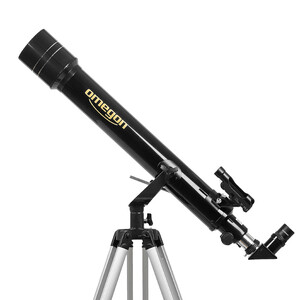
The no-pitfall starter refractor: Moon, Saturn's rings and Jupiter's moons from the very first night. No collimation.
Price: € 119
Best for advanced observers: Skywatcher Dobson Telescope N 200/1200 Skyliner Classic
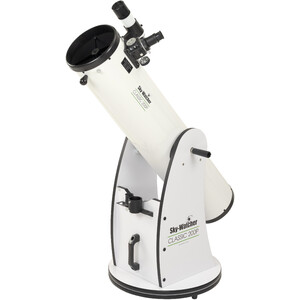
200 mm of aperture — the most sky for your money. Set it on the ground, point by hand: nebulae, clusters and galaxies for years to come.
Price: € 479
* Affiliate link: if you buy through this link we may earn a small commission from Astroshop or High Point Scientific, at no extra cost to you.
Your kit won’t have to sit in a drawer until 2027 either: with eclipse glasses, solar film or a telescope filter you can follow sunspots all year round. How to do it safely — and which filter fits which device — is covered in our guide How to Observe the Sun Safely.
And if you never got hold of eclipse glasses: the next sky show doesn’t need any. On 4 October 2026 Saturn stands at opposition and is visible all night – how and with what to observe it is in the Saturn guide. The lunar eclipse of 28 August 2026 can be read up on in recap. And so dates like these never catch you out again:
The best observing dates, explained in plain language, plus honest buying advice without the marketing noise. Free, unsubscribe any time.
You will get a confirmation email in a moment. Your address stays with us – no sharing, no third-party ads.
Did the eclipse leave you wanting more? Then the important question first.
Six short questions, an honest answer by e-mail – with no pressure to buy.
Frequently asked questions
Do I really need special eclipse glasses?
Yes, without exception. Even at 90 % coverage the remaining sliver of Sun is bright enough to damage your retina. Certified ISO 12312-2 glasses cost only a few pounds — there is no reason to improvise.
Is the 12 August 2026 solar eclipse total in the UK?
No. Across the UK and Ireland it is a deep partial eclipse (up to about 90 % in the west). Totality is limited to Greenland, western Iceland and northern Spain. To see the black Sun you’d need to travel into the Spanish path of totality.
What if it’s cloudy?
Flexibility is the only real answer: check the forecast a day or two ahead and, if you can, travel towards clearer skies. Even under cloud, the drop in light and temperature around maximum is still noticeable — an experience in itself.
When is the next solar eclipse visible from the UK?
Another deep partial eclipse follows on 2 August 2027 (total over southern Spain and North Africa). A total solar eclipse won’t be visible from the British mainland again for many decades, so a trip to Iceland or Spain in 2026 is by far the nearer chance.
Sources: NASA eclipse catalogues, timeanddate.com. Times in BST; local values may vary by a few minutes.