By Alexander Merz · Published on · Details checked on 10 October 2026
In April 2027, Mars and Jupiter stand high in the south in the early evening – higher than they will be again this year. On 15 April the Moon slips exactly between the two, just under 4° from each.
The spring sky is also the galaxy sky: Leo, Ursa Major and Canes Venatici are well placed. The Lyrids, on the other hand, are out of luck with the Moon in 2027.
Which telescope is up to the job for galaxies is explained in our buying guide to telescopes for galaxies.
More in our overview: Astronomical Events.
The highlights at a glance
- 15 April, 22:00: Moon between Mars and Jupiter – just under 4° from each, 54° high in the south. The sight of the month
- Jupiter and Mars in the evening: both more than 50° high from the end of twilight, Jupiter at −2.2 mag in Cancer, Mars in Leo
- 7 April: new moon – the first half of April belongs to the galaxies
- 21 April, 00:27: full moon, the “Pink Moon”
- 22/23 April: Lyrids – up to 18 meteors per hour, of which the almost full Moon leaves only a few
- 24 April, at night: The Moon passes just under 1° from Antares, low in the south
- Looking ahead: In the night sky in May 2027 Mercury appears in the evening sky
Sky events in April 2027: the calendar
All times in CEST, calculated for central Germany. Further west, rise and set times shift up to 20 minutes later, further east they come earlier.
| Date | Event | What you get out of it |
|---|---|---|
| 2 April | Mars resumes direct motion | After its loop around opposition it moves eastwards through Leo again – towards Regulus |
| 7 April, 01:51 | New moon | Dark nights until about 11 April – time for galaxies |
| 7 April | Saturn behind the Sun | Conjunction with the Sun, Saturn stays invisible until the end of May |
| 13 April | Jupiter resumes direct motion | It slowly makes its way back from Cancer into Leo |
| 14 April, 00:56 | First quarter | Half moon in the evening |
| 14 April, 22:00 | Moon at the Beehive Cluster | The Moon stands 1.8° from the star cluster Praesepe |
| 15 April, 22:00 | Moon between Mars and Jupiter | Mars 3.9° and Jupiter 3.8° from the Moon, all three a good 50° high in the south |
| 16 April, 22:00 | Moon at Regulus | Around 5° from the brightest star in Leo |
| 21 April, 00:27 | Full moon, “Pink Moon” | Visible all night |
| Night of 22/23 April | Lyrid maximum | Up to 18 meteors per hour – with a 95% Moon, realistically more like four |
| 24 April, 0:00–4:00 | Moon at Antares | Just under 1° apart, but only 2 to 12° high in the south-east to south |
| 28 April, 22:17 | Last quarter | From now on moon-free evenings again |
When does it get properly dark in April?
In April the night begins a good two minutes later every evening, and almost three minutes later by the end of the month. On 1 April astronomical twilight ends at 21:48, in mid-April at 22:21, and at the end of the month not until around 23:00.
The fully dark night therefore shrinks from a good seven hours to four and a half. For the planets that makes no difference – they are already high enough during twilight. For galaxies you need the hours after 22:00 and an evening without the Moon.
The Moon between Mars and Jupiter on 15 April
On the evening of 15 April the Moon, 71 per cent lit, stands almost exactly halfway between Mars and Jupiter. Both planets are just under 4° from the edge of the Moon, and around 22:00 all three stand a good 50° high in the south.
To the naked eye they form a striking triangle of white Jupiter, orange Mars and the Moon. In binoculars you will also see Jupiter’s four large moons as points of light in a row.
The evening before, the Moon is still west of Jupiter next to Praesepe; the evening after, it is east of Mars near Regulus. So three evenings in a row are worth a look – and you can see how far the Moon travels in a single day.
The Lyrids on 22/23 April: unlucky with the Moon in 2027
The Lyrids are the first meteor shower worth mentioning after three quiet months. The maximum falls on 23 April at around 03:41; under ideal conditions up to 18 meteors per hour would be possible.
In 2027, two days after full moon, the Moon is 95 per cent lit and rises at around 23:00. Realistically, about four meteors per hour remain under a dark rural sky. The best window is late evening, before the Moon rises.
More about the shower: the Lyrids in April. The next, better chance comes with the Eta Aquariids in May at new moon; all the dates are in the meteor shower calendar.
The phases of the Moon in April 2027
| Phase | Date and time | In the sky |
|---|---|---|
| New moon | 7 April, 01:51 | Invisible – dark evenings until about 11 April |
| First quarter | 14 April, 00:56 | Half moon in the evening in the south-west |
| Full moon | 21 April, 00:27 | Visible all night, “Pink Moon” |
| Last quarter | 28 April, 22:17 | Half moon in the second half of the night |
The April full moon owes the name “Pink Moon” to the pink-flowering wild phlox in North America – it has nothing to do with the colour of the Moon. All the dates are in the full moon calendar for April.
The planets in April 2027
| Planet | Visibility | Brightness | Where |
|---|---|---|---|
| Jupiter | Evenings until after midnight, more than 50° high | −2.3 to −2.1 mag | Cancer |
| Mars | Evenings until after midnight, more than 50° high | −0.3 to +0.3 mag | Leo |
| Uranus | Only in early April, low in the west | +5.8 mag | Taurus |
| Saturn | Not visible, conjunction on 7 April | – | Pisces |
| Venus | Not visible | – | – |
| Mercury | Not visible | – | – |
In April, Mars and Jupiter reach their greatest altitude in the early evening. Both are already more than 50° high at the end of twilight – above the turbulent air near the horizon. That makes up for the fact that both Mars’s little disc and Jupiter are slowly getting smaller.
The constellations in April: Leo rules
Around 22:00, Leo stands high in the south, with the long, stretched-out Hydra below it. The Big Dipper is almost straight overhead.
In the east Boötes rises with orange Arcturus, while in the west Orion and Taurus take their leave in the twilight. You can find Leo via the Big Dipper: extend the line from Megrez to Phecda in the bowl of the Dipper downwards and you reach Regulus.
Deep sky in April: galaxies in Leo and Canes Venatici
April is the best month for galaxies. Our view then points away from the plane of our Milky Way, so no dust blocks the view of distant star systems.
In Leo lies the Leo Triplet with M 65, M 66 and NGC 3628, around 35 million light years away. A 130 mm telescope shows the three as oval smudges of light in one field, while a 200 mm instrument hints at the shape and dust lane of NGC 3628.
High overhead are M 81 and M 82 in Ursa Major, and in Canes Venatici the Whirlpool Galaxy M 51. Its spiral arms need a dark sky and at least 200 mm of aperture – with less, you are left with two round cores. The darkest evenings fall between 2 and 11 April.
The worthwhile dates are often weeks apart – and easily forgotten. So that you don’t miss any of them:
One short email, in good time – with the times and an honest take on whether it is worth getting up for.
You will get a confirmation email in a moment. Your address stays with us – no sharing, no third-party ads.
Equipment for the April sky
For Mars, Jupiter and the bright galaxies, a 130 mm reflector is enough. It shows Jupiter’s belts and moons, the Leo Triplet and M 81/82. On a Dobsonian mount (a simple, stable rocker box) it is set up in two minutes.
The starter scope for the spring sky: Skywatcher Dobson Telescope N 130/650 Heritage FlexTube
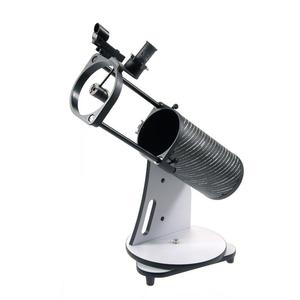
A compact tabletop Dobson with a true parabolic mirror. Folds down, fits in a bag: the Moon, planets and the bright deep-sky classics.
Price: € 265
If you want more: With 200 mm of aperture, the Dobsonian gathers more than twice as much light. With galaxies, that is exactly what decides whether you see a smudge or structure. The extra cost is worth it for anyone who wants to use the spring for galaxies.
For advanced observers: Skywatcher Dobson Telescope N 200/1200 Skyliner Classic
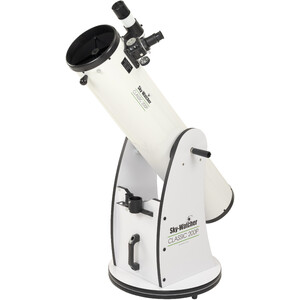
200 mm of aperture — the most sky for your money. Set it on the ground, point by hand: nebulae, clusters and galaxies for years to come.
Price: € 479
* Affiliate link: if you buy through this link we may earn a small commission from Astroshop, High Point Scientific or another linked retailer, at no extra cost to you.
Frequently asked questions about the night sky in April
When is the Moon near Mars and Jupiter in April 2027?
On the evening of 15 April. Around 22:00 the Moon stands almost exactly between the two planets, just under 4° from each and a good 50° high in the south.
When are the Lyrids in 2027?
The maximum falls on the night of 22 to 23 April 2027. Because the Moon, two days after full, is bright in the sky, realistically only around four meteors per hour remain.
When is the full moon in April 2027?
On 21 April 2027 at 00:27 CEST. It is called the “Pink Moon” after the wild phlox that flowers in April.
Which planets can you see in April 2027?
In the evening, Jupiter and Mars, both more than 50° high in the south. Mercury and Saturn are too close to the Sun, Venus stays too low in the morning sky because of the shallow ecliptic, and Uranus disappears into the twilight in early April.
Which constellations can you see in April?
Around 22:00, Leo stands high in the south and the Big Dipper is almost at the zenith. In the east Boötes rises with Arcturus, and in the west Orion and Taurus are setting.
➡️ What comes next: The night sky in May 2027 – with Mercury in the evening sky and Mars at Regulus.
⬅️ The month before: The night sky in March 2027 – with the start of spring and the Moon at the Pleiades.