By Alexander Merz · Published on · Details checked on 8 October 2026
A question mark standing mirror-reversed in the spring sky, and beneath it a clean triangle: the constellation Leo is one of the very few constellations in which you actually recognize the animal without much imagination. The Sickle forms the head and mane, the triangle the hindquarters – and right at the front sits Regulus, the brightest star of the figure, almost exactly on the ecliptic.
⚡ The quick answer: Leo (Latin Leo) is the large spring constellation in the southern sky. You find it via the Big Dipper: the rear edge Megrez–Phecda, extended downward about ten times, points straight at the Lion’s head.
Best time: February to June. In April, Regulus is highest in the evening around 10 p.m. – at 50° north, roughly 52° above the horizon. From August to November, Leo cannot be seen at all in the evening.
What makes it special: Leo looks out of the Milky Way. That is why there are no star clusters or nebulae here, but galaxies – nine of them are already within reach of amateur telescopes, including the famous Leo Triplet.

The constellation Leo at a glance: data, size and boundaries
Leo is one of the 48 classical constellations that Claudius Ptolemy listed in the 2nd century in his Almagest – so it is at least two thousand years old, and in truth considerably older. With just under 947 square degrees it ranks 12th among the 88 constellations that the International Astronomical Union established as binding in 1928.
| Feature | Value |
|---|---|
| Latin name | Leo (genitive: Leonis) |
| Official abbreviation | Leo |
| Area | 946.96 square degrees (rank 12 of 88) |
| Right ascension | 9h 22m to 11h 58m |
| Declination | −6° 21′ to +33° 08′ |
| Brightest star | Regulus (α Leonis), 1.36 mag |
| Stars brighter than 3 mag | 5 (Regulus, Algieba, Denebola, Zosma, Algenubi) |
| Visible between | 85° north and 60° south |
| Best observing time | February to June, peak in April |
| Culmination height of Regulus | 51.8° at 50° north |
| Sun in the constellation | 11 August to 17 September |
| Meteor showers | Leonids, January Leonids, Delta Leonids |
| Neighbors | Ursa Major, Leo Minor, Lynx, Cancer, Hydra, Sextans, Crater, Virgo, Coma Berenices |
Two figures from this table matter more in practice than all the others. The first is the declination range: the constellation reaches from −6° to +33°, so it lies almost entirely in the northern half of the celestial sphere and is therefore comfortable to observe from Central Europe. The second is the culmination height of 51.8°. An object standing a good 50° high has hardly any haze or air turbulence above it – and lies safely above the worst light pollution at the horizon. For the faint galaxies in Leo, that is precisely what counts.
The prominent stars themselves are spread over a much smaller area than the official surface: they lie between 9.5h and 11.8h right ascension and between +10° and +26° declination. From Regulus to Denebola, that is from the chest to the tip of the tail, the span is 24.9° – that comes to two and a half hand-widths at arm’s length.
Finding the constellation Leo: the route via the Big Dipper
Leo has a great advantage over most other constellations: there is a reliable, always identical route to it. The Big Dipper is in the sky all year round in Central Europe – it is circumpolar – and on spring evenings it stands high, from the east up to the zenith. From there two independent lines lead to Leo.
The main sighting: Megrez over Phecda downward
Take the two rear bowl stars of the Big Dipper, that is the side farther from where the handle joins: Megrez at the top and Phecda at the bottom. The distance between the two is 4.5°. Extend the line from Megrez over Phecda downward – and far: after about 47°, roughly ten times that distance, you land right in the head of Leo, between Regulus and Algieba.
A mnemonic for the Big Dipper: the front bowl side (Merak → Dubhe) points upward to the Pole Star. The rear bowl side (Megrez → Phecda) points downward to Leo. One dipper, two signposts, opposite directions.
Memory gaps? The saying “a leak in the dipper drips onto the Lion” helps: the underside of the dipper’s bowl “drips” exactly onto the Lion’s coat.
The cross-check: Dubhe over Merak to Zosma
Because 47° is a long stretch and it is easy to go astray, a second measurement from another direction is worthwhile. Take the front bowl side, but this time the other way round: from Dubhe over Merak downward. After about 45.6° – a good eight times the Dubhe–Merak distance of 5.4° – you reach Zosma, the star on the Lion’s back. If both sightings cross in the same area, you have the constellation for certain.
The detour via the Spring Triangle
If you already have some sky experience, you can also come from below. The Spring Triangle of Arcturus in Boötes, Spica in Virgo and Regulus in Leo spans the entire eastern side of the spring sky. The side lengths: Regulus–Spica 54.1°, Regulus–Arcturus 59.7°, Spica–Arcturus 32.8°. Some star maps put Denebola in the corner instead of Regulus – the triangle then becomes almost equilateral, at 35.1° / 35.3° / 32.8°, and markedly more compact.
One final note on orientation: Regulus lies almost exactly on the ecliptic, the apparent path of the Sun. If a bright planet stands in this region in spring – Jupiter, Mars or Venus – it is practically always next to Leo. Conversely: if you follow the ecliptic on your star map and reach the next bright star after Cancer, that is Regulus.
The figure of Leo: Sickle, body and triangle
Leo splits into two parts that you should learn separately. At the front the Sickle, at the back the triangle. Together they form a reclining animal that looks to the right – when you face south, that is toward the west.
The Sickle: head and mane as a question mark
Six stars form an arc that swings up from Regulus and then to the right. In descriptions it is usually called a “mirror-reversed question mark” – Regulus is the dot beneath it, the rest the hook. The order from bottom to top:
| Star | Distance from the previous | Role in the figure |
|---|---|---|
| Regulus (α) | – | the dot under the question mark |
| η Leonis | 4.8° | faint, but needed for the arc’s shape |
| Algieba (γ) | 4.3° | the second-brightest star, a double star |
| Adhafera (ζ) | 3.7° | here the arc begins to curve right |
| Rasalas (μ) | 6.0° | the top of the arc |
| Algenubi (ε) | 2.7° | the end of the Sickle, the muzzle |
The Sickle measures 21.5° along the arc; the straight-line distance from Regulus to Algenubi, by contrast, is only 13.0°. It is precisely this curvature that makes the figure recognizable. All angular distances on this page we calculated ourselves from the stars’ J2000 coordinates.
The body and the triangle of the hindquarters
From Algieba a long line runs left to Zosma (13.5°), the star on the back. From there it continues 10.2° to Denebola, the tip of the tail. And below this stretch, Chertan closes the triangle: 5.1° below Zosma and 8.5° ahead of Denebola. This small, almost right-angled triangle of Zosma, Chertan and Denebola is the most striking part of the whole constellation – and the most important for deep-sky observing, because the Leo Triplet stands directly beneath it.
From the chest, Subra (ο Leonis) hangs down, 7.0° from Regulus, as the front paw. And far to the right, 14.0° from Regulus, Alterf (λ Leonis) marks the muzzle. Both, at 3.5 and 4.3 mag respectively, are markedly fainter and need a dark sky.
The stars in the constellation Leo: from Regulus to Wolf 359
| Star | Bayer | mag | Distance (ly) | Name and meaning |
|---|---|---|---|---|
| Regulus | α Leonis | 1.36 | 78 | “little king” (Lat. regulus) |
| Algieba | γ Leonis | 2.01 | 126 | Arabic al-jabha, “the forehead” |
| Denebola | β Leonis | 2.14 | 36 | Arabic dhanab al-asad, “tail of the lion” |
| Zosma | δ Leonis | 2.56 | 58 | Greek zosma, “girdle” |
| Algenubi | ε Leonis | 2.97 | 251 | “the southern star of the head” |
| Chertan | θ Leonis | 3.33 | 170 | Arabic al-kharatan, “the two small ribs” |
| Adhafera | ζ Leonis | 3.43 | 260 | Arabic al-dafira, “the lock of hair” |
| η Leonis | η Leonis | 3.48 | 2,000 | no proper name, a supergiant |
| Subra | ο Leonis | 3.52 | 116 | Arabic, “lion’s paw” |
| ρ Leonis | ρ Leonis | 3.84 | 2,500 | no proper name, very distant |
| Rasalas | μ Leonis | 3.88 | 133 | “head of the lion” (northern part) |
| Alterf | λ Leonis | 4.32 | 250 | Arabic at-tarf, “the glance” |
The distance column shows very clearly what a constellation really is: not a group, but a line of sight. Denebola stands 36 light-years away, η Leonis in the same picture about 2,000 – the one is a neighbor of the Sun, the other a supergiant that is visible at all only because it shines ten thousand times brighter.
Regulus: the royal star on the ecliptic
Regulus, at 1.36 mag, is the 21st-brightest star in the entire sky and the only first-magnitude star that stands practically on the ecliptic: its ecliptic latitude is only +0.47°. The consequence is spectacular – the Moon regularly passes directly in front of it and occults it. Such Regulus occultations occur in series over several years and are an experience already in binoculars, because the star vanishes abruptly.
Physically, Regulus is an extreme case. It rotates once in only 15.9 hours – the Sun takes 25 days – and is thereby so strongly flattened that its equatorial diameter is markedly larger than its polar diameter. In all it is about 3.5 times the Sun’s diameter. It is also a triple system: 3 arcminutes away stands a companion pair of 7.6 mag that any pair of binoculars shows and that is about 4,200 astronomical units distant – one orbit takes some 130,000 years. A third component of 13 mag sits only 4 arcseconds from the main star.
Algieba: the finest double star of spring
Algieba (γ Leonis) is the reason to point a telescope into the Lion’s head in the first place. What appears to the naked eye as a single star of 2.0 mag splits in the eyepiece into two golden-yellow giants of 2.2 and 3.5 mag, 4.4 arcseconds apart. An aperture of 4 centimeters already manages it – provided you push the eyepiece to at least 100× magnification and the air is steady. For many observers, Algieba is the finest double star north of the celestial equator.
Denebola: the tail with a companion
Denebola marks the rear end of Leo and, at 36 light-years, is one of the nearest bright stars of all. It shines about twenty times brighter than the Sun. In binoculars you find, 19 arcminutes away, a companion of sixth magnitude – no physical partner, but a pretty optical double star that even simple prism binoculars separate.
Wolf 359 and R Leonis: two curiosities
Wolf 359 stands 12.9° southeast of Regulus and, at 7.9 light-years, is the third-nearest star system to the Sun, after the Alpha Centauri system and Barnard’s Star. You still will not see it: the red dwarf is only 13.5 mag and needs at least 20 centimeters of aperture and a precise finder chart.
R Leonis, on the other hand, is at times easy to see. The Mira-type star varies, with a period of 311 days, between 4.4 and 11.3 mag – at maximum it is thus just at the limit of naked-eye visibility, at minimum a telescope is needed. It stands only 5.1° west of Regulus and is thereby one of the most convenient objects for a start in variable-star observing.
When Leo is visible: month by month in the evening sky
Leo is a classic spring constellation. It rises and sets – unlike the circumpolar constellations, which are always there. The following diagram shows, for each month, how high Regulus and Denebola stand above the horizon at 10 p.m. local time, computed for 50° north and 10° east.
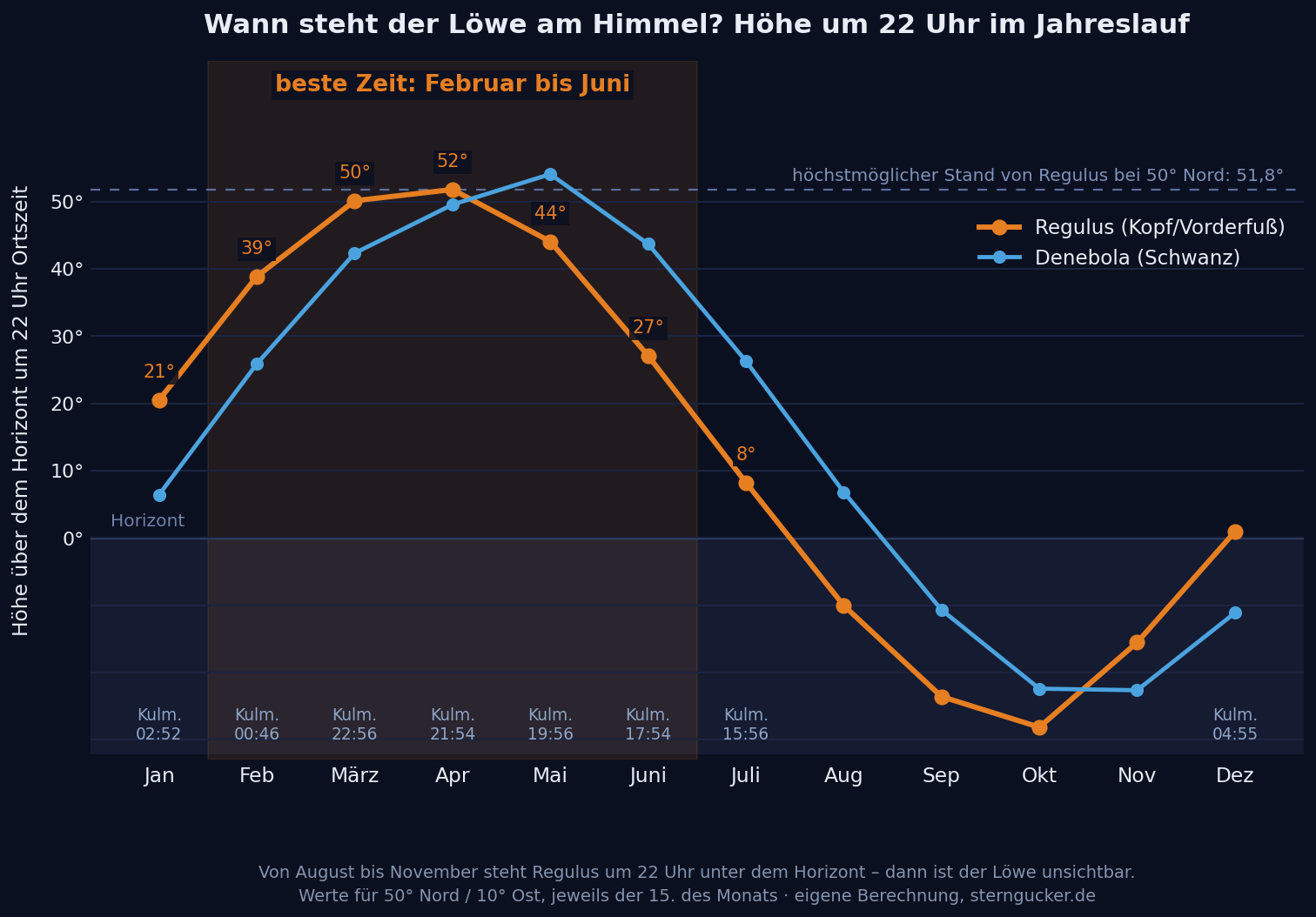
| Month | Regulus 10 p.m. | Denebola 10 p.m. | Culmination | In practice |
|---|---|---|---|---|
| January | 20.5° | 6.4° | 02:52 | rises after midnight |
| February | 38.9° | 25.9° | 00:46 | really good from now on |
| March | 50.1° | 42.4° | 22:56 | culminates late in the evening |
| April | 51.8° | 49.6° | 21:54 | best month |
| May | 44.1° | 54.1° | 19:56 | already sinking toward the west |
| June | 27.1° | 43.7° | 17:54 | only low in the west now |
| July | 8.3° | 26.3° | 15:56 | sets in the twilight |
| August | below horizon | 6.8° | 13:54 | no longer visible |
| September | below horizon | below horizon | 11:52 | in the sky during the day |
| October | below horizon | below horizon | 09:54 | only in the morning sky |
| November | below horizon | below horizon | 06:52 | just before sunrise in the east |
| December | 0.9° | below horizon | 04:55 | rises around 10 p.m. |
The table explains an observation that trips up many people: from August to November, Leo is not in the sky at all in the evening. It then stands above us during the day, together with the Sun. Anyone who wants to see it in autumn has to get up before sunrise – in November, Regulus rises around 1 a.m. and stands quite high in the southeast by dawn.
The order in spring is interesting too. In March and April Regulus leads; in May Denebola overtakes it – because the Lion’s head is already tipping westward by then, while the hindquarters are still near the meridian. Anyone aiming at the galaxies in the body in May therefore has better conditions than in March. More on the changing of the constellations through the year can be found under the astronomical seasons.
How long is Leo above the horizon each night?
This too can be calculated exactly. At 50° north, Regulus stays above the horizon for 13 hours 57 minutes, Denebola 14 hours 24 minutes, Zosma even 15 hours 32 minutes. The galaxy NGC 3521, which lies just south of the celestial equator, manages only 12 hours – and for a good part of that it stands so low that observing gives little pleasure. For it you need a truly clear southern horizon.
How high Leo rises: culmination heights for eleven cities
How high an object rises at most depends solely on the geographic latitude. The following values apply to the moment of upper culmination, that is the highest point in the south – regardless of whether it is dark at that time.
| City | Latitude | Regulus | Denebola | Zosma | M 66 |
|---|---|---|---|---|---|
| Hamburg | 53.6° | 48.4° | 51.0° | 57.0° | 49.4° |
| Berlin | 52.5° | 49.4° | 52.1° | 58.0° | 50.5° |
| Dresden | 51.1° | 50.9° | 53.5° | 59.5° | 51.9° |
| Cologne | 50.9° | 51.0° | 53.6° | 59.6° | 52.1° |
| Frankfurt | 50.1° | 51.9° | 54.5° | 60.4° | 52.9° |
| Stuttgart | 48.8° | 53.2° | 55.8° | 61.7° | 54.2° |
| Vienna | 48.2° | 53.8° | 56.4° | 62.3° | 54.8° |
| Munich | 48.1° | 53.8° | 56.4° | 62.4° | 54.9° |
| Zurich | 47.4° | 54.6° | 57.2° | 63.1° | 55.6° |
| Graz | 47.1° | 54.9° | 57.5° | 63.5° | 55.9° |
| Bern | 46.9° | 55.0° | 57.6° | 63.6° | 56.0° |
The difference between Hamburg and Bern is about seven degrees. That sounds small, but for galaxies it makes a noticeable difference: the higher an object stands, the less air you look through. In Bern, M 66 culminates at 56°, about as high as the Sun at midday in high summer – in Hamburg, at 49°, noticeably lower. Anyone living in the north should therefore observe strictly in the weeks around culmination, and not hours before or after.
Zosma stands highest, because at +20.5° it has the most northerly declination of the bright Leo stars. The practical consequence: the galaxy group around M 95 and M 96, which lies a little below the body, is far more comfortable to observe than NGC 3521 far in the south.
Deep sky in the constellation Leo: nine galaxies at a glance
Here lies the real appeal of the constellation. Leo points toward the galactic north pole – our view goes perpendicularly out of the disk of the Milky Way, without dust and without foreground stars. That is why there are practically no star clusters and no nebulae here, but an unusually large number of galaxies. Nine of them are within reach of amateur equipment.
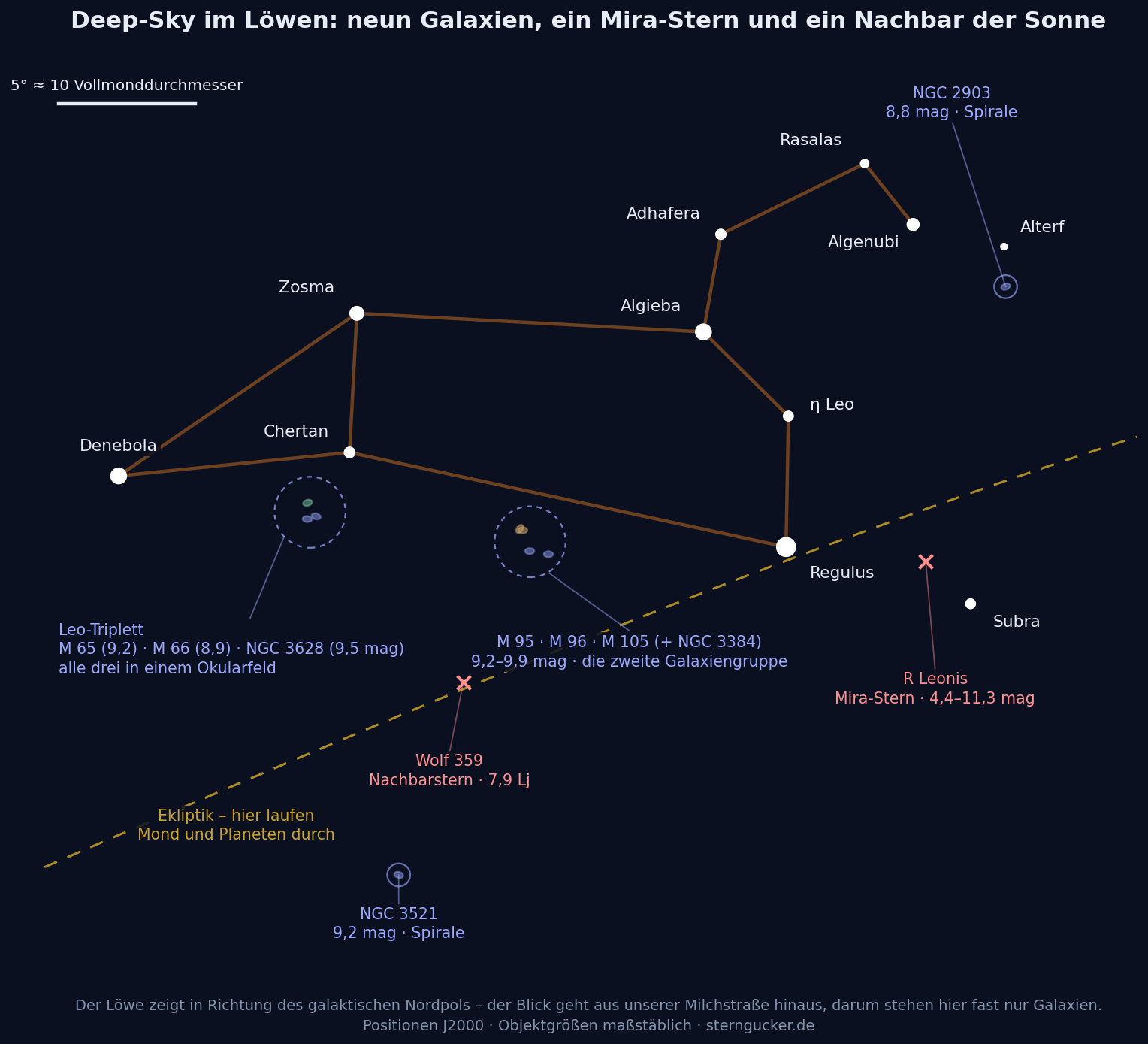
| Object | Type | mag | Distance (ly) | Aperture | Note |
|---|---|---|---|---|---|
| M 65 | spiral galaxy | 9.2 | ~35 million | from 10 cm | member of the Leo Triplet |
| M 66 | spiral galaxy | 8.9 | ~35 million | from 8 cm | brightest of the Triplet |
| NGC 3628 | spiral galaxy | 9.5 | ~35 million | from 15 cm | edge-on, “Hamburger Galaxy” |
| M 95 | barred spiral | 9.8 | ~35 million | from 15 cm | the faintest of the group |
| M 96 | spiral galaxy | 9.2 | ~35 million | from 10 cm | brightest of the M 96 group |
| M 105 | elliptical galaxy | 9.5 | ~35 million | from 10 cm | round patch of light without structure |
| NGC 3384 | lenticular | 9.9 | ~35 million | from 15 cm | only 7′ from M 105 |
| NGC 2903 | barred spiral | 8.8 | ~30 million | from 8 cm | overlooked by Messier |
| NGC 3521 | spiral galaxy | 9.2 | ~26 million | from 10 cm | stands low in the south |
To put the distances in context: the figures vary, depending on the measurement method, between about 30 and 40 million light-years. That is normal – galaxy distances are hard to determine. For practical purposes the order of magnitude suffices: all these objects stand about a thousand times farther away than the Andromeda Galaxy, which is why they are so faint.
The Leo Triplet: M 65, M 66 and NGC 3628
The most famous group of the constellation stands just below Chertan – 2.6° to 2.8° away, so only two finger-widths. M 65 and M 66 are separated by just 0.34°, NGC 3628 stands 0.6° from both. All three thus fit into a single overview eyepiece: with a 1° true field of view you have the complete Triplet in sight at once, and that is exactly what makes it so appealing.
In practice you do not see the same thing. M 66, at 8.9 mag, is the brightest and already shows itself in an 8-centimeter telescope as an elongated little cloud. M 65 follows shortly after. NGC 3628, by contrast, is tricky: the galaxy stands exactly edge-on, its light is spread over a long thin strip, and a dark dust band cuts through its middle. Its surface brightness is therefore low. Under a city sky it often remains invisible, while the two Messier galaxies are long since visible.
How to find the Triplet:
- Center Chertan (θ Leonis) in the finder – the star below the Zosma–Denebola line.
- Move about 2.5° to the southeast, that is toward Denebola and slightly downward.
- Use an eyepiece with at least a 1° field of view. M 65 and M 66 appear as two pale ovals side by side.
- Only once you have both securely, look for NGC 3628 – it stands north of the two and forms a flat triangle with them.
Important: use averted vision. Look slightly past the galaxy, then its light falls on the more sensitive part of the retina.
The M 96 group: M 95, M 96, M 105 and NGC 3384
The second gathering stands 8.7° to 9.4° east of Regulus, roughly halfway between Regulus and Chertan. Here the objects are even tighter: M 95 and M 96 are separated by 0.7°, M 105 and NGC 3384 by only 0.12°, a good seven arcminutes – the two fit comfortably together in one eyepiece field at high magnification.
The character of the four differs. M 96 is a classic spiral and the brightest. M 105 is elliptical and looks like a blurred star – you will never see structure in it, no matter how large your telescope. M 95 is a barred spiral, but at 9.8 mag the faintest of the group and needs a really dark sky. If you manage only one group in a night, take the Triplet – the M 96 group is the more demanding one.
NGC 2903: the galaxy Messier overlooked
Curiously, the brightest galaxy of the constellation carries no Messier number at all. NGC 2903 shines, at 8.8 mag, brighter than anything in the Triplet, but stands far forward at the muzzle – only 1.5° south of Alterf and 3.9° from Algenubi. Charles Messier simply overlooked it, although it is easy to see in any 8-centimeter telescope and shows hints of its spiral arms in larger instruments. For many observers it is the most rewarding single object in Leo.
What else Leo conceals
Beyond the reach of amateurs it becomes spectacular. In Leo stands NGC 3842, the central galaxy of a galaxy cluster, in whose core sits one of the most massive known black holes – with about ten billion solar masses. Also here: the quasar PKS 1127-145 and the Leo Ring, a vast, almost starless hydrogen cloud 650,000 light-years across. None of this is visible – but it shows how deep the view reaches in this direction of the sky. Further worthwhile targets can be found in our deep-sky section and at M 49 in neighboring Virgo.
Which telescope for Leo: an honest recommendation
For most constellations our answer is: start with binoculars. For Leo it is different – and we say so deliberately, even though binoculars would be cheaper. The reason lies in the nature of the objects.
| Instrument | What you see | Assessment |
|---|---|---|
| Naked eye | The figure, Sickle and triangle, R Leonis at maximum | Instantly. The starting point. |
| Binoculars 10×50 | Regulus with its companion pair, Denebola with its optical partner, the Sickle as a whole | Nice for the overview – but not a single galaxy for sure. |
| Telescope 13 cm | Algieba split, M 65/M 66/M 96/NGC 2903 as little patches | The sensible entry point. |
| Telescope 20 cm | All nine galaxies, NGC 3628 with dust band, first hints of structure | This is where it gets really good. |
Here is the honest verdict: binoculars show hardly any deep sky in Leo. The galaxies are bright enough by their catalog figures, to be sure, but their light is spread over an area – the surface brightness is low, and that is exactly what matters. In Orion or in Cassiopeia there are star clusters that binoculars show splendidly; in Leo there are distant galaxies. Anyone who wants to see them needs aperture. We have written this up in detail in our comparison Telescope or binoculars.
For the start: a compact reflector
If Leo is your first reason to buy a telescope, you do not need a big investment. With 13 centimeters of aperture you split Algieba cleanly, see M 66 and M 65 as ovals side by side, and pick up NGC 2903 easily. A reflector on a Dobsonian mount is the most straightforward design for this – set it up, look in, done.
The honest entry into Leo: Skywatcher Dobson Telescope N 130/650 Heritage FlexTube
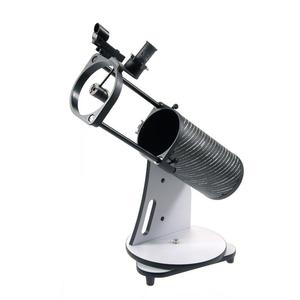
A compact tabletop Dobson with a true parabolic mirror. Folds down, fits in a bag: the Moon, planets and the bright deep-sky classics.
Price: € 265
For the galaxies for real: from 20 centimeters of aperture
Anyone who wants not merely to detect the galaxies but to look at them can hardly get around 20 centimeters. The difference is not subtle: NGC 3628 turns from a doubtful shimmer into a clearly bounded needle with a dark dividing line, M 66 shows brightness differences within the disk, and the four objects of the M 96 group all stand securely in the field. An 8-inch Dobsonian has for decades been the most sensible solution for this, because it gathers the most light per dollareuro.
The right choice for the galaxies: Skywatcher Dobson Telescope N 200/1200 Skyliner Classic
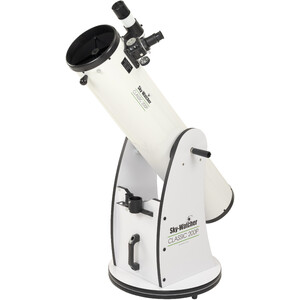
200 mm of aperture — the most sky for your money. Set it on the ground, point by hand: nebulae, clusters and galaxies for years to come.
Price: € 479
More on designs, apertures and price ranges can be found in our guide Telescope for galaxies, in the overview of Dobsonian telescopes and among the beginner telescopes. If you are unsure, our telescope advice will help you further.
More important than any telescope: the location. Galaxies react to sky brightness more sensitively than any other object. A 13-centimeter telescope under a truly dark rural sky shows more in Leo than a 20-centimeter instrument on the edge of town.
Nebula filters, by the way, do not help here: filters work with emission lines, but galaxies radiate across the whole spectrum. Against light pollution in Leo, the only thing that helps is driving away.
Leo in the zodiac: constellation and star sign
Leo is one of the twelve zodiac constellations – the ecliptic runs right through it, close past Regulus. As a result the Sun, the Moon and all the planets pass regularly through this constellation. That is precisely why there is a star sign of the same name.
Only the two date ranges do not coincide, and markedly so. The star sign Leo runs from 23 July to 22 August. The Sun, however, is actually in the constellation Leo only from 11 August to 17 September. The shift of about three weeks arises from precession: the Earth’s axis wobbles around once in 25,800 years; since the zodiac signs were fixed about 2,000 years ago, the sky has turned on accordingly.
How strongly this acts is shown by Regulus itself. 5,000 years ago it stood at a right ascension of 5.3 hours and a declination of +24° – so far in the north. Today it is at 10.2 hours and +12°. In three thousand years it will have reached +7°, and in the year 5000 of our era it will stand at −4°, south of the celestial equator. Constellations, after all, are not eternal. More on this in our article on star signs and constellations.
A further difference: the twelve star signs divide the zodiac into twelve exactly equal sections of 30° each. The constellations, by contrast, are of differing sizes. Leo, at 947 square degrees, is one of the largest, the Cancer region one of the smallest. And with Ophiuchus there is even a thirteenth constellation on the ecliptic, which appears in no horoscope.
The Leonids in November: shooting stars from Leo
Once a year Leo becomes interesting even when it is poorly placed. The Leonids are one of the best-known meteor showers of all. Their radiant – the point from which the meteors appear to come – lies in the Sickle, near Algieba.
| Shower | Activity | Maximum | ZHR | Radiant |
|---|---|---|---|---|
| Leonids | 6 to 30 November | 17/18 November | approx. 15 | near γ Leonis (Algieba) |
| January Leonids | 1 to 7 January | 4 January | low | in the head of Leo |
| Delta Leonids | February to March | late February | low | near δ Leonis (Zosma) |
In a normal year the Leonids deliver about 15 meteors per hour under ideal conditions. Their reputation, however, comes from the exceptional years: roughly every 33 years, when the parent comet 55P/Tempel-Tuttle has left fresh material behind, this can turn into an outright storm. In 1833 and 1966 more than a thousand meteors per minute fell at times. The comet’s next passage is due in 2031.
In practical terms: on the night of 17/18 November it is worth getting up. The radiant only stands usefully high after midnight – Regulus rises around 1 a.m., then in the second half of the night Leo climbs in the east. Do not look directly at the radiant, but about 40° to the side; the trails are longer there. All the year’s dates can be found in our meteor shower calendar and in the overview of the night sky in November.
Mythology of the constellation Leo: Heracles, Egypt and Berenice
The Nemean Lion
In the Greek tradition the lion in the sky is the monster of Nemea, whose hide no weapon could pierce. Heracles was to kill it as the first of his twelve labors. Arrows bounced off, the club shattered – in the end he strangled the beast with his bare hands. He then stripped off its hide with the animal’s own claws and wore it from then on as a cloak, with the jaws as a helmet. Zeus placed the lion in the sky in memory of the fight.
The Egyptian trail
But the figure is older than the Greek myth, and its origin is probably Egyptian. About four thousand years ago the Sun crossed the constellation from mid-June to mid-July – so in the time of the greatest summer heat. Just then the lions withdrew to the sandbanks of the Nile to find water. The Egyptians thus linked the season, the animal and the star figure very concretely.
Interestingly, the Egyptian constellation comprised only the body. The chain of stars we read today as head and mane counted for them as a knife. Persians, Syrians, Babylonians and Jews too saw a lion at this spot in the sky – the figure is thus among the most stable of the whole sky across cultures.
How Leo lost the tuft of its tail
Leo was originally even larger. The stars we know today as Coma Berenices formed, until the 2nd century AD, the tuft of its tail. Then they were declared a constellation of their own – named after Berenice II, queen of Egypt, who offered her hair to the gods so that her husband would return safely from war. The hair vanished from the temple, and the court astronomer promptly declared that Zeus had placed it in the sky.
And one more layer of meaning: in the Jewish tradition the lion stands for the tribe of Judah and is regarded as a symbol of the Messiah. It was thus for a long time the only figurative depiction permitted in synagogues.
The neighbors of Leo: what stands around it in the sky
Nine constellations border on Leo. Anyone who knows them finds their way around the spring sky quickly – Leo stands almost exactly at the center of this region.
| Neighbor | Position | Remark |
|---|---|---|
| Ursa Major | north | contains the Big Dipper – the sighting aid to Leo |
| Leo Minor | north | inconspicuous star group between Leo and Ursa Major |
| Lynx | northwest | touches Leo only at one corner, very poor in stars |
| Cancer | west | ahead of it on the zodiac, with the Praesepe cluster |
| Hydra | southwest | the largest constellation by area of all |
| Sextans | south | faint, directly below Regulus |
| Crater | southeast | small quadrilateral in the spring sky |
| Virgo | east | behind it on the zodiac, with Spica and the Virgo Cluster |
| Coma Berenices | northeast | the former tail tuft, full of galaxies |
Two of these neighbors are especially important for deep-sky observers. To the east adjoin Virgo and Coma Berenices – there lies the Virgo Cluster with over a thousand members. Anyone who has worked through the galaxies in Leo in spring moves on there of their own accord. And to the west, in Cancer, stands Praesepe, one of the finest open clusters in the sky – a good fallback when the galaxies will not play along on a hazy evening. Farther west then follow Gemini.
An overview of all 88 constellations and their arrangement in the sky can be found in our constellation catalog. What else is going on in the sky in the coming weeks is in our astro events and the highlights of the northern hemisphere.
Frequently asked questions about the constellation Leo
When is the constellation Leo best seen?
From February to June, with the peak in April. Regulus is then highest around 10 p.m. – at 50° north, about 52° above the southern horizon. From August to November, Leo is not visible in the evening at all, because it then stands together with the Sun in the daytime sky.
How do I find the constellation Leo in the sky?
Via the Big Dipper. Extend the rear bowl side from Megrez over Phecda downward, about ten times as far as the distance between the two stars – after roughly 47° you are in the Lion’s head. As a check: the front bowl side from Dubhe over Merak meets Zosma after 45°.
Which is the brightest star in the constellation Leo?
Regulus (α Leonis) at 1.36 mag, the 21st-brightest star in the whole sky. It stands 78 light-years away, rotates once in only 15.9 hours and is thereby strongly flattened. The name means “little king”.
How many stars does the constellation Leo have?
The main figure consists of nine to eleven stars, depending on whether Subra and Alterf are counted. Five of them are brighter than 3 mag: Regulus, Algieba, Denebola, Zosma and Algenubi. Within the official constellation boundaries there are of course far more stars – with the naked eye, under a good sky, about seventy.
Constellation Leo with 7 or 8 letters – which star is meant?
For crosswords: with 3 letters the Latin name Leo is meant. With 5 letters Zosma, Chort (the short form of Chertan) and Subra come into question. With 7 letters it is Regulus or Algieba, with 8 letters Denebola or Adhafera.
Why are there so many galaxies in Leo?
Because it points toward the galactic north pole. Our view goes perpendicularly out of the disk of the Milky Way, without dust clouds and without dense foreground stars. That is why Leo lacks the star clusters and gas nebulae that dominate the picture in, say, Cassiopeia or Cygnus – and instead one sees, unobstructed, all the way to galaxies thirty million light-years away.
Can the galaxies in Leo be seen with binoculars?
Honestly, hardly. Under a very dark sky M 66 can be glimpsed as a hint, but no more. The catalog values of 8.8 to 9.9 mag sound attainable, yet this light is spread over an area – the surface brightness is low. For the galaxies in Leo you need a telescope with at least 10 to 13 centimeters of aperture, and for a really fine view rather 20.
What is the Leo Triplet?
A group of three galaxies – M 65, M 66 and NGC 3628 – that stands about 35 million light-years away and is found just below Chertan. Because the three lie only 0.3° to 0.6° apart, they fit together in one eyepiece field. That makes them one of the most popular subjects in astrophotography.
Is Leo a star sign or a constellation?
Both – but they are two different things. The constellation is a real area of the sky with fixed boundaries, the star sign a 30° section of the ecliptic. The periods shift by about three weeks: star sign 23 July to 22 August, constellation 11 August to 17 September.
How far is the constellation Leo from Earth?
This question has no single answer, because a constellation is not an object but a line of sight. The main stars stand at distances between 36 light-years (Denebola) and about 2,500 light-years (ρ Leonis), one behind the other. The galaxies in the same field of view lie at about 30 million light-years – so nearly ten thousand times farther than the brightest stars of the figure.
Can the constellation Leo be seen from the southern hemisphere?
Yes, and very well at that. Leo is visible between 85° north and about 60° south, so from almost the whole Earth. In the southern hemisphere, however, it stands upside down in the north – the Sickle then opens in the other direction, which makes recognition harder at first.
Read more on Sterngucker
- Big Dipper – the signpost to Leo
- Constellation Virgo – the eastern neighbor with the Virgo Cluster
- Constellation Cancer – the western neighbor with Praesepe
- Coma Berenices – the detached tail tuft
- Night sky in spring – what else stands in the spring sky
- Leonids – the shooting stars from the Lion’s head
- Telescope for galaxies – what matters when it comes to aperture
- Star signs and constellations – why the dates diverge
- All constellations at a glance – the way into our catalog