By Alexander Merz · Published on · Details checked on 14 September 2026
🌠 Reading this outside July? The Perseids are over for 2026. What is actually in the sky right now is in the night sky in September, and every meteor peak with a moon rating is in our shooting star calendar 2026/2027. The next big night: the Geminids on 13/14 December.
What does the night sky in July have to offer in the way of exciting things to observe? Here is a clear summary.

The key facts in brief
In the northern hemisphere there are a few observing highlights that come round every July. Here is a small selection you can look forward to:
- Visibility of the planets: Mars, Venus, Saturn and Jupiter should all be easy to see. Jupiter and Saturn are visible in the first half of the night, while Mars and Venus are best seen shortly after sunset or shortly before sunrise.
- Moon phases: new moon on 1 July, first quarter on 8 July, full moon on 16 July and last quarter on 24 July. These different phases offer excellent opportunities for observing the moon.
- Saturn at opposition: on 4 July Saturn reaches opposition, which means it is closest to Earth and visible all night long. It is also brighter than at any other time of the year.
- Mercury at its best: Mercury reaches its greatest eastern elongation – its largest apparent distance from the Sun – on 16 July. This is the best time to see Mercury shortly after sunset.
- Delta Aquariids meteor shower: this meteor shower begins in the middle of July and peaks on 28 or 29 July. They are not the brightest meteors, but under good conditions you can expect around 20 meteors per hour.
- The Summer Triangle: this striking figure, made up of the stars Deneb, Vega and Altair, is easy to see during the summer months.
- The Milky Way: in July the Milky Way is particularly easy to see. From a dark site without light pollution, look for a bright band of stars stretching across the sky.
- Andromeda Galaxy: under ideal conditions with little light pollution, the Andromeda Galaxy can be seen with the naked eye in July.
- Ring Nebula (M57): this fascinating planetary nebula in the constellation Lyra can be observed with a small telescope.
- The double star Albireo: in the summer sky the colourful double star Albireo in the constellation Cygnus is a wonderful telescope target.
The moon phases in July
The end of the month is the best time for observing deep-sky objects. The moon is very dark then.
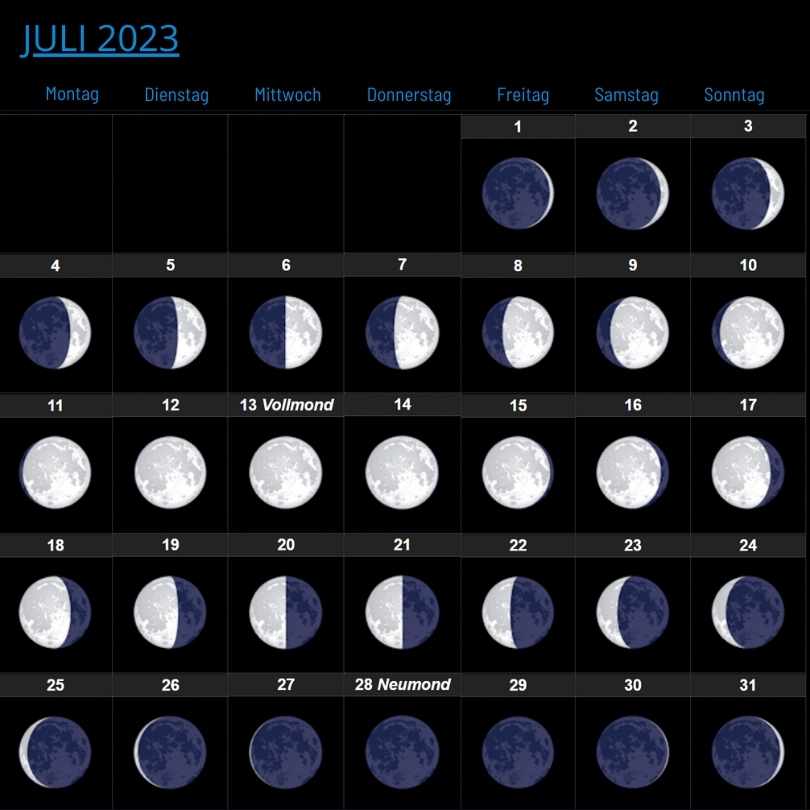
Night sky in July
In July you can see three bright summer stars in the night sky: Deneb, Altair and Vega. Together they form a triangle, the “Summer Triangle“. At night you can find it high in the eastern sky.
One interesting thing to notice is a dark patch in the Milky Way called the “Cygnus Rift“. This dark patch is in fact a lane of dust in our part of the Milky Way that hides the light of the stars behind it.
Arcturus and Antares are two particularly bright stars that are easy to see in July. Both are “red giants“, in other words very large and very luminous stars. Arcturus is the second brightest star in the sky and 22 times larger than our Sun. Antares, on the other hand, shines close to the southern horizon and is especially easy to see from the tropics and the southern hemisphere.


On 5 and 6 July you can see the two dwarf planets Ceres and Vesta in the constellation Virgo. They are almost equally bright and equally large, even though Ceres is in fact twice the size of Vesta. NASA’s “Dawn” probe visited both: it orbited Vesta in 2011/2012 and then Ceres from 2015 until the mission ended in 2018.
Four planets are visible in July: Venus, Mercury, Saturn and Mars. Venus can be seen in the morning as a bright point above the eastern horizon. Mercury is visible shortly before sunrise, although still very faint.
Saturn is moving through the constellation Libra and looks as if it were running backwards, because Earth moves faster along its orbit and “overtakes” it. On 21 July Saturn’s motion comes to a standstill and you can make out its true direction again.
A fun fact: the name “Antares” means “against Mars”. The Romans gave it that name because they thought it was a rival to their god of war, Mars, on account of its reddish colour.
The dates that are actually worth it are often months apart – and easily forgotten. So you do not miss one:
One short email, in good time – with the times and an honest take on whether it is worth getting up for.
You will get a confirmation email in a moment. Your address stays with us – no sharing, no third-party ads.
The planets in July
Although Mercury does move far enough away from the Sun by the end of July, it will still not appear in our evening sky.
Venus reaches its greatest brightness in July at -4.7 mag. Its observing window, however, ends at the end of the month. With a telescope or binoculars you can watch the crescent of Venus growing steadily narrower.
On the 10th, Mars comes very close to Regulus in the constellation Leo. To see them in the evening twilight you will need binoculars. After the 10th, Mars moves into the brighter part of the sky.
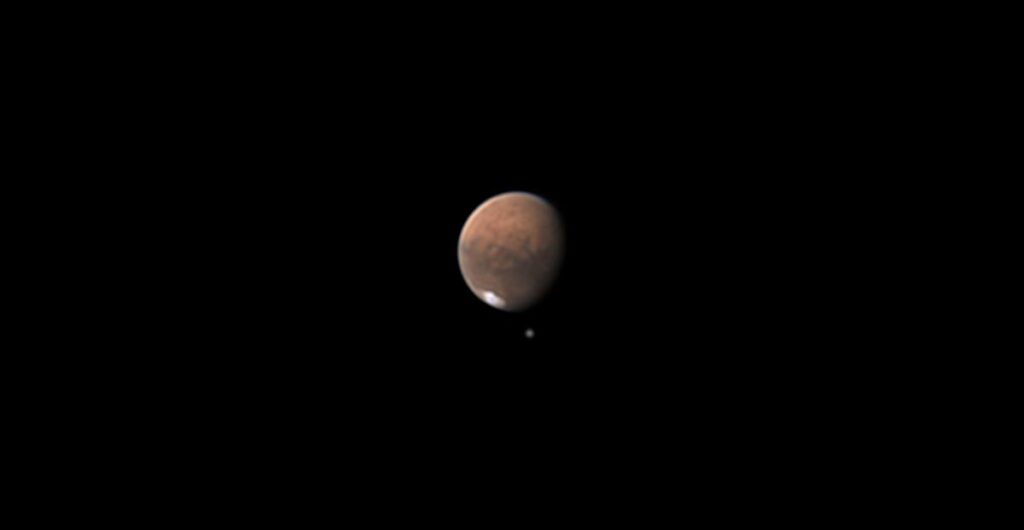
(Photographer: James Bates. Equipment: Celestron NexStar 8SE Computerized SCTCelestron NexStar 8 SE GoTo Telescope ($1,699.00€ 2,149), ZWO ADC, ASI224MC)
Jupiter, which stands in the constellation Aries, is the planet of the late night. On the morning of 11 July the waning moon joins Jupiter.
Saturn, the ringed planet, does not reach opposition until the end of August and is therefore only visible in the later evening hours in the south-east. In the night of 6/7 July the moon passes just below Saturn.
Uranus, which stands in the constellation Aries, becomes an interesting object for morning observing from the middle of July onwards.
Neptune in the constellation Pisces begins its opposition loop on 1 July, but is still a challenge to observe in the morning sky.
Deep-sky objects in July
Most of the events mentioned so far are visible with the naked eye, but this month I wanted to add a new section covering all the deep-sky objects you can see.
You will need binoculars or a telescope for these, but it is worth it! There is a great deal of beauty to see in the July night sky.
- M13 (Hercules Cluster): M13 is one of the most impressive globular clusters – densely packed balls of stars – in the northern sky and can be seen with binoculars or a small telescope. What makes it exciting is that it contains around 300,000 stars and lies about 25,000 light years away.
- M57 (Ring Nebula): lying in the constellation Lyra, the Ring Nebula is a planetary nebula – that is what is left of a star similar to our Sun when it dies. In fact, our Sun will probably look much the same in a few billion years.
- M27 (Dumbbell Nebula): another planetary nebula, but one with a dumbbell-shaped structure. It was the first object of this kind ever discovered.
- M31 (Andromeda Galaxy): visible to the naked eye under ideal conditions, this spiral galaxy is our nearest large galactic neighbour. One astonishing fact is that it is racing towards us and will collide with the Milky Way in about 4 billion years.
- M11 (Wild Duck Cluster): an open star cluster that owes its name to its shape. It is one of the richest and most compact open clusters known.
- Albireo (Beta Cygni): although it is not technically a “deep-sky object”, Albireo is a beautiful double star in Cygnus. What makes it special is the clear colour contrast between the two stars – one is blue and the other is gold.
- M81 and M82: these two galaxies in the constellation Ursa Major can often be seen together in a single binocular or telescope field. M82, also known as the Cigar Galaxy, is particularly interesting because it is a starburst galaxy – a galaxy in which stars are forming at an extremely high rate.
Enjoy observing these fascinating objects in the sky!