By Alexander Merz · Updated on · Details checked on 14 September 2026
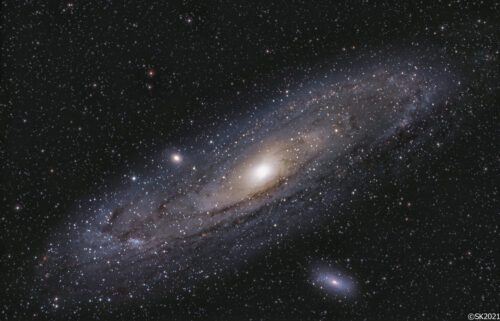
The Andromeda Galaxy (M31) is the nearest large spiral galaxy to our Milky Way: about 2.5 million light-years away and, at magnitude 3.4, the most distant object you can see with the naked eye.
⭐ In short
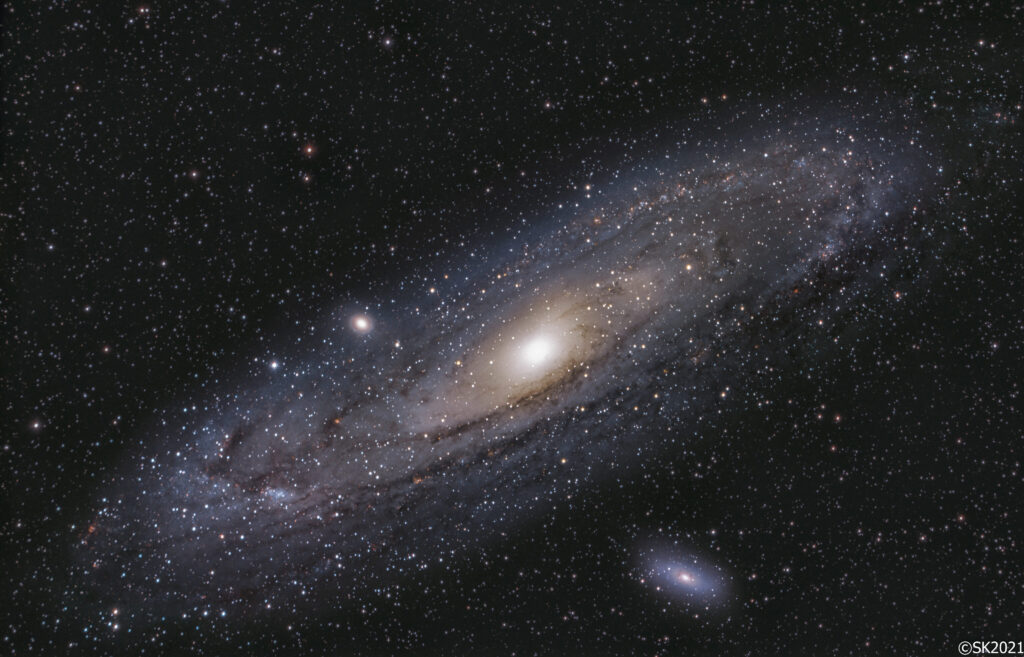
From September to January M31 stands high in the evening sky – this is its season. A dark site does more than any instrument: there you can already see it with the naked eye as an elongated little cloud, and binoculars show it at its best. No telescope, however, shows the spiral arms of the famous photos in the eyepiece – only a camera brings those out.
Andromeda Galaxy at a glance
| Property | Value |
|---|---|
| Type | Spiral galaxy (Sb) |
| Catalogue | Messier 31, NGC 224 |
| Distance | about 2.5 million light-years |
| Diameter | roughly 150,000 to 220,000 light-years, depending on where the outer disc is taken to end |
| Stars | an estimated one trillion or so |
| Brightness | magnitude 3.4 |
| Size in the sky | about 3 × 1 degrees – roughly six full-Moon widths long |
| Constellation | Andromeda |
| Brightest companions | M32 and M110 (NGC 205) |
Figures for the diameter and the number of stars vary considerably in the literature. The edge of a galaxy is not a sharp line but thins out gradually – measure further out and you get larger values.
Finding the Andromeda Galaxy: two easy ways
Via the Great Square of Pegasus and Mirach
- Find the Great Square of Pegasus: four stars of similar brightness forming a large square.
- From its corner star Alpheratz a chain of stars leads up and to the left to the bright star Mirach.
- From Mirach, go two fainter stars upwards (μ and ν Andromedae).
- Just to the right of the second one lies M31 – an elongated, bright smudge of light.
Via the W of Cassiopeia
If you know Cassiopeia, it is even quicker. The point of the W at the star Schedar points down towards the galaxy, about three times as far as the W is wide.
When is the Andromeda Galaxy visible?
The best time is the evenings from September to January. North of about 49° latitude M31 never quite sets; further south it dips below the horizon for a while in early summer.
| Month | Time | Height above the horizon | Direction |
|---|---|---|---|
| Mid-September | 10 pm | about 45° | East |
| Mid-October | 9 pm | about 55° | East |
| Mid-November | 8 pm | about 73° | high in the south-east |
| Mid-December | 8 pm | about 79° | almost overhead |
| Mid-January | 8 pm | about 62° | West |
| Mid-March | 7 pm | about 35° | West-north-west |
The values apply to central Europe (about 51° north, local time). The sky is darkest in the days around new Moon – that is when it is most worth trying.
What you see with the eye, binoculars and a telescope
| Instrument | What you realistically see |
|---|---|
| Naked eye | Under a dark sky an elongated, faint glow. In a city usually nothing at all. |
| 10×50 binoculars | Bright core with an oval halo, a good three degrees long. M110 is often visible beside it as a faint patch. |
| Telescope 100–150 mm | Core and halo more distinct, M32 as a small, round, bright spot. |
| Telescope 200 mm and up | First dust lanes at the edge, the star cloud NGC 206 and the globular cluster G1 as a faint little star. |
Because M31 is so large, of all things the cheapest instrument is the best one to start with. Binoculars fit the whole galaxy into the view, a telescope at high magnification only a section of it. The Celestron UpClose G2 10x50 Porro Binoculars for € 62 is all you need; more on this in the guide Astronomy binoculars.
For dust lanes, NGC 206 and G1, on the other hand, you need aperture and a dark sky. How much difference aperture makes for galaxies is explained in the guide Telescope for galaxies.
For dust lanes and G1: Skywatcher Dobson Telescope N 200/1200 Skyliner Classic
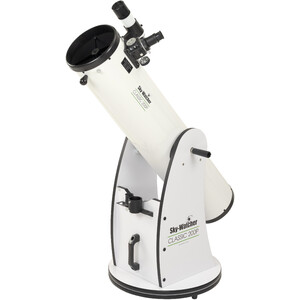
200 mm of aperture — the most sky for your money. Set it on the ground, point by hand: nebulae, clusters and galaxies for years to come.
Price: € 479
Photographing the Andromeda Galaxy
In a photo M31 shows what the eye cannot manage: dust lanes, spiral structure and both companions. The field of view is what matters, because the galaxy is about three degrees long.
| Equipment | Field of view | Does all of M31 fit? |
|---|---|---|
| Camera with 135–200 mm telephoto lens on a tracking mount | 7–10° or 5–7° depending on the sensor | yes, with plenty of surroundings |
| DWARF 3 (smart telescope) | about 2.9 × 1.6° | yes, just about filling the frame |
| Seestar S30 Pro (smart telescope) | about 4.0 × 2.3° | yes, with a margin |
| Seestar S50 Pro | about 2.1 × 1.2° | almost – the ends stick out; complete as a mosaic |
| Seestar S50 (first generation, no longer available new) | about 1.3 × 0.7° | no, only the core – or as a mosaic |
The fields of view are calculated from focal length and sensor size. For M31 a large field of view matters more than a long focal length. How the smart telescopes differ otherwise is covered in the comparison Smart telescope.
Fits all of M31 in the frame: DWARFLAB DWARF 3 Smart Telescope
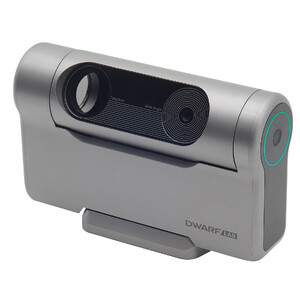
A 1.3 kg smart telescope: it photographs nebulae and galaxies straight to your phone, even from the city. The simplest way into astrophotography.
Price: € 529
With a mirrorless or DSLR camera it also works without a smart telescope. How that works with tracking and stacking is explained in the guide Deep-sky astrophotography.
Is Andromeda bigger than the Milky Way?
In diameter and number of stars, Andromeda is probably larger. The Milky Way has a few hundred billion stars according to current estimates, M31 about a trillion.
Total mass is a different story. Including dark matter, recent measurements put both galaxies at roughly the same mass.
When will Andromeda collide with the Milky Way?
M31 is approaching us at about 110 kilometres per second. For a long time a collision in about 4 to 5 billion years was therefore considered certain.
An analysis of new Hubble and Gaia data published in 2025 has put this firmly into perspective. According to it, the probability of a merger within the next 10 billion years is only about 50 per cent, and within the next 5 billion years just a few per cent.
Even if it happens, hardly any stars will collide. The distances between them are far too large for that.
From “nebula” to galaxy: a short history
- 964: The Persian astronomer al-Sufi describes M31 as a “small cloud” – the oldest known mention.
- 1612: Simon Marius is the first to observe it through a telescope.
- 1764: Charles Messier adds it to his catalogue as number 31.
- 1923: Edwin Hubble finds a variable star in M31 that allows its distance to be measured. That settles it: the “Andromeda Nebula” lies far outside the Milky Way.
The old name Andromeda Nebula dates from the time before that. Back then every fuzzy patch of light in the sky was called a nebula, whatever it really was.
Frequently asked questions about the Andromeda Galaxy
Can you see the Andromeda Galaxy with the naked eye?
Yes, under a dark sky away from towns. It appears as an elongated, faint glow next to the star ν Andromedae. In light-polluted cities it usually cannot be seen.
How far away is the Andromeda Galaxy?
About 2.5 million light-years. The light you see today set off before there were any humans.
Is Andromeda bigger than the Milky Way?
In diameter and number of stars, probably yes. In total mass including dark matter, both are now considered roughly equal.
When will the Andromeda Galaxy hit us?
Not for several billion years at the earliest, and it is no longer certain. According to 2025 data, the probability of a merger within the next 10 billion years is about 50 per cent.
Is there life in the Andromeda Galaxy?
Nobody knows. With around a trillion stars, planets there are very likely, but they cannot be detected at that distance.
What is the best instrument for viewing the Andromeda Galaxy?
A pair of 10×50 binoculars under a dark sky. It shows the whole galaxy at once. A telescope only pays off for details such as dust lanes and companion galaxies.
More galaxies, nebulae and star clusters for the autumn sky can be found in the overview Deep-sky objects.