By Alexander Merz · Updated on
The Celestron PowerSeeker 127EQ is a 127 mm (5-inch) reflector on a small manual equatorial mount, sold as a beginner telescope for around $200 to $230 in the US. It reaches its 1000 mm focal length in a 436 mm tube with a corrector lens in the focuser, a so-called Bird-Jones design.
Before you buy it, compare it with our overview of the best telescopes for beginners.
⭐ In short: For the list price, we would not buy the PowerSeeker 127EQ. Owners get good Moon views, but the shaky mount, the finder and the corrector design cause more frustration than the aperture is worth.
For the same money a tabletop Dobsonian such as the Heritage 130Heritage 130 shows more and is easier to use. Used for $20 to $60, the 127EQ is an acceptable Moon scope.
Transparency: we do not own a PowerSeeker 127EQ. This guide combines Celestron’s specs with about 168 owner reports from 202 Reddit threads. How we review telescopes.
PowerSeeker 127EQ specs
The box promises up to 750x, but the useful limit of a 127 mm telescope is about 250x under perfect conditions. Specs from Celestron, September 2026:
| Spec | PowerSeeker 127EQ |
|---|---|
| Aperture / focal length | 127 mm / 1000 mm, f/7.9 |
| Optical design | Spherical primary mirror, corrector lens in the focuser |
| Tube length | 436 mm |
| Eyepieces | 20 mm (50x) and 4 mm (250x) |
| Barlow | 3x (150x and 750x with the stock eyepieces) |
| Finder | 5×24 |
| Mount | Manual equatorial, EQ-1 class, two slow-motion cables |
| Weight | 5.9 kg (13 lb) complete |
| US list price | $229.95 (Celestron) |
Availability: in September 2026 High Point Scientific lists it as back-ordered, Agena as discontinued, and Astroshop no longer sells it new. That is why we link no shop for it, only the alternatives.
What about 168 owners report
We read 202 Reddit threads about the 127EQ (January 2020 to September 2026) and counted posts from people who own or owned one. The counts are approximate, because many original posts were deleted and only titles survive.
| Topic | Owners (approx.) | What they say |
|---|---|---|
| Good Moon views and phone photos | 40 | The most consistent positive, at low power |
| Saw Jupiter | 20 | Moons yes; cloud bands mentioned by only 3, blur by 5 |
| Saw Saturn’s rings | 13 | Usually “just the rings” |
| Positive overall | 20 | Almost always with a “but” about mount and finder |
| Finder useless or replaced | 18 | Would not hold alignment; red-dot finders help |
| Mount shaky or fiddly | 17 | Wobbles when focusing or touching the tube |
| Frustrated, returned or abandoned | 17 | Often a gift that ends up in the closet |
| Collimation hard or impossible | 14 | The corrector has to come out to collimate properly |
| Mechanical defects | 10 | Stripped gears, stuck bolts, missing screws |
How to read these numbers: the Reddit community is strongly critical of this scope, and help posts over-represent problems. Photo posts, on the other hand, over-represent successes.
The Bird-Jones problem explained
A normal 1000 mm Newtonian needs a tube about a metre long; the 127EQ’s tube is 436 mm. The corrector lens in the focuser makes up the difference, as the graphic above shows.
That shortcut has a cost. The lens sits in the light path and moves with the focuser, which makes precise collimation very hard. Owners who got sharp views usually shimmed the focuser, blackened the drawtube or rebuilt the scope.
Common mistake: trying the 4 mm eyepiece with the 3x Barlow. 750x is three times beyond what any 5-inch telescope can show, and on this mount the image shakes out of view.
What you can see with it
The Moon looks good, and that is where most owners are happy. Jupiter’s moons and Saturn’s rings are visible, but crisp planetary detail is rare in the reports.
Bright deep-sky objects such as the Orion Nebula appear at low power under dark skies. Galaxies stay faint smudges, as with any small telescope.
Better alternatives at the same price
Experienced users recommend a tabletop or full-size Dobsonian instead, more than any other alternative. Dobsonians are named in 70 of the 202 threads.
| Alternative | Why it is better | Price |
|---|---|---|
| Sky-Watcher Heritage 130Sky-Watcher Heritage 130 | ⭐ Our pickReal parabolic Newtonian, stable tabletop base, no wobble | $305.00€ 265 |
| StarSense Explorer LT 114StarSense Explorer LT 114 | Phone app guides you to objects | $239.99€ 259 |
| Sky-Watcher Heritage 150Sky-Watcher Heritage 150 | More aperture, still tabletop | $355.00€ 345 |
| Apertura AD8Apertura AD8 | 8 inches, the classic long-term scope | $699.95€ 499 |
Links with an asterisk are affiliate links.
More options by budget are in our best beginner telescopes guide and our telescope cost overview.
Our pick instead of the 127EQ: Skywatcher Dobson Telescope N 130/650 Heritage FlexTube
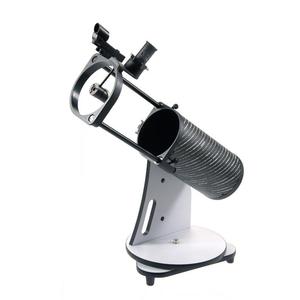
A compact tabletop Dobson with a true parabolic mirror. Folds down, fits in a bag: the Moon, planets and the bright deep-sky classics.
Price: € 265
If you want more: the Apertura AD8
With 203 mm of aperture, the AD8 collects about 2.5 times the light of the PowerSeeker and sits on a stable Dobsonian base that does not wobble. The extra cost pays off if you want galaxies and planetary detail and have room to store a 46-inch tube. Details in our Apertura AD8 guide.
For advanced observers: Omegon Advanced X N 203/1200 Dobsonian
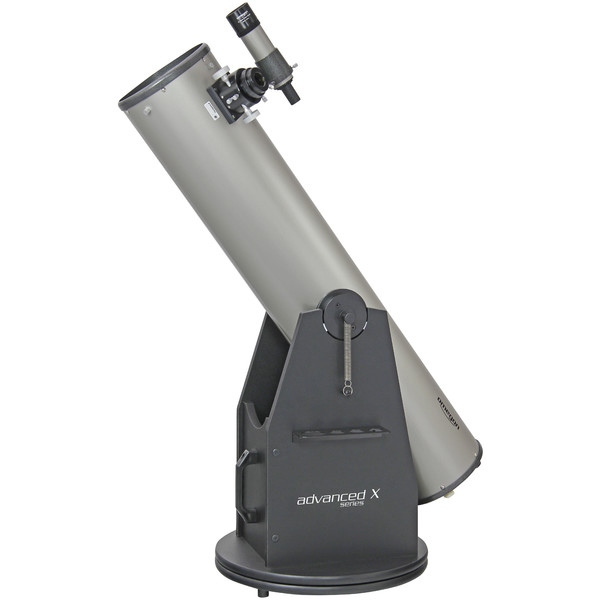
8-inch Dobsonian: maximum aperture for the money - no-frills deep-sky observing, set up in minutes.
Price: € 499
Already own one? How to make it work
Owners who stuck with it made three changes, and none of them costs much. Start with the cheapest fix.
Tip: Replace the finder with a red-dot finder, use a 25 mm or 32 mm Plössl for most observing, and set the mount up on firm ground with the legs short. Skip the 4 mm eyepiece.
* Affiliate link: if you buy through this link we may earn a small commission from Astroshop or High Point Scientific, at no extra cost to you.
Frequently asked questions
Is the PowerSeeker 127EQ a good beginner telescope?
Not at its list price. It works for the Moon, but the mount, finder and corrector design frustrate many beginners. A tabletop Dobsonian at the same price is easier and shows more.
Can you see Saturn’s rings with the PowerSeeker 127EQ?
Yes, about 13 owners report seeing them. Expect a small planet with its ring at around 100x, not the detail of photos.
Is a used PowerSeeker 127EQ worth it?
For $20 to $60 it is an acceptable Moon scope. Check that the gears move freely and all screws are present.
How do you collimate the PowerSeeker 127EQ?
Only partly: the primary mirror can be adjusted, but the corrector in the focuser makes precise collimation very hard. Laser collimators often give misleading results on this design.
What is the best eyepiece for the PowerSeeker 127EQ?
A 25 mm or 32 mm Plössl for wide, bright views, the most common upgrade among owners. Higher powers rarely help on this scope.
Can I do astrophotography with it?
Phone snapshots of the Moon, yes. For deep-sky imaging the mount is far too weak; a smart telescope is the realistic route.
PowerSeeker 127EQ or AstroMaster 130EQ?
The AstroMaster 130EQ uses a classic parabolic Newtonian without a corrector lens and is easier to collimate. Experienced users still recommend a Dobsonian ahead of both.
Verdict: a Moon telescope with too many compromises
The PowerSeeker 127EQ shows the Moon well and not much more reliably. Its weak points are the mount, the finder and the Bird-Jones optics, and at the list price a tabletop Dobsonian is the better first telescope.

Who wrote this guide
Alexander Merz writes our telescope guides and answers the reader questions in our free telescope advice. He observes with his own 8-inch Dobsonian (Omegon Advanced 203) and a Unistellar eVscope 2 smart telescope.
Where we have not used a scope ourselves, we say so and show our sources: how we review telescopes.