By Alexander Merz · Published on · Details checked on 12 October 2026
The planets in order of size are: Jupiter, Saturn, Uranus, Neptune, Earth, Venus, Mars and Mercury. The ranking uses the diameter at the equator – at 142,984 km, Jupiter is eleven times as wide as Earth, while Mercury, at 4,879 km, is the smallest.
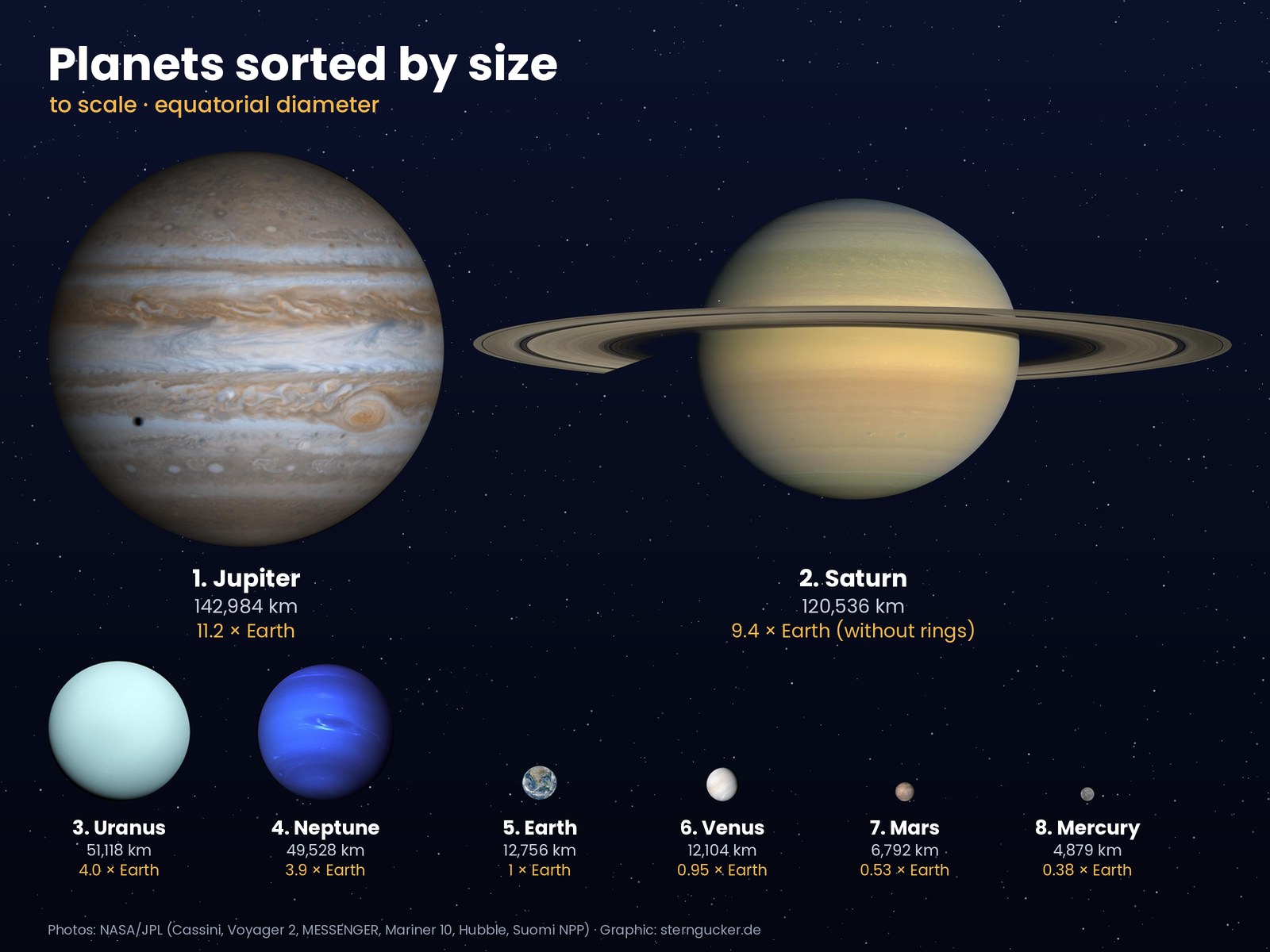
Planets in order of size: the table
The table ranks all eight planets by their equatorial diameter. The column “Earths that fit inside” compares volume – it shows how many Earth-sized globes it would take to fill the planet.
| Rank | Planet | Diameter | Earth = 1 | Earths that fit inside |
|---|---|---|---|---|
| 1 | Jupiter | 142,984 km | 11.2 × | 1,321 |
| 2 | Saturn | 120,536 km | 9.4 × | 764 |
| 3 | Uranus | 51,118 km | 4.0 × | 63 |
| 4 | Neptune | 49,528 km | 3.9 × | 58 |
| 5 | Earth | 12,756 km | 1 × | 1 |
| 6 | Venus | 12,104 km | 0.95 × | 0.86 |
| 7 | Mars | 6,792 km | 0.53 × | 0.15 |
| 8 | Mercury | 4,879 km | 0.38 × | 0.06 |
The biggest gap in the list lies between rank 4 and rank 5. Neptune is almost four times as wide as Earth, even though it is the smallest of the four giants.
Uranus and Neptune, on the other hand, are almost twins: they differ by just 3 percent. Earth and Venus are similarly close – which is why Venus is called Earth’s sister planet.
Planet size comparison: giants and rocky planets
Line up all the planets side by side and the solar system splits into two classes. Together, the four giants account for more than 99 percent of the total planetary mass; next to them, the four rocky planets are little more than crumbs.
There is a physical reason for this divide: beyond the so-called snow line, the young solar disc was cold enough for ice. Out there, planetary cores could grow quickly and pull in huge amounts of hydrogen and helium.
| Group | Planets | Diameter | Composition |
|---|---|---|---|
| Gas giants | Jupiter, Saturn | 120,000–143,000 km | almost entirely hydrogen and helium, no solid ground |
| Ice giants | Uranus, Neptune | around 50,000 km | water, methane and ammonia ices beneath a gas envelope |
| Rocky planets | Earth, Venus, Mars, Mercury | 4,900–12,800 km | rock and a metal core, solid surface |
How many Earths fit inside Jupiter?
About 1,321 Earths fit inside Jupiter, and 764 inside Saturn. That sounds like a lot – until you compare it with the Sun: it is almost ten times as wide as Jupiter, and around 1.3 million Earths fit inside the Sun.
Sorted by mass: Neptune overtakes Uranus
Size and weight are not the same thing. Sort by mass and Uranus and Neptune swap places: Neptune is slightly smaller, but denser and therefore heavier.
| Rank | Planet | Mass (Earth = 1) | Density |
|---|---|---|---|
| 1 | Jupiter | 318 | 1.33 g/cm³ |
| 2 | Saturn | 95 | 0.69 g/cm³ |
| 3 | Neptune | 17.1 | 1.64 g/cm³ |
| 4 | Uranus | 14.5 | 1.27 g/cm³ |
| 5 | Earth | 1 | 5.51 g/cm³ |
| 6 | Venus | 0.82 | 5.24 g/cm³ |
| 7 | Mars | 0.11 | 3.93 g/cm³ |
| 8 | Mercury | 0.06 | 5.43 g/cm³ |
Jupiter alone is more than twice as heavy as all the other planets combined. Saturn, in turn, is less dense than water – in a big enough bathtub, it would in theory float.
Earth is the densest planet of all. Its large iron core makes it heavier than its size would suggest.
Which planet looks biggest in the sky?
If you observe for yourself, what counts is not the true diameter but the apparent size. That depends on distance – and the winner is not Jupiter but Venus. We calculated the values ourselves using orbital data from the Jet Propulsion Laboratory (JPL ephemeris DE421) for the years 2020 to 2052.
| Planet | Apparent size | Magnification for “full-Moon size” | What you see in the telescope |
|---|---|---|---|
| Venus | 10–63″ | from about 30 × | phases like the Moon, no surface detail |
| Jupiter | 31–50″ | about 40 × | cloud belts, four moons, the Great Red Spot |
| Saturn | 15–21″, rings up to 47″ | about 40 × for the rings | rings, Cassini Division, the moon Titan |
| Mars | 3.5–25″ | 75–500 × | polar cap and dark areas, only around opposition |
| Mercury | 4.6–12″ | over 150 × | tiny phase, low in the twilight |
| Uranus | 3.4–4.1″ | about 450 × | pale green little disc |
| Neptune | 2.2–2.4″ | about 800 × | bluish dot, barely recognisable as a disc |
At around 40× magnification, Jupiter looks as big as the full Moon does without binoculars. Any beginner telescope can manage that – but details in the cloud belts still need more, usually 120× to 200×.
Uranus and Neptune, by contrast, look tiny despite their size. Atmospheric turbulence in Central Europe rarely allows more than about 250× magnification, so even in a good telescope Neptune stays a little dot.
Which aperture and magnification really make sense for planets is explained in detail in our guide Telescope for planets. Which planet is in the sky right now is shown on the page Planets visible tonight.
Our pick for planets: Skywatcher Dobson Telescope N 200/1200 Skyliner Classic
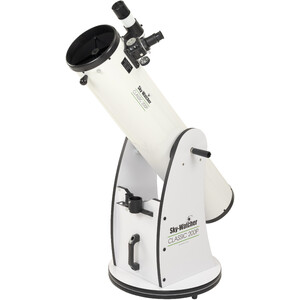
200 mm aperture for under 500 euros: in steady air, this Dobsonian shows the Cassini Division in Saturn’s rings, structure in Jupiter’s cloud belts and the polar cap of Mars. The catch: it’s big, and at high magnification you track by hand.
Price: € 479
The largest planet in the solar system: Jupiter
Jupiter is the largest planet in the solar system – 11.2 times as wide as Earth and 318 times as heavy. Its Great Red Spot, a storm that has been raging for centuries, is still slightly wider than Earth.
Jupiter is also visibly flattened: because it spins once in just under ten hours, it measures around 9,000 km more at the equator than from pole to pole. More about the giant and its moons is on the page Jupiter.
The smallest planet: Mercury – and the moons that are bigger
The smallest planet in the solar system is Mercury, with a diameter of 4,879 km. Two moons are bigger than it: Jupiter’s moon Ganymede and Saturn’s moon Titan.
| Body | Type | Diameter |
|---|---|---|
| Ganymede | moon of Jupiter | 5,268 km |
| Titan | moon of Saturn | 5,150 km |
| Mercury | planet | 4,879 km |
| Callisto | moon of Jupiter | 4,821 km |
| Io | moon of Jupiter | 3,643 km |
| The Moon | Earth’s moon | 3,475 km |
| Pluto | dwarf planet | 2,376 km |
| Eris | dwarf planet | 2,326 km |
Even so, Mercury is more than twice as heavy as Ganymede. A planet is not defined by its size but by its orbit: it circles the Sun directly and has cleared its orbital path.
That is exactly where Pluto fell short: since 2006 it has been classed as a dwarf planet. It is even smaller than our Moon – more about our companion on our page about the Moon.
The largest planet in the universe
The largest known planet is the exoplanet HAT-P-67 b in the constellation Hercules, about 1,200 light-years away. Its radius is about 2.14 times that of Jupiter – roughly 306,000 km in diameter, or about 24 Earths side by side.
It isn’t heavy, though: it has less than half of Jupiter’s mass. Its density is only about one sixteenth that of water – the planet is heated so strongly by its nearby star that it has puffed up like a balloon.
Without that kind of heat, a planet can hardly get much bigger than Jupiter. Adding mass doesn’t make a gas planet wider, it makes it denser – and from about 13 Jupiter masses we speak of a brown dwarf. How exoplanets are found in the first place is explained on the page Exoplanets.
Size comparison: planets, the Sun and the largest stars
Next to the Sun, even the giants shrink. The Sun is 109 times as wide as Earth and almost ten times as wide as Jupiter – more on our page about the Sun.
| Body | Diameter | compared with the Sun |
|---|---|---|
| Jupiter | 142,984 km | 0.1× |
| Sun | 1.39 million km | 1× |
| Sirius A | 2.4 million km | about 1.7× |
| Rigel | 110 million km | about 79× |
| Betelgeuse | 1.06 billion km | about 760× |
| UY Scuti | 2.4 billion km | about 1,700× |
| Stephenson 2-18 | 3.0 billion km | about 2,150× |
If Stephenson 2-18 took the Sun’s place, its surface would reach beyond the orbit of Saturn. At that scale, Earth would be smaller than a speck of dust on a football.
FAQ: planets in order of size
How big are the 8 planets?
Jupiter measures 142,984 km, Saturn 120,536 km, Uranus 51,118 km and Neptune 49,528 km. The rocky planets follow: Earth 12,756 km, Venus 12,104 km, Mars 6,792 km and Mercury 4,879 km.
What are the two largest planets?
Jupiter and Saturn. Both are gas giants, and together they hold a good 92 percent of all the planetary mass in the solar system.
Which is the largest and which the smallest planet?
The largest planet is Jupiter, the smallest is Mercury. Jupiter is almost 30 times as wide as Mercury.
Which planet is the same size as Earth?
Venus. It reaches 95 percent of Earth’s diameter and has a good four fifths of Earth’s mass – no other planet is so similar to Earth in size.
Is Pluto the smallest planet?
No – since 2006 Pluto is no longer a planet but a dwarf planet. At 2,376 km, though, it would indeed be smaller than Mercury and even smaller than Earth’s Moon.
Which planet is the second smallest?
Mars. At 6,792 km it is about half as wide as Earth and has only a tenth of its mass.
How big is the largest planet in the universe?
The largest known planet, HAT-P-67 b, has about 2.14 times Jupiter’s radius – roughly 306,000 km in diameter. But it is lighter than Jupiter and extremely puffed up.
Read more
- Our planets – an overview of all eight planets
- Planet mnemonic – remember the order from the Sun for good
- Jupiter – the giant planet and its moons, including Ganymede, the largest moon in the solar system
- Telescope for planets – which instrument really shows you Jupiter, Saturn and Mars
* Affiliate link: if you buy through this link we may earn a small commission from Astroshop or High Point Scientific, at no extra cost to you.