By Alexander Merz · Published on · Details checked on 30 September 2026
Aquila (the Eagle) is a summer constellation on the celestial equator whose brightest star, Altair, forms the southern corner of the Summer Triangle. It covers 652 square degrees, lies right in the band of the Milky Way and stands 51 to 73 degrees high in the south on late-summer evenings across the US.
More in our overview: Constellations.
At a glance
| Latin name | Aquila (crossword answer: AQUILA, 6 letters) |
| Area | 652 square degrees (rank 22 of 88) |
| Brightest star | Altair (Atair), magnitude 0.76, 16.7 light-years |
| Best time to observe | July to October, evenings; highest at 10 p.m. in early September |
| Altair’s culmination altitude | 51° in Seattle, 58° in New York, 66° in Dallas, 73° in Miami |
| Neighbors | Sagitta, Delphinus, Hercules, Ophiuchus, Serpens, Scutum, Sagittarius, Capricornus, Aquarius |
| Zodiac constellation? | No, the Sun never passes through Aquila |
How to find the Aquila constellation
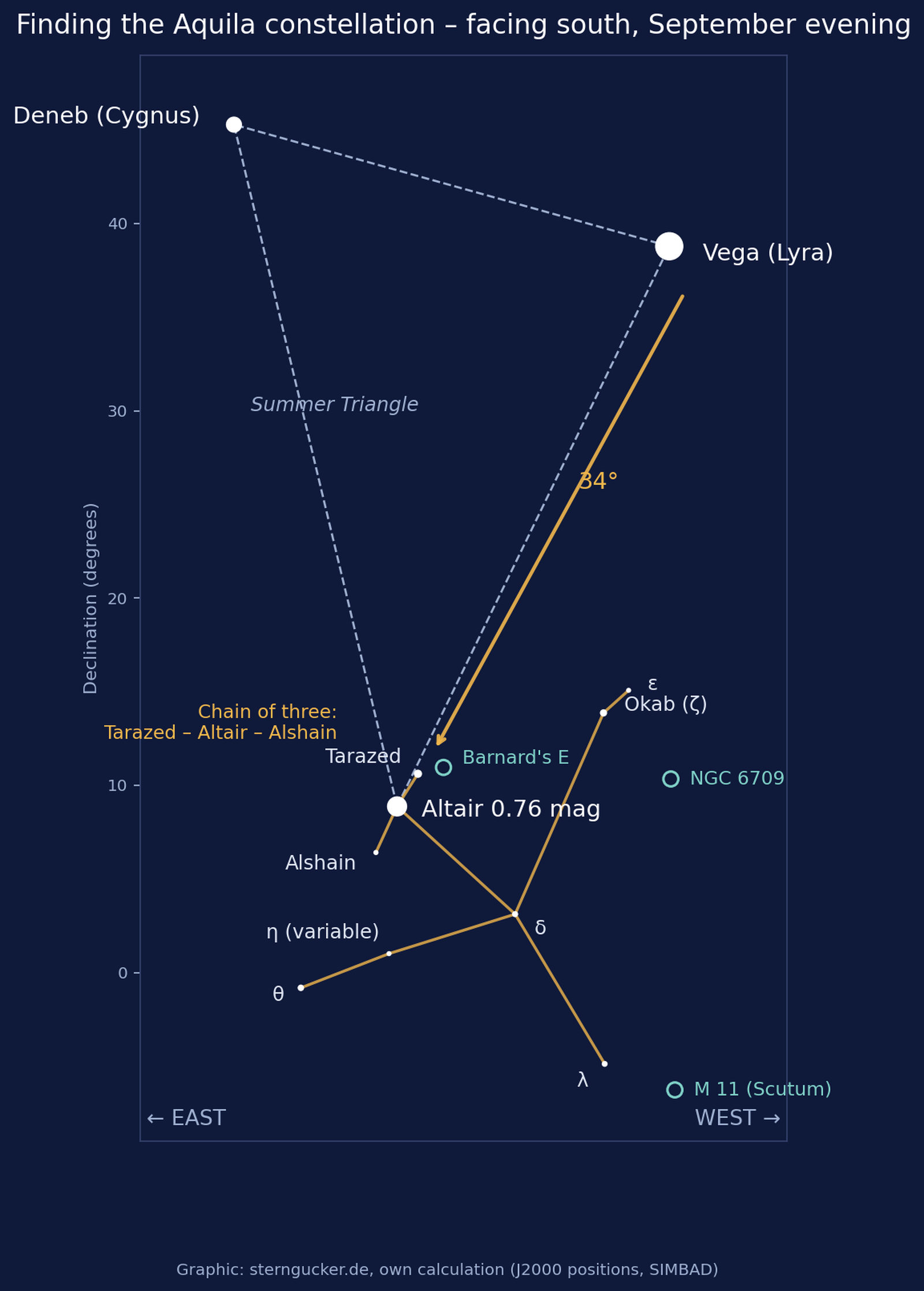
The surest starting point is the Summer Triangle. First find Vega, the bright star high overhead, and from there go 34 degrees south, slightly to the left – that is just over three fist-widths at arm’s length. The brightest star you reach there is Altair.
Its unmistakable pattern tells you whether you have it right. Altair sits in a short chain between Tarazed (2.1 degrees northwest) and Alshain (2.7 degrees southeast). No other bright star in the summer sky has such close company.
You will only see the rest of the figure under a darker sky. From the head with Altair, the body runs down to the right to the star Delta, and from there the wings spread to the lower left (Eta, Theta) and the upper right (Okab). The tail with Lambda points southwest toward Scutum.
Altair: the fast-spinning star in the Summer Triangle
At magnitude 0.76, Altair is the twelfth-brightest star in the night sky. At 16.7 light-years it is one of our close neighbors – of the three Summer Triangle stars it is the nearest; Vega is 25 and Deneb well over 1,000 light-years away.
What makes it special is its speed. Altair spins once on its axis in just under eight hours, while the Sun needs about 25 days. At its equator the surface races along at roughly 240 km (150 miles) per second.
This rotation visibly distorts the star. Its diameter at the equator is about a quarter larger than from pole to pole, and the poles, at about 8,600 kelvin (roughly 15,000 °F), are much hotter than the equator at about 6,800 kelvin (roughly 11,800 °F).
This isn’t just theory. In 2007 Altair became the first main-sequence star after the Sun to have its surface imaged directly – a star that, like the Sun, quietly burns hydrogen. It was done with the CHARA interferometer, which links several telescopes into one virtual giant telescope.
The stars of Aquila
| Star | Magnitude | Distance | Type |
|---|---|---|---|
| Altair (α Aql) | 0.76 | 16.7 light-years | white main-sequence star A7 V |
| Tarazed (γ Aql) | 2.72 | about 400–580 light-years | orange giant K3 II |
| Okab (ζ Aql) | 2.99 | about 85 light-years | white star A0 IV–V |
| θ Aql | 3.22 | about 230 light-years | B9.5 III |
| δ Aql | 3.36 | about 51 light-years | F1 IV–V |
| λ Aql | 3.43 | about 127 light-years | B8.5 V |
| Alshain (β Aql) | 3.71 | 44 light-years | yellowish subgiant G8 IV |
| η Aql | 3.5–4.4 | about 890 light-years | Cepheid, yellow supergiant F6 Iab |
Here, too, appearances deceive. Tarazed and Alshain look like Altair’s companions but sit at completely different depths: Alshain is 44 light-years away, Tarazed about ten times as far or more.
How high Aquila climbs over the US
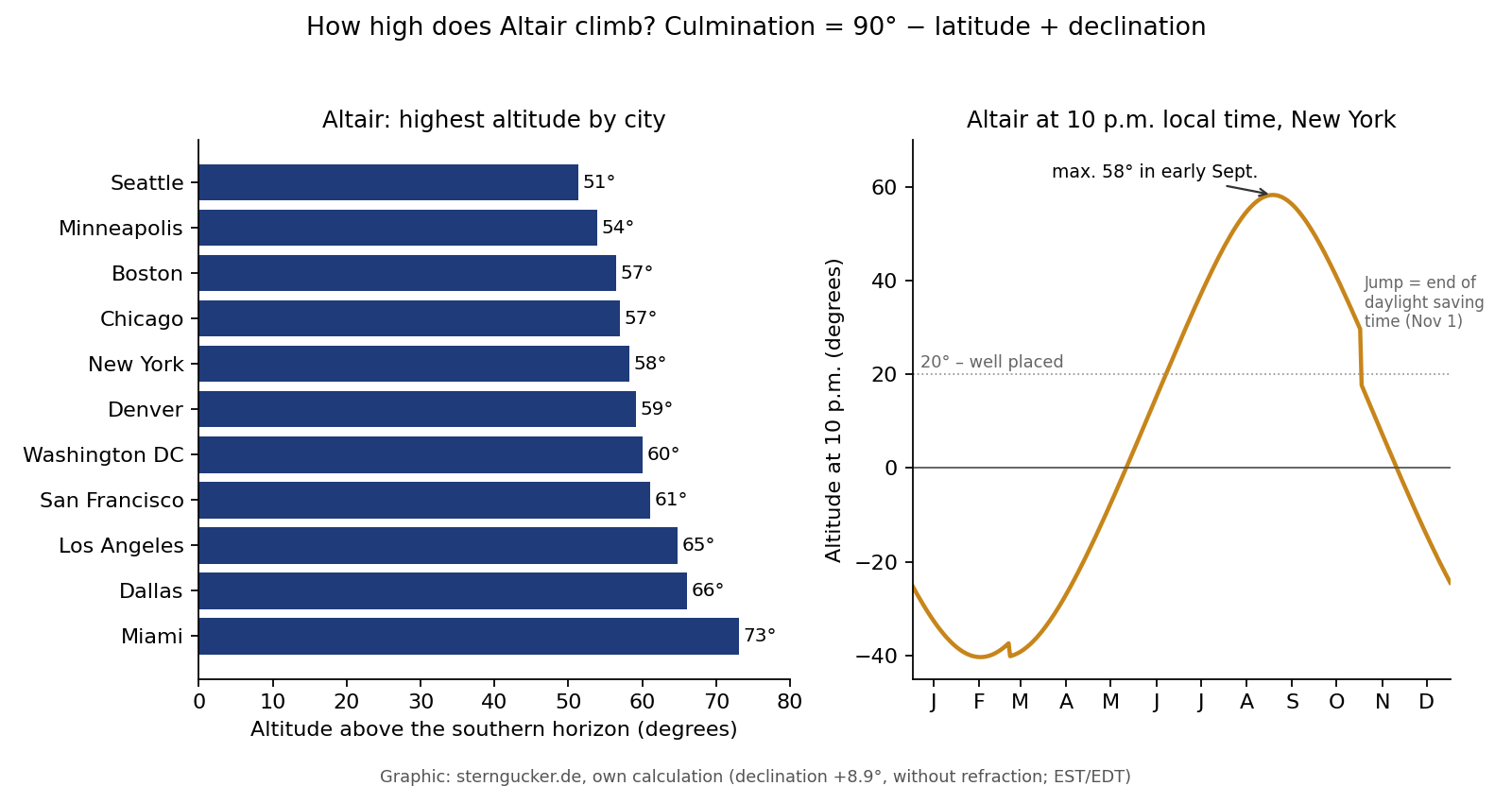
Altair lies just under nine degrees north of the celestial equator. That is why it climbs to between 51 and 73 degrees everywhere in the US – comfortably high, above the haze of most horizons.
| City | Altair | λ Aql (tail) |
|---|---|---|
| Seattle | 51° | 38° |
| Minneapolis | 54° | 40° |
| Boston | 57° | 43° |
| Chicago | 57° | 43° |
| New York | 58° | 44° |
| Denver | 59° | 45° |
| Washington DC | 60° | 46° |
| San Francisco | 61° | 47° |
| Los Angeles | 65° | 51° |
| Dallas | 66° | 52° |
| Miami | 73° | 59° |
Even the lowest part of the figure is hardly a problem. Lambda at the tip of the tail still reaches 38 degrees in Seattle – for comparison, Sirius in Canis Major only manages 26 there.
When you can see the Aquila constellation
Aquila is a summer and fall constellation. From late June to the end of October, Altair stands more than 20 degrees high at 10 p.m., highest in early September at 58 degrees in New York.
| Month | Altitude at 10 p.m. | Culmination |
|---|---|---|
| June | 15° | 3:10 a.m. |
| July | 37° | 1:12 a.m. |
| August | 55° | 11:10 p.m. |
| September | 56° | 9:08 p.m. |
| October | 41° | 7:10 p.m. |
| November | 7° | 4:08 p.m. |
| December to May | below the horizon | during the day |
In winter Aquila stays invisible because it is then close to the Sun. The Sun comes closest around January 22 but stays 29 degrees away, in Capricornus. It never passes through Aquila itself – which is why Aquila is not one of the zodiac constellations.
If you want to know what is worth looking at in a given month, check our monthly guides under Astronomical events. There you’ll find each month’s highlights in the evening sky, including the Summer Triangle while it is well placed.
Highlights: dark clouds, a pulsating star and a nova
Aquila lies in the middle of the summer Milky Way. Its most exciting object is therefore not a nebula but a hole in the carpet of stars: Barnard’s E, two dark clouds of dust that together look like a large E.
You find it about 1.4 degrees west of Tarazed. It only becomes visible under a truly dark sky and with bright, large-aperture binoculars – in the city you will search in vain. Don’t expect a view like the photos: at the eyepiece the cloud shows far less contrast.
A project for the naked eye is Eta Aquilae. The star is a Cepheid and varies between magnitude 3.5 and 4.4 every 7.2 days – Cepheids are pulsating giant stars that astronomers use to measure distances. Compare it with Delta (3.36) and Alshain (3.71) over two weeks, and you will see the change yourself.
In June 1918 a new star suddenly blazed up in Aquila. Nova Aquilae reached magnitude −0.5, brighter than Altair; today the star, V603 Aquilae, can only be found in a telescope as a faint speck.
Two star clusters are also worth a look in binoculars. The open cluster NGC 6709 (magnitude 6.7) lies just under 5 degrees southwest of Okab, and 4 degrees southwest of Lambda waits the Wild Duck Cluster M 11 – although it already belongs to the neighboring constellation Scutum.
The eagle in myth and legend
In Greek mythology the eagle is the animal of Zeus. It carried his thunderbolts and abducted the handsome shepherd boy Ganymede to Olympus – Ganymede can be seen in neighboring Aquarius. Another legend makes it the eagle that ate Prometheus’s liver as punishment.
In East Asia people tell a love story. There Altair is the cowherd, Vega the weaver girl, and the Milky Way separates the two; only once a year may they meet, which is commemorated by the Japanese Tanabata and the Chinese Qixi festival.
Binoculars or telescope
In Aquila, binoculars win. Barnard’s E, the Milky Way star fields and the color contrast between Tarazed and Altair need a wide field of view, not high magnification. A telescope only pays off here for small targets such as planetary nebulae or resolving M 11.
What matters when choosing is explained in our guide to astronomy binoculars. For getting started, a 10×50 is the most honest choice: usable handheld and bright enough for the Milky Way.
For the Milky Way in Aquila: Celestron Cometron 7x50 Binoculars
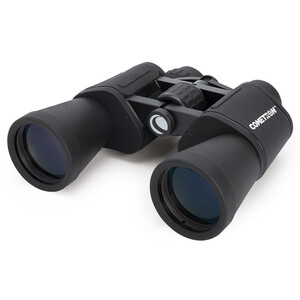
The astronomy classic among affordable binoculars: 7×50 with a large exit pupil for bright handheld views of the Moon and Milky Way – the ideal first step before a telescope.
Price: € 65
When bigger binoculars are worth it
With dark clouds, every millimeter of aperture counts. A 15×70 collects about twice as much light as a 10×50, and only this background of faint stars makes the dark gap of Barnard’s E stand out.
The Celestron 15 x 70 SkyMaster Pro Waterproof BinocularsOmegon Nightstar 15×70 shows noticeably more faint stars with its 70 mm (2.8 in) aperture, and therefore more contrast on dark clouds like Barnard’s E. Its 15x magnification also splits close star pairs and shows M 11 as a grainy patch. The catch: handheld the image shakes, so you need a tripod – the extra cost only pays off if you observe regularly under a dark sky.
For advanced observers: Omegon Nightstar 15x70 Binoculars
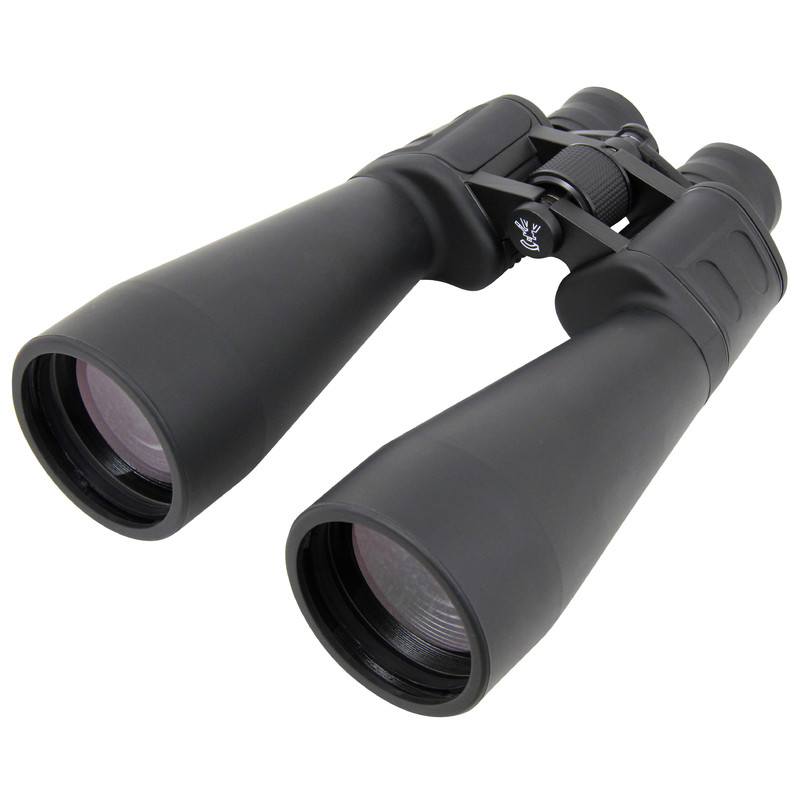
The classic astronomy binocular: 70 mm gathers twice the light of a 50 mm, and 1.5 kg is still manageable when braced.
Price: € 119
Frequently asked questions about the Aquila constellation
What is the brightest star in Aquila (6 letters)?
ALTAIR – that is the six-letter answer you are looking for. With 5 letters, the spelling ATAIR (used in German, for example) fits. Other stars in Aquila for crosswords are TARAZED and ALSHAIN (7 letters each) and OKAB (4 letters).
Is Altair the same as Atair?
Yes. Both names come from the Arabic at-tair, “the flying one”. Atair is common in German, while English and the International Astronomical Union use Altair.
Which constellation is Altair in?
Altair is the main star of the constellation Aquila, the Eagle. Together with Vega in Lyra and Deneb in Cygnus it also forms the Summer Triangle – but that is not a constellation of its own, rather a striking star pattern spanning three constellations.
How far away is Altair?
16.7 light-years. Among the especially bright stars you can see from most of the US, only Sirius and Procyon are closer. The light you see tonight is therefore almost 17 years old.
When is the best time to see the Aquila constellation?
In the evening from July to October, best in early September around 10 p.m. Altair then stands 58 degrees high in the south as seen from New York. From December to May Aquila cannot be seen in the evening.
Is the Eagle Nebula in the constellation Aquila?
No. The Eagle Nebula M 16 belongs to the constellation Serpens and lies about 32 degrees from Altair. The name refers to the shape of the gas cloud, which resembles an eagle with outstretched wings.
Further reading
- Summer Triangle – Altair, Vega and Deneb as signposts
- Vega – the bright star from which you find Altair
- Deneb – the distant third corner of the triangle
- Cygnus constellation – the neighbor in the middle of the Milky Way
- Identify constellations – how to find your way around the sky
- All constellations – our catalog at a glance
* Affiliate link: if you buy through this link we may earn a small commission from Astroshop or High Point Scientific, at no extra cost to you.