By Alexander Merz · Published on · Details checked on 14 September 2026
When it gets truly dark on a summer evening, all you need to do is tilt your head back: three dazzlingly bright stars stretch out a huge triangle high above you – the Summer Triangle. It is the perfect beginner’s target: impossible to miss, visible for months on end and the ideal starting point for exploring constellations, double stars and even the Milky Way. Here you’ll get to know its three stars – and everything hidden between them.
⚡ The quick answer: The Summer Triangle is made up of the three brightest stars of the summer sky: Vega (constellation Lyra), Deneb (Cygnus) and Altair (Aquila). It is not an official constellation, but an “asterism” – a striking star pattern drawn from three constellations. Visible from May into December, at the height of summer it stands almost directly overhead in the evening – right in the middle of the Milky Way.
The three stars of the Summer Triangle at a glance
| Star | Constellation | Brightness | Distance | What makes it special |
|---|---|---|---|---|
| Vega | Lyra | 0.0 mag (brightest of the three) | 25 light-years | Shining blue-white; it was our pole star 12,000 years ago – and will be again |
| Deneb | Cygnus | 1.25 mag | roughly 1,500–2,600 light-years | A supergiant with about 200,000 times the luminosity of the Sun – by far the most distant bright star in the sky |
| Altair | Aquila | 0.77 mag | 17 light-years | It rotates so fast that it is visibly flattened – a day on Altair lasts only about 9 hours |
💡 The goosebumps fact: All three stars seem equally “close” – in reality they are separated by a factor of around a hundred: Altair’s light was on its way for 17 years, Vega’s for 25 – but Deneb’s light set out when the Romans were just then ruling Europe (or even earlier: its distance remains astonishingly uncertain to this day). That Deneb still appears so bright makes it one of the most luminous stars in the entire Milky Way.
Finding the Summer Triangle: where and when?
- Season: From May onward it rises in the east in the evening sky; in July/August it stands almost at the zenith around 11 p.m. – directly above your head. Right into December it lingers in the west in the evening sky.
- How to spot it: Look for the three brightest stars high in the sky – they form a large, almost right-angled triangle. Vega is the brightest (in the west of the triangle), Altair lies furthest south (with two companion stars beside it), Deneb marks the north-east corner.
- Bonus under a dark sky: the band of the Milky Way flows right through the middle of the triangle – at its finest on nights near the new moon (dates in the full moon calendar). If you follow the band down from the triangle toward the south, you end up in the constellation Sagittarius – there you look straight into the centre of the Milky Way, and the band is at its brightest.
Is the Summer Triangle a constellation?
No – and that is the most common mix-up: the Summer Triangle is an asterism, a conspicuous star pattern that spans three official constellations (Lyra, Cygnus, Aquila). Just like the Big Dipper (part of Ursa Major), it is one of those figures everyone knows but which appear in no official constellation catalogue. Why the 88 constellations are defined the way they are is explained in our article Zodiac sign vs. constellation.
Treasure map: what hides within the Summer Triangle
The triangle is a complete observing programme for balmy nights:
- Albireo (the head of Cygnus): the most beautiful double star in the sky – gold and sapphire blue, already split in a small telescope.
- The Ring Nebula M57 (Lyra): the famous “smoke ring” of a dying star, between the two lower stars of Lyra.
- The Coathanger Cluster (Cr 399): through binoculars it really does look like an upside-down coat hanger – an insider tip between Altair and Albireo.
- The Dumbbell Nebula M27 (Vulpecula): one of the brightest planetary nebulae – a little smudge in binoculars, impressive in a telescope.
- Epsilon Lyrae, the “double-double star” next to Vega: a pair of stars whose two components are pairs in turn.
- The Milky Way star clouds in Cygnus – every sweep of the binoculars reveals hundreds of stars and dark dust lanes.
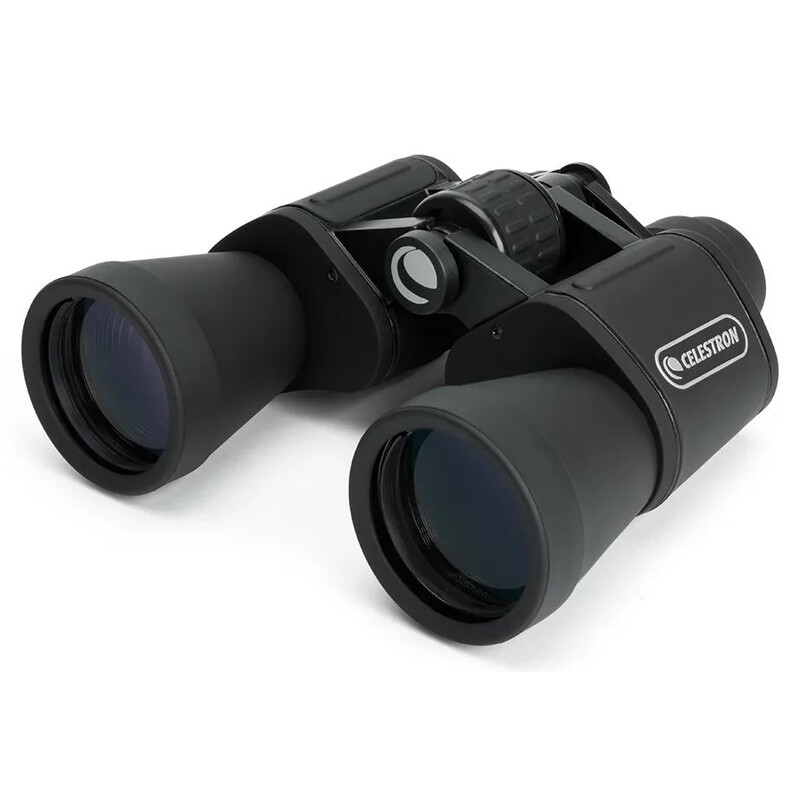 🔭 You can cover half the treasure map with binoculars: the Coathanger Cluster, Milky Way star clouds, Epsilon Lyrae – the Celestron UpClose G2 10x50 Porro Binoculars are the perfect Summer Triangle companion. Add the rotating star chart (€ 19.90) to help you find your way:
View binoculars* → View star chart* →
*Affiliate link: if you buy through it, we receive a small commission – the price does not change for you.
Summer Triangle and Winter Hexagon: the signposts of the seasons
What the Summer Triangle is to balmy nights, the Winter Hexagon is to frosty ones: a huge figure made up of the season’s brightest stars (Sirius, Rigel, Aldebaran, Capella, Pollux, Procyon) around Orion. Anyone who knows both figures can find their way around the sky all year round – and in late autumn you can even see both at the same time: the Summer Triangle setting in the west, the Winter Hexagon rising in the east.
Frequently asked questions about the Summer Triangle
Which stars make up the Summer Triangle?
Vega (Lyra), Deneb (Cygnus) and Altair (Aquila) – the three brightest stars of the summer sky.
Where can I find the Summer Triangle tonight?
In summer: after nightfall, high in the south to right above you. The three brightest stars high in the sky, forming a large triangle – you can hardly miss it.
Why can the Summer Triangle also be seen in autumn?
The name is misleading: the triangle is visible in the evening sky from May to December – in autumn it slowly moves toward the western horizon.
Which star in the Summer Triangle is the brightest?
Vega – at 0.0 mag, the fifth-brightest star in the entire night sky. The apparently “faintest” one, Deneb, is in fact by far the most luminous – it just happens to be a hundred times farther away.
⭐ Explore further: Vega · Deneb · Constellation Cygnus · The night sky in August 2026 · All constellations
And anyone who looks straight down from the Summer Triangle toward the southern horizon will find the constellation Scorpius with Antares there – the lowest, but also one of the most striking constellations of summer.