By Alexander Merz · Published on · Details checked on 30 September 2026
Auriga, the Charioteer, is a winter constellation and home to Capella, the sixth-brightest star in the night sky. It covers 657 square degrees, sits above Orion and in January passes almost straight overhead across much of the United States.
More in our overview: Constellations.
At a glance
| Latin name | Auriga (the Charioteer) |
| Area | 657 square degrees (rank 21 of 88) |
| Brightest star | Capella, magnitude 0.08, just under 43 light-years |
| Best time to observe | evenings from December to February |
| Peak altitude of Capella | 88° in Seattle, 85° in New York, 77° in Dallas |
| Circumpolar | Capella yes, north of 44° N (e.g. Seattle, Minneapolis); farther south it sets for a few hours |
| Neighbors | Camelopardalis, Perseus, Taurus, Gemini, Lynx |
| Best-known deep-sky objects | open star clusters M 36, M 37 and M 38 |
How to find the Auriga constellation
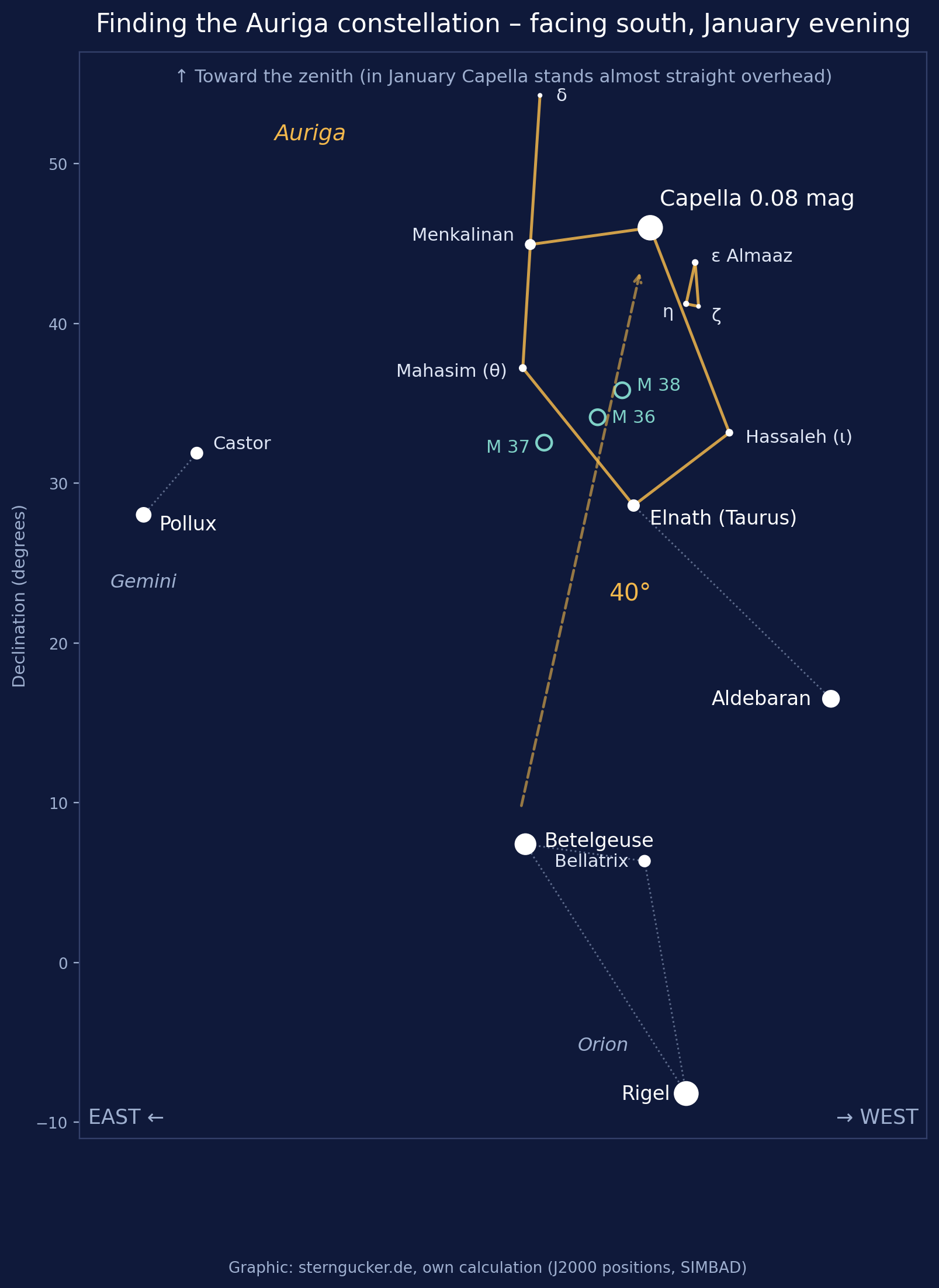
On a winter evening, Orion is your signpost. From reddish Betelgeuse, his left shoulder, go about 40 degrees straight up – roughly four hand widths at arm’s length. The brightest star you run into there is Capella.
Halfway there you pass Elnath, 22 degrees above Betelgeuse. Elnath forms the bottom point of the pentagon that it makes together with Capella, Menkalinan, Mahasim and Hassaleh. The figure stands above Orion like a lopsided house with a pointed roof.
In the fall, the Orion method does not work yet. Then Capella rises low in the northeast in the evening and often twinkles in surprisingly vivid colors – an effect of the thick layer of air near the horizon. Our guide to the stars helps you tell which bright star is which.
The stars of Auriga
| Star | Magnitude | Distance | Type |
|---|---|---|---|
| Capella (α Aur) | 0.08 | just under 43 light-years | two yellow giants G8 III + G0 III |
| Menkalinan (β Aur) | 1.90 | about 81 light-years | eclipsing binary, A-type |
| Mahasim (θ Aur) | 2.62 | about 166 light-years | white star A0p, double star |
| Hassaleh (ι Aur) | 2.69 | about 450 light-years | orange giant K3 II |
| Almaaz (ε Aur) | 2.99 | uncertain, 2,000–3,500 light-years | supergiant F0, eclipsing binary |
| Haedus (η Aur) | 3.18 | about 233 light-years | blue main-sequence star B3 V |
| Saclateni (ζ Aur) | 3.75 | about 860 light-years | K5 II + B7 V, eclipsing binary |
A striking number of these stars are eclipsing binaries. Menkalinan, Almaaz and Saclateni are double stars whose partners block each other as seen from Earth – for Menkalinan every 3.96 days, although you will hardly notice it.
Elnath used to be the star γ Aurigae. Today it officially belongs to the Taurus constellation, where it marks the tip of the northern horn. It is still drawn as part of the Charioteer’s figure.
Capella: the star in Auriga
Capella means “little she-goat”. At magnitude 0.08 it is the sixth-brightest star in the entire sky and, after Arcturus and Vega, the third-brightest in the northern sky. Its yellowish hue resembles our Sun.
In fact, Capella is not a single star. It is two yellow giant stars of about two and a half solar masses each, orbiting each other in just 104 days. They are roughly 12 and 9 times the Sun’s diameter, and each shines about 75 times as bright as the Sun.
You cannot split the two. They are only 0.74 astronomical units apart – less than the Sun–Earth distance – which from just under 43 light-years can only be measured with interferometers (large telescopes linked together). A pair of faint red dwarfs orbits much farther out.
Why Capella passes almost overhead
Capella has a declination of +46.0 degrees. At exactly 46 degrees north – just north of Portland, Oregon, and Minneapolis – it passes straight overhead. It reaches 89 degrees in Minneapolis, 88 in Seattle, 85 in New York and still 70 degrees in Miami.
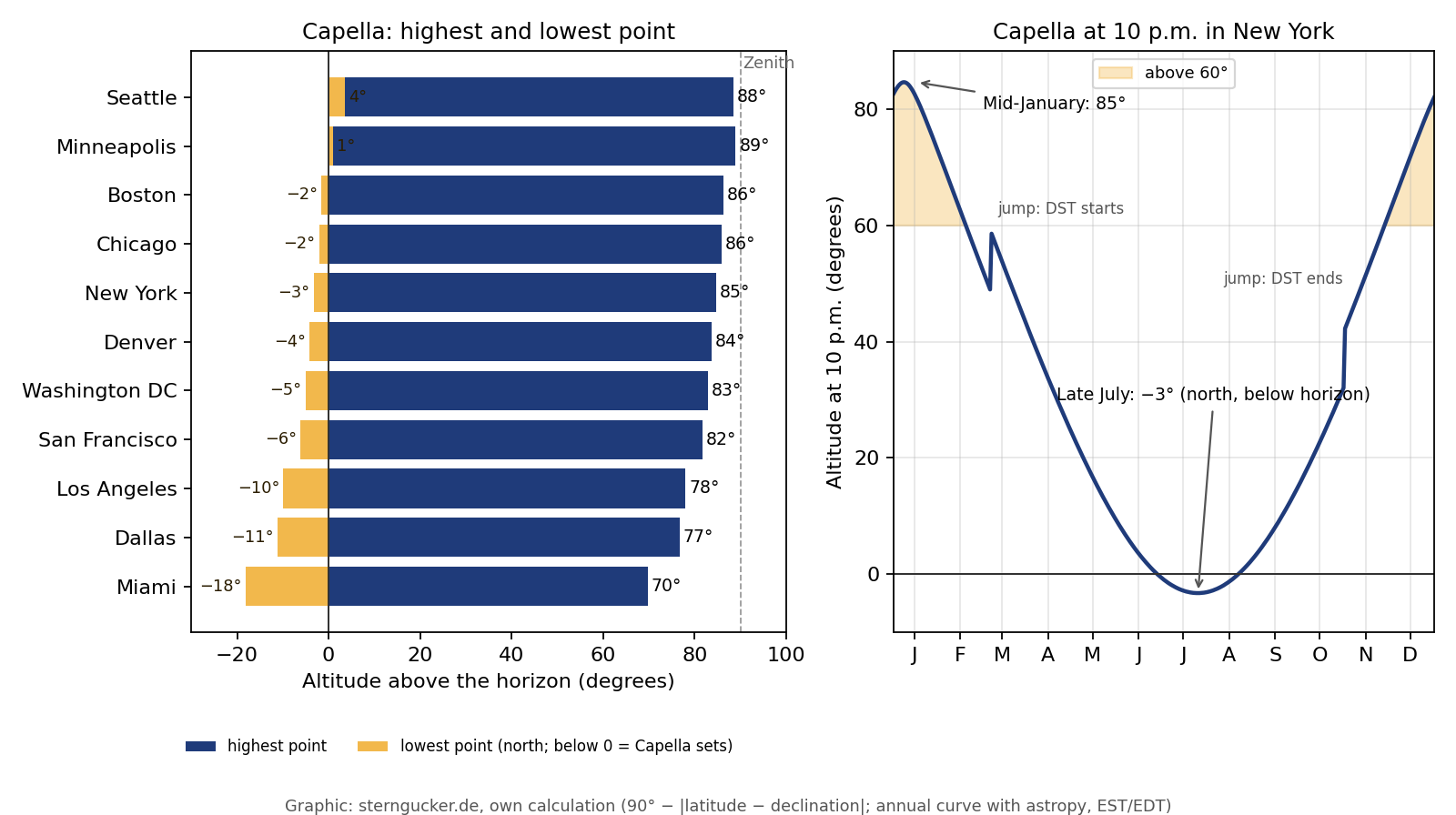
The second consequence of this high declination: Capella is circumpolar and never sets north of 44 degrees latitude. At its lowest point in the north it still stands 4 degrees high in Seattle and 1 degree in Minneapolis. From Boston southward it dips below the northern horizon for a while – about 2.5 hours in Boston, 3.6 in New York and 8 hours in Miami.
For observing, this means: in winter Auriga sits right above you in the best seeing, far from the haze near the horizon. Looking straight up is uncomfortable, though – a reclining lawn chair helps.
When Auriga is visible
Auriga is a classic winter constellation. From late November to mid-February, Capella stands higher than 60 degrees at 10 p.m., highest in mid-January.
| Month | Altitude at 10 p.m. | Direction | Culmination |
|---|---|---|---|
| September | 8° | northeast | 6:34 a.m. |
| October | 23° | northeast | 4:36 a.m. |
| November | 51° | northeast | 1:34 a.m. |
| December | 72° | northeast | 11:36 p.m. |
| January | 83° | almost overhead, slightly north | 9:32 p.m. |
| February | 63° | northwest | 7:30 p.m. |
| March | 54° | northwest | 6:40 p.m. |
| April to June | 34° to 4° | northwest | afternoon |
| July and August | below the horizon (−3° to −1°) | north | morning |
In summer, little is left of Auriga. In mid-June the Sun passes only a good 5 degrees from Elnath, and the southern part of the figure sets in daylight. Capella itself hugs the northern horizon in the short nights or, in most of the US, dips below it.
The Sun never enters Auriga on its yearly path. That is why it is not a zodiac constellation, unlike its neighbor Taurus. And if you ever want to observe the Sun during the day: only with a certified front-mounted solar filter.
M 36, M 37 and M 38: three star clusters in a row
In the middle of the pentagon lie three open star clusters – loose groups of young stars born together. M 38, M 36 and M 37 line up almost perfectly, just under 6 degrees long in total. They are between about 3,700 and 4,900 light-years away.
| Cluster | Magnitude | Size | Distance |
|---|---|---|---|
| M 36 | 6.0 | 12 arcminutes | about 3,900 light-years |
| M 37 | 5.6 | 23 arcminutes | about 4,900 light-years |
| M 38 | 6.4 | 20 arcminutes | about 3,700 light-years |
In binoculars they look like three small fuzzy patches. Only a telescope resolves them into individual stars – M 37 is the richest and most beautiful, with a dense core of hundreds of faint stars. M 36 looks loose and bright by comparison, while M 38 shows a striking cross shape.
Epsilon Aurigae: the star with the 27-year eclipse
Almaaz, only 3.4 degrees from Capella, is one of the most puzzling stars of all. Every 27.1 years a huge, dark disk of dust slides in front of the supergiant and dims it for almost two years from magnitude 2.9 to 3.8.
The last eclipse ran from 2009 to 2011. By our calculation, the next one begins in the fall of 2036, with mid-eclipse in 2037. You will be able to see the drop in brightness with the naked eye by comparing Almaaz with the neighboring Kids.
Mythology: charioteer and goat
The figure combines two legends. The Charioteer himself is usually identified as Erichthonius, revered as the inventor of the four-horse chariot; other traditions see him as the charioteer Myrtilus.
On his shoulder he carries a goat. Capella is the goat Amalthea, who nursed the infant Zeus with her milk, and the Kids next to her are her young. That is also where the names Capella (“little she-goat”) and Haedus (“young goat”) come from.
Binoculars or telescope
For Auriga, the telescope wins. M 36, M 37 and M 38 are small enough that only aperture and magnification reveal their stars – aperture means the diameter of the main optics, which determines how much light it collects. A pair of Celestron 7x50 Cometron BinocularsCelestron UpClose G2 10x50 Porro Binoculars is enough to find the three patches, but not much more.
Ideal for M 36 to M 38: Skywatcher Dobson Telescope N 130/650 Heritage FlexTube
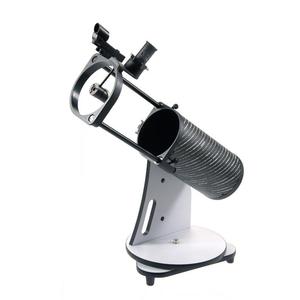
A compact tabletop Dobson with a true parabolic mirror. Folds down, fits in a bag: the Moon, planets and the bright deep-sky classics.
Price: € 265
When more aperture pays off
More aperture mainly shows you more faint stars. M 37 in particular gains with every millimeter, because its dense core consists of very faint members.
The Skyliner 200/1200 DobsonianSkyliner 200/1200 Dobsonian collects a good twice as much light as a 130 mm with its 200 mm (8 in) aperture. In practice that means M 37 resolves into individual stars right into its core, and fainter clusters in Auriga such as NGC 1893 become worthwhile. The extra cost pays off if star clusters and nebulae keep drawing you back – for a first look at the three Messier clusters you do not need it.
For advanced observers: Skywatcher Dobson Telescope N 200/1200 Skyliner Classic
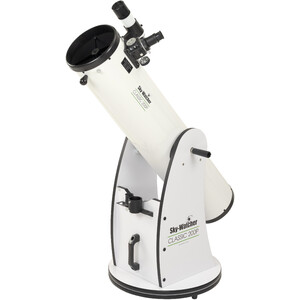
200 mm of aperture — the most sky for your money. Set it on the ground, point by hand: nebulae, clusters and galaxies for years to come.
Price: € 479
Frequently asked questions about the Auriga constellation
How do I find the Auriga constellation?
In winter, go about 40 degrees straight up from Betelgeuse in Orion – roughly four hand widths. There you will find the bright, yellowish Capella. Auriga’s pentagon closes below it with Elnath.
What does Auriga mean?
Auriga is the Latin name of the constellation and means charioteer. In crosswords, AURIGA (6 letters) is the usual answer for “the Charioteer constellation”. The IAU abbreviation is Aur.
How bright is the star Capella and how far away is it?
Capella shines at magnitude 0.08, making it the sixth-brightest star in the night sky. It is just under 43 light-years away. Behind the point of light are two yellow giant stars that orbit each other in 104 days.
Is Auriga visible all year?
North of 44 degrees – Seattle, Minneapolis – Capella never sets; farther south it dips below the northern horizon for a few hours each day. In summer it stands at most a few degrees above the northern horizon and gets lost in the twilight. You can see the whole figure well from November to March.
Which star clusters are in Auriga?
The best known are the open star clusters M 36, M 37 and M 38, all between magnitude 5.6 and 6.4. In binoculars they are small patches; in a telescope they resolve into stars. M 37 is considered the most beautiful of the three.
Does Elnath belong to Auriga or to Taurus?
Officially to Taurus, where it is called β Tauri. It used to be listed as γ Aurigae as well. Star charts still usually draw it as a corner of Auriga’s pentagon.
When is the next eclipse of Epsilon Aurigae?
The period is 27.1 years, and the last eclipse ran from 2009 to 2011. By our calculation, the next one begins in the fall of 2036 and lasts almost two years. You can follow it with the naked eye.
Keep reading
- Orion constellation – the signpost to Auriga
- Taurus constellation – the neighbor that Elnath belongs to today
- Deep-sky objects – what sets star clusters, nebulae and galaxies apart
- Astronomy binoculars – which binoculars suit the night sky
- Night sky in January – what you can see when Auriga is highest
- Identify constellations – the method that actually works
- All constellations – our catalog at a glance
* Affiliate link: if you buy through this link we may earn a small commission from Astroshop or High Point Scientific, at no extra cost to you.