By Alexander Merz · Published on · Details checked on 14 September 2026
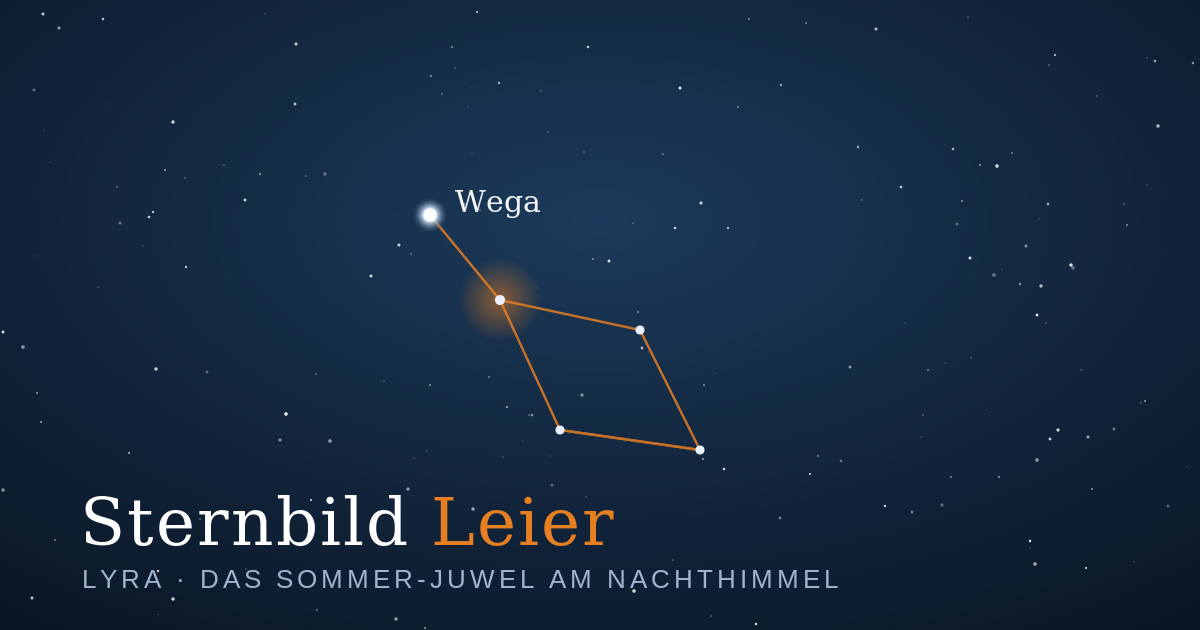
Lyra at a glance: a small but striking summer constellation that stands almost directly overhead on summer evenings in Germany. Its brightest star Wega is one of the brightest stars in the sky – and hidden at the heart of Lyra, the Ring Nebula M57 is probably the finest telescope target for beginners.
Lyra (Latin: Lyra) is one of the smallest constellations in the sky – but also one of the most rewarding. Packed into a small area you’ll find a star of superlatives, a famous quadruple star to test your telescope, and a dying star drifting through space as a glowing smoke ring.
This guide shows you how to find Lyra, what treasures it holds, and which equipment is best for observing it.
Fact sheet: the constellation Lyra
| Feature | Detail |
|---|---|
| Latin name | Lyra (Lyr) |
| Brightest star | Wega (α Lyrae), 0,03 mag |
| Best-known objects | Ring Nebula M57, quadruple star (Double Double) ε Lyrae |
| Size | 286 square degrees (rank 52 of 88) |
| Best visibility | June to October, at the zenith in high summer |
| Visible from | all of Germany, Austria, Switzerland |
| Neighboring constellations | Cygnus, Hercules, Draco, Vulpecula |
Where and when can I find Lyra?
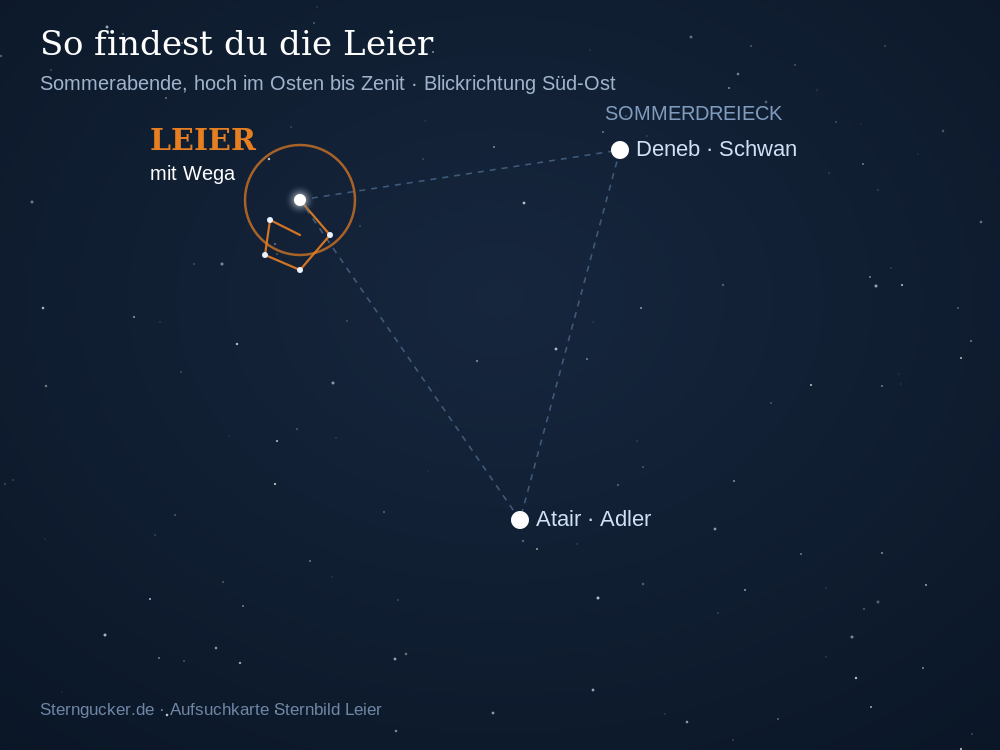
Lyra is a classic summer constellation. From April onward it climbs above the eastern horizon late in the evening, and throughout summer it sits high at the zenith – so you need to look almost straight up.
The easiest way is via its brightest star: Wega is so bright that you’ll spot it immediately. Together with Deneb in Cygnus and Atair in Aquila, it forms the striking Summer Triangle – the three brightest stars in the summer sky. Wega is the brightest and westernmost of the three.
Directly below Wega you’ll spot a small, slanted parallelogram made of four fainter stars. That’s the body of Lyra – the shape sticks in your memory quickly.
| Month | Visibility of Lyra |
|---|---|
| April/May | late at night, low in the east |
| June–August | all night, at the zenith in high summer |
| September/October | in the evening, high in the west |
| Winter | not visible (daytime sun) |
For a first look, the naked eye is enough. If you want to scan the area around Wega and enjoy the Milky Way at the same time, reach for binoculars – the perfect tool to get started:
The best choice for exploring: Celestron UpClose G2 10x50 Porro Binoculars
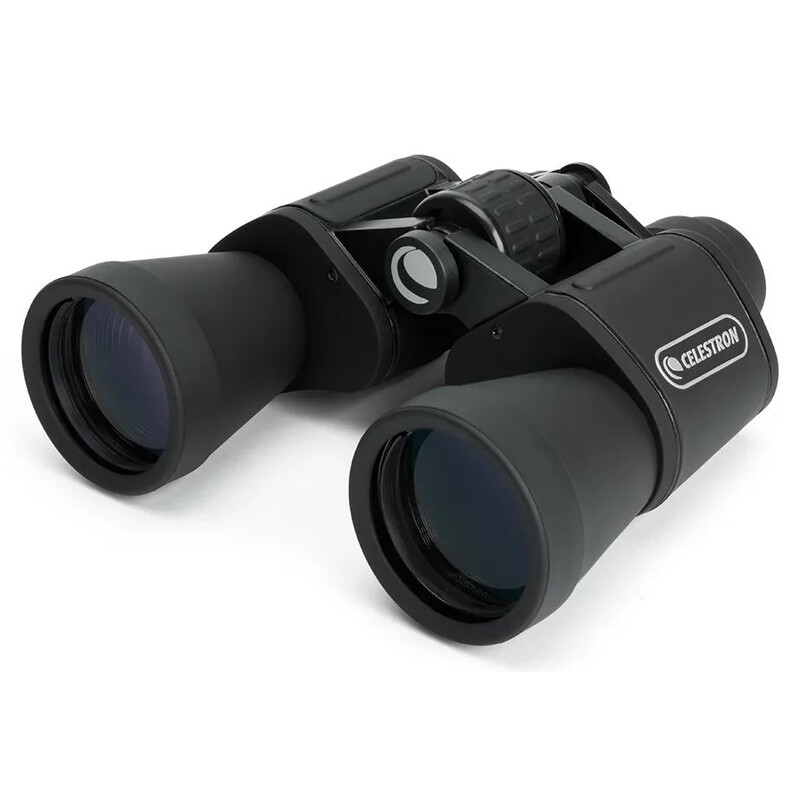
The honest entry point: 10x50 with a 5 mm exit pupil, rubber-armoured, under 80 euros. Shows the Moon, the Pleiades and Jupiter’s moons.
Price: € 62
The stars of Lyra
Wega (α Lyrae) is the star of the constellation – quite literally. At 0,03 mag it is the fifth-brightest star in the entire night sky and only about 25 light-years away. Its bluish-white light long served astronomers as the zero point of the magnitude scale. You can read everything about this exceptional star in the profile of Wega.
Sheliak (β Lyrae) is a fascinating eclipsing binary: two stars orbit each other so closely that they eclipse one another – every 12,9 days the brightness visibly changes. Compare Sheliak with neighboring Sulafat over a week or two, and you’ll see the difference with the naked eye.
Sulafat (γ Lyrae) marks the lower corner of the parallelogram and shines steadily at 3,3 mag. Together with Sheliak it forms the “base” of Lyra. The other corner stars, Delta and Zeta, complete the constellation’s characteristic shape.
Epsilon Lyrae: the famous quadruple star
Right next to Wega sits Epsilon Lyrae, one of the most popular test objects in amateur astronomy. Even in binoculars the star splits into two points of light. But the real marvel only appears in a telescope: each of the two stars is itself again a double star – a quadruple system, the “Double Double”.
That’s exactly why stargazers love Epsilon Lyrae: whether your telescope cleanly separates all four stars is the classic test of its optical sharpness and of steady air. From about 60 mm of aperture and 100x magnification, the split succeeds on a calm night.
Perfect for splitting the quadruple star & for getting started:
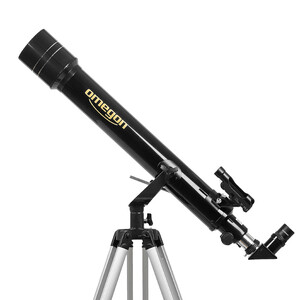
Omegon Teleskop AC 70/700 AZ-2 – approx. 119 €
A rugged, maintenance-free refractor. Shows the Double Double, the Moon’s craters, and the bright planets – the ideal taster introduction for families.
View offerRing Nebula M57 – the jewel of Lyra
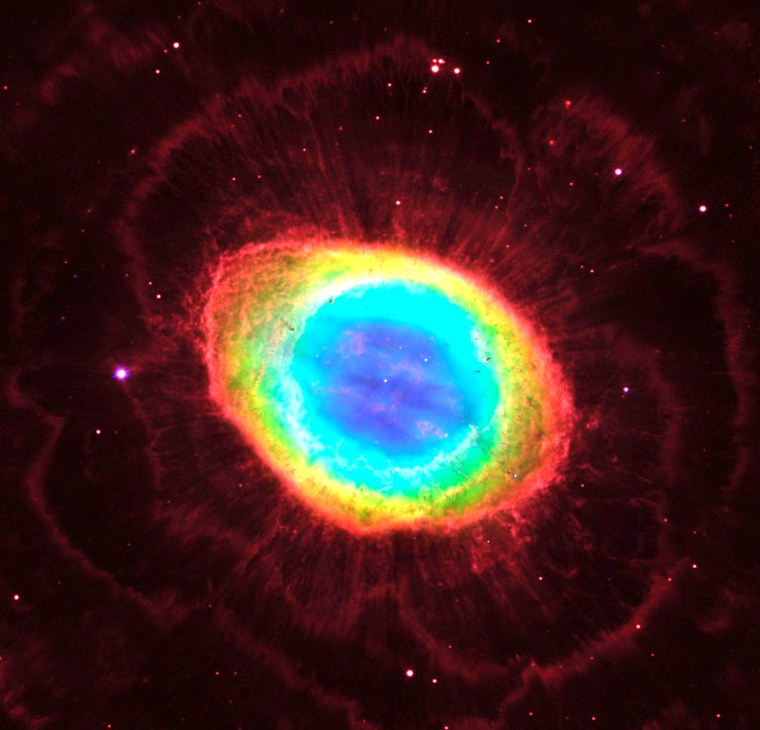
Exactly halfway between the two lower parallelogram stars Sheliak and Sulafat lies the highlight of Lyra: the Ring Nebula M57. It is a planetary nebula – the shed gas shell of a dying star that once resembled our Sun.
From Earth we look straight through the tube of this shell, which is why we see it as a perfect, glowing smoke ring. In about 5 to 6 billion years, our Sun will put on a similar display.
Important to know in advance: M57 remains invisible to the naked eye or with binoculars – the nebula is too small and too faint for that. To see the ring, there’s no way around using a telescope.
Here’s how to see M57 yourself: the Ring Nebula is small, but already visible in a telescope from about 100 mm of aperture as a tiny, grey smoke ring. The larger the aperture, the more clearly the ring shape stands out. A sky that’s as dark as possible, away from city lights, is essential. Photographically, M57 then reveals its full array of colors – a rewarding target for deep-sky astrophotography.
Our recommendation for seeing the Ring Nebula clearly as a ring:
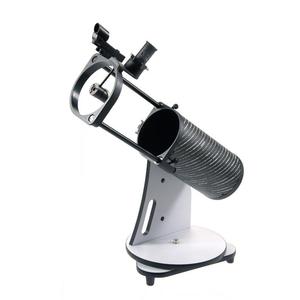
Skywatcher Heritage 130/650 FlexTube – approx. 265 €
Plenty of aperture for the money: the 130 mm shows M57 as a distinct ring and resolves globular clusters. Compact and collapsible, and dead simple to use thanks to its Dobson mount – our best value-for-money pick.
View offerWhen you’re ready for the next step
More aperture means more light: our best-selling telescope for advanced stargazers shows you the Ring Nebula M57 and countless other deep-sky objects noticeably brighter and more detailed.
Skywatcher Dobson Telescope N 200/1200 Skyliner Classic
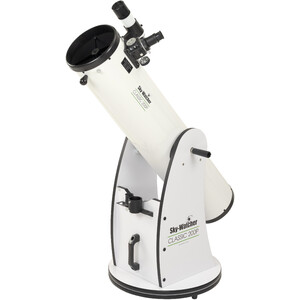
200 mm of aperture — the most sky for your money. Set it on the ground, point by hand: nebulae, clusters and galaxies for years to come.
Price: € 479
Which device suits you best is explained in our beginner’s telescope guide – and for faint nebulae and galaxies, it’s worth checking out the telescope-for-galaxies guide.
Even more treasures in Lyra
Globular cluster M56: between Lyra and Cygnus hides this dense ball of hundreds of thousands of stars – in a telescope, a hazy, grainy patch, a nice contrast to the Ring Nebula.
RR Lyrae: this unassuming star gives its name to an entire class of stars. RR Lyrae stars pulsate with an extremely regular rhythm and serve astronomers as “standard candles” for measuring distances in the universe.
The Lyrids: every year around April 22, shooting stars appear to stream out of Lyra – the Lyrids, one of the oldest known meteor showers of all.
The mythology: Orpheus and his lyre
According to legend, the lyre belonged to the gifted singer Orpheus. His playing was so enchanting that it tamed wild animals and even brought stones to tears.
When his wife Eurydice died of a snakebite, Orpheus descended with his lyre into the underworld. His music moved even Hades, the god of the dead – he was allowed to lead Eurydice back to life, on one condition: not to turn around even once on the way up. At the last moment, doubt won out, Orpheus looked back – and lost Eurydice forever. In remembrance, the gods placed his lyre in the sky as a constellation.
Observing tips: how to get the most out of Lyra
Give your eyes time. Only after 20 to 30 minutes in darkness do your eyes reach full sensitivity (dark adaptation). Avoid bright light during this time – and use night mode for the star chart on your phone, or a red film over your flashlight.
Use averted vision. Faint objects like the Ring Nebula M57 appear more distinct when you don’t look directly at them, but slightly to the side. This technique of “averted vision” makes use of the more sensitive outer areas of the retina – a real insider tip for nebulae and galaxies.
Choose the right night. Observing is best at new moon with clear, calm air. Full moon nights brighten the sky and make M57 nearly disappear. And the further you get away from the city’s light pollution, the more stars and detail Lyra will show you.
Photographing Lyra. Even with just a camera and tripod you can capture Wega and the Summer Triangle above the landscape. For the Ring Nebula itself you’ll need a tracking mount and some practice – our guide to deep-sky photography shows you how to get started. The technique of Moon photography also helps you understand the interplay between focal length and exposure.
Frequently asked questions about Lyra
What is the brightest star in the constellation Lyra called?
The brightest star is Wega (α Lyrae) at 0,03 mag – also the fifth-brightest star in the entire night sky, and only about 25 light-years away.
When and where can you see Lyra in Germany?
From June to October. In high summer it sits almost directly overhead at night (at the zenith). You can find it via the bright star Wega, the westernmost point of the Summer Triangle.
What is the Ring Nebula M57?
A planetary nebula – the shed gas shell of a dying star. We look straight through the tube of the shell and see it as a glowing ring. It lies midway between the two lower stars of Lyra and is visible from approx. 100 mm of telescope aperture.
Why is Epsilon Lyrae so special?
It’s a quadruple system – the “Double Double”. Even in binoculars the star splits into two points; in a telescope, each of those becomes a double star in turn. A classic test for the sharpness of your optics.
What telescope do I need for Lyra?
For Wega and the Summer Triangle, the naked eye or binoculars are enough. To split Epsilon Lyrae, a small telescope from 60–70 mm is sufficient. For the Ring Nebula M57 as a clear ring, an aperture of 100–130 mm is recommended.