By Alexander Merz · Updated on
Hercules is the fifth-largest of the 88 constellations and sits in the summer sky between Arcturus and Vega. It is famous for M 13, the best-known globular cluster of the northern sky – a ball of several hundred thousand stars about 24,000 light-years away.
Hercules constellation at a glance
| Latin name | Hercules, abbreviation Her |
| Area | 1,225 square degrees (rank 5 of 88) |
| Brightest star | Kornephoros (β Her), magnitude 2.8 |
| Best time to observe | Evenings from June to September |
| Highest altitude of M 13 | 76° in Frankfurt, 73° in Hamburg, almost 80° in Bern |
| Neighbours | Draco, Lyra, Vulpecula, Sagitta, Aquila, Ophiuchus, Serpens, Corona Borealis, Boötes |
| Best-known deep-sky objects | Globular clusters M 13 and M 92, planetary nebula NGC 6210 |
How to find the Hercules constellation
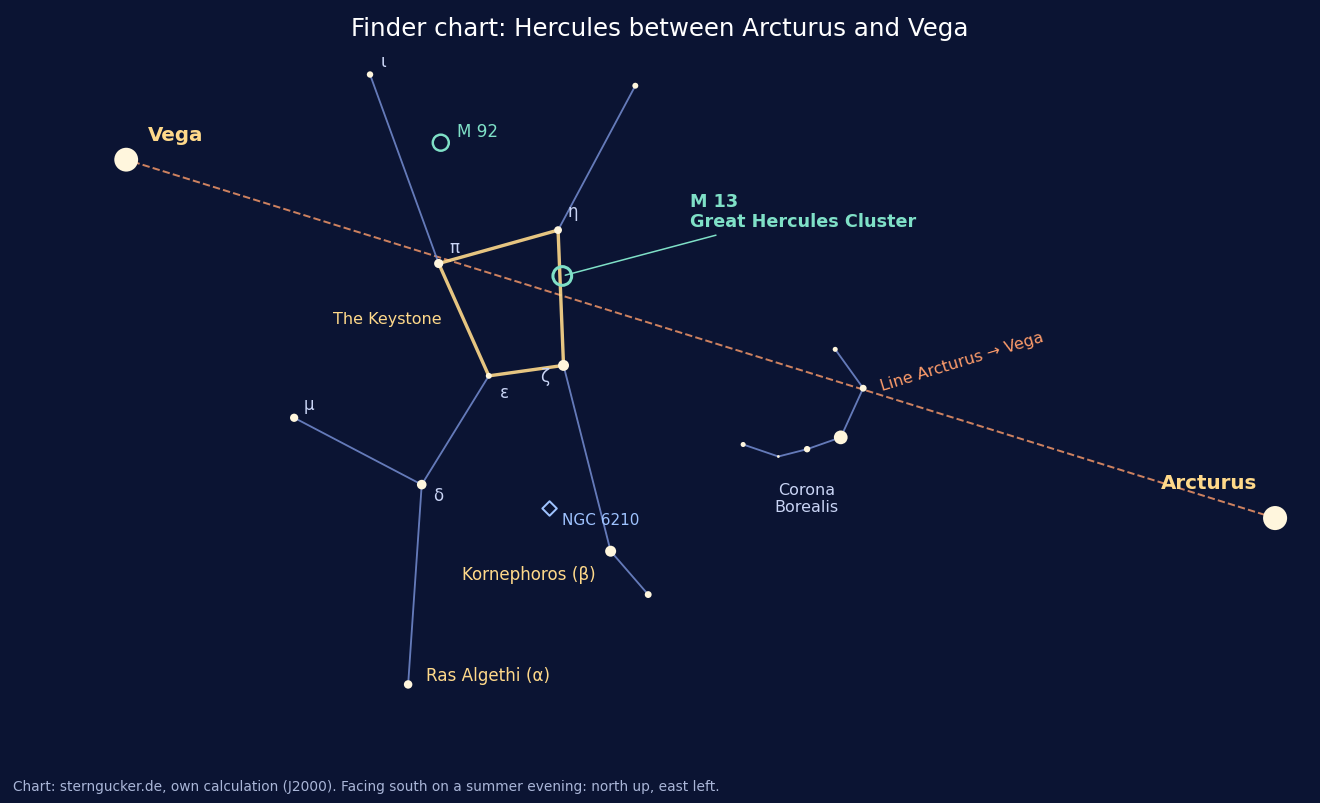
Hercules has no single eye-catching star. So you find it via two neighbours: orange Arcturus to the west and white Vega to the east. You reach Arcturus in early summer by following the arc of the handle of the Big Dipper; Vega is the brightest star high in the east.
Imagine a line from Arcturus to Vega. About two-thirds of the way along lies the quadrilateral of ε, ζ, η and π Herculis, known as the Keystone. The four stars are only 3rd to 4th magnitude, but they form a clear trapezoid with sides 4 to 7 degrees long.
The figure’s arms and legs branch off from the Keystone. From Central Europe Hercules appears upside down: his head, Ras Algethi, lies low in the south, while his legs reach up towards Draco. Under a bright city sky usually only the quadrilateral remains – and that is enough for M 13.
The stars of Hercules
| Star | Magnitude | Distance | Type |
|---|---|---|---|
| Kornephoros (β Her) | 2.8 | about 140 light-years | yellow giant |
| ζ Her | 2.8 | about 35 light-years | close binary, Sun-like |
| Ras Algethi (α Her) | 3.1 to 3.9 | about 360 light-years | red supergiant, variable |
| Sarin (δ Her) | 3.1 | about 75 light-years | white star |
| π Her | 3.2 | about 380 light-years | orange giant |
| μ Her | 3.4 | about 27 light-years | yellow subgiant |
| η Her | 3.5 | about 110 light-years | yellow giant |
| ε Her | 3.9 | about 155 light-years | white main-sequence star |
Ras Algethi means “head of the kneeling one”. It is a red supergiant several hundred times the size of the Sun and varies irregularly between magnitude 3.1 and 3.9.
In a telescope it becomes a gem. Just under 5 arcseconds from the orange primary sits a 5th-magnitude companion that looks greenish by contrast. Even a small telescope splits the pair at 100×.
Kornephoros, the “club bearer”, is only narrowly the brightest star of the constellation. ζ Herculis is almost as bright and much closer: the pair lies just 35 light-years away, and its two suns orbit each other in a little over 34 years.
Visibility: Hercules month by month
Hercules is a constellation of early summer and summer. It is best placed in the evening sky from June to September, and in July at half past ten at night it stands 76 degrees high, almost overhead. For M 13, though, the sky at 10 pm only gets truly dark from mid-August.
| Month | M 13 at 10 pm | Direction | Highest point |
|---|---|---|---|
| March | 14° | northeast | 5:33 am |
| April | 22° | northeast | 4:31 am |
| May | 40° | east | 2:33 am |
| June | 60° | east | 12:32 am |
| July | 75° | southeast | 10:34 pm |
| August | 69° | southwest | 8:32 pm |
| September | 50° | west | 6:30 pm |
| October | 32° | west | 4:31 pm |
| November | 8° | northwest | 1:29 pm |
| December to February | below 3° | north | in the morning |
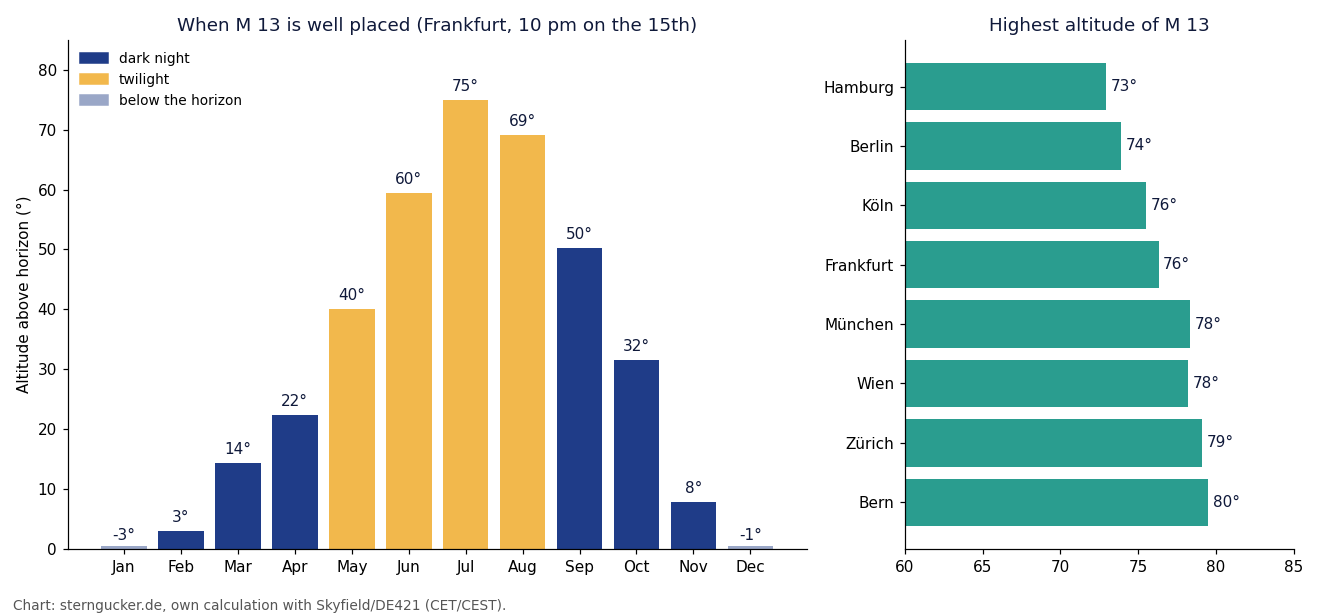
In autumn Hercules says goodbye. In mid-October M 13 stands only 32 degrees high in the west at 10 pm, and in mid-November 23 degrees in the northwest at 8 pm. If you still want to catch it, observe right after the end of twilight.
It only disappears briefly. In Hamburg M 13 just grazes the northern horizon at its lowest point; further south it sets for a few hours. From March, Hercules reappears in the northeast in the second half of the night.
M 13: the Great Hercules Cluster
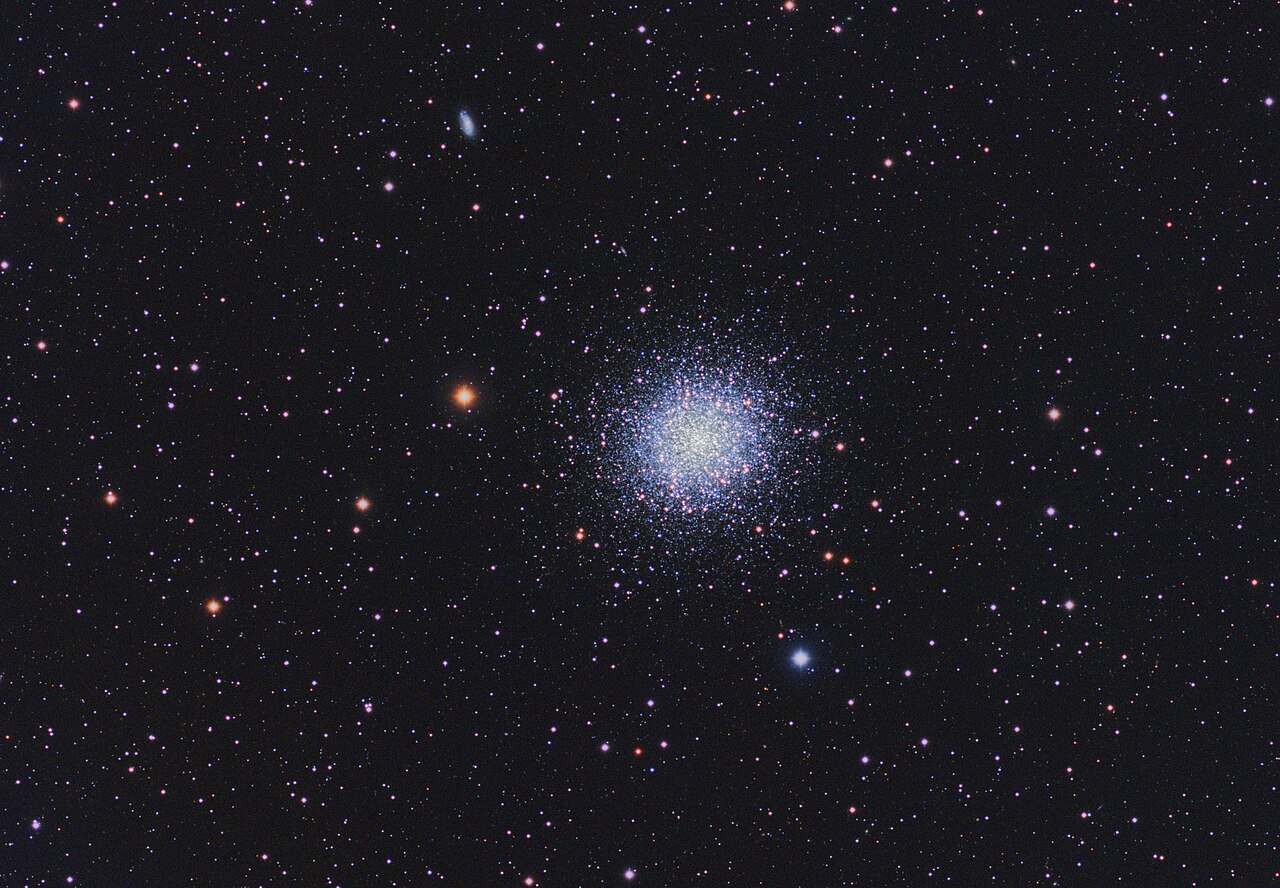
M 13 is a globular cluster: a densely packed ball of very old stars that orbits the centre of the Milky Way in its halo. At magnitude 5.8 it is one of the brightest globular clusters of the northern sky and passes almost overhead in summer.
| Catalogue number | Messier 13, NGC 6205 |
| Magnitude | 5.8 |
| Apparent size | about 20 arcminutes, two-thirds of the full Moon |
| Distance | about 24,000 light-years |
| Diameter | about 140 light-years |
| Number of stars | several hundred thousand |
| Age | about 11 to 12 billion years |
| Discovered | 1714 by Edmond Halley |
How to find M 13
M 13 lies on the western edge of the Keystone – the right-hand edge in summer. Go 2.5 degrees from η Herculis towards ζ Herculis, a third of the way. There you will find a small, round smudge framed by two 7th-magnitude stars.
With binoculars this is easy. η Herculis and M 13 fit comfortably into the same field of view. With a telescope, use the eyepiece with the lowest magnification to locate it, and only then switch to a stronger one.
What you really see of M 13
The individual stars of M 13 are faint; the brightest barely reach magnitude 12. That is why aperture – the diameter of the lens or mirror – decides whether you see stars or a haze. You also need magnification so that the tightly packed stars move apart.
| Instrument | Magnification | What you see |
|---|---|---|
| Naked eye | – | only under a dark rural sky, as a faint fuzzy star, best with averted vision |
| 10×50 binoculars | 10× | small round smudge with a brighter centre, no individual stars |
| Telescope 70 to 90 mm | 50× to 100× | larger glow, the edge looks grainy |
| Telescope 114 to 130 mm | 100× to 150× | the outer stars resolve individually, the core stays hazy |
| Telescope 200 mm | 150× to 200× | resolved almost to the core, chains of stars, under a dark sky the “propeller” of three dark lanes |
| Telescope from 300 mm | from 200× | fully resolved, sparkling like a firework |
The Arecibo message of 1974
On 16 November 1974 the Arecibo radio telescope in Puerto Rico sent a message towards M 13. It consisted of 1,679 bits, arranged into a picture of 23 by 73 dots: numbers, DNA, a human figure, the Solar System and the telescope itself.
It was mainly meant as a demonstration of the technology, designed among others by Frank Drake and Carl Sagan. The signal will only reach M 13 in about 24,000 years – and by then the cluster will have moved on along its orbit.
More deep-sky objects in Hercules
M 13 steals the show, yet Hercules has more to offer. The second globular cluster, M 92, is barely fainter and often overlooked.
| Object | Type | Magnitude | Distance |
|---|---|---|---|
| M 92 | globular cluster | 6.3 | about 27,000 light-years |
| NGC 6210 | planetary nebula | 8.8 | uncertain, several thousand light-years |
| NGC 6229 | globular cluster | 9.4 | about 100,000 light-years |
M 92 lies 6.3 degrees north of π Herculis, in the direction of ι Herculis. It is more compact than M 13 and is one of the oldest star clusters in the Milky Way. Johann Elert Bode discovered it in Berlin in 1777.
NGC 6210 lies 4 degrees northeast of Kornephoros. This planetary nebula – the cast-off gas shell of a dying star – is tiny but bright. From about 100× the “star” turns into a blue-green disc.
NGC 6229 is one for advanced observers. At about 100,000 light-years it is one of the most distant globular clusters you can still see with an amateur telescope – as a small, round glow from about 150 mm aperture.
Mythology: the kneeling hero
The Greeks first simply called the figure Engonasin, “the kneeling one”. Only later was it linked with Heracles, son of Zeus and the mortal Alcmene, whom the Romans called Hercules.
Hera pursued the hero with hatred. As atonement he had to complete twelve labours, including the fight against the Nemean lion and the Hydra. Both are in the sky too – as the constellation Leo and Hydra.
In the sky Hercules rests his foot on the head of the dragon. This is Ladon, who guarded the golden apples of the Hesperides – the eleventh of his labours.
Binoculars or telescope for Hercules
For Hercules the telescope clearly wins. M 13 and M 92 are small and dense; their stars only show with aperture and magnification. A pair of Celestron 7x50 Cometron BinocularsCelestron UpClose G2 10x50 Porro Binoculars helps you find them, but shows no more than a smudge.
The honest start for M 13: Skywatcher Dobson Telescope N 130/650 Heritage FlexTube
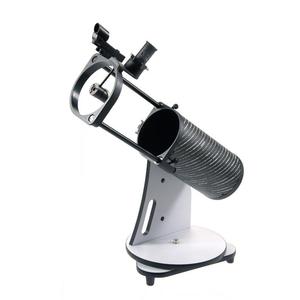
A compact tabletop Dobson with a true parabolic mirror. Folds down, fits in a bag: the Moon, planets and the bright deep-sky classics.
Price: € 265
When more aperture pays off
With globular clusters every millimetre counts. With 200 mm you see stars almost a full magnitude fainter than with 130 mm – and that is exactly where most of M 13’s stars lie.
The Skyliner 200/1200 DobsonianSkyliner 200/1200 Dobsonian collects more than twice as much light as a 130 mm scope with its 200 mm aperture. In practice: M 13 resolves into stars almost to the core, M 92 as well, and NGC 6229 becomes a sure target. The extra cost is worth it if star clusters, nebulae and galaxies keep drawing you back and you have a permanent spot for the larger instrument.
For advanced observers: Skywatcher Dobson Telescope N 200/1200 Skyliner Classic
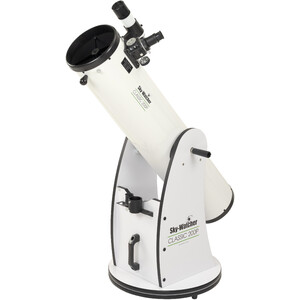
200 mm of aperture — the most sky for your money. Set it on the ground, point by hand: nebulae, clusters and galaxies for years to come.
Price: € 479
Frequently asked questions about the Hercules constellation
How do I find the constellation Hercules?
In summer, connect orange Arcturus with bright Vega. About two-thirds of the way along lies the quadrilateral of Hercules, the Keystone. On its right-hand edge, between η and ζ Herculis, sits M 13.
What is M 13?
M 13 is a globular cluster in the constellation Hercules, also called the Great Hercules Cluster. It contains several hundred thousand very old stars in a space about 140 light-years across. At magnitude 5.8 it is the best-known globular cluster of the northern sky.
How far away is M 13?
According to Gaia data, about 24,000 light-years. Older books give values between 22,000 and 25,000 light-years. The light you see today set off about 24,000 years ago.
Can you see M 13 with the naked eye?
Yes, but only under a truly dark sky far from towns. It then appears as a faint, fuzzy star on the edge of the Keystone. In binoculars, however, it is easy to find even from the edge of a city.
When is Hercules best visible?
On evenings from June to September, highest in July and August. You get the darkest conditions at 10 pm from mid-August. In October and November Hercules sinks into the west and northwest in the evening.
What does the constellation Hercules represent?
It shows the Greek hero Heracles, kneeling and upside down in the sky. His foot rests on the head of the dragon Ladon. Originally the figure was simply called “the kneeling one”; the hero’s name was added later.
What is the abbreviation for Hercules?
The official abbreviation of the International Astronomical Union is Her. The Latin name Hercules is also used in English; the Greek form is Heracles.
When will the Arecibo message reach M 13?
The radio message of 16 November 1974 travels at the speed of light. It takes as many years as M 13 is light-years away – about 24,000 years. A reply could reach us at the earliest after twice that time.
Further reading
- Lyra constellation – home of Vega, the eastern signpost to Hercules
- Big Dipper – the arc of its handle leads to Arcturus
- Draco constellation – the neighbour Hercules stands on
- Summer Triangle – finding your way in the summer sky
- Deep-sky objects – what sets star clusters, nebulae and galaxies apart
- Identify constellations – the method that really works
- All constellations – our catalogue at a glance
* Affiliate link: if you buy through this link we may earn a small commission from Astroshop or High Point Scientific, at no extra cost to you.